February 4, 2013
WASHINGTON – The National Transportation Safety Board is sending investigators to assist in the investigation of a Robinson R44 II helicopter that crashed about 80 miles north of Asuncion, Paraguay. Initial reports indicate that the pilot and two passengers were fatally injured.
The investigation is being led by the Paraguay Civil Aviation Authority (CIPAA). The NTSB has designated senior investigator Paul Cox as the U. S. accredited representative to the CIPAA’s investigation and he will be accompanied by representatives from NTSB, the FAA, Robinson Helicopters, and Lycoming Engines. The U.S. team is expected to arrive Wednesday morning. Further information regarding the investigation will be released by the CIPAA.
Similar Posts
- Beechcraft | Crash | Florida | NTSB
Beech Crashes House in Miami Gardens

What: Beech 18 (N18R)
Where: near Opa-Locka Airport, Miami Gardens Florida
When: May 2, 2010
Who: pilot Harry Trauffer
Why: Right after takeoff, the pilot of the twin engine Beechcraft 18 cargo plane that was carrying household goods to the Bahamas radioed he was going down, before he clipped trees, crashed through a fence and 2 cars and into a residential yard. Neighbors were at home at the time of the crash, and witnessed it.More than 90 Miami-Dade firefighters were on the scene. Although we saw reports that the fire only caused smoke damage to the exterior of the home, and that it did not strike the building, it is clear in the video that the house was breached by the plane, and there were several areas of the house that were on fire. The family is staying elsewhere and no one in the house was injured.
and was toxic while burning,
The pilot who was killed in the crash was 64 year old Harry Trauffer, who regularly flew clothing, bedding and auto parts to the Bahamas.Near the accident site on 38th Avenue and 150th Street., the NTSB is holding a 3:00 PM press briefing conducted by NTSB Investigator-in-Charge, Todd Gunther
- Airbus | Crash | electrical | NTSB | smoke | United Airlines | USA | Video
NTSB TEAM Investigating New Orleans Emergency Landing
On April 4, 2011, a United Airlines Airbus 320-232 with 109 passengers and crew aboard returned to the airport about 20 minutes after take-off due to electrical difficulties and smoke in the cockpit. On landing, the crew described a loss of anti-skid braking and nose-wheel steering and passengers had to exit via slide. (The right front slide failed.) Dan Bower is investigator-in-charge of the NTSB team including reps of Federal Aviation Administration,United Airlines, the Air Line Pilots Association, theAssociation of Flight Attendants, and the International Brotherhood of Teamsters and an Airbus rep appointed by the Bureau d’Enquêtes et d’Analyses (BEA) of the Government of France.
What: United Airlines Airbus A320-200 en route from New Orleans,LA to San Francisco,CA
Where: Louis Armstrong Airport
When: April 4 2011 7:20 a.m. after a 13 minute flight
Who: 100 passengers 5 crew
Why: After takeoff, the pilot reported smoke in the cockpit, and returned to the airport. The pilot reported losing all instruments, and landed on backup power, blowing out a tire and running off the runway. Passengers evacuated via slides.After landing, passengers were taken to the Hilton.
TRANSCRIPT OF AIR TRAFFIC CONTROLLER, PILOT CONVERSATION
UA 497: Clear for takeoff runway 19, thank for you very much.
UA 497: We need to vector back to the airport, we got a smoke issue with the airplane.
N.O. Approach: Turn right 030 (degrees) and maintain 4,000 (feet.)
UA 497: 030 4,000. And we’d like the longest runway please.
N.O. Approach: There are men and equipment on the runway – they’re going to try to get them off now. Descend at pilot’s discretion. Maintain 2,000.
UA 497: We are declaring an emergency and please roll equipment for our landing please.
N.O. Approach: We are unable for (runway) 10, can you take (runway) 19?
UA 497: ..no..
N.O. Approach: Roger, we are clearing the runway now.
Airport operations: How much time do we have?
New Orleans Tower: I’d say they are about 11 miles to the west.
Airport operations: Tower, we can start trying to pull them off, but I don’t think we will get them all off in time.
N.O. Approach: United 497, Say souls on board and fuel remaining.
UA 497: 106 souls on board, fuel remaining 32,400 pounds.
N.O. Approach: They are still trying to get all the vehicles off the runway and 19 is still available if you like….
New Orleans Tower: … working as fast as they can (unintelligible) There is a bunch of equipment on there they’re tying to get off now.
UA 497: You need to clear it for us.
New Orleans Tower: I understand, sir. We’re getting them off as fast as we can.
N.O. Approach: Turn right heading 140, main 2,000 ….cleared ILS runway 10 approach.
New Orleans Tower: Can you verify the vehicles are exiting?
Airport operations: We are attempting to get the vehicles off right now, I’m removing the cones also.
New Orleans Tower: OK, cause I haven’t seen any of the vehicles move and the aircraft is ten to the northwest and they have to have runway 100.
N.O. Approach: United 497, Turn right heading 180.
UA 497: um…. We only have one… um … (Alarms sounding in background.)
N.O. Approach: United 497 say again sir?
New Orleans Tower: We need three minutes to get the runway clear.
UA 497: (alarms blaring) We’ve lost all our instruments right now and we’re going to need (directions)
N.O. Approach: United turn left heading, 20 degrees left
N.O. Approach: Just continue left turn, I’ll tell you when to stop.
UA 497: (unintelligible) What vector are we from the airport?
N.O. Approach: Right now sir you are on the 330 degree heading from the airport. Northwest of the airport for runway 19er. If you continue on this present heading you’ll set up on the shoreline for 19.
UA 497: Shoreline for 19.
N.O. Approach: I can set u up there or I can vector you, what’d you need?
UA 497: That’s fine.
N.O. Approach: (unintelligible…)You got the water, right?
UA 497: Yeah, we got the water and we’re going to stop here about 600 feet.
N.O. Approach: Roger that. The airport’s currently at your 1 o’clock and five miles.
UA 497: 1 o’clock and five miles roger.
New Orleans Tower to fire crews: Fox-6, next arrival runway 19er is our aircraft. And the aircraft is approximately 3 miles northwest runway 19er.
N.O. Approach: If you start your right turn now I can set you up on final.
UA 497: Start turn on final.
New Orleans Tower to fire crews: The aircraft is over the shoreline around two miles out. You do have permission to proceed on to the runway after he lands.
N.O. Approach: Make a right turn. The airport is off to yoru right side,
N.O. Approach: 497, clear to land 19er. You’ll be able to make it sir? Winds 180 at 16, gusts to 20, Clear to land. Runway 19er.
New Orleans Tower to fire trucks: Fox-5, this is our aircraft touvh ing down bow.
New Orleans Tower: Follow the aircraft down the runway.
New Orleans Tower: We’re going to need runway 10 operational. Runway 19er is fouled at this time. Ethiopia Airlines Press Release
Ethiopian Refutes Unfounded Reports In Relation to ET-409
Ethiopian Airlines continues to refute any suggestions or conclusions made in reference to the recent accident of ET409 until the official results of the investigations are publicly released.
However, quoting an unknown source, AFP reported on May 5, 2010 that the accident of Flight ET 409 was caused by pilot error based on preliminary report. AFP acknowledged that the report was “preliminary” and that it “has not been made public.” AFP also quoted the Lebanese Information Minister as saying that he “could not comment on the preliminary findings before the release of the final report…” Furthermore, AFP admitted that “none of the investigators would comment on the preliminary findings,” including the American and Ethiopian investigators. Therefore, Ethiopian fails to comprehend the coverage of the account by AFP in light of all the above information.
Ethiopian Airlines has consistently maintained that it will not entertain any speculations or premature conclusions until the official findings are released and made public by the professionals designated to carry out the investigation in accordance with established international norms and principles. Ethiopian strongly believes that any release of information contrary to this process is not only unproductive but also misleading to the general public.
During the past sixty plus years, Ethiopian has become one of the continents leading carriers, unrivalled in Africa for its efficiency, safety and operational success. It prides itself from the high standards of its workforce including pilots, technicians and many other highly qualified personnel. Professionals in any position at Ethiopian must undertake extensive training and pass stringent evaluation and scrutiny prior to their assignments. These requirements are consistent with international aviation standards of which Ethiopian is a dedicated subscriber and certified member.
Any characterization of our pilots contrary to the foregoing is pure fabrication and cannot stand the test. Therefore, the assertions that the cockpit crew had limited experience on B737-800 and that the pilot had 200 hours of flight time in one month is far from the truth.
Individual(s) spreading unfounded information are heartless in that they do not care about the feelings of the families and relatives of the victims in addition to misleading the public at large. We urge the media to refrain from publishing such information and patiently wait the release of the preliminary findings of the investigation.
eptember 2010 Passenger Airline Employment Down 0.6 Percent from September 2009
Tuesday, November 16, 2010 – U.S. scheduled passenger airlines employed 0.6 percent fewer workers in September 2010 than in September 2009, the U.S. Department of Transportation’s Bureau of Transportation Statistics (BTS) reported today. This is the 27th consecutive decrease in full-time equivalent employee (FTE) levels for the scheduled passenger carriers from the same month of the previous year (Tables 1, 2). FTE calculations count two part-time employees as one full-time employee.
BTS, a part of the Research and Innovative Technology Administration, reported that the September FTE total of 377,676 for the scheduled passenger carriers was 2,248 below that of September 2009 (Table 3). Historic employment data can be found on the BTS web site.
Five network airlines – American Airlines, US Airways, Alaska Airlines, Continental Airlines and United Airlines – decreased employment from September 2009 to September 2010. The sixth network carrier, Delta Air Lines, after completing its merger with Northwest Airlines, is reporting combined employment numbers in 2010 and reported 8.4 percent more FTEs in September 2010 than the combined totals of both carriers for September 2009 (Table 9). Network airlines operate a significant portion of their flights using at least one hub where connections are made for flights to down-line destinations or spoke cities.
All seven low-cost carriers reported more FTEs in September 2010 than in September 2009. They are Spirit Airlines; Frontier Airlines; Virgin America Airlines; Allegiant Air; JetBlue Airways; AirTran Airways; and Southwest Airlines (Table 12). Regional carriers Atlantic Southeast, Comair, Horizon Air, Mesa Airlines, Mesaba Airlines, Shuttle America Airlines, and Lynx Airlines reported reduced employment levels compared to last year (Table 15).
Scheduled passenger airline categories include network, low-cost, regional and other airlines.
The six network airlines employed 377,676 FTEs in September, 67.7 percent of the passenger airline total, while seven low-cost carriers employed 17.0 percent and 18 regional carriers employed 13.9 percent (Table 4).
Delta employed the most FTEs in September among the network airlines, Southwest employed the most FTEs among low-cost airlines, and American Eagle Airlines employed the most FTEs among regional airlines. Six of the top 10 employers in the industry are network airlines (Table 6).
Beginning with October 2007 data, US Airways’ numbers are combined with numbers for America West Airlines in the network category. For previous months, America West’s numbers were included with the low-cost airlines.
Boeing-built C-17 Fleet Surpasses 2 Million Flight Hours

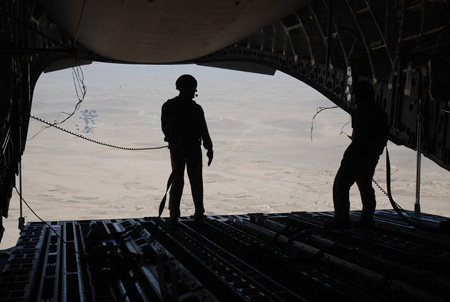
LONG BEACH, Calif., Dec. 20, 2010 — The worldwide fleet of C-17 Globemaster III airlifters built by The Boeing Company [NYSE: BA] surpassed 2 million flying hours during an airdrop mission over Afghanistan on Dec. 10. Reaching 2 million flight hours equates to 1.13 billion nautical miles – the equivalent of a C-17 flying to the moon and back 2,360 times.
The representative mission, flown by a U.S. Air Force C-17, airdropped 74,000 pounds of jet fuel in support of U.S. and coalition troops just south of Kabul.The C-17 has a mission readiness rate of more than 85 percent. It is the world’s only strategic airlifter with tactical capabilities that allow it to fly between continents, land on short, austere runways, and airdrop supplies precisely where they are needed.
“There’s tremendous satisfaction in knowing that in those 2 million hours, the C-17 fleet has saved countless lives around the world,” said Bob Ciesla, Boeing C-17 program manager. “Boeing congratulates the U.S. Air Force and our international C-17 customers on reaching this milestone. We’re very proud that the C-17 continues to exceed expectations for performance and reliability.”
The C-17 fleet, now in its 17th year of service, has supported humanitarian and disaster-relief missions worldwide. With 226 airlifters in service around the world, the C-17 fleet continues to operate at an accelerated rate due to the recent troop surge in Afghanistan, reaching the 2 million flight-hours milestone less than five years after reaching 1 million flight hours in March 2006, when 152 C-17s were in service. This year, lifesaving aeromedical evacuations of wounded troops from Afghanistan and Iraq, along with relief missions for natural disasters such as earthquakes in Pakistan, Chile and Haiti, have intensified the C-17’s normal workload.
Boeing helps keep the C-17 flying through a worldwide support and sustainment program. “Boeing has had the honor of supporting the entire C-17 fleet since the delivery of the first aircraft to Charleston Air Force Base in 1993,” said Gus Urzua, program manager for the Boeing C-17 Globemaster III Sustainment Partnership. “Through innovative Performance-Based Logistics contracting and partnering with the Air Force, we have maintained the highest level of aircraft readiness while continuously reducing the cost of ownership.”
While providing relief to Haiti in January and February, C-17s delivered nearly 14,000 short tons of cargo and transported some 25,000 passengers and 280 patients. C-17s also played a key role in a record year for airdrops in support of Operation Enduring Freedom in Afghanistan. As of Oct. 31, C-17s and other airlifters have airdropped more than 45 million pounds of cargo to troops in remote locations.
Boeing has delivered 20 C-17s to international customers. The U.S. Air Force — including active duty, National Guard, and Air Force Reserve units — has taken delivery of 206. Other customers include the U.K. Royal Air Force, the Canadian Forces, the Royal Australian Air Force, the United Arab Emirates Air Force, the Qatar Emiri Air Force, and the 12-member Strategic Airlift Capability initiative of NATO and Partnership for Peace nations. India is expected to be the next C-17 customer.
A unit of The Boeing Company, Boeing Defense, Space & Security is one of the world’s largest defense, space and security businesses specializing in innovative and capabilities-driven customer solutions, and the world’s largest and most versatile manufacturer of military aircraft. Headquartered in St. Louis, Boeing Defense, Space & Security is a $34 billion business with 68,000 employees worldwide. Follow us on Twitter: @BoeingDefense.
S7 Airlines is Now Part of oneworld
- World’s premier airline alliance adds Russia’s leading domestic carrier
- Group’s network in Commonwealth of Independent States tripled
- Double miles offer to frequent flyer to celebrate
- Moscow ceremony marks latest landmark in oneworld’s breakthrough year
VANCOUVER, British Columbia, Nov. 15, 2010 /PRNewswire/ — S7 Airlines today became part of oneworld®, adding Russia’s leading domestic carrier to the world’s premier global airline alliance. Its subsidiary Globus joined at the same time, as an affiliate member of oneworld.
They now offer oneworld’s full range of services and benefits, joining an alliance of best-in-class airline partners from every region around the world – American Airlines, British Airways, Cathay Pacific Airways, Finnair, Iberia, Japan Airlines, LAN Airlines, Malev Hungarian Airlines, Mexicana, Qantas and Royal Jordanian and almost 20 affiliated airlines.
Customers benefit from expanded global network
S7 and Globus between them serve 90 destinations and 28 countries. They add 55 destinations in Russia and the Commonwealth of Independent States to the oneworld schedule, plus nine countries, in Armenia, Azerbaijan, Georgia, Kazakhstan, Kyrgyzstan, Moldova, Tajikistan, Turkmenistan and Uzbekistan. This has almost tripled the number of destinations served by oneworld in Russia, the CIS and other parts of East Europe to a total 84 destinations in 26 countries.
It expands oneworld’s global coverage to a total of more than 750 destinations in almost 150 countries, served by 8,500 departures a day operated by a combined fleet of some 2,250 aircraft, carrying 300 million passengers a year, with annual revenues of more than US$85 billion. When oneworld member designates airberlin, Europe’s fifth largest airline, and Kingfisher Airlines, India’s leading carrier, join in the coming 18 months, that will grow further to some 900 destinations, served by 9,500 daily departures operated by 14 airlines and 20 affiliates, carrying 340 million passengers a year on a combined fleet of 2,500 aircraft, generating annual revenues of US$90 billion.
Extended frequent flyer benefits – with ‘double miles’ offer to celebrate
Members of the S7 Priority frequent flyer program have now, in effect, had the privileges they receive when flying with S7 extended to cover travel using any oneworld member airline worldwide.
They can now earn and redeem mileage awards on any oneworld flight – and to celebrate the airline’s addition to the group, they will receive double the normal mileage awards when flying on S7’s oneworld partners for the next two months. (See notes below.)
S7 Priority Platinum and Gold cardholders have oneworld Emerald and Sapphire status respectively, gaining them access to some 550 airport lounges worldwide offered by the alliance’s airlines. S7 Priority Silver cardholders will have oneworld Ruby status.
The 100 million members of the established oneworld airlines’ frequent flyer programs can now earn and redeem awards and tier status points and receive all other oneworld benefits on S7. Members of oneworld airlines’ loyalty programs will receive double the normal mileage awards when flying on S7 until Jan. 15, to mark its addition to the alliance. (See notes below.)
Most extensive network in Russia and CIS now covered by market-leading alliance fares
S7’s network – the most extensive in the region – is now covered by oneworld’s market-leading range of alliance fares and sales products, including oneworld Explorer, the most popular round-the-world fare globally.
Its Russian domestic market is the world’s largest country in terms of land mass, the ninth most populous and with the eighth largest gross domestic product. It is predicted to be one of the world’s fastest growing regions for air travel demand.
Currently seven of oneworld’s established airlines – British Airways, Cathay Pacific, Finnair, Iberia, Japan Airlines, Malev Hungarian Airlines and Royal Jordanian – serve Moscow, plus St, Petersburg and Ekaterinburg in Russia.
Completion of one of its biggest yet projects strengthens S7’s position
For S7, joining oneworld will strengthen its competitive and financial position, enabling it to offer customers an unrivalled alliance global network served by partners including some of the best and biggest airlines in the world.
Its addition to the alliance completes what has been one of the biggest projects in the airline’s history, with working groups covering some 35 streams of activity.
British Airways has been supporting S7 through its 18-month alliance implementation project, as its oneworld sponsor airline.
S7’s IT systems have now been linked to those of oneworld’s established members and various internal processes and procedures brought into line with the alliance’s requirements. An extensive employee training and communications program has been completed to ensure employees at S7 and throughout the alliance are ready to provide oneworld’s customer services and benefits across the expanded alliance.
As part of an extensive marketing communications program, all S7 Priority Platinum, Gold and Silver cardholders have been sent new membership cards, bearing the oneworld logo, to ensure they receive their alliance benefits from today.
S7 check-in desks, sales counters and other facilities at airports throughout its network have been specially decorated with balloons and banners today to celebrate its addition to oneworld.
Senior representatives from all oneworld airlines gather in Moscow for joining ceremony
Senior representatives from all oneworld’s established and designate member airlines – led by British Airways Chief Executive Willie Walsh, airberlin Chief Executive Joachim Hunold and oneworld Managing Partner John McCulloch – gather in Moscow today for a formal joining ceremony hosted by S7 Group Chief Executive Vladislav Filev.
S7 Group Chief Executive Vladislav Filev said: “Today represents the start of a new and exciting era for S7, as we take one of the most significant steps in our airline’s history. It is a real honor to be part of what is very clearly the world’s pre-eminent global airline alliance, flying alongside some of the most distinguished names in our industry. We move S7 into the next phase of its development as part of the highest quality grouping of airlines. oneworld gives S7 the best quality partners, the best worldwide network, the best alliance services for our customers and the best opportunity to put our airline firmly on the global stage.
“Getting to this position has required a great deal of hard work, and I would like to take this opportunity to give my personal thanks to everyone who has been involved in this project – at S7, at our oneworld sponsor British Airways, at the central oneworld team and at all of our partner airlines.”
Willie Walsh, Chief Executive of British Airways, S7’s oneworld sponsor, said: “Our aim has always been to establish oneworld as the world’s pre-eminent and most successful global airline alliance, with an unrivalled collection of quality carriers, offering the best coverage of the places our key target customers really want to reach and delivering unmatched benefits to customers and member airlines.
“Our focus on quality means that we are particularly selective and demanding in the airlines we invite to join us. We only consider carriers who match the quality of our existing members – in their approach to customer service, innovation, safety and security. Today, oneworld has added another great airline, the best, we firmly believe, in Russia and the Commonwealth of Independent States – S7.”
oneworld Managing Partner John McCulloch added: “S7 will expand oneworld’s network substantially in a key region of growing travel demand, with a carrier that matches our demanding quality requirements, while enabling S7 to offer its customers a truly global network on quality partners. We are delighted to be welcoming them to the oneworld alliance.”
Latest landmark in oneworld’s breakthrough year
The addition of S7 is the latest landmark for oneworld in what is turning into a breakthrough year for the alliance. In other key milestones so far in 2010:
- India’s leading carrier Kingfisher Airlines became a oneworld member elect in June – followed by airberlin, Europe’s fifth biggest airline, in July.
- American Airlines, British Airways, Iberia, Finnair and Royal Jordanian in July received long-awaited final approval for their application for anti-trust immunity across the Atlantic, with American, BA and Iberia launching their trans-Atlantic joint business in October.
- Japan Airlines has been expanding its co-operation with its oneworld partners since reaffirming its membership of the alliance in February. It has now gained final approval from authorities in both Japan and the United States to launch a joint business with American Airlines between Asia and North America beginning early next year. JAL has also substantially expanded codesharing with many other oneworld partners.
- British Airways and Iberia are on track to complete their merger by the end of the year.
- LAN Airlines celebrated its 10th anniversary as a oneworld member on June 1. Since joining, it has added to the grouping its affiliates in Argentina, Ecuador and Peru.
- oneworld’s biggest airport co-location project in Asia was completed at the end of October, with British Airways moving alongside all the other online oneworld airlines in Terminal 2 at JAL’s Tokyo Narita international base. At the same time, oneworld positioned itself as the leading alliance at Tokyo Haneda, as it opened to scheduled international services, offering the airport’s widest international network and biggest domestic operation.
- oneworld last week retained the World’s Leading Airline Alliance title in the World Travel Awards for the eighth year running after being named the World’s Leading Airline Alliance in Skytrax’s World Airline Awards earlier in the year.
Watch S7’s oneworld joining ceremony online
You can watch S7’s oneworld joining ceremony in Moscow today on-line on demand via a webcast. To view it:
In English, go to http://www.s7.ru/en/S7oneworldjoining.html
In Russian, go to http://www.s7.ru/ru/S7oneworldjoining.htmlNotes
S7 Priority members will earn double the normal miles when flying on eligible flights on American Airlines, British Airways, Cathay Pacific, Finnair, Iberia, Japan Airlines, LAN, Malev, Qantas and Royal Jordanian until Jan. 15, 2011. Members of American Airlines, British Airways, Cathay Pacific, Finnair, Iberia, Japan Airlines, LAN, Malev, Qantas and Royal Jordanian frequent flyer programs will earn double the normal miles when flying on eligible S7 flights until Jan. 15, 2011. For full details, see each airline’s frequent flyer program website.
About S7 Airlines
S7 is Russia’s leading airline in terms of network, domestic passenger carryings, customer service quality and innovation.
It is the first carrier in Russia to convert to an all Western-built Airbus and Boeing fleet and the first to adopt full electronic ticketing and online reservations and sales. It holds the internationally recognized IOSA (International Air Transport Association Operational Safety Audit) certification, renewed in October 2008 and gained by its Globus subsidiary in October 2010.
S7 offers a two-class product to international standards on all departures – Business Class and Economy.
Its fleet, decorated in a distinctive bright green livery, includes 28 Airbus A320 family types, one Airbus A310, two Boeing 767s, four Boeing 737-400s and four Boeing 737-800s, with an average age of nine years.
S7 and Globus carried 5.6 million passengers in 2009, with a bigger share of the domestic Russian air travel market than any other airline. Including its international network, it is Russia’s second biggest carrier.
Its main hub Moscow Domodedovo is the capital’s most modern airport. Its secondary hubs are Novosibirsk and Irkutsk. Its international destinations include oneworld hubs Madrid and Bangkok.
S7 is one the most progressive airlines in Russia giving passengers new standards of service, supported by the use of latest technology. Tracing its origins back to 1957, it changed its brand name from Sibir Airlines to S7 Airlines five years ago with a radical rebranding to make it stand out from its competitors as customer-friendly, quality, modern carrier – winning the annual national award “People’s mark / Brand No 1 in Russia.”
Since its election as a oneworld member designate in May 2009, S7 has launched codesharing with alliance partners Iberia and Royal Jordanian. S7 also code-shares with oneworld member elect airberlin.
The airline generated profits of US$151 million (operating) and US$18 million (net) in 2009 on revenues of US$1.1 billion. S7 employs 2,596 staff and uses SITA as its main IT platform. It is 75 percent privately owned.
S7’s English-language website is www.s7.ru/en/index.html
About oneworld
oneworld enables its members to offer their customers more services and benefits than any airline can provide on its own. These include a broader route network, opportunities to earn and redeem frequent flyer miles and points across the combined oneworld network and more airport lounges. oneworld offers more alliance fares than any of its competitors.