|

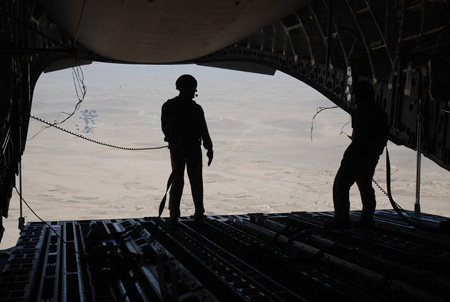
Boeing-built C-17 Fleet Surpasses 2 Million Flight Hours

Similar Posts

  • | | | |

    Southwest Airlines Flight Makes Emergency Landing in Houston

    Southwest Airlines flight WN-289 had to divert and make an emergency landing in Houston, Texas, on February 18th.

    The Boeing 737-700 plane heading from Belize to Denver, Colorado, was diverted due to loss of cabin pressure.

    The plane landed uneventfully. All passengers and crew members remained safe.

    To include the featured image in your Twitter Card, please tap or click their icon a second time.
  • The Families of Air France Flight 447 Turn to US

    The Association of the relatives of the victims of Air France Flight 447 are proceeding against European manufacturer Airbus. To spearhead their undertaking, the families have contracted aviation consultant George Hatcher and the law firm of Masry & Vittoe.

    Hatcher conferred with the victims’ relatives monday (20), in Rio De Janeiro, to discuss legal strategies that will be adopted in the case. According to the specialist, at this stage, regardless of the cause of the accident, the responsible party is the manufacturer of the airplane, France’s Airbus, subsidiary of EADS, a European aerospace company.

    In a disaster of this stature, payments can reach up to $700 million dollars (U.S.).

    According to Mr Hatcher who maintains a list of hundreds of pilot experts, “Two of our Airbus pilots agree that in their expert opinion, a significant responsibility for the loss of the aircraft lies within defective computers and/or flawed computer technology. The Airbus, in their evaluation is far from perfect.”

    Hatcher will be working the Air France case, in addition to his work on the TAM case in Florida. “In respect for the family’s deep feelings,” he explained, “we are moving forward as quickly and carefully as the wheels of justice allow. Settlements in the US tend to be higher than elsewhere. The Tam hearing is scheduled for March of 2010. We came to a partial agreement with the TAM, but the case is pending on the responsible parties like BFGoodrich, responsible for the brakes, and the Pratt&Whitney, manufacturer of the turbines, one of which was with the broken reverser.”

    The Air France is eligible to be tried in Florida where Airbus maintains a training center commercial office of the Airbus.

    To include the featured image in your Twitter Card, please tap or click their icon a second time.
  • FAA OKs Four More Portable Oxygen Concentrators

    WASHINGTON — The Federal Aviation Administration (FAA) announced today that passengers needing medical oxygen now have the option of using four additional portable oxygen concentrators while traveling, bringing the total number of approved units to 11.

    The newly authorized devices are DeVilbiss Healthcare’s iGo, International Biophysics Corporation’s LifeChoice, Inogen’s Inogen One G2 and Oxlife’s Independence Oxygen Concentrator.

    “This is our latest step toward making air travel more accessible for people who need medical oxygen,” said FAA Administrator Randy Babbitt. “We want these passengers to have as many options as possible while ensuring all of our safety guidelines are being met.”

    Portable oxygen concentrators are small, portable devices that separate oxygen from nitrogen and other gases in the air and provide oxygen to users at greater than 90 percent concentration. They do not use compressed or liquid oxygen, which the government classifies as hazardous material.

    The Department of Transportation requires that U.S. carriers allow passengers to use portable oxygen concentrators approved by the FAA during all phases of a flight – including taxiing, takeoff and landing – if the unit displays a manufacturer’s label that indicates it meets FAA requirements for portable medical electronic devices, is properly stowed, and meets certain other applicable safety-related conditions.

    For example, passengers must ensure the unit is in good working order and must be able to respond to the unit’s warning alarms. They must protect extra batteries in carry-on baggage from short circuits and physical damage. Carriers also must let passengers operate these FAA-approved concentrators while moving about the cabin whenever the captain turns off the “Fasten Seat Belt” sign.

    Carriers can legally refuse to allow inflight use of an FAA-approved portable oxygen concentrator that does not have a manufacturer’s label indicating that the device complies with FAA requirements. However, the Department encourages airlines to voluntarily allow the inflight use of such devices. Inflight use of an FAA-approved portable oxygen concentrator, whether labeled or not, poses no safety danger so long as carriage of the device is in accordance with instructions provided by the FAA.

    The FAA previously approved these portable oxygen concentrators for use:

    Delphi Medical Systems RS-00400
    Invacare XPO2
    AirSep Lifestyle
    AirSep Freestyle
    Inogen One
    SeQual Eclipse
    Respironics EverGo
    ###

    To include the featured image in your Twitter Card, please tap or click their icon a second time.
  • | | | | | |

    Utair Boeing Skids off Runway


    On July 15, 2013, a UTair Boeing 737-524 en route from Moscow to Kiev ran off the runway on landing. It was misting at the time, leading to a slippery runway but was described as coming to a quick stop at 30-40 meters on level ground.

    Firefighters took five minutes to arrive and ambulances five minutes after that but there was no fire and no injury reported.

    None of the 77 passengers or crew sustained any injury. Passengers disembarked evacuated from the plane with fixed ladders rather than inflatable emergency ladders on to the soft ground, and were transported to the gate.

    Raw Video

    To include the featured image in your Twitter Card, please tap or click their icon a second time.
  • Boeing: Press Release

    Boeing Statement on President’s Remarks and the Need for Immediate Development of a Heavy-lift Vehicle

    KENNEDY SPACE CENTER, Fla., April 16, 2010 — Speaking at NASA’s Kennedy Space Center on April 15, U.S. President Barack Obama unveiled proposed changes to the administration’s fiscal year 2011 budget submission for space exploration, including a crew rescue vehicle and a decision on a heavy-lift rocket in 2015. The Boeing Company responded today with the following statement:

    “The president’s enthusiasm for space exploration was encouraging. We are pleased that the president remains committed to human spaceflight. We remain convinced that America stands at an inflection point with regard to space: If we make the right decisions today, we have the opportunity to create a new Golden Age of Space. Our national leadership’s focus on this bodes well for our country and its highly experienced space industrial base.

    “Boeing has served as a major partner in humankind’s exploration of space since the beginning. Our talented people bring a mature understanding of NASA’s enduring needs; a practical, businesslike approach to innovation; and a commitment to mission assurance and the safety and success of our astronaut corps.

    “We are encouraged by the extension of the International Space Station program and look forward to enhancing scientific research onboard, upgrading the space station, and using it as a U.S. national laboratory. Benefits to be gained from extension of the space station include international cooperation; medical and pharmaceutical advancements; its use as a test bed for demonstrating Earth-observation capabilities and future exploration technologies; and the availability of a waypoint for future exploration missions.
    “Excellence in human spaceflight is an important part of the American identity and symbolizes global leadership on the highest of technological platforms. We are greatly concerned that by backing away from the challenges of human space exploration, the United States would relinquish its leadership of a mission that has inspired generations.

    “A bold national space program also supports the United States’ security and economy by fostering a domestic work force that is educated and skilled in science, technology, engineering and math. It encourages the growth of new technologies and emerging businesses, large and small.
    “We support the president’s call for increased investment in heavy-lift launch vehicle technology, but we believe the United States should be on a clear path to accelerate the development and production of this critical system, along with a deep-space capsule. Both of these vehicles are essential to any deep-space exploration mission. We have the technology and the people to commence development of these vehicles now. A plan that includes a heavy-lift vehicle would enable space exploration supported by humans, large-array telescopes and deep-space robotic missions. It could achieve maximum benefit from American tax dollars by drawing on the cutting-edge technology already being developed for the Constellation program.

    “Remaining at the forefront of human spaceflight is the only choice worthy of this great nation and to the long line of explorers and visionaries who brought us to where we are today.”

    To include the featured image in your Twitter Card, please tap or click their icon a second time.
  • | | | |

    Boeing vs Cessna


    Click to view full size photo at Airliners.net
    Contact photographer Barry Shipley

    What: Cargojet Boeing 757-200 en route from Ottawa to Hamilton
    Where: Hamilton
    When: Mar 25th 2010
    Why: While on approach to Hamilton, a small privately owned Cessna turned into the Boeing’s path (reducing the distance between the two to 1.5nm horizontally and 200 feet vertically). The Cessna—on approach to the wrong runway—was corrected by ATC; and the Boeing landed safely.

    The Cessna pilot acknowledged error on his runway approach.

    This situation brings to mind two recent collisions- the March 20 Florida collision between a Piper and an experimental plane, and the February 6 Cirrus-Piper collision in Colorado. The circumstances of the collisions are entirely different but I should poitn out that neither of those collisions occurred under the direct eye of ATC. Perhaps there are extra kudos due to Air Traffic Control (or perhaps the Boeing pilot? whoever’s quick eye caught and cured the impending crisis) for the accident that did not happen.

    It would be interesting to find out if the error is fatigue related, or if there were some other hidden cause. Anytime a collision is averted is a good thing.

    To include the featured image in your Twitter Card, please tap or click their icon a second time.