Update on United 777 Diversion to Henderson Field Airport Midway Atoll.
United Airlines revealed what went wrong on Flight 201.
A problem with the equipment supply cooling fan on board the Boeing 777 caused the problems which required the pilots to divert to Midway to land there in the dark. The passengers waited in a gym until the replacement flight arrived.
The plane that flew in to Midway to pick up the passengers also brought parts and a repair crew. The plane with the bad fan was fixed, and returned from Midway Island back to San Francisco.
In fact, it was returned to service.
Now we’d like to hear about the passengers getting their luggage back.
Newspaper reports talk about traces of black soot on the Auxiliary Power Unit. The APU is like your computer backup—similar in theory to the battery backup you may have at home hooked to your computer.
The APU is an auxiliary engine that provided electric power and air to the Ethiopian Airlines Boeing 737 until the main engines began to run.
We ourselves haven’t seen soot, or proof of fire–but we haven’t seen much proof at all, since the report that we keep hearing whispers of has not been made public.
Some facts are known We know, for example, that…
—…the APU is located in the rudder section.
—…the weather was bad.
OLBA 250300Z 06004KT 030V090 5000 VCTS RA FEW020CB BKN026 10/06 Q1014 NOSIG
We have heard rumors which may or may not be unfounded:
—Statements made anonymously by Lebanese airport sources report that Captain Habtamu Benti, the pilot in command (PIC) of the Ethiopian Airlines Boeing 737-800 encountered engine problems, perhaps a flame out, during takeoff, and requested permission to abort the flight and return to Beirut. He was given clearance to do so, but another aircraft, a Etihad Airlines flight from Abu Dhabi, United Arab Emirates was in the process of landing and could have interfered with his emergency maneuvers. *
But some information has been made public.
—The rudder found at the plane’s tail was reported to have been sent to France. *
—“One of the five cockpit voice recorders which has a damaged segment will be sent from France’s BEA to a Seattle-based company [Honeywell] to recover that lost segment.” *
So we have even more questions. Where, for example, are the statements of the witnesses? What has France said about the rudder? Has the APU been found, and if so, what is its condition?
Even if ATC sent pilot in to a storm, the pilot also has radar and should have seen the storm and refused the order to take off and/or the heading issued to him. Did his radar fail? Did the APU fail? It might well be that the pilot was misled by a radar system in the plane that was not operating correctly. Unlikely, but, possible. There are still a lot of possibilities we can not rule out. The captain had too many hours logged to take off in to a storm with a plane that he knew was not built to withstand the forces of a cell ahead of him.
Even if there is no immediate report available yet, we look forward to the promised release in March/July. (They say that data collection will continue until March 15 2011, in April the data will be verified/validated by Ethiopian and Lebanese authorities, officials of Boeing and the US National Transport Safety Board by May 30th, with a tentative public release date in July.) When more official information is released, it will help to rule out all gross speculation, so we can focus on possible culpable parties in the chain of events that caused this tragedy.
We shall see.
What: Ethiopian Airlines Boeing 737 en route from Beirut to Addis Ababa Where: 2 miles west of the coastal village of Na’ameh. When: Jan 25 2010 Who: 7 crew 83 passengers Why: Shortly after taking off in stormy weather and heavy lightning, Lebanese ATC lost contact. The plane disappeared from radar 45 minutes after leaving Beirut. Witnesses on the coast saw the plane as it crashed into the sea. So far 9 bodies have been found by members of the Lebanese army . Update
Initial reports of 7 survivors, became 9 bodies, and now the count has reached 21 bodies.
The site of the crash is 2 miles west of the coastal village of Na’ameh.
Fifty-four passengers were Lebanese, 22 Ethiopian, two were British and there were also Canadian, Russian, French, Iraqi and Syrian nationals.
A Cypriot police helicopter has joined the Lebanese army in the search for survivors, and two U.N. helicopters are on the scene.
Ethiopian Airlines is state owned, and has a standing order of 10 of Boeing’s Next-Generation 737-800s
—
ET-409 Incident – 25 January, 2010
Ethiopian flight ET-409 was scheduled to operate from Beirut to Addis Ababa on January 25th lost contact with the Lebanese air controllers shortly after take off. The flight departed at 02:35 Lebanese time from Beirut International Airport.
Flight ET-409 carried 82 passenger plus 8 Ethiopian Crew members. Out of the total passengers 23 were Ethiopian, 51 Lebanese, 1 Turkish, 1 French, 2 British, 1 Russian, 1 Canadian, 1 Syrian, 1 Iraqi nationals.
Strobe flashes
To include the featured image in your Twitter Card, please tap or click their icon a second time.
Croatia Airlines flight OU-4456 made an emergency landing in Brussels, Belgium, on February 22nd.
The plane flying from Zagreb, Croatia, was on final approach to Brussels when the crew received an unsafe nose gear indication and went around to work the checklists.
The plane subsequently landed safely. All fifty-eight people aboard remained unharmed.
To include the featured image in your Twitter Card, please tap or click their icon a second time.
What: Continental Airlines Boeing 777-200 en route from Tel Aviv to Newark,NJ Where: Tel Aviv When: Nov 9th 2011 Who: 280 aboard Why: When smoke was reported as coming from the baggage compartment, the pilots returned to Ben-Gurion International Airport and made a safe landing.
45 ambulances and 17 mobile units were on the scene of the emergency landing.
The origin of the smoke turned out to be an oven in the aft galley.
To include the featured image in your Twitter Card, please tap or click their icon a second time.
What: Delta Airlines Boeing 767-300 from New York JFK,NY to Sao Paulo Where: New York When: Mar 6th 2011 Why: The Delta Boeing encountered heavy wind on takeoff and suffered a tail strike. The pilot returned to JFK and made a safe landing. According to Flight Aware, the duration of the flight was 49 minutes.
To include the featured image in your Twitter Card, please tap or click their icon a second time.
SEATTLE, Sept. 22 — Boeing and Cathay Pacific Airways today announced the Hong Kong-based carrier has exercised existing purchase rights for six additional Boeing 777-300ERs (extended range).
The six new airplanes, with an estimated value of US$1.6 billion at Boeing list prices, will increase Cathay Pacific’s 777-300ER future fleet from 30 to 36.
Cathay Pacific, one of the world’s largest operators of the popular jetliner, also operates 12 Boeing 777-300s and five 777-200s.
“Cathay Pacific is a valued long-time Boeing customer. The global reach of Cathay Pacific’s 777 fleet showcases the airplane’s exceptional performance features and its passenger appeal around the world,” said Marlin Dailey, vice president of Sales for Boeing Commercial Airplanes. “This additional commitment from a world-class operator like Cathay Pacific is a testament to the greater efficiency, economics and reliability of the 777-300ER.”
Cathay Pacific first announced its selection of the 777-300ER in 2005. This announcement is Cathay Pacific’s fourth increase in its acquisition plans for the long-range jetliner.
“We are very pleased to confirm this purchase of six more Boeing 777-300ERs – a superb aircraft that already has significantly enhanced our operations on key long-haul routes,” said Cathay Pacific Chief Executive Tony Tyler. “We have been very impressed by the operating economics of these aircraft, while their high efficiency has resulted in a reduced environmental impact. As we continue to enhance our fleet, the 777-300ER will play a crucial role in our operations in the years to come.”
The Boeing 777 is the world’s most successful twin-engine, long-haul airplane. The 777-300ER extends the 777 family’s span of capabilities, bringing twin-engine efficiency and reliability to the long-range market.
Boeing incorporated several performance enhancements for the 777-300ER, extending its range and payload capabilities. Excellent performance during flight testing, combined with engine efficiency improvements and design changes that reduce drag and airplane weight, contributed to the increased capability.
In addition to Boeing 777s, Cathay Pacific operates 47 747-400s in both passenger and cargo versions. The airline also has ordered 10 Boeing 747-8 Freighters. The highly efficient new cargo airplane will augment the airline’s fleet of 25 747 Freighters used to connect Hong Kong to a wide range of international markets.
Sixty-one customers around the world have ordered more than 1,100 777s.
To include the featured image in your Twitter Card, please tap or click their icon a second time.


 Croatia Airlines flight OU-4456 made an emergency landing in Brussels, Belgium, on February 22nd.
 Alitalia flight AZ-785 had to divert and make n emergency landing at Munich Airport, Germany, on June 17.
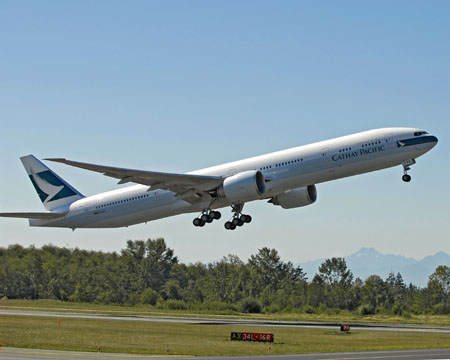 SEATTLE, Sept. 22 — Boeing and Cathay Pacific Airways today announced the Hong Kong-based carrier has exercised existing purchase rights for six additional Boeing 777-300ERs (extended range).