| |

NTSB 2013 Most Wanted List

Similar Posts

  • |

    Press Release – FAA Proposes $330,000 Civil Penalty Against Heli-Dudes

    For Immediate Release
    January 6, 2011

    SALT LAKE CITY—The Federal Aviation Administration (FAA) is proposing a $330,000 civil penalty against Heli-Dudes LLC, of Salt Lake City, for allegedly operating sightseeing helicopter rides for hire when it was not authorized to do so, a violation of Federal Aviation Regulations.

    The FAA alleges that Heli-Dudes did not have an FAA operating certificate or letter of authorization when it conducted 30 sightseeing flights for hire between Feb. 6 and Feb 14, 2010, using a Robinson R-22, a two-seat, piston engine-powered helicopter.

    The FAA denied two Heli-Dudes applications for a Letter of Authorization in January and March, 2010. The first denial was because the company submitted the wrong employee drug-testing certificate. The second denial came because Heli-Dudes conducted for-hire flights when it was not authorized to do so.

    Heli-Dudes has 30 days from receipt of the FAA’s enforcement letter to respond to the agency.

    To include the featured image in your Twitter Card, please tap or click their icon a second time.
  • FAA Safety

    Updated: 2:12 pm ET March 10, 201 Randy Babbitt, FAA Administrator announced that the FAA Air Traffic Organization is now managing under a safety management system to handle National Airspace System changes. This involves procedure modifications utilizing a new methodology for the FAA to “identify, assess and manage safety risks associated with changes to the National Airspace System.”

    The Safety Management System is made up of four components:

    • safety policy – how implementation is carried out, and functions, processes, and responsibilities.

    • safety assurance reviews, evaluations, audits, inspections, investigations, and data tracking and analysis measuring safety

    • safety risk management hazard identification and mitigation

    • safety promotion. safety education and training
    To include the featured image in your Twitter Card, please tap or click their icon a second time.
  • |

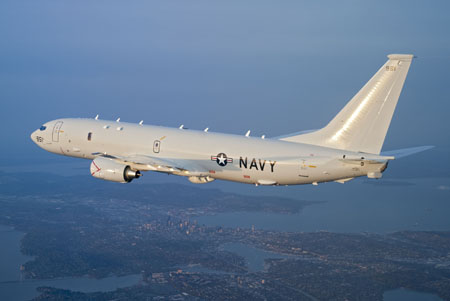
    Boeing Receives $1.6B Contract for P-8A Poseidon Low-Rate Initial Production


    SEATTLE, Jan. 25, 2011 — Boeing [NYSE: BA] on Jan. 21 received a $1.6 billion contract from the U.S. Navy for low-rate initial production (LRIP) of the P-8A Poseidon aircraft. The LRIP 1 contract is for six P-8A aircraft, spares, logistics and training devices.

    The Navy plans to purchase 117 of the Boeing 737-based P-8A anti-submarine warfare, anti-surface warfare, intelligence, surveillance and reconnaissance aircraft to replace its P-3 fleet. Initial operational capability is planned for 2013.

    “Providing these production aircraft to the Navy fleet on schedule is our No. 1 goal,” said Chuck Dabundo, Boeing vice president and P-8 program manager. “This is an exciting day for Boeing and the Navy and a testament to the P-8 team’s hard work and determination.”

    “This first production contract represents a significant commitment by the U.S. Navy to recapitalize its force of long-range maritime patrol and reconnaissance aircraft,” said Capt. Leon Bacon, P-8A deputy program manager for the Navy. “Ensuring that this capability arrives on schedule and within budget remains our primary objective.”

    Boeing will begin final assembly of the first LRIP aircraft at its Renton, Wash., facility this summer. The Poseidon team is using a first-in-industry in-line production process that draws on Boeing’s Next-Generation 737 production system. All P-8A-unique aircraft modifications will be made in sequence during fabrication and assembly.

    “The in-line approach we’ve incorporated on this military derivative aircraft is already paying the dividends we expected by helping us improve efficiency and reduce costs,” said John Pricco, Boeing Commercial Airplanes P-8 program manager.

    As part of the U.S. Navy System Development and Demonstration contract awarded to Boeing in 2004, the team is building and testing six flight-test and two ground-test aircraft. The first three flight-test planes, T1, T2 and T3, are completing testing at Naval Air Station Patuxent River, Md. The program’s static test plane, S1, recently completed its test program, which began in May 2009; S2, the fatigue test plane, will begin testing later this year.

    A derivative of the Next-Generation 737-800, the Poseidon is built by a Boeing-led industry team that includes CFM International, Northrop Grumman, Raytheon, Spirit AeroSystems, BAE Systems and GE Aviation.

    To include the featured image in your Twitter Card, please tap or click their icon a second time.
  • | |

    Non-Compliance Results in FAA Fines

    $160,000 in penalties may be levied against SkyWest Airlines.

    Four passenger flights failed to follow cargo and baggage documentation procedures, resulting in weight, balance, cargo and baggage load data errors.

    Four flights went out without a load manifest that accurately reflected the weight of the cargo and baggage, when the total weight of the aircraft was not computed under approved procedures, and when the aircraft were not loaded according to an approved load schedule.

    SkyWest has paid civil penalties in eight similar previous cases.

    To include the featured image in your Twitter Card, please tap or click their icon a second time.
  • | | |

    NTSB Announces Investigative Hearing on Asiana Flight 214


    Agency provides third investigative update on San Francisco crash

    The National Transportation Safety Board is convening a 2-day investigative hearing to discuss the ongoing investigation into the crash of Asiana Airlines Flight 214 and to gather additional factual information. The hearing, which will be held December 10–11, 2013, at the NTSB’s Board Room and Conference Center in Washington, DC, will focus on pilot awareness in highly automated aircraft, emergency response, and cabin safety. Parties participating in the investigative hearing will be announced at a later time.

    Below is an update of the ongoing investigation. This is a factual update only and no interviews are being conducted.

    The investigator-in-charge and investigators from the Operations and Human Performance Group traveled to Korea and met with officials from Asiana Airlines and the KARAIB. While in Korea, investigators conducted numerous interviews with Asiana management and training personnel, observed Asiana procedures in a simulator and an exemplar aircraft, and gathered further documentation on airline training and policies.
    NTSB investigators from the Maintenance Group also traveled to Korea and reviewed the records for the accident airplane, including the maintenance that had been performed on the evacuation slides.
    The Survival Factors Group conducted an examination of the evacuation slide/raft systems at the manufacturer’s facility in New Jersey and is planning future testing of the systems. The group also re-examined the wreckage to gather additional information about the fire propagation and structural damage. Following that examination, the wreckage was sectioned and moved to a secure storage facility.
    Investigators and party members met in Seattle to examine the recorded flight data and compare it to the expected airplane systems operation. The Systems Group is currently developing a test plan for the mode control panel and the Vehicle Performance Group is finalizing the event simulation match.

    To include the featured image in your Twitter Card, please tap or click their icon a second time.
  • | |

    NTSB COMPLETES DATA COLLECTION FOR EXPERIMENTAL- AMATEUR-BUILT AIRCRAFT ACCIDENT Study

    National Transportation Safety Board
    Washington, DC 20594

    Throughout the 2011 calendar year, the NationalTransportation Safety Board has been conducting a study ofExperimental Amateur-Built (E-AB) aircraft to evaluate thesafety of this growing and innovative segment of general aviation. In addition to using the information gathered during its accident investigations, the NTSB has been working with the Federal Aviation Administration (FAA), the Experimental Aircraft Association (EAA), and individual owners and builders to evaluate a range of issues unique to this popular segment of general aviation.

    “The cooperation we have received from EAA and the E-AB community has been tremendous,” said NTSB Chairman Deborah A.P Hersman. “Through this study, we hope that we’ll be ableto give the innovators and aviators in the community
    information about accidents that will result in a real and immediate safety payoff for them when they are flying these aircraft.”

    As part of the study, NTSB investigators have conducted in-depth investigations of 222 E-AB aircraft accidents that occurred during 2011. Fifty-four of these accidents resulted in 67 fatalities. Most of these accidents (93%) involved
    amateur-built airplanes, the remaining accidents involved gyroplanes (4%), helicopters (2%), and gliders (1%). These accidents occurred in 44 states, with California (18 accidents), Texas (16 accidents), and Florida (14 accidents)
    accounting for the most. More than half (53%) of the E-AB accidents investigated in 2011 involved E-AB aircraft that were bought used, as opposed to having been built by the current owner.

    The EAA has supported the study by conducting a web-based survey of E-AB owners and builders. More than 5,000 E-AB owners and builders responded to EAA’s survey, and 4,923 of these responses were sufficiently complete to use in
    analyses. Most respondents (97%) described E-AB airplanes, while gliders, gyrocopters, and helicopters were each described by slightly less than 1% of the respondents. Sixty-three percent of respondents had already built their
    E-AB aircraft, 13% were currently building their E-AB aircraft, and nearly 24% had bought used E-AB aircraft. More than 340 distinct makes of amateur-built aircraft were reported, although kit manufacturers accounted for more than 55% of the reported aircraft.

    “The NTSB is extremely pleased with the number of respondents who participated in the survey,” said Dr. Joseph Kolly, Director of the Office of Research and Engineering. “The survey data provides us with quantifiable, factual
    information that enriches our understanding of how E-AB aircraft are built and operated.”

    The safety study is scheduled to be completed in the spring of 2012.

    To include the featured image in your Twitter Card, please tap or click their icon a second time.