|

Press Release – FAA Proposes $330,000 Civil Penalty Against Heli-Dudes

Similar Posts

  • |

    FAA Selects Harris Corporation As Voice System Provider

    August 27- The Federal Aviation Administration (FAA) has selected Harris Corp. of Melborne, Fla., to support an essential element of the Next Generation Air Transportation System (NextGen). The NextGen-enabling program is called the National Airspace System (NAS) Voice System (NVS).

    NVS replaces the 40-year-old, legacy voice switches with a modern and flexible operational voice capability. NVS supports ground-to-ground voice communications between air traffic controllers and air-to-ground voice communications between controllers and aircraft. The FAA will deploy NVS in air traffic control towers, terminal and en route facilities, and future NextGen air traffic control facilities.
    “This system is another example of the critical role that interconnecting technologies serve as part of NextGen,” said FAA Acting Administrator Michael Huerta. “NVS will help ensure more efficient and reliable voice communications between our air traffic facilities as we maintain the world’s safest aviation system.”

    NVS will take advantage of modern router-based telecommunications technologies that enable the FAA to transition to a NAS-wide networked system. The current legacy voice switches operate independently at individual facilities and some have been in place since the early 1980s. NVS is a major modernization initiative that will enable the FAA to route, monitor and share information from one facility to another. It also offers the flexibility to allow the FAA to shift controller workload between facilities as needed.

    NVS will support airspace redesign, dynamic re-sectorization and offloading, and business continuity planning to protect against a loss of communications at air traffic control facilities. With the implementation of NVS, the FAA will have enhanced visibility and control over communications resources and will be able to manage them as a unified system versus individual platforms.
    The NVS contract has a five-year base and five two-year options, with a potential total value of $291.6 million.

    To include the featured image in your Twitter Card, please tap or click their icon a second time.
  • | |

    We Predict…

    …that you should watch this space tomorrow.

    If the Federal Aviation Administration publishes their safety directive as expected tomorrow, we will publish it here.

    Expectations are that airlines operating Boeing 737-600s will be the subject of the FAAs upcoming directive, and their Boeing tail sections will required to undergo revamped inspections.

    To include the featured image in your Twitter Card, please tap or click their icon a second time.
  • NTSB CHAIRMAN HIGHLIGHTS RUNWAY SAFETY

    National Transportation Safety Board
    Washington, DC 20594

    FOR IMMEDIATE RELEASE: March 23, 2010
    SB-10-09

    NTSB CHAIRMAN HIGHLIGHTS RUNWAY SAFETY AND HUMAN FATIGUE IN
    ADDRESS TO AIR TRAFFIC CONTROLLERS

    Washington, DC – In an address to the National Air Traffic
    Controllers Association (NATCA) in Orlando today, NTSB
    Chairman Deborah A.P. Hersman lauded controllers for their
    role in keeping the number of runway incursions low while
    challenging the Federal Aviation Administration to hasten
    the pace of its efforts to improve runway safety.

    Attributing the decline in runway related incidents and
    accidents in part to “robust procedures, safe designs, and
    well-trained and alert controllers and pilots,” Hersman said
    that “we still have a lot of work to do,” and that the FAA
    needs to move more aggressively to lower the risk of runway
    accidents.

    Hersman chaired the NTSB’s February meeting in which runway
    safety was again voted onto its Most Wanted List of Safety
    Improvements where it has been since its inception in 1990.
    The Safety Board’s recommendations to the FAA includes
    providing immediate warnings of probable collisions and
    incursions directly to flight crews in the cockpit;
    requiring specific ATC clearance for each runway crossing;
    requiring operators to install cockpit moving map displays
    or an automatic system that alerts pilots when a takeoff is
    attempted on a taxiway or a runway other than the one
    intended; and requiring a landing distance assessment with
    an adequate safety margin for every landing.

    Citing an ongoing investigation of an incident in which a
    767 landed on a taxiway in Atlanta in October, Hersman said
    that the NTSB took a strong interest in the event “because
    we want to know what led a professional flight crew to
    mistake a taxiway for a runway, whether the controllers
    could have detected the misaligned final approach to landing
    and intervened, and whether there are technological tools
    that can be used to prevent such incidents from ever
    occurring in the first place.” Although no one was injured
    in the incident, Hersman said that “if this event had
    resulted in a fatal collision, there would be – far and wide
    – immediate and understandable calls for changes.”

    Hersman also cited human fatigue as an area that the Safety
    Board has become particularly focused on, saying that “We
    are seeing fatigue as a causal or contributing factor in
    numerous accidents across all transportation modes.” The
    NTSB has made recommendations to the FAA to set working hour
    limits for flight crews, aviation mechanics, and air traffic
    controllers, and has asked the FAA develop a fatigue
    awareness and countermeasures training program for
    controllers and those who schedule them for duty.

    Recently, NATCA and the FAA established a working group to
    collaboratively address the human fatigue issues that the
    NTSB has identified. Hersman noted the significance of this
    positive step by the leadership of both organizations and
    called it a very encouraging development.

    Concluding with an invitation for air traffic controllers to
    participate in a three-day forum on pilot and controller
    excellence that the NTSB will be holding in Washington in
    May, Hersman emphasized the value of learning from the
    numerous examples of superior job performance by
    controllers. “Through our work we are very good at finding
    out what went wrong, but frankly, it is just as important to
    know what is going right, because we want to replicate that
    throughout the entire national airspace system,” she said.

    The complete text of Chairman Hersman’s speech may be
    obtained on the Board’s website at
    http://www.ntsb.gov/Speeches/hersman/daph100323.html

    ###

    To include the featured image in your Twitter Card, please tap or click their icon a second time.
  • |

    Boeing Support Teams Honored by Army Aviation Association of America

    HUNTSVILLE, Ala., Feb. 11, 2011 — Boeing [NYSE: BA] on Feb. 10 received two awards from the Army Aviation Association of America (AAAA) at the Joseph P. Cribbins Aviation Product Symposium in Huntsville: the Materiel Readiness Awards for a Major Contractor and for an Industry Team.
    “Capturing both these Materiel Readiness Awards is recognition for our efforts to support U.S. Army Aviation,” said Jim O’Neill, Boeing vice president and general manager of Integrated Logistics. “Our support programs are designed to produce readiness results for our customers, and these results have been outstanding.”

    Boeing received the Major Contractor award for the readiness provided by the company’s AH-64D Apache Performance-Based Logistics team and the Boeing Chinook Interim Contractor Support team, both parts of Boeing Rotorcraft Support.

    The AAAA’s Materiel Readiness Award for an Industry Team, Group or Special Unit went to the Boeing CH-47 Interim Contractor Support team. Over the past year, this team has supported the Army’s CH-47F Cargo Helicopter Program Management Office and Chinook Combat Aviation brigades through support at the Boeing Aircraft Modification Center in Millville, N.J., and 10th Mountain Combat Aviation Brigade at Fort Drum, N.Y., via embedded field service representatives, and through logistics support representatives and asset managers providing components and materials anywhere in the world.
    The Aircraft Modification Center at Millville received a separate award from the U.S. Army Cargo Helicopter Project Office at the symposium for the team’s modification of 31 CH-47F Chinooks in 2010.

    Boeing Rotorcraft Support is a subdivision of Integrated Logistics, a division of the Boeing Global Services & Support business. It includes AH-64 Apache, CH-47 Chinook, H-46 Sea Knight and V-22 Osprey support programs as well as United Kingdom Rotorcraft Support and Ground Forces Support Solutions. It provides tailored, innovative solutions that maximize global readiness for customers around the world.

    To include the featured image in your Twitter Card, please tap or click their icon a second time.
  • |

    Press Release – FAA Announces Over $2.5 Million in Additional Recovery Act Airport Grants

    For Immediate Release
    September 28, 2010

    WASHINGTON – The U.S. Department of Transportation’s Federal Aviation Administration (FAA) today announced that three additional airport projects have been selected for funding, paid for with more than $2.5 million in American Recovery and Reinvestment Act dollars that became available because of airport projects that came in under budget nationwide.

    “With these additional Recovery Act dollars, we can provide a bigger boost to economic growth while we modernize more of our nation’s airports,” said U.S. Transportation Secretary Ray LaHood.

    Earlier this month, the FAA announced that five other airport projects would receive $9 million in Recovery Act funding that became available thanks to low bids and under-budget airport projects.

    “We are thrilled that we have been able to stretch Recovery Act dollars to meet the needs of more airports. These projects will improve airport operations and help our airspace system to run more efficiently,” said FAA Administrator Randy Babbitt.

    The three additional rehabilitation projects are:

    • Lawrence, Mass., Municipal Airport
      An ARRA grant for $1.2 million will fund several pavement rehabilitation projects on airport taxiways and aircraft parking aprons.
    • Hartsfield-JacksonAtlanta International Airport
      This $1 million ARRA grant will fund the ongoing construction and paving of the new international terminal apron.
    • CharlesM. Schulz-Sonoma County Airport, Santa Rosa, Calif.
      A $379,000 ARRA grant will allow the airport to complete the second phase of its terminal rehabilitation and replace the terminal building roof.

    Under the Recovery Act, more than $1.3 billion has been made available nationwide for both airport improvement projects and air traffic control facility and system upgrades. Because of low construction bids for projects, more Recovery Act dollars were available for additional facilities, equipment and airport projects. These grants have been distributed to airports that serve commercial passengers, cargo and general aviation.

    To include the featured image in your Twitter Card, please tap or click their icon a second time.
  • |

    Boeing Press Release:Training Class

    Boeing Completes First 787 Dreamliner Maintenance Training Class
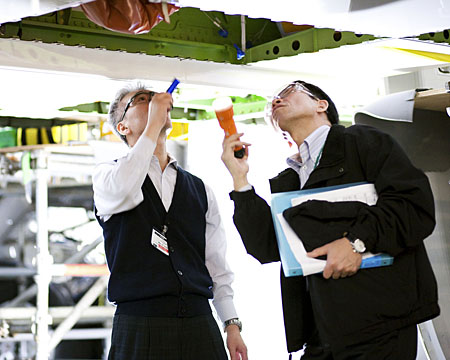
    EVERETT, Wash., April 6 — Boeing (NYSE: BA) today announced that it has completed the first maintenance training class for the 787 Dreamliner. The class consisted of 10 mechanics from 787 launch customer ANA (All Nippon Airways) and two regulators from the Japan Civil Aviation Bureau (JCAB).

    The mechanics, who completed the training last week, are the first of 150 ANA mechanics to be trained by Boeing over the next seven months. They spent more than 30 days learning how to maintain the world’s most advanced commercial jetliner, including 20 days of theoretical training, two days of engine runs and taxi testing, five days of practical training and five days of troubleshooting exercises. To conclude the training, students conducted component identification exams on production airplanes, as well as troubleshooting exams in the full flight simulator.

    To support the all-new 787, Boeing Training & Flight Services, a division of Commercial Aviation Services, Boeing Commercial Airplanes, has developed an all-digital, Internet-based teaching system for maintenance training, along with training tools that connect real-time to a virtual airplane and airplane systems.

    “Getting our mechanics trained and prepared is essential to being ready to take delivery of the airplane later this year,” said Michihide Kono, vice president of Engineering and Maintenance for ANA. “This is an important milestone for our ANA team and we are delighted to see the continued progress on the program.”

    The curriculum is designed to focus on performance-based training that incorporates real-world simulated maintenance scenarios for a more immersive training experience.

    “The use of personal tablet computers, interactive computer-based training, three-dimensional images and desktop simulation makes it possible to deliver training more efficiently,” said Sherry Carbary, vice president of Boeing Training & Flight Services, Commercial Aviation Services, Boeing Commercial Airplanes. “Our team is committed to providing our customers with the resources and tools they need to be successful.”

    The 787 comes with digital tools and databases that replace volumes of printed materials. The graphic and textual database has point-and-click features for more details, allowing mechanics to navigate through documents quickly to get the information they need to do their jobs.

    “This milestone is another important step along the way to being service-ready,” said Mike Fleming, director of 787 Services and Support, Boeing Commercial Airplanes. “Our goal is to make entry into service a seamless experience for our customers.”

    Fifty-seven customers around the world have ordered 866 787s since the program was launched in April 2004, making the Dreamliner the fastest-selling new commercial jetliner in history. Delivery of the first 787 is planned for the fourth quarter of 2010.

    To include the featured image in your Twitter Card, please tap or click their icon a second time.