|

Goodrich to Address the Barclays Capital Third Annual Industrial Select Conference

Similar Posts

  • |

    Press Release – FAA Proposes $455,175 Civil Penalty Against Corporate Air

    For Immediate Release

    October 12, 2010

    SEATTLE – The Federal Aviation Administration (FAA) is proposing a $455,175 civil penalty against Corporate Air of Billings, Mont., for allegedly operating a Beech 1900C airliner when it was not in compliance with Federal Aviation Regulations.

    “Our aviation safety rules are designed to protect the flying public,” said U.S. Transportation Secretary Ray LaHood. “We expect airlines to comply with these rules and will take enforcement action when they do not.”

    The FAA alleges Corporate Air failed to maintain the aircraft under the company’s general maintenance manual, which includes the Pratt & Whitney Canada maintenance manual for the aircraft’s turboprop engines.

    Specifically, the FAA alleges that Corporate Air operated the aircraft on at least 80 flights in spite of continued evidence of excessive oil consumption by the right engine. The FAA-approved aircraft and engine manuals call for post-flight inspection and repair of an engine experiencing excessive oil consumption. Corporate Air did not correct the oil consumption problem despite repeated inspections in which oil had to be added.

    Corporate Air operates charter and air taxi service under Part 135 of the Federal Aviation Regulations.

    “The safety of the passengers and crew must be the top priority for any operator,” said FAA Administrator Randy Babbitt. “All operators must comply with maintenance requirements.”

    Corporate Air has 30 days from the receipt of the FAA’s enforcement letter to respond to the agency.

    To include the featured image in your Twitter Card, please tap or click their icon a second time.
  • |

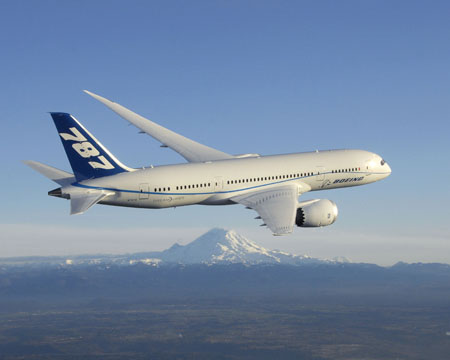
    Boeing Completes 1,000th 787 Flight

    EVERETT, Wash., Feb. 24, 2011 /PRNewswire/ — The Boeing 787 Dreamliner made its 1,000th flight yesterday, marking another milestone in the flight test program. There are seven airplanes participating in flight testing. The landing of 787 flight test airplane ZA004, just after 1 p.m. MST at Yuma International Airport in Arizona, counted as the official 1,000th flight.

    The program is near its 3,000th hour of flying and 787s have flown a total of more than one million miles.
    “The team is making great progress,” said Scott Fancher, vice president and general manager of the 787 program. “We are getting through the test conditions needed to certify this airplane with nearly 80 percent of the conditions for the first model, with Rolls-Royce engines, already complete. And, we’re more than 60 percent of the way through the test conditions for the 787s with General Electric engines.”

    Capt. Mike Carriker, chief pilot for the 787, Boeing Test & Evaluation, said the airplane continues to behave well in testing.

    “We’re really eager to get this airplane through its flight testing so our customers can see for themselves this airplane’s excellent performance,” said Carriker.

    Pictured here, ZA004 frames Mt. Rainier in Western Washington during a test flight earlier this year.

    To include the featured image in your Twitter Card, please tap or click their icon a second time.
  • | |

    Washington Headquarters Press Release: Mexico

    For Immediate Release
    July 30, 2010
    Contact: Sasha Johnson or Laura Brown
    Phone: sasha.j.johnson@faa.gov or laura.j.brown@faa.gov

    FAA Finds Mexico Does Not Meet ICAO Safety Standards

    WASHINGTON, D.C. – The U.S. Department of Transportation’s Federal Aviation Administration (FAA) today announced that Mexico is not in compliance with international safety standards set by the International Civil Aviation Organization (ICAO), following an assessment of the country’s civil aviation authority. As a result, the United States is downgrading Mexico from a Category 1 to Category 2 rating.

    As part of the FAA’s International Aviation Safety Assessment (IASA) program, the agency assesses the civil aviation authorities of all countries with air carriers that operate or have applied to fly to the United States and makes that information available to the public. The assessments determine whether or not foreign civil aviation authorities are meeting ICAO safety standards, not FAA regulations. With the IASA Category 2 rating, Mexican air carriers cannot establish new service to the United States, although they are allowed to maintain existing service.

    While Mexico has been responsive to the FAA’s findings and has made significant improvements in recent months, it was unable to fully comply with all of the international safety standards. However, under the leadership of Director General Hector Gonzalez Weeks, Mexico continues to make progress. The FAA is committed to working closely with the Mexican government and providing technical assistance to help Mexico regain its Category 1 rating.

    A Category 1 rating means the country’s civil aviation authority complies with ICAO standards. A Category 2 rating means a country either lacks laws or regulations necessary to oversee air carriers in accordance with international standards, or that its civil aviation authority – equivalent to the FAA for aviation safety matters – is deficient in one or more areas, such as technical expertise, trained personnel, record-keeping or inspection procedures.

    Countries with air carriers that fly to the United States must adhere to the safety standards of ICAO, the United Nations’ technical agency for aviation that establishes international standards and recommended practices for aircraft operations and maintenance.

    To include the featured image in your Twitter Card, please tap or click their icon a second time.
  • | | | | | | |

    NY: Hudson River Crash Update


    Click to view full size photo at Airliners.net
    Contact Photographer Tom Turner

    What: Piper PA-32 registered to LCA Partnership in Fort Washington, Pa flying out of Teteboro Airport to Ocean City and a Liberty Helicopter Sightseeing Tour Eurocopter AS 350
    Where: over the Hudson River between New York and Hoboken, New Jersey near West 14th Street
    When: Sat Aug 8 2009
    Who: Helicopter: 5 Italian tourists and a pilot;
    plane: pilot and 2 passengers (including a child)
    Why: The airplane flew into the helicopter. The impact (or rotors) severed off the plane’s wing. Both aircrafts are in the river. The helicopter is reported to have “dropped like a rock” when the aircrafts “clipped.”

    All bodies have been recovered.

    Though not necessarily considered directly responsible, two FAA employees (the plane’s air traffic controller and the ATC supervisor) have been put on administrative leave in connection with this crash. The ATC was engaged in inappropriate conversation, and the supervisor was not in the room as required.

    To include the featured image in your Twitter Card, please tap or click their icon a second time.
  • |

    NTSB SAFETY RECOMMENDATION

    The National Transportation Safety Board recommends that the Federal Aviation Administration:

    Require that the hover performance charts published by helicopter manufacturers reflect the true performance of the helicopter in all conditions for which the charts are applicable, including light and variable wind conditions. (A-10-148)

    Develop and implement a surveillance program specifically for 14 Code of Federal Regulations (CFR) Part 135 operators with aircraft that can operate both as public aircraft and as civil aircraft to maintain continual oversight ensuring compliance with 14 CFR Part 135 requirements. (A-10-149)

    Take appropriate actions to clarify Federal Aviation Administration (FAA) authority over public aircraft, as well as identify and document where such oversight responsibilities reside in the absence of FAA authority. (A-10-150)

    Require the installation of fuel tanks that meet the requirements of 14 Code of Federal Regulations 29.952 on S-61 helicopters that are used for passenger transport. (A-10-151) Require that S-61 helicopters that are used for passenger transport be equipped with passenger seats and seat mounting structures that provide substantial improvement over the requirements of Civil Air Regulations 7.260, such as complying with portions of 14 Code of Federal Regulations 29.561 and 29.562. (A-10-152)

    Require operators of transport-category helicopters to equip all passenger seats with restraints that have an appropriate release mechanism that can be released with minimal difficulty under emergency conditions. (A-10-153)

    Require that Advisory Circular 21-34 be used to evaluate all shoulder harness retrofit installations and to determine that the installations reduce the risk of occupant injury. (A-10-154)

    Require operators of Sikorsky S-61 helicopters with General Electric model CT58-140 engines to install 10-micron airframe fuel filters. (A-10-155)

    Require Carson Helicopters, Inc., to put a conspicuous notification on the title page of the Instructions for Continuing Airworthiness that accompany its supplemental type certificate for installing side-mounted seats indicating that the installation does not provide enhanced occupant protection over that provided by the originally installed seats and meets Civil Air Regulations 7.260 standards. (A-10-156)

    Require all applicants for supplemental type certificate (STC) seat installations in any type of aircraft to put a conspicuous notification on the title page of the Instructions for Continuing Airworthiness that accompany the STC indicating whether the installation provides enhanced occupant protection over that provided by the originally installed seats and the certification standard level met by the seating system. (A-10-157)

    Require supplemental type certificate (STC) applicants to improve the crashworthiness design of the seating system, such as complying with portions of 14 Code of Federal Regulations 29.561 and 29.562, when granting STC approval for older transport-category rotorcraft certificated to Civil Air Regulations 7.260 standards. (A-10-158)

    Also, the National Transportation Safety Board reiterates the following previously issued recommendation to the Federal Aviation Administration:

    Do not permit exemptions or exceptions to the flight recorder regulations that allow transport-category rotorcraft to operate without flight recorders, and withdraw the current exemptions and exceptions that allow transport-category rotorcraft to operate without flight recorders. (A-06-18)

    To include the featured image in your Twitter Card, please tap or click their icon a second time.
  • |

    Southwest Airlines Names New Vice President of Network Planning

    Southwest Airlines is pleased to announce John Jamotta as the new Vice President of Network Planning. John has been with Southwest Airlines and Network Planning–formerly known as Schedule Planning–since 1987, serving as Senior Director for the past seven years and leading the integrated planning function within Network Planning.

    “We are proud to announce John’s new role at Southwest Airlines as Vice President of Network Planning,” said Bob Jordan, Southwest Airlines Executive Vice President of Strategy and Planning. “We have seen a number of significant and exciting changes for Southwest Airlines recently, including the potential to add the 737-800; the addition of destinations such as Panama City Beach, Charleston, and Greenville/Spartanburg; and the continued press into New York City through the acquisition of Newark slots. Productively growing the network is at the heart of those changes, while at the same time it’s vital that we stay true to our core network fundamentals that have sustained us for nearly 40 years. John’s Leadership will help us shape our network strategy as we look to the future.”

    The Network Planning department at Southwest is comprised of a Team of exceptionally talented Employees, who manage Southwest’s flight schedules, routes, capacity planning, integrated planning, and network development as well as conducting operational and traffic analysis.

    John is a Leader in advancing technology innovation as tools for the scheduling and planning disciplines. He has also been active in the Company’s efforts to proliferate its culture within the organization, and to the communities it serves. Prior to joining Southwest Airlines, John worked for Pan Am in both ground operations and in management. Originally from New York, John has a Psychology degree from St. John’s University in New York City. For a photo of John Jamotta, please visit: www.swamedia.com/photos.

    After nearly 40 years of service, Southwest Airlines (NYSE: LUV) continues to differentiate itself from other low fare carriers — offering a reliable product with exemplary Customer Service. Southwest Airlines is the nation’s largest carrier in terms of originating domestic passengers boarded; now serving 69 cities in 35 states. Southwest also is one of the most honored airlines in the world known for its commitment to the triple bottom line of Performance, People, and Planet. To read more about how Southwest is doing its part to be a good citizen, visit southwest.com/cares to read the Southwest Airlines One Report(TM). Based in Dallas, Southwest currently operates more than 3,100 flights a day and has nearly 35,000 Employees systemwide.

    To include the featured image in your Twitter Card, please tap or click their icon a second time.