|

NTSB SAFETY RECOMMENDATION

Similar Posts

  • |

    Boeing Receives US Air Force Contract for C-17 Training Devices

    ST. LOUIS, Dec. 22, 2010 — The Boeing Company today announced it has received a contract from the U.S. Air Force to deliver C-17 training devices to three sites. The contract value is $44 million initially and up to $72 million if two options are exercised.

    The first set of devices is an Integrated Training Center (ITC) to be delivered to Wright-Patterson Air Force Base, Ohio, in the first quarter of 2012. The ITC will consist of a weapon systems trainer, pilot and co-pilot station, loadmaster station and related courseware and support equipment. A second weapon systems trainer will be installed at McChord Air Force Base, Wash., in the third quarter of 2012 and a third ITC will go to a new C-17 training site in early 2013.

    “Wright-Patterson is set to receive its first of eight C-17s next year and McChord has 54,” said Mark McGraw, Boeing vice president for Training Systems & Services. “We are proud to add to the Air Force’s training capability and support warfighter readiness with these new devices.”

    The ITCs support pilot and co-pilot instruction in flight operations, mission planning and emergency procedures through computer-based training, advanced aircraft simulation and other desktop training devices. C-17 loadmasters also receive computer-based and aircraft training in addition to training on the loadmaster station, cargo loading models and cargo compartment trainer. Additionally, maintenance personnel can use the ITCs for training on engine run procedures.

    To include the featured image in your Twitter Card, please tap or click their icon a second time.
  • | |

    Boeing, Ethiopian Airlines, Seattle Anesthesia Outreach Partner for Relief Flight


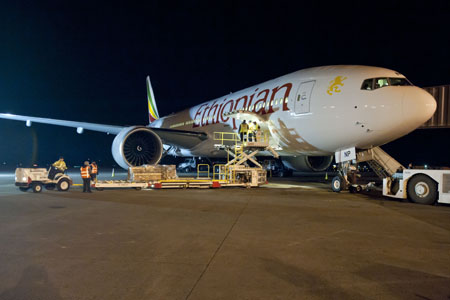
    SEATTLE, Jan. 27, 2011 — For the second time in less than two months, Boeing ( Ethiopian Airlines and Seattle Anesthesia Outreach (SAO) have partnered to deliver medical equipment to Black Lion Hospital, Ethiopia’s largest hospital. The first consignment was delivered in December 2010.

    Approximately 2,700 pounds (1.2 metric tons) of medical supplies were loaded into the cargo hold of a new Boeing 777-200LR (longer range) delivered to Ethiopian Airlines on Jan. 26. Some of the supplies, such as electrical converters and other power items, supplement the anesthesia equipment transported in December.

    “Through collaborative efforts such as this, Boeing is able to help bring relief to people around the world. Black Lion Hospital provides free medical care to the poor and this equipment will improve capabilities there,” said Liz Warman, director of Boeing Global Corporate Citizenship for the Northwest region.

    The supplies will prove vital when a group of 28 Seattle doctors, nurses and technicians travel to Ethiopia next month as part of ongoing humanitarian support to that region.

    Since 1992, Boeing and airline partners as well as non-profit partners in the Humanitarian Delivery Flights (HDF) program have collaborated on many humanitarian missions.
    Ethiopian Airlines is committed to support worthy social activities, which are designed to help build sustainable livelihoods for individuals and the community.

    To include the featured image in your Twitter Card, please tap or click their icon a second time.
  • |

    NASA Flies Large Unmanned Aircraft in Public Airspace Without Chase Plane

    Credits: NASA Photo / Carla Thomas
    NASA’s remotely-piloted Ikhana aircraft, based at the agency’s Armstrong Flight Research Center in Edwards, California, successfully flew its first mission in the National Airspace System without a safety chase aircraft on Tuesday. This historic flight moves the United States one step closer to normalizing unmanned aircraft operations in the airspace used by commercial and private pilots.

    Flying these large remotely-piloted aircraft over the United States opens the doors to all types of services, from monitoring and fighting forest fires, to providing new emergency search and rescue operations. The technology in this aircraft could, at some point, be scaled down for use in other general aviation aircraft.

    “This is a huge milestone for our Unmanned Aircraft Systems Integration in the National Airspace System project team,” said Ed Waggoner, NASA’s Integrated Aviation Systems Program director. “We worked closely with our Federal Aviation Administration colleagues for several months to ensure we met all their requirements to make this initial flight happen.”

    Flights of large craft like Ikhana, have traditionally required a safety chase aircraft to follow the unmanned aircraft as it travels through the same airspace used by commercial aircraft. The Ikhana flew in accordance with the Federal Aviation Administration’s (FAA) Technical Standard Order 211 — Detect and Avoid Systems — and Technical Standard Order 212 — Air-to-Air Radar for Traffic Surveillance.

    The FAA granted NASA special permission to conduct this flight under the authority of a Certificate of Waiver or Authorization on March 30. The certificate permitted Ikhana’s pilot to rely on the latest Detect and Avoid technology, enabling the remote pilot on the ground to see and avoid other aircraft during the flight.

    NASA successfully worked with its industry partners to develop a standard for Detect and Avoid technologies, complied with the requirements of the FAA Technical Standard Orders, and garnered flight approval from the FAA.

    The Ikhana aircraft was equipped with detect and avoid technologies, including an airborne radar developed by General Atomics Aeronautical Systems, Inc., a Honeywell Traffic Alert and Collision Avoidance System, a Detect and Avoid Fusion Tracker, and an Automatic Dependent Surveillance-Broadcast capability – a surveillance technology where the aircraft determines its position via satellite navigation and periodically broadcasts this information so other aircraft can track it.

    The flight took off from Edwards Air Force Base in California and entered controlled air space almost immediately. Ikhana flew into the Class-A airspace, where commercial airliners fly, just west of Edwards at an altitude of about 20,000 feet. The aircraft then turned north toward Fresno, requiring air traffic control to be transferred from the Los Angeles Air Route Traffic Control Center to the Oakland Air Route Traffic Control Center. On the return trip, the pilot headed south toward Victorville, California, requiring communication control to be transferred back to Los Angeles.

    During the return flight, the pilot began a gentle decent over the city of Tehachapi, California, into Class E airspace — about 10,000 feet — where general aviation pilots fly. The pilot initiated an approach into Victorville airport at 6,000 feet, coordinating in real time with air traffic controllers at the airport. After successfully executing all of these milestones, the aircraft exited the public airspace and returned to its base at Armstrong.

    “We are flying with a suite of sophisticated technology that greatly enhances the safety capabilities of pilots flying large unmanned aircraft in the National Airspace System,” said Scott Howe, Armstrong test pilot. “We took the time to mitigate the risks and to ensure that we, as a program, were prepared for this flight.”

    Tuesday’s flight was the first remotely-piloted aircraft to use airborne detect and avoid technology to meet the intent of the FAA’s “see and avoid” rules, with all test objectives successfully accomplished.

    To include the featured image in your Twitter Card, please tap or click their icon a second time.
  • | | |

    FAA Delays Closure of 149 Air Traffic towers until June 15

    WASHINGTON – The U.S. Department of Transportation’s Federal Aviation Administration (FAA) announced today that it will delay the closures of all 149 federal contract air traffic control towers until June 15. Last month, the FAA announced it would eliminate funding for these towers as part of the agency’s required $637 million budget cuts under sequestration.

    This additional time will allow the agency to attempt to resolve multiple legal challenges to the closure decisions. As part of the tower closure implementation process, the agency continues to consult with airports and operators and review appropriate risk mitigations. Extending the transition deadline will give the FAA and airports more time to execute the changes to the National Airspace System.
    “This has been a complex process and we need to get this right,” said U.S. Transportation Secretary Ray LaHood. “Safety is our top priority. We will use this additional time to make sure communities and pilots understand the changes at their local airports.”

    As of today, approximately 50 airport authorities and other stakeholders have indicated they may join the FAA’s non-Federal Contract Tower program and fund the tower operations themselves. This additional time will allow the FAA to help facilitate that transition.

    “We will continue our outreach to the user community to answer any questions and address their concerns about these tower closures,” said FAA Administrator Michael Huerta.

    On March 22, the FAA announced that it would stop federal funding for 149 contract towers across the country. A phased, four-week closure process was scheduled to begin this Sunday, April 7. That phased closure process will no longer occur. Instead, the FAA will stop funding all 149 towers on June 15 and will close the facilities unless the airports decide to continue operations as a nonfederal contract tower.

    To include the featured image in your Twitter Card, please tap or click their icon a second time.
  • |

    Press Release: Lufthansa


    Special flight schedule published at www.lufthansa.com due to expected pilots’ strike
    East Meadow, N.Y., Feb. 19, 2010 — As a consequence of the strike measures which have been initiated by the “Vereinigung Cockpit” trade union, Lufthansa is making corresponding adjustments to its flight schedule from Monday to Thursday, February 22- 25. About two thirds of the affected Lufthansa-operated flights will have to be cancelled, however Lufthansa regional partners such as Lufthansa City Line will operate their flightsaccording to schedule.

    The special flight schedule for the period of the strike can now be accessed at
    www.lufthansa.com and lists all flights which should be operating according to the current planning. Depending upon the actual operating conditions during the days of the strike, further changes could be made to the special flight schedule.

    Customers who have purchased a Lufthansa ticket for a flight which is operated by a partner airline (codeshare) will not find the LH flight number known to them in the special flight schedule. Since the partner airlines are not affected by the strike, these flights will operate as planned (flight numbers LH1400-2629 and LH5050-6999).

    Lufthansa is doing everything in its power to inform its customers as soon as possible and offer them alternative travel options. Passengers already booked on a Lufthansa flight during the period from February 22 to 25 can rebook once free of charge on another Lufthansa flight, if they wish to change their travel plans – provided their ticket was issued before February 18, the new travel date is before May 31, 2010 and their arrival and departure destinations remain the same.

    Should a flight be cancelled, and the purpose of the journey no longer applies,
    passengers can cancel their booking free of charge. Travelers have the opportunity to regularly check the status of their flight at www.lufthansa.com under the heading “My bookings”. A cancellation of the flight and the booking will be shown there. If a rebooking has been made, the travel alternatives will be shown there as well.

    Passengers on domestic German flights, whose flights have been cancelled, can
    independently purchase a rail ticket for the identical route in the same travel class and later, together with proof of the flight ticket purchased from Lufthansa, claim a refund. They can access the passenger receipt of their etix online at www.lufthansa.com under Information & Service > Check-in > Passenger Receipt.

    Customers can continue to obtain information about their bookings, as well as about the Rebooking options and cancellations, at the toll-free number 1-800-645-3880 in the U.S. and 1- 800-563-5954 in Canada.

    According to the special flight schedule, the following flights to/from North America are scheduled to take place during the period from February 22-25:

    February 22
    LH 412 Munich – Newark
    LH 413 Newark – Munich
    LH 430 Frankfurt – Chicago
    LH 431 Chicago – Frankfurt
    LH 434 Munich – Chicago
    LH 435 Chicago – Munich
    LH 438 Frankfurt – Dallas Ft Worth
    LH 439 Dallas Ft Worth – Frankfurt
    LH 492 Frankfurt – Vancouver
    LH 493 Vancouver – Frankfurt
    LH 498 Frankfurt – Mexico City
    LH 499 Mexico City – Frankfurt

    February 23
    LH 412 Munich – Newark
    LH 413 Newark – Munich
    LH 492 Frankfurt – Vancouver
    LH 493 Vancouver – Frankfurt

    February 24
    LH 412 Munich – Newark
    LH 413 Newark – Munich
    LH 434 Munich – Chicago
    LH 435 Chicago – Munich
    LH 442 Frankfurt – Detroit
    LH 443 Detroit – Frankfurt
    LH 492 Frankfurt – Vancouver
    LH 493 Vancouver – Frankfurt
    LH 498 Frankfurt – Mexico City
    LH 499 Mexico – City Frankfurt

    February 25
    LH 412 Munich – Newark
    LH 413 Newark – Munich
    LH 434 Munich – Chicago
    LH 435 Chicago – Munich
    LH 490 Frankfurt – Seattle
    LH 491 Seattle – Frankfurt
    LH 492 Frankfurt – Vancouver
    LH 493 Vancouver – Frankfurt
    ###
    Deutsche Lufthansa AG
    Corporate Communications
    Martin Riecken
    Tel.: +1 516-296-9671
    americaspr@dlh.de
    www.lufthansa.com
    http://twitter.com/Lufthansa_USA

    To include the featured image in your Twitter Card, please tap or click their icon a second time.
  • |

    Press Release – FAA Mandates Crew Resource Management Training for On-Demand Charters

    For Immediate Release
    January 20, 2011

    WASHINGTON – The Federal Aviation Administration (FAA) has finalized a rule that requires non-scheduled charter airlines and air taxis to train pilots and flight attendants in Crew Resource Management (CRM), a well-established concept that helps reduce human error in commercial aviation by teaching pilots, flight attendants and other aviation workers to act as a team.

    Air carriers affected by the final rule must establish initial and recurrent CRM training for crewmembers within two years of the effective date of the rule. The training must address the captain’s authority; intra-crew communications; teamwork; managing workload, time, fatigue and stress; and decision-making skills.

    “This type of training is critical for the safety of flight crews and passengers,” said U.S. Secretary of Transportation Ray LaHood.
    The FAA has required CRM training for air carriers operating larger airplanes since December 1995.

    “I know the value of making Crew Resource Management part of the safety culture from my days as an airline pilot,” said FAA Administrator Randy Babbitt. “A crew that works as a team is a better crew, regardless of the size of the plane or the size of the airline.”

    CRM training focuses on the interactions among personnel including pilots, flight attendants, operations personnel, mechanics, air traffic controllers and flight service stations. This training in communications and teamwork can help prevent errors such as runway incursions, misinterpreting information from air traffic controllers, crewmembers’ loss of situational awareness, and failure to fully prepare for takeoff or landing.

    This final rule responds to a 2003 National Transportation Safety Board recommendation that is currently on the Board’s “Most Wanted” list of safety improvements.

    To include the featured image in your Twitter Card, please tap or click their icon a second time.