| |

Washington Headquarters Press Release: Mexico

Similar Posts

  • U.S. Virgin Applauds DOT Decision

    Virgin America Cleared for Take-Off in 2010

    San Francisco – January 8, 2010 – Virgin America, a privately-held domestic airline, today applauded the Department of Transportation’s (DOT) decision confirming the carrier’s financial fitness and U.S. citizenship status. Earlier today, the DOT issued a ruling that the airline and its proposed new ownership structure will remain fully compliant with U.S. ownership laws. U.S. law requires that domestic airlines remain under the control of U.S. citizens, with no more than 25% of the voting stock being held by foreign citizens. As a matter of policy, the DOT reviews any proposed ownership changes of over 10 percent of the voting stock of any U.S.-domiciled airline.

    “Today is a great day for airline competition, for our traveling guests and for our teammates,” said Virgin America President and CEO David Cush. “We’re extremely pleased with the Department of Transportation’s announcement. With this behind us, we intend to focus on what we do best: injecting new competition into markets as we grow, creating new jobs and delivering an unrivalled guest experience.”

    The proposed new ownership structure will reflect a change among Virgin America’s U.S. investors and also allow the Company’s teammates to participate in the airline’s future via an Employee LLC. Under the new structure, the airline’s voting stock will remain in its previous configuration with 75 percent held by the U.S.-based VAI Partners, LLC and 25 percent held by Virgin Group. However, the U.S. investors comprising VAI Partners will change with the following entities now comprising the VAI stake:

    Cyrus Aviation Investor, LLC – 55.5 percent
    VAI MBO Investors, LLC—27.8 percent
    VX Employee Holdings, LLC—16.7 percent
    VAI Management, LLC—less than 1 percent
    Cyrus Aviation Investor, LLC is an entity related to long-time Virgin America investor, Cyrus Capital. Under the new structure it will substantially increase its investment to become the airline’s principal U.S. investor.

    VAI MBO Investors, LLC is comprised of five individual investors. Four of the investors, Don Carty, Sam Skinner, Cyrus Freidheim, and David Cush, are current Virgin America Board members, and a fifth, Robert Nickell, will assume a Board seat at the closing of this transaction.

    VX Employee Holdings, LLC is an entity established to hold the economic value of 16.7 percent of VAI for distribution to the employees of Virgin America at the time of a qualified liquidity event, such as an initial public offering.

    “Given that our success to date is due to the efforts of this entrepreneurial start-up team, we are pleased that our teammates will now have a stake in the financial success of our airline,” added Cush.

    As part of the proposed transaction, Virgin America will obtain an additional $68.4 million in unsecured debt from its shareholders. This facility will further improve the liquidity of the company, positioning it for additional growth in 2010 and beyond.

    The company will continue to have a U.S. controlled Board of Directors (with seven of nine seats held by U.S. citizens). Although a privately-held company, the airline is announcing these details given DOT’s public ruling earlier today.

    Since its August 2007 launch, the San Francisco-based Virgin America has created more than 1500 new jobs, swept all the major reader-based travel awards, and lowered fares and improved service in the new markets it has entered. The start-up airline’s most recently reported financial results included the announcement of its first quarterly operating profit, a year-over-year revenue increase of 38 percent, record load factors and improved unit costs for the third quarter of 2009.

    Virgin America flies to San Francisco, Los Angeles, New York, Washington D.C., Seattle, Las Vegas, San Diego, Boston, Orange County and Fort Lauderdale. Virgin America has flown over 6.2 million guests since its inaugural flights and now counts over 1.2 million Elevate loyalty program members. In just over two years flying, Virgin America has captured a list of travel industry best-in-class awards, including “Best Domestic Airline” in the Condé Nast Traveler Readers’ Choice Awards and in Travel + Leisure’s World’s Best Awards.

    # # #

    Virgin America is a U.S.-controlled, owned and operated airline. It is an entirely separate company from Virgin Atlantic. Sir Richard Branson’s Virgin Group is a minority share investor in Virgin America.

    To include the featured image in your Twitter Card, please tap or click their icon a second time.
  • | | | |

    Respond now to NTSB ISSUING FINAL RULE IN RESPONSE TO PILOT’S BILL OF RIGHTS

    The National Transportation Safety Board announced today that it has issued a Final Rule to implement several changes to its Rules of Practice applicable to aviation certificate enforcement appeals. This final rule responds to public comments received by the NTSB as a result of an interim final rule (IFR) it issued last October. The NTSB issued the IFR after the enactment of the Pilot’s Bill of Rights legislation and it became effective upon its publication in the Federal Register on October 16, 2012.

    Under the Pilot’s Bill of Rights: (1) the Federal Aviation Administration (FAA) must disclose its enforcement investigative report (EIR) to the FAA certificate holder in an aviation certificate enforcement case; (2) NTSB administrative law judges must apply the Federal Rules of Civil Procedure and Federal Rules of Evidence in enforcement cases; and (3) litigants now have the option of appealing the NTSB’s final orders to either a Federal district court or a Federal court of appeals. The IFR implemented these Pilot’s Bill of Rights requirements. Under the IFR, an FAA certificate holder is permitted to submit a motion to dismiss an FAA complaint if the FAA fails to disclose releasable portions of its EIR. The NTSB received 10 comments in response to the IFR. The Final Rule describes these comments in detail, as most of the comments provided substantive feedback and suggestions.

    In considering the IFR comments, the NTSB determined it should include a proposal to extend the EIR availability requirement in the Pilot’s Bill of Rights to emergency enforcement cases. As a result, the NTSB is also publishing a new Notice of Proposed Rulemaking (NPRM) in conjunction with publication of the Final Rule in the Federal Register.


    Both the Final Rule and NPRM are available at http://www.gpo.gov/fdsys/pkg/FR-2013-09-19/pdf/2013-22634.pdf (Final Rule) and http://www.gpo.gov/fdsys/pkg/FR-2013-09-19/pdf/2013-22633.pdf (NPRM). The public may submit comments to the NPRM, concerning the proposal to require the FAA to make available the EIR in emergency enforcement cases, via www.regulations.gov, Docket No. NTSB-GC-2011-0001, or via postal mail or facsimile, addressed to the NTSB Office of General Counsel. Comments should be submitted no later than October 21, 2013. The Final Rule is immediately effective.

    See the bill below

    In George’s Point of View

    Time to take note of the final rule. The public can submit their opinion at http://www.regulations.gov, Docket No. NTSB-GC-2011-0001, or via postal mail or facsimile, addressed to the NTSB Office of General Counsel.

    To include the featured image in your Twitter Card, please tap or click their icon a second time.
  • FAA Controllers in Philadelphia Transition to Next Generation Air Transportation System Technology

    For Immediate Release
    April 26, 2010
    Contact: Tammy L. Jones or Paul Takemoto
    Phone: (202) 267-3883

    WASHINGTON, D.C. — As part of the Federal Aviation Administration’s (FAA) plan to modernize the national airspace system, controllers in the Philadelphia area now have the capability to use a satellite-based system to more efficiently and safely track and separate aircraft.

    “This new technology is a tremendous leap forward in transforming the current air traffic control system,” said FAA Administrator Randy Babbitt. “The operational benefits in Philadelphia extend as far as Washington, DC, and New York, which has some of the most congested airspace in the world.”

    Called Automatic Dependent Surveillance-Broadcast (ADS-B), the new system is a core technology under the Next Generation Air Transportation System (NextGen). By using ADS-B, air traffic controllers have more precise information while separating aircraft in the sky and on the runways, leading to greater efficiency and safety benefits. Controllers who have access to ADS-B receive one-second update rates compared to four-and-a- half second update rates with radar.

    Potentially, they will be able to reduce separation in the en route environment from the current five nautical miles to three, saving both time and money for the airlines while reducing the carbon footprint. Pilots flying aircraft equipped with ADS-B know precisely where they are and are able to see other properly equipped aircraft. They also have access to better information on area weather and receive flight information electronically, such as airmen notices and temporary flight restrictions.

    Philadelphia is one of four key sites that the FAA selected to demonstrate ADS-B services. The other sites include Houston, Louisville, KY, and Juneau, AK. The sites were selected because of their unique airspace environments and local needs.

    ADS-B coverage at Philadelphia extends 60 nautical miles out and approximately 10,000 feet up. It also covers the surface area and the approach corridors to the runways. Philadelphia was selected because of its current automation platform that is used by air traffic controllers, called the Standard Terminal Automated Replacement System. Also, UPS has equipped for ADS-B services and a large amount of their operations are conducted at Philadelphia International Airport. In addition, US Airways is in the process of equipping its aircraft to use ADS-B.

    Philadelphia Airport also has Airport Surface Detection Equipment (ASDE-X), which provides detailed coverage of movement on runways and taxiways allowing controllers to detect potential conflicts. The ASDE-X at Philadelphia has been upgraded to receive ADS-B data. Additionally, the ASDE-X surveillance data will be used as a Traffic Information Service – Broadcast (TIS-B) source so pilots can see non-ADS-B targets on their cockpit displays.

    FAA is installing the ground infrastructure for ADS-B. The agency has proposed that airlines and private aircraft install ADS-B avionics by 2020. Some airlines and private aircraft have already started equipping in advance of that date. ADS-B is expected to be available nationwide by 2013.

    To include the featured image in your Twitter Card, please tap or click their icon a second time.
  • | | | |

    Delta Airlines Flight Returns to Mexico City due to Engine Issue

    Delta Airlines flight DL-603 had to return and make an emergency landing in Mexico City, Mexico, on November 26th.
    The Airbus A319-100 plane took off for Salt Lake City, Utah, but had to turn back due to an engine issue.

    The plane landed back safely. All passengers and crew members remained unharmed.

    To include the featured image in your Twitter Card, please tap or click their icon a second time.
  • | | | | | |

    José Francisco Blake Mora Dead in Chopper Crash

    What: Fuerza Aerea Mexicana Aérospatiale AS 332L Super Puma
    Where: Temamatla , Edo de Mexico
    When: Nov 11, 2011, around noon
    Who: 9 aboard, 9 fatalities
    Why: A Mexican government helicopter en route from Mexico City to Cuernavaca carrying 9 passengers crashed, killing everyone aboard.

    Those aboard included José Francisco Blake Mora, Secretary of the Interior, Felipe Zamora Castro, Legal Affairs and Secretary of the Interior Ministry DH, Jose Alfredo Garcia Medina, director of social communication Interior Ministry, Diana Miriam Hayton Sanchez, technical secretary of the office, and Major Rene de Leon, Lt. Col. Philip Bacio Cortes, Jorge Luis Juarez Gomez, Ramon Escobar Segundo and Pedro Teninete Becerra.

    The chopper was en route to a prosecutors meeting. It went down in heavy cloud cover, so weather is considered to be a factor. Mexico’s No. 2 official, Francisco Blake Mora, who embodied Mexican government’s get-tough attitude, is one of the victims of the crash. Mora been a key figure in Mexico’s battle with drug cartels and he oversaw disaster response, like the pipeline explosion in San Martin Texmelucan in 2010. He is the 2nd interior secretary in this administration to die in an air accident.

    To include the featured image in your Twitter Card, please tap or click their icon a second time.
  • |

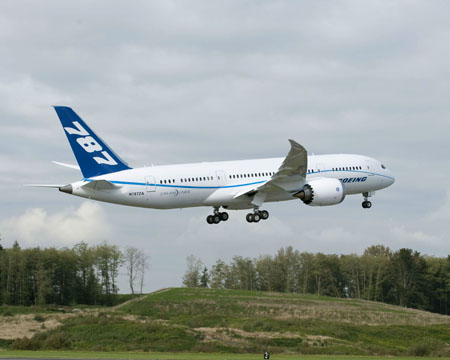
    Sixth Boeing 787 Makes First Flight, Testing Program Making Good Progress

    EVERETT, Wash., Oct. 4 — The final Boeing 787 Dreamliner to join the flight test fleet made its first flight today from Paine Field in Everett, Wash. The airplane, ZA006, is the second 787 equipped with General Electric GEnx engines to fly.

    Captains Christine Walsh and Bill Roberson were at the controls during the 1 hour and 4 minute flight. The airplane landed at Boeing Field at 12:45 p.m. (Pacific time).

    “It’s great to have our last flight test airplane join the fleet,” said Scott Fancher, vice president and general manager of the 787 program. “We have been focused on completing the testing required for certification of the 787 with Rolls-Royce engines, because that is the first model we deliver. A great deal of the testing that we’ve done also applies to the 787s with GE engines and won’t need to be repeated,” said Fancher.

    There is, however, a smaller portion of testing that is unique to the engine/airframe combination. In general, this portion includes noise testing, extreme weather operations, function and reliability, and extended operations. In addition, testing to verify the airplane handles the same regardless of engine type and that the systems work on both models is required.

    Some additional flight tests will be performed on one of the production airplanes, the ninth 787 to be built, but it is not considered a full-time member of the flight test fleet.
    787 Testing Progress Report

    In addition to achieving first flight of ZA006, the Boeing test team has completed a number of flight test milestones in recent weeks.

    Boeing wrapped up a series of natural and artificial icing tests, meeting all requirements with no changes required. Pilots reported that the airplane continues to handle well even in the presence of ice.
    Flight loads survey testing, which demonstrates the pressure distribution on the airplane structure throughout the phases of flight in a variety of configurations, also has been completed. The team conducted this testing on ZA004 primarily at the airport at Victorville, Calif. Analysis of this testing continues.

    A dramatic series of tests that stress the airplane’s brakes, called maximum brake energy testing, was completed in late September at Edwards Air Force Base, also in California. ZA001 conducted this testing as well as a series of extreme takeoff and landing conditions including minimum takeoff speed testing. Earlier in the month, ZA001 completed wet runway testing at Roswell, NM.
    ZA003 flew to Glasgow, Mont., to complete community noise testing. All results were within expectations.

    As a result of these tests and others, all takeoff performance and handling characteristics testing is complete for the initial version of the 787. Additional testing will be required for 787s equipped with GE engines.

    The 787 flight test program has logged more than 1,900 hours over 620 flights and completed more than 65 percent of the flight test conditions for 787s with Rolls-Royce engines.
    Equally important to the testing required in the air is the ground testing required to certify a new airplane. Boeing has completed well over 4,000 hours of ground testing on the same airplanes that are in the flight test program.

    In addition, fatigue testing has started at a test rig in Everett. Fifteen flights have been simulated. Federal regulations require Boeing to conduct twice as many flight cycles as any airplane in revenue service. Boeing plans to have completed 10,000 flight cycles prior to first delivery.
    “We continue to be extremely satisfied with the performance of the 787 in its testing operations,” said Fancher. “This airplane handles wonderfully and will be a valuable tool for our customers.”

    To include the featured image in your Twitter Card, please tap or click their icon a second time.