Carrier

  • | | | |

    Diligent Kudos to AeroMexico for Averting a Disaster

    What: Aeromexico Boeing 737-700 scheduled from Costa Rica to Mexico City
    Where: Costa Rica
    When: Mar 12, 2011
    Who: 2 (drunk) Mexican pilots, 101 passengers
    Why: Saturday on arrival at the airport in Costa Rica for their shift, these two AeroMexico pilots complained of nausea. They probably had big heads too, since they had attended some kind of drunken revelry 7 hours before in San Jose, which is not long enough for the alcohol to be metabolized out of their systems. They were apparently intending to fly their shifts, but some eagle-eyed AeroMexico personnel correctly evaluated their condition. One of them refused the alcohol test, but not the other. Neither was allowed to fly, and both were suspended. The flight was delayed until replacement pilots (sober ones) were found to take the cockpit. Passengers were compensated for the delay.

    In George’s Point of View

    Is March the month for drinking? A case was just brought to our attention yesterday, and though it is not aviation, it is frighteningly similar, though I could argue they were completely different. But then, I could argue anything even if I’m not a lawyer.

    The case I’m talking about is that of the BOLT Driver Arrested for DUI. Bolt is not an airline, but a bus division. So what is the similarity? There it was bussing (trucking) down the road when it was pulled over and the driver cited for tailgating, and driving in the wrong lane before he got his driving under the influence AND his license taken away. He was caught, sadly, not before his shift, and not by crew, but by passengers who clearly feared for their lives and called 911 from inside the bus, as the driver was either weaving, or napping or drinking, or all of the above. Someone had seen his pocket flask.

    Okay, the obvious similarities are drunks at the wheel of communal transit. Both were caught before serious damage occurred. The difference—and this is crucial—are that the BOLT bus driver was allowed to take his shift, regardless of his condition. He put everyone aboard that bus at serious risk.

    So kudos to AeroMexico. Even though all you’re going to hear about it is grousing from individuals complaining of the delay, your diligence probably saved the lives of 110 passengers.

  • | | |

    CRJ Makes Cautious Landing in Halifax With Unknown Haze

    What: Air Canada Jazz Canadair CRJ-200 en route from Halifax, NS to St. John’s
    Where: Halifax
    When: Mar 14th 2011
    Who: 42 passengers and 3 crew
    Why: After takeoff, the cabin was temporarily obscured by some kind of haze.

    The pilots returned to Halifax and made a safe landing. Passengers were booked on other flights. The plane was taken for maintenance to locate the source of the problem. Responding to haze is frequently termed “abundance of caution.”

    Haze can be an air conditioning problem, an electrical power source problem, but most frequently in icy weather, de-icing fluid can get into an air intake, causing a “vanishing” mist.

  • | | |

    Comair Flight Resurrects Spector of Tragedy


    Pictured: The team lost in the 1970 crash

    What: Comair flight en route from Atlanta to Charleston
    Where: Lexington Bluegrass Airport
    When: Mar 10, 2011
    Who: passengers include 9 Marshall assistant football coaches
    Why: After visiting Texas Christian University and Mississippi state, Marshall coaches reunited in Atlanta with the intent of returning to Atlanta on the same plane.

    Prior to takeoff, that plane developed unknown issues and the flight was delayed as a replacement plane had to be brought in.

    Then, while en route, the replacement plane developed a problem with the landing gear. The pilot diverted to Lexington Bluegrass Airport and made a safe landing.

    While they apparently endured the flight with aplomb and some extra prayers, there was no outward panic, but one can only guess how the coaches felt. With two problems on two separate planes, they were no doubt remembering the fatal 1970 plane crash that took Marshall’s football team. Is Marshall University cursed or what? If I went to Marshall, or especially played football for Marshall, I’dt be thinking about alternative transportation.

  • | | | |

    Display Failure Aboard Airbus: Now What?


    Click to view full size photo at Airliners.net
    Contact photographer Paul Carlotti

    What: Air Canada Airbus A319-100 en route from Toronto to Winnipeg
    Where: Sault Ste Marie
    When: Mar 8 2011
    Who: 125 aboard
    Why: While en route, the plane was over Canada when the displays quit. The loss of the displays is being attributed to an electronic power failure. (Wonder if there was a short or if it was something else?) The displays were only offline for less than a minute, and subsequently began flashing error messages. Pilots continued on to Winnipeg and managed to land safely. The plane was taken out of commission in order to have an Airbus inspection to determine what exactly was going on.

    Flying an Airbus without electronic displays is, I think, tantamount to suicide. I am surprised they didn’t divert somewhere and land immediately. Is it not somewhat risky to continue flying an airbus when the display connections are flakey? This same sort of thing happened on a BMI Airbus A321. Apparently catastrophic failure in rough conditions is not unheard of. In fact, rough conditions are not required to cause the need for a reboot. The term for “rebooting” an airbus that has lost its electronics is called “recycling,” a common enough thing that there is recognizable pilot humor regarding it.

  • | | |

    Sad Chopper Crash in Colombia.

    What: Bell UH-1H
    Where: Melgar, Tolima – Colombia
    When: March 07, 2011 5:40
    Who: 5 fatalities, 4 injuries
    Why: Six helicopters were engaged in a training mission when the rotors of two of the UH-1Hs collided. One of the helicopters fell, and caught on fire.

    Technician Felipe Pava Rodriguez, technician John Mario Diaz Llanos, Lt. Manuel Alberto Cuspoca, Mexican Lt. Dante Herrera Alarcon, and Capt. Juan Jose Orjuela were killed in the crash. Lt. Hugo Estrada Lopez is one of 4 survivors, all from the 2nd helicopter which managed to make a controlled, if hard, landing.

    The cause of the crash has tentatively been attributed to human error.

  • | | | | |

    Delta: Whacked Tail at JFK

    What: Delta Airlines Boeing 767-300 from New York JFK,NY to Sao Paulo
    Where: New York
    When: Mar 6th 2011
    Why: The Delta Boeing encountered heavy wind on takeoff and suffered a tail strike. The pilot returned to JFK and made a safe landing. According to Flight Aware, the duration of the flight was 49 minutes.

  • | | | | | | |

    Emergency Landing: Safety for Tripoli Evacuation


    Click to view full size photo at Airliners.net
    Contact photographer Vivek Manvi

    What: Air India Airbus A330-200 en route from Tripoli to Delhi
    Where: Malta
    When: Mar 6th 2011
    Why: After taking off from Tripoli, the landing gear failed to retract. The pilot diverted to Malta and made a safe landing.

    So far, of 18,000 Indians expats, 9,200 people had been evacuated from Tripoli. Egypt Air has also been making chartered flights to bring Indian citizens back home in “Operation Safe Homecoming.” As of Mar 2, Air India had retrieved 6 flights worth of passengers.

  • | | | |

    Smoke Causes Emergency Landing in Savoy

    What: American Eagle Embraer ERJ-145 en route from Chicago to Charlotte NC
    Where: Champaign
    When: March 4 2011, 9:36pm
    Who: 31 passengers
    Why: After takeoff, the pilot smelled smoke.
    The pilots diverted to Savoy and made a safe landing. Emergency responders (whom, it was noted, had 12 minutes to set up) included Tolono and Savoy firefighters, Pro Ambulance and University of Illinois police.

    There were no injuries reported. Passengers were ported to the terminal and the plane was sent for examination.

  • | | | | | |

    Dash 8 Has Gusty Landing Ending in Crunch


    Click to view full size photo at Airliners.net
    Contact photographer Stefan Sonnenberg

    What: Flugfelag Air Iceland de Havilland Dash 8-100 en route from Reykjavik Iceland to Nuuk Greenland
    Where: Nuuk
    When: Mar 4th 2011
    Who: 31 passengers and 3 crew
    Why: After weather conditions had already delayed the flight for more than a day, passengers were finally able to make the journey. However, on landing, the plane veered off the runway in gusty conditions. The de Havilland Dash received nose, propellers and engines damage, but no one aboard was injured.

    Perhaps they should have delayed the flight for another day.

  • | | |

    Sata Airbus Tire Punctured

    What: SATA International Airbus A320-200 en route from Lisbon to the Terceira Azores Islands
    Where: Lajes
    When: Mar 4th 2011
    Why: Landing in Portugal on a wet runway, the plane ran over a sandbag and cable, puncturing a tire. The runway was closed, as the situation was dealt with.

  • |

    DGAC Oversight Focuses on Ageing Aircraft

    After Aerosur and Lloyd Aereo Boliviano experienced serious events with old airplanes, the Bolivian aviation authority announced an edict that banned planes older than 25 years from flying in Bolivian airspace to begin in January of this year. However, instead of a ban being activated, craft over than 25 years will undergo additional maintenance inspections and be under additional environmental scrutiny.

    Aerosur will be affected by the special restrictions, but not Lloyd Aereo Boliviano, which is no more.

  • Delta Most Admired

    Delta Air Lines issued the following memo from CEO Richard Anderson to its more than 80,000 employees:

    FORTUNE magazine has ranked Delta the most admired airline worldwide in its 2011 World’s Most Admired Companies airline industry list, published today. This is a remarkable achievement and yet another testament to the hard work of Delta people. Congratulations!

    Delta has moved up in the airline rankings in the FORTUNE list from 10th in 2007, to sixth in 2008 and 2009, and third place in 2010. The airlines ranked second through 12th in the FORTUNE industry list, in order, are: Singapore Airlines, Southwest Airlines, Lufthansa Group, Air France-KLM Group, Cathay Pacific Airways, United Continental, Qantas Airways, British Airways, All Nippon Airways, US Airways Group and AMR.

    The annual FORTUNE World’s Most Admired Companies airlines list is based on results of a global survey of airline executives, directors and analysts who rate companies in their own industry on nine criteria: people management, quality of management, innovation, long-term investment, use of corporate assets, financial soundness, social responsibility, quality of product and services and global competitiveness. In addition to ranking top overall in the airline industry list, Delta ranked No. 1 among airlines in long-term investment, quality of management, global competitiveness and social responsibility.

    This award is proof of the great strides we have made in building a strong global business for our customers, employees, shareholders and the communities we serve. We’ve completed virtually all our merger integration, launched significant investments in our customer experience and the technology that supports the way we do business, strengthened our industry-leading joint venture and alliance relationships, and expanded our international reach. These are just a few of the things that have caused others to recognize what the more than 80,000 employees of Delta have achieved.

    The recognition is not only a testament to what we have accomplished, but also our path in getting to this point. Through all of this change, we’ve preserved a unique culture anchored in dignity and respect. Delta stayed true to its word, with no frontline involuntary furloughs as a result of the merger. We created new jobs in TechOps, Cargo, Airport Customer Service, Reservations, Flight Operations and In-flight Service to support our larger international network. In addition to frontline pay increases, Delta also has invested more than $2.5 billion in Delta people in the form of company equity, profit sharing, and operational performance bonuses over the last four years, all while maintaining low unit costs and reducing debt.

    Our progress and steadfast commitment to the Delta culture have been remarkable. Business leaders around the world have noticed all the hard work you have been doing. Your commitment to make Delta a better airline for our customers and investors, while building on our heritage as a great place to work is a point of pride for all of us.

    Thank you for all you do for Delta every day.

  • | |

    Goodrich Completes B787 Electric Braking Sys Certification

    First electrically actuated braking system on a commercial aircraft

    CHARLOTTE, N.C., March 3, 2011 — Goodrich Corporation’s electric brake system for the 787 Dreamliner has completed all required dedicated flight test conditions. The achievement follows a comprehensive development and qualification program involving multiple Goodrich business units and close collaboration with Boeing.

    The braking system incorporates the latest iteration of Goodrich’s proprietary DURACARB(R) carbon heat sink material which provides exceptional brake performance and up to 35% better brake life than competing carbon friction materials. Required test conditions included extensive on-aircraft testing of the wheels and electric brake hardware as well as validation of the proprietary software incorporated in the electric brake actuator controllers. Max brake energy testing was completed at Edwards Air Force Base.

    Brian Brandewie, president of Goodrich’s Aircraft Wheels and Brakes business said, “We anticipated demand for an alternative to traditional, hydraulically actuated braking, and began the pursuit of electrically actuated braking technology more than 15 years ago. The 787 system represents our sixth generation of electric brakes. Goodrich is again honored to be part of aviation history by being a supplier for the world’s first electric brake system on a commercial airplane. We look forward to working with Boeing and the launch customer airlines to ensure a successful entry into service.”

    The majority of announced 787 customers have selected the Goodrich electric brake system.

    All Nippon Airlines is the airplane’s launch customer.

  • |

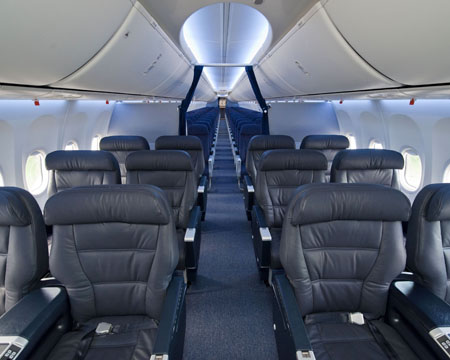
    Boeing Delivers Copa Air 1st 737 BoeingSky Interior

    Copa becomes first Latin America carrier to fly with the new cutting-edge interior

    SEATTLE, March 3, 2011 /PRNewswire/ — Boeing (NYSE: BA) today delivered a Next-Generation 737 with the new Boeing Sky Interior to Copa Airlines – the first Latin American carrier to take delivery of Boeing’s innovative interior.

    “We are proud to bring this state-of-the art technology and unmatched passenger experience to our valued customers,” said Pedro Heilbron, CEO of Copa Airlines. “This new interior represents yet another example of our progressive leadership in the Americas and will enhance the world-class service for which Copa Airlines has become known.”

    The Boeing Sky Interior introduces new cove lighting and curving architecture that create a distinctive entry way. Passengers will enjoy a more open cabin and a soft blue sky overhead simulated by light-emitting diode (LED) lighting. The new interior also brings new, modern, sculpted sidewalls and window reveals to draw passengers’ eyes to the view outside the window as well as larger stowage bins allowing passengers the ability to store their luggage closer to their seats.

    The 737 Boeing Sky Interior is the latest in a series of enhancements designed to improve the Next-Generation 737 for both airlines and passengers. The next to come will be a package of performance improvements that will reduce fuel consumption and carbon emissions by 2 percent – making the airplane a full 7 percent more efficient than the first Next-Generation 737s delivered. The performance improvements to the airframe and engine are in certification test, and will be phased into production between mid-2011 and early 2012.

  • | | | |

    Flybe Takes Off without Tire


    Click to view full size photo at Airliners.net
    Contact photographer Luc Verkuringen

    What: Flybe Bombardier Q 400 en route from Exeter Airport to Newcastle
    Where: Exeter International Airport
    When: March 4, 2010
    Who: 39 passengers
    Why: On takeoff, passengers witnessed one of the Flybe’s wheels shooting sparks and detaching.

    The pilot dumped fuel and circled for an hour and a half before returning to land safely at the airport. There were no injuries.

  • |

    Twitter News: Mesa Survives

    It’s being circulated on Twitter that Mesa Air is out of Chapter 11, and is now in a good position. Apparently they downsized, eliminated 200 inessential planes, and cut out unnecessary leases.

    This is what Mesa is now: 76 aircraft with approximately 450 daily system departures to 94 cities, 38 states, the District of Columbia, and Mexico; and still maintains contractual agreements with US Airways and United Airlines.

    Of course you can read about it on their website: http://www.mesa-air.com/

  • | | | | | |

    SAS Boeing Emergency Diversion-1 Engine Down


    Click to view full size photo at Airliners.net
    Contact photographer Joost de Wit

    What: SAS Scandinavian Airlines Boeing 737-700 en route from Bergen to Oslo (Norway)
    Where: Bergen
    When: Mar 2nd 2011
    Who: 89 passengers
    Why: After takeoff, the right engine started misbehaving, making rude noises and sparking. The pilots had to return to Bergen to get the engine’s attitude adjusted.

  • | | | |

    American Airlines Time to Bring out the Duct Tape


    Click to view full size photo at Airliners.net
    Contact photographer Joe M Hill

    What: Airlines Boeing 757-200 en route from San Juan Puerto Rico to Miami,FL
    Where: San Juan
    When: Mar 1st 2011
    Why: After takeoff, the side panels in the cabin began to quiver, and passenger windows were cracking. The crew returned to San Juan and the plane made a safe landing.

    You know, when I’m on plane with a twenty-one year old frame and the interior walls start moving, and the windows are cracking (separate issues, by the way), I can’t help but worry about things like frame fatigue. 21 years worth of stress is plenty of years for a plane. I’m glad the flight made it down safely. Maybe it is time for American to let this bird roost.

  • |

    American Airlines Employees Aid Veterans, US Troops

    FORT WORTH, Texas, March 2, 2011 — Thanks to the fuel conservation efforts of American Airlines employees, a total of $409,513 is being provided to Air Compassion for Veterans, a not-for-profit organization that helps active military, veterans and their families travel for medical, counseling and rehabilitation needs.

    Through its employee-driven fuel conservation program, called Fuel Smart, American granted a portion of the proceeds from the initiative to assist those who have served or currently serve in the U.S. military when they need access to medical and related resources.

    “American’s ability to make such a significant contribution to help service members and their families is a direct result of our employees’ participation in Fuel Smart,” said Matt Pfeifer, American’s Managing Director – Operations Strategic Planning. “When our troops and veterans return home, it is imperative that we all pull together to ensure that they receive access to the best possible care. This is made easier because of our employees’ tremendous fuel conservation efforts.”

    In 2010, nearly 1,000 flights were made possible on American and American Eagle aircraft as a result of direct contributions from American Airlines employees. In addition to medical-related travel, Air Compassion for Veterans provides transportation for family members to visit service men and women who are undergoing treatment away from home.

    “So many of our soldiers, sailors, airmen and Marines have been injured during their military service and face years of surgeries, therapy and rehabilitation,” said American Airlines First Officer Tom Marquardt, a Major in the Air Force Reserve who plays an instrumental role in American’s partnership with Air Compassion for Veterans. “The ability to go home, or to have your family visit while you’re undergoing rehab, is such an important part of the healing process. My fellow employees are helping make sure this is possible for these brave men and women.”

    Today, the final 2010 donation was made during a special ceremony at American’s Maintenance & Engineering facilities at Dallas/Fort Worth International Airport. A number of employee workgroups that helped make the contribution possible were honored for their efforts.

    “We are honored to partner with a company like American Airlines, which has made such a strong commitment to serving our military and veterans,” said Ed Boyer, President and CEO of Mercy Medical Airlift, the parent organization of Air Compassion for Veterans. “Without the hard work of American Airlines employees, many of the veterans and their family members simply would not be able to make important trips during rehab and recovery. On behalf of the men and women who wear the cloth of our great nation, we express our deepest thanks.”

    The success of this partnership depends on employee involvement in American’s Fuel Smart program, which aims to achieve fuel savings of 138 million gallons and reduce carbon emissions by 2.9 billion pounds in 2011.

    The employee-led program works across all departments to identify fuel savings opportunities and make them a part of daily routines. Several key programs drive donations and help improve fuel efficiency, including:

    Pilots reducing fuel burn by using a single engine to taxi in and out of gates when possible.
    Airport and flight crews working together to quickly connect ground power and pre-conditioned air hoses to planes and turning off the aircraft auxiliary power when they arrive at the terminal.

    Dispatchers and flight crews using all available planning tools, procedures and expertise to safely plan flight fuel loads without carrying excess fuel.

    American Airlines has a long history of supporting the nation’s armed forces and veterans, dating to World War II and C.R. Smith, the airline’s first president. Currently, more than 60 percent of American’s pilots and 10 percent of all American and American Eagle Airlines employees are active military/reservists or veterans. American supports members of the military, veterans and their families when they travel and in their communities, including special military airfares, waived baggage fees, support of non-profit organizations, and employee engagement in a wide variety of events and activities. To learn more about American’s Military/Veterans Initiatives, visit AA.com/JoinUs.

  • | |

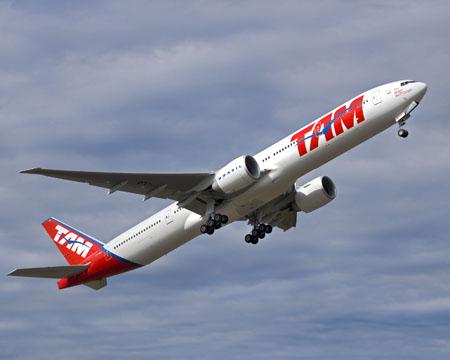
    Boeing, TAM Complete Contract for Two 777-300ERs

    TAM 777-300ER fleet will now consist of 12

    SEATTLE, Feb. 28, 2011 /PRNewswire/ — Boeing and TAM Linhas Aereas today announced the Brazilian carrier ordered two additional 777-300ERs (extended range) with two purchase rights. Today’s order, valued at approximately $568 million at current list prices, brings the total number of 777s TAM has on order to 12.

    “TAM continues to position itself as one of the world’s leading airlines,” said Marlin Dailey, vice president of Sales & Marketing for Boeing Commercial Airplanes. “We are pleased TAM continues to choose Boeing’s 777-300ER for its long-haul fleet needs and look forward to working together with TAM as they grow their international network.”

    The Boeing 777 is the market leader in the 300 to 400 seat market. It is the world’s most successful twin-engine, long-haul airplane.

    “These additional airplanes will help us expand our long-haul service capability to meet the growing market demand in Brazil and beyond,” said Marco Antonio Bologna, chief executive officer, TAM Holdings.

    The 777 delivers exceptional value to the airlines that fly it and is consistently ranked at the top of operator and investor polls.

    “The Brazilian aviation market continues to grow at a rapid pace. The 777-300ER provides us the performance and versatility we need to develop our network competitively and capitalize on robust international traffic growth,” added Libano Barroso, chief executive officer, TAM Airlines.

    The Boeing 777-300ER is 19 percent lighter than its closest competitor. It produces 22 percent less carbon dioxide per seat and costs 20 percent less to operate per seat. The airplane can seat up to 365 passengers in a three-class configuration and has a maximum range of 7,930 nautical miles (14,685 km).

  • |

    Hercules Lands at Kelowna

    What: Canadian Department of Defense C130 Hercules
    Where: Kelowna International Airport
    When: Feb 01, 2011
    Who: crew
    Why: The Hercules cargo plane was en route and lost the use of an engine. The pilot put the plane down at Kelowna International Airport, with no reported injuries. The flight may or may not have been carrying volatile chemicals.

    The incident is undergoing investigation and the plane is undergoing maintenance.

  • | | |

    New Boeing 737-800 Needs Electrical Work


    Pictured: Air Austral F-ONGA. F-ONGB is the plane that had the electrical problem.
    Click to view full size photo at Airliners.net
    Contact photographer Mickael Payet

    What: Air Austral Boeing 737-800 from Saint Denis to Johannesburg
    Where: Saint Denis
    When: Feb 27th 2011
    Why: After take-off from Saint Denis, the plane developed an electrical problem and had to return to the airport. An alternative plane was flown in to make the replacement flight.

    Air Austral Boeing was delivered in December 2010.

  • | | |

    Smokey Delta Flight Overnights in Omaha

    What: Delta en route from New York City to Phoenix
    Where: Eppley Airfield
    When: Feb 28, 2011
    Why: While en route, the plane developed smoke in the cockpit.

    The flight diverted to Omaha and made a safe landing with rescue crews standing by.

    Passengers disembarked and were booked on an 8:15 am Omaha to Phoenix flight.

  • | | | |

    Continental Bird Strike


    Click to view full size photo at Airliners.net
    Contact photographer Juan Carlos Guerra – FlyAPM

    What: Continental Airlines Boeing 737-800 en route from Washington DC to Houston
    Where: Washington’s International Airport
    When: Feb 28th 2011, 7:45 a.m
    Who: 44 passengers
    Why: On takeoff, the plane’s engines digested birds. Following the bird strike, the plane diverted to Washington’s International Airport and made a safe landing. Passengers were booked on alternative flights.

  • | | | | |

    British Airways Diverts to Tamanrasset


    Click to view full size photo at Airliners.net
    Contact photographer Mark Kwiatkowski

    What: British Airways Boeing 747-40 en route from Lagos Nigeria to London
    Where: Tamanrasset Algeria
    When: Feb 27th 2011
    Who: 301 passengers, 16 crewmembers
    Why: While en route, the plane developed engine trouble with an air bleed valve.

    The crew shut down an engine and diverted to Tamanrasset Algeria where they made a safe landing.

    A maintenance crew was dispatched to Tamanrasset. The replacement jet and the repaired plane were both in London less than 24 hours later.