| |

United and Continental Offer Rebooking Options to Customers Affected by Weather Forecast for Texas

Similar Posts

  • |

    Boeing Achieves Power On for New 747-8 Intercontinental

    EVERETT, Wash., Nov. 5, 2010 /PRNewswire/ — Boeing (NYSE: BA) has completed the power on sequence for the new 747-8 Intercontinental. This milestone enables the program to begin functional tests on the airplane.

    “This is a critical step in the assembly process for the new 747-8 Intercontinental,” said Elizabeth Lund, 747 deputy program manager, Boeing Commercial Airplanes. “The airplane’s systems are now live. This milestone is a reflection of the focus and hard work of our engineers, mechanics and suppliers.”

    Power on is a complex series of tasks that methodically energize and activate the airplane’s systems. In this critical stage of the assembly process, the electrical, hydraulic and pneumatic systems are brought on line.

    Mechanics connected the 747-8 to an external power cart to energize the flight-deck display and maintenance systems. The electricity coursing through the airplane’s 133 miles (214 km) of wire will be as high as 105 kilovoltampere (kVa).

    The program also activated the airplane’s hydraulic and pneumatic systems. Pressurized to 3,000 pounds per square inch (psi), the hydraulics power the flight control surfaces, landing gear, brakes and steering systems. The 160 psi applied to the pneumatic system enables the airplane to operate the environmental control systems and the leading-edge flaps.

    “We are very methodical in ensuring the integrity of the airplane’s systems,” said Todd Zarfos, vice president of 747 engineering, Boeing Commercial Airplanes. “This accomplishment is a key milestone in validating the design, installation and functionality of the electrical, hydraulic and pneumatic systems.”

    A video that gives you an inside look at the power on sequence is available at http://bit.ly/dlXgym.

    The program is expected to complete assembly of the 747-8 Intercontinental in the first quarter of 2011. The airplane is scheduled to enter service in late 2011 following the flight test program.

    The 747-8, which includes the 747-8 Intercontinental and the 747-8 Freighter, was launched in November 2005. Boeing has 109 orders for the 747-8 — 33 for the 747-8 Intercontinental and 76 for the 747-8 Freighter. The first 747-8 Intercontinental is scheduled to deliver in late 2011.

    The new 747-8 Intercontinental offers the lowest operating costs and best economics of any large passenger airplane, while providing enhanced environmental performance. The 747-8 provides new revenue opportunities that allow airlines to maximize profits. Eighteen feet longer than the 747-400, the 747-8 has 51 additional seats to accommodate 467 passengers in a typical three-class configuration, and it also offers 26 percent more cargo volume.

    To include the featured image in your Twitter Card, please tap or click their icon a second time.
  • |

    Boeing Projects Steady Growth for Commercial Airplanes Market in Africa

    More than 700 airplanes, worth $80 billion, needed in region over 20 years

    CAPE TOWN, South Africa, Sept. 21 — Boeing forecasts that air carriers in Africa will experience steady growth over the next 20 years as air travel in Africa continues to grow with the economy.

    The African economy is projected to grow 4.8 percent in 2010 following 2.9 percent growth in 2009. This strong growth results from worldwide recovery stimulating demand for African exports as well as imports into the continent. West Africa shows the strongest growth with foreign interest in petroleum development.

    “As the demand for African commodities grows and foreign development and tourism increase, African carriers will require a modernized fleet in order to compete on routes historically dominated by foreign carriers,” said Mike Warner, senior market analyst for Boeing Commercial Airplanes, today at a media briefing in Cape Town.

    “Africa’s current fleet is nearly 20 years old on average in a market that demands newer, more fuel-efficient airplanes to help offset the rising cost of fuel.”

    Boeing’s forecast calls for the delivery of more than 700 airplanes with a value of approximately $80 billion for the African airplane market over the next 20 years.

    Growth in the airline market, along with the demand to replace older, less fuel-efficient single-aisle airplanes and regional jets with new-generation, more fuel-efficient models, will drive new airplane deliveries.

    Strong demand exists to support increased non-stop routes between Africa and Europe, the United States, the Middle East, India, and China. Twin-aisle fleets will evolve in the region as airlines continue to expand international services. Boeing forecasts that twin-aisle airplanes will account for 32 percent of new airplanes delivered to African carriers over the next 20 years compared to 23 percent worldwide. Single-aisle airplanes will represent 60 percent of the African new-airplane market, compared to 69 percent worldwide.

    Newer airplane types such as the Next-Generation 737 and 787 Dreamliner offer significant advantages in environmental performance as well as improved capabilities, fuel efficiency and maintenance costs.
    Today’s market update was part of a series of briefings that highlight Boeing’s airplane capabilities and advantages as well as discuss the African aviation market for the next 20 years. Boeing kicked off the effort at last month’s Aviation & Allied Business Leaders conference in Gaborone, Botswana. Later this year, Boeing will participate in the Airlines Association of South Africa Annual General Meeting in Manzini, Swaziland, in October and the African Airlines Association General Assembly and conference in Addis Ababa, Ethiopia, in November.

    To include the featured image in your Twitter Card, please tap or click their icon a second time.
  • | | |

    DETERIORATED PARTS ALLOWED FLUTTER WHICH LED TO FATAL CRASH AT 2011 RENO AIR RACES


    August 27, 2012
    WASHINGTON – The National Transportation Safety Board determined today that deteriorated locknut inserts found in the highly modified North American P-51D airplane that crashed during the 2011 National Championship Air Races in Reno, Nevada, allowed the trim tab attachment screws to become loose, and even initiated fatigue cracking in one screw. This condition, which resulted in reduced stiffness in the elevator trim system, ultimately led to aerodynamic flutter at racing speed that broke the trim tab linkages, resulting in a loss of controllability and the eventual crash.

    On September 16, 2011, as the experimental single-seat P-51D airplane “The Galloping Ghost,” traveling about 445 knots, or 512 mph, in the third lap of the six-lap race, passed pylon 8, it experienced a left-roll upset and high-G pitch up. During the upset sequence, the airplane’s vertical acceleration peaked at 17.3 G, causing incapacitation of the pilot. Seconds later, a section of the left elevator trim tab separated in flight. The airplane descended and impacted the ramp in the spectator box seating area, killing the pilot and 10 spectators and injuring more than 60 others.

    “In Reno, the fine line between observing risk and being impacted by the consequences when something goes wrong was crossed,” said NTSB Chairman Deborah A. P. Hersman. “The pilots understood the risks they assumed; the spectators assumed their safety had been assessed and addressed.”

    Contributing to the accident were the undocumented and untested major modifications made to the airplane, as well as the pilot’s operation of the airplane in the unique air racing environment without adequate flight testing.

    The nearly 70-year-old airplane had undergone numerous undocumented modifications. The modifications, designed to increase speed, included shortening of the wings, installation of a boil-off cooling system for the engine, increasing the elevator counterweights, modification of the pitch trim system, and changing the incidence of the horizontal and vertical stabilizers.

    Although the Federal Aviation Administration required that a flight standards district office be notified in writing of any major changes made to The Galloping Ghost before it could be flown, investigators could find no records that such notifications were made except for the installation of the boil-off cooling system. The undocumented major modifications were identified through wreckage examinations, photographic evidence, and interviews with ground crewmembers.

    In April, while the investigation was ongoing and after the NTSB’s investigative hearing in January on air race and air show safety, the NTSB issued 10 safety recommendations to the Reno Air Racing Association, the National Air racing Group Unlimited Division, and the FAA. These recommendations addressed:

    • requiring engineering evaluations for aircraft with major modifications;
    • raising the level of safety for spectators and personnel near the race course;
    • improving FAA guidance for air race and course design;
    • providing race pilots with high-G training and evaluating the feasibility of G-suit requirements for race pilots; and
    • tracking the resolution of race aircraft discrepancies identified during prerace technical inspections.

    Although no additional safety recommendations were issued today, the Board reclassified nine existing recommendations as described below:

    • Eligibility Requirements for Aircraft with Major Modifications – recommendations A 12 9 and A-12-13 classified “Open—Acceptable Response”
    • Prerace Technical Inspection Discrepancy Tracking – recommendation A 12 10, classified “Closed—Acceptable Action”
    • Spectator Safety – recommendations A 12 14 and 15, classified “Closed—Acceptable Action”
    • High G Training, G-Suit Feasibility for Pilots – recommendations A 12 11, -12, -16, and -17, classified “Closed—Acceptable Action”

    A tenth safety recommendation, issued to the FAA, which addressed air race and course design guidance was reclassified as “Open—Acceptable Response” on July 25, 2012.

    “It’s good news for the air races that so many of our recommendations have been addressed,” said Chairman Hersman. “We will continue to push for the full implementation of all of our safety recommendations.”

    To include the featured image in your Twitter Card, please tap or click their icon a second time.
  • |

    Boeing and Ethiopian Airlines Partner With Non-Profits to Deliver Needed Medical Supplies


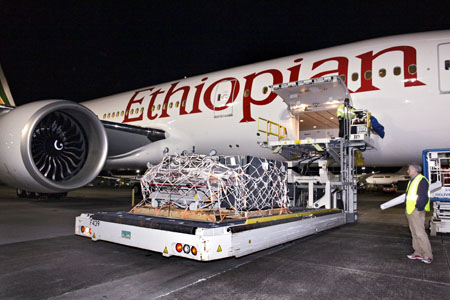
    Ethiopian Airlines’ 777-200LR carries more than $500K worth of anesthesia equipment to Ethiopia’s largest hospital

    EVERETT, Wash., Dec. 17, 2010 — Boeing partnered with Ethiopian Airlines and Seattle Anesthesia Outreach (SAO) for this week’s 777-200LR (longer range) delivery to Ethiopian Airlines to transport much needed anesthesia equipment to Black Lion Hospital – Ethiopia’s largest hospital.

    “Boeing and its airline partners have been working together to fill what is sometimes empty cargo space to help bring relief to people around the globe,” said Liz Warman, director of Boeing Global Corporate Citizenship for the Northwest region. “Our company has a history in humanitarian efforts. Our Humanitarian Delivery Flights program is another way we can continue leveraging our resources to help those in need.”

    “Since its inception, Ethiopian Airlines has been engaged in various corporate social responsibility activities, which support community initiatives and development efforts,” said Ato Girma Wake, CEO of Ethiopian Airlines. “We see our airplanes as not only a resource for our airline, but also a source of vital service for the people of Ethiopia and when we can use that resource in a manner such as this; it truly reaffirms our commitment to undertake social responsibilities whenever and wherever we can.”

    Ethiopian Airlines’ new 777-200LR (its second of five 777-200LRs on order) will deliver approximately 12,000 pounds (5,443 kg) of medical supplies, mainly anesthesia machines, monitors and books, from Seattle Anesthesia Outreach to Black Lion Hospital in Addis Ababa, Ethiopia. Black Lion Hospital is the largest hospital in Ethiopia as well as the largest teaching hospital for the University of Addis Medical School.

    “We’re thrilled at the opportunity to work with Boeing and Ethiopian Airlines to use this flight to support our efforts in Ethiopia,” said Dr. Mark Cullen, vice president and co-founder of SAO. “These supplies will prove critical when a group of 20 doctors travel to Ethiopia in February as part of our ongoing humanitarian trips to the region.”

    A majority of the medical supplies being shipped to Ethiopia were donated by Swedish Medical Center, which is the largest and most comprehensive non-profit health provider in the greater Seattle area. In addition to the donation of medical supplies, 12 affiliated physicians and clinical staff from Swedish have donated vacation time to volunteer as part of SAO’s humanitarian trips to Ethiopia.

    The Boeing Humanitarian Delivery Flights (HDF) program is a collaboration effort between Boeing, airline customers and non-profit organizations to deliver humanitarian aid throughout the world to communities in need or crisis. The humanitarian items are loaded into the empty cargo space of new airplanes being delivered and transported to the customer’s home destination.
    Ethiopian Airlines as a responsible corporate firm is committed to support worthy social activities, which are designed to help build sustainable livelihoods for individuals, the community and the society in general. In doing so, it has left its mark on major social initiatives.

    To include the featured image in your Twitter Card, please tap or click their icon a second time.
  • |

    New Software Tool to Optimize Available Airport Pavement Information

    The Federal Aviation Administration’s (FAA) Airport Technology Research and Development Team, based at the William J. Hughes Technical Center, has released its newest software program, FAA PAVEAIR.

    Airport managers, engineers, consultants and technicians can use FAA PAVEAIR to assess the condition of airport pavements, and make informed decisions to best allocate funds for pavement repair and maintenance. Use of this software is not required to obtain Airport Improvement Project funding assistance.

    FAA PAVEAIR is a web-based airport pavement management system that provides users with historic current information about airport pavement construction, maintenance and management. The program offers users a planning tool capable of modeling airport pavement surface degradation due to external effects such as traffic and the environment. The program can be used with other FAA pavement applications, such as BAKFAA and COMFAA, to give users input to determine repair scheduling and strategies. It has been developed for installation and use on a stand-alone personal computer, a private network, an intranet and the internet. An implementation of the internet version of FAA PAVEAIR will be hosted and supported on a server at the William J. Hughes Technical Center, near Atlantic City, N.J., and will be accessible from the FAA PAVEAIR website.

    FAA PAVEAIR will be posted for download as a beta version for about one year in the initial release. Airport technology research and development specialists will hold workshops and user group meetings to assess the software utility, during this time.

    To include the featured image in your Twitter Card, please tap or click their icon a second time.
  • |

    NASA Flies Large Unmanned Aircraft in Public Airspace Without Chase Plane

    Credits: NASA Photo / Carla Thomas
    NASA’s remotely-piloted Ikhana aircraft, based at the agency’s Armstrong Flight Research Center in Edwards, California, successfully flew its first mission in the National Airspace System without a safety chase aircraft on Tuesday. This historic flight moves the United States one step closer to normalizing unmanned aircraft operations in the airspace used by commercial and private pilots.

    Flying these large remotely-piloted aircraft over the United States opens the doors to all types of services, from monitoring and fighting forest fires, to providing new emergency search and rescue operations. The technology in this aircraft could, at some point, be scaled down for use in other general aviation aircraft.

    “This is a huge milestone for our Unmanned Aircraft Systems Integration in the National Airspace System project team,” said Ed Waggoner, NASA’s Integrated Aviation Systems Program director. “We worked closely with our Federal Aviation Administration colleagues for several months to ensure we met all their requirements to make this initial flight happen.”

    Flights of large craft like Ikhana, have traditionally required a safety chase aircraft to follow the unmanned aircraft as it travels through the same airspace used by commercial aircraft. The Ikhana flew in accordance with the Federal Aviation Administration’s (FAA) Technical Standard Order 211 — Detect and Avoid Systems — and Technical Standard Order 212 — Air-to-Air Radar for Traffic Surveillance.

    The FAA granted NASA special permission to conduct this flight under the authority of a Certificate of Waiver or Authorization on March 30. The certificate permitted Ikhana’s pilot to rely on the latest Detect and Avoid technology, enabling the remote pilot on the ground to see and avoid other aircraft during the flight.

    NASA successfully worked with its industry partners to develop a standard for Detect and Avoid technologies, complied with the requirements of the FAA Technical Standard Orders, and garnered flight approval from the FAA.

    The Ikhana aircraft was equipped with detect and avoid technologies, including an airborne radar developed by General Atomics Aeronautical Systems, Inc., a Honeywell Traffic Alert and Collision Avoidance System, a Detect and Avoid Fusion Tracker, and an Automatic Dependent Surveillance-Broadcast capability – a surveillance technology where the aircraft determines its position via satellite navigation and periodically broadcasts this information so other aircraft can track it.

    The flight took off from Edwards Air Force Base in California and entered controlled air space almost immediately. Ikhana flew into the Class-A airspace, where commercial airliners fly, just west of Edwards at an altitude of about 20,000 feet. The aircraft then turned north toward Fresno, requiring air traffic control to be transferred from the Los Angeles Air Route Traffic Control Center to the Oakland Air Route Traffic Control Center. On the return trip, the pilot headed south toward Victorville, California, requiring communication control to be transferred back to Los Angeles.

    During the return flight, the pilot began a gentle decent over the city of Tehachapi, California, into Class E airspace — about 10,000 feet — where general aviation pilots fly. The pilot initiated an approach into Victorville airport at 6,000 feet, coordinating in real time with air traffic controllers at the airport. After successfully executing all of these milestones, the aircraft exited the public airspace and returned to its base at Armstrong.

    “We are flying with a suite of sophisticated technology that greatly enhances the safety capabilities of pilots flying large unmanned aircraft in the National Airspace System,” said Scott Howe, Armstrong test pilot. “We took the time to mitigate the risks and to ensure that we, as a program, were prepared for this flight.”

    Tuesday’s flight was the first remotely-piloted aircraft to use airborne detect and avoid technology to meet the intent of the FAA’s “see and avoid” rules, with all test objectives successfully accomplished.

    To include the featured image in your Twitter Card, please tap or click their icon a second time.