| |

Symposium Announced: Airline Code-Sharing Arrangements and Their Role in Aviation Safety

Similar Posts

  • |

    Press Release: Boeing Delivers 11th 737-800 Airplane to Air Algerie


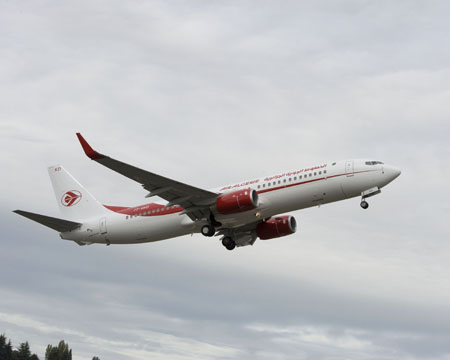
    SEATTLE, Sept. 29 — Boeing today delivered to Air Algerie its 11th 737-800.

    Air Algerie, the state-owned flag carrier of Algeria, operates a fleet composed primarily of Boeing 737s and some 767s. Boeing is scheduled to deliver two additional 737-800s in 2010 as well as four more in 2011. Air Algerie will be operating 17 737-800s in 2011 for a total of 22 Next-Generation 737 airplanes to complement its fleet.

    “The Boeing 737-800 has played an instrumental part in contributing to the success of Air Algerie’s growth in the region,” said Abdelwahid Bouabdallah, director general of Air Algerie.

    More than 120 customers around the world have ordered more than 5,000 Next-Generation 737s.

    To include the featured image in your Twitter Card, please tap or click their icon a second time.
  • Press Release: Premier Turbines Named Designated Repair Center in Americas for M601 and H80 Engines

    December 8, 2009 — RENO, NEVADA — GE Aviation has selected Premier Turbines as its Designated Repair Center in North and South Americas for M601 and H80 turboprop engines.

    As part of this exclusive agreement, Premier Turbines will offer heavy repair services, exchange engines and rentals, line replacement unit rotable pools and field service support to all existing and future M601 and H80 engines in the Americas region. GE Aviation will provide the necessary OEM parts to meet Premier Turbines’ needs. Premier Turbines will be ready to accept M601 engines for repair in the first quarter of 2010.

    “GE chose Premier Turbines based on its strong commitment to customer support and quality as well as its extensive experience providing repair services for turbine engines,” said Brad Mottier, vice president and general manager of Business & General Aviation at GE Aviation. “This designation will further expand GE’s service and support offerings for M601 operators and future H80 engine operators.”

    Located in Neosho, Missouri, Premier Turbines is a leading provider of repair and overhaul services for commercial, government and military turbine engines, components and accessories with more than 40 years experience. Premier Turbines is dedicated to providing precision service, on-time performance and the expertise that comes from decades of experience on thousands of turbine engines. The company was acquired by BBA Aviation in 2003.

    Last year, GE Aviation began offering M601 operators around-the-clock customer support through its Business Jet Operations Center. The Business Jet Operations Center is staffed with customer product technicians who can provide a rapid response to needs, such as parts availability, trouble-shooting and field issues. M601 engines are overhauled at GE Aviation Czech’s facility in Prague.

    GE Aviation, an operating unit of General Electric Company (NYSE: GE), is a world-leading provider of commercial and military jet engines and components as well as avionics, electric power, and mechanical systems for aircraft. GE Aviation also has a global service network to support these offerings. For more information, visit us at www.ge.com/aviation.

    GE AVIATION EXPANDING OPERATIONS IN BATESVILLE

    Governor Haley Barbour announced today that GE Aviation is expanding its operation in Batesville. The company’s Batesville plant produces composite components for the GEnx jet engine, which will power Boeing’s new 787 and 747-8 aircraft. The GEnx engine is the world’s only jet engine with composite fan blades, composite fan platforms and a composite fan case.

    With the expansion, GE Aviation will add an additional 350 jobs over the next few years. The facility currently employs more than 100 employees.

    “I am delighted that GE Aviation is expanding its operations in Mississippi and is adding 350 jobs at its Batesville facility,” Governor Barbour said. “This premier aviation company has become a valued corporate citizen in Mississippi, and I commend it for its continued commitment to the state and for creating additional high-wage, high-skill jobs for Mississippians.”

    The opportunity to expand these operations stems from the growth of advanced composites in jet engines, which can provide greater durability and weight savings over more traditional metal materials. GE Aviation is pursuing advanced technologies, materials and processes that will result in more efficient jet engines.

    “Our Batesville operation is involved in some of the most advanced manufacturing processes in the aviation industry,” said Jeanne Edwards, GE’s plant leader in Batesville. “Also, GE is very fortunate to have a strong order book for its new GEnx engine. Many of the technology advantages inherent in the GEnx engine are linked directly to the components produced in Batesville.”

    The expansion will represent a company investment of approximately $85 million. The Mississippi Development Authority provided $8.6 million in Momentum Mississippi incentives to assist with this project. In addition, Panola County provided $4 million to assist with the expansion.

    GE Aviation partnered with Mississippi State University’s Raspet Flight Research Laboratory to demonstrate the capabilities necessary for producing composite fan platforms in 2006. In 2007, the company announced it would locate a new manufacturing facility in the state. After its Batesville facility was completed in 2008, the company began production of these components there.

    In June of this year, GE Aviation announced a new research partnership with the University of Southern Mississippi in which researchers from both the company and the university are working together on technologies related to composite panels, which will also be produced in Batesville.

    “Mississippi is rapidly becoming known as a center for composite materials and technologies,” said Gray Swoope, executive director of the Mississippi Development Authority. “I am proud that GE Aviation is utilizing our available resources and developing these materials and processes here in Mississippi, and I am pleased the company is working with Mississippi universities to further refine these technologies. GE Aviation’s decision to further invest in its Mississippi operations demonstrates its continued confidence in the state and in our workforce.”

    To include the featured image in your Twitter Card, please tap or click their icon a second time.
  • |

    Boeing Press Release:Training Class

    Boeing Completes First 787 Dreamliner Maintenance Training Class

    EVERETT, Wash., April 6 — Boeing (NYSE: BA) today announced that it has completed the first maintenance training class for the 787 Dreamliner. The class consisted of 10 mechanics from 787 launch customer ANA (All Nippon Airways) and two regulators from the Japan Civil Aviation Bureau (JCAB).

    The mechanics, who completed the training last week, are the first of 150 ANA mechanics to be trained by Boeing over the next seven months. They spent more than 30 days learning how to maintain the world’s most advanced commercial jetliner, including 20 days of theoretical training, two days of engine runs and taxi testing, five days of practical training and five days of troubleshooting exercises. To conclude the training, students conducted component identification exams on production airplanes, as well as troubleshooting exams in the full flight simulator.

    To support the all-new 787, Boeing Training & Flight Services, a division of Commercial Aviation Services, Boeing Commercial Airplanes, has developed an all-digital, Internet-based teaching system for maintenance training, along with training tools that connect real-time to a virtual airplane and airplane systems.

    “Getting our mechanics trained and prepared is essential to being ready to take delivery of the airplane later this year,” said Michihide Kono, vice president of Engineering and Maintenance for ANA. “This is an important milestone for our ANA team and we are delighted to see the continued progress on the program.”

    The curriculum is designed to focus on performance-based training that incorporates real-world simulated maintenance scenarios for a more immersive training experience.

    “The use of personal tablet computers, interactive computer-based training, three-dimensional images and desktop simulation makes it possible to deliver training more efficiently,” said Sherry Carbary, vice president of Boeing Training & Flight Services, Commercial Aviation Services, Boeing Commercial Airplanes. “Our team is committed to providing our customers with the resources and tools they need to be successful.”

    The 787 comes with digital tools and databases that replace volumes of printed materials. The graphic and textual database has point-and-click features for more details, allowing mechanics to navigate through documents quickly to get the information they need to do their jobs.

    “This milestone is another important step along the way to being service-ready,” said Mike Fleming, director of 787 Services and Support, Boeing Commercial Airplanes. “Our goal is to make entry into service a seamless experience for our customers.”

    Fifty-seven customers around the world have ordered 866 787s since the program was launched in April 2004, making the Dreamliner the fastest-selling new commercial jetliner in history. Delivery of the first 787 is planned for the fourth quarter of 2010.

    To include the featured image in your Twitter Card, please tap or click their icon a second time.
  • |

    Aeromar and Continental Airlines to Start Codeshare Flights

    CHICAGO and MEXICO CITY, Jan. 25, 2011
    Aeromar and Continental Airlines, a wholly-owned subsidiary of United Continental Holdings, Inc. (NYSE: UAL) and a Star Alliance member, today announced that they will begin codeshare cooperation on routes within Mexico.

    Effective Feb. 1, 2011 Continental will initially place its code on Aeromar-operated flights between Mexico City and 13 destinations in Mexico. The codeshare builds on frequent-flyer cooperation launched in August 2010 that permits Continental OnePass members to accrue and redeem miles on all Aeromar-operated flights. In addition, Continental international first- and business-class passengers, Presidents Club members and Star Alliance Gold customers may access Aeromar’s Salon Diamante lounge in Mexico City.

    “The expansion of our partnership with Continental Airlines via codesharing will continue to broaden our leading joint market presence to better serve our customers, especially at a time when Aeromar is phasing in its first regional jets and further developing its route network within Mexico,” said Ami Lindenberg, Aeromar president.

    “We are pleased to expand our cooperation with Aeromar, which complements our extensive service to Mexico and offers new options to our customers,” said Jim Compton, executive VP and chief revenue officer of United Continental Holdings, Inc.

    About Aeromar

    Founded in 1987, Aeromar is Mexico’s most experienced airline. From its main operations base at Mexico City’s International Airport Terminal 2, Aeromar currently covers a network of 21 destinations in Mexico, as well as San Antonio, Texas, in the U.S.A. It performs over 100 average daily flights with a fleet of ATR-42 turboprop and CRJ-200 jet complying with the IOSA certification for the airline industry’s highest operational and safety audited standards established by IATA.

    Aeromar is a highly customer-focused airline, featuring the most convenient schedules and amenities for the business and leisure traveler, such as the “Salon Diamante” executive lounges, which are available at the Aguascalientes, Colima, Jalapa, Mexico City and Tepic airports. All-inclusive vacation packages, VIP charter flights and “FastPaq” courier and freight are among some of Aeromar’s additional products and services. For further information please visit us on the web at www.aeromar.us.

    To include the featured image in your Twitter Card, please tap or click their icon a second time.
  • |

    Lufthansa and UFO union agree pay settlement for around 16,000 flight attendants

    Successful arbitration under Heide Simonis / Agreement on 22-month pay freeze and significant improvements in working conditions

    Deutsche Lufthansa AG and the independent UFO flight attendants’ trade union have reached agreement at their protracted pay talks. Both sides today accepted a mediated settlement put forward by former Schleswig-Holstein Premier Heide Simonis, ending months of negotiations stretching back to March 2010. Under the terms of the arbitration settlement, the pay accord for some 16,000 Lufthansa flight attendants is to be extended and the collective wage agreement re-defined.

    At the talks on remuneration, the two sides agreed on a pay freeze. The existing pay settlement is to be re-concluded unchanged for a period of 22-months, lasting up to 31 December 2011. The new collective bargaining agreement is to last up to 28 February 2014. It envisages further improvements in working conditions: Among others, it reduces changes to duty rosters, giving cabin crews greater planning security, as well as defining and extending rest and break periods. Furthermore, in compensation for the staggered implementation of improved working conditions, cabin crews are to receive a structural, compensatory payment amounting to 1,000 euros in March.

    On conclusion of the pay accord, Member of the Lufthansa German Airlines Board Finance & Human Resources, Dr. Roland Busch, said a fair compromise has been reached after long and difficult negotiations. It takes account of the need of flight attendants for planning stability and the special pressures they encounter in air traffic as well as the Company’s need for flexible and cost-efficient operations. “With this pay settlement, we are investing in significantly better working conditions for cabin crews. That was highly important to our staff, which is why we have made material concessions where their need for change was greatest. Now is the time to look ahead and face the challenges from competition in the industry together,“ Dr. Busch emphasised

    To include the featured image in your Twitter Card, please tap or click their icon a second time.
  • Press Release: NTSB issues update on its investigation of Flight 188 that overflew intended Minneapolis Airport

    In its continuing investigation of an Airbus A320 that overflew the Minneapolis-St Paul International/Wold-Chamberlain Airport (MSP), the National Transportation Safety Board has developed the following factual information: On Wednesday, October 21, 2009, at 5:56 pm mountain daylight time, an Airbus A320, operating as Northwest Airlines (NWA) flight 188, became a NORDO (no radio communications) flight at 37,000 feet. The flight was operating as a Part 121 flight from San Diego International Airport, San Diego, California (SAN) to MSP with 144 passengers, 2 pilots and 3 flight attendants.

    Both pilots were interviewed separately by NTSB investigators yesterday in Minnesota. The following is an overview of the interviews:

    The first officer and the captain were interviewed for over 5 hours combined.
    The Captain, 53 years old, was hired in 1985. His total flight time is about 20,000 hours, about 10,000 hours of A-320 time of which about 7,000 was as pilot in command.
    The First Officer, 54 years old, was hired in 1997. His total flight time is about 11,000 hours, and has about 5,000 hours on the A-320.
    Both pilots said they had never had an accident, incident or violation.
    Neither pilot reported any ongoing medical conditions.
    Both pilots stated that they were not fatigued. They were both commuters, but they had a 19-hour layover in San Diego just prior to the incident flight. Both said they did not fall asleep or doze during the flight.
    Both said there was no heated argument.
    Both stated there was a distraction in the cockpit. The pilots said there was a concentrated period of discussion where they did not monitor the airplane or calls from ATC even though both stated they heard conversation on the radio. Also, neither pilot noticed messages that were sent by company dispatchers. They were discussing the new monthly crew flight scheduling system that was now in place as a result of the merger. The discussion began at cruise altitude.
    Both said they lost track of time.
    Each pilot accessed and used his personal laptop computer while they discussed the airline crew flight scheduling procedure. The first officer, who was more familiar with the procedure was providing instruction to the captain. The use of personal computers on the flight deck is prohibited by company policy.
    Neither pilot was aware of the airplane’s position until a flight attendant called about 5 minutes before they were scheduled to land and asked what was their estimated time of arrival (ETA). The captain said, at that point, he looked at his primary flight display for an ETA and realized that they had passed MSP. They made contact with ATC and were given vectors back to MSP.
    At cruise altitude – the pilots stated they were using cockpit speakers to listen to radio communications, not their headsets.
    When asked by ATC what the problem was, they replied “just cockpit distraction” and “dealing with company issues”.
    Both pilots said there are no procedures for the flight attendants to check on the pilots during flight.
    The Safety Board is interviewing the flight attendants and other company personnel today. Air traffic control communications have been obtained and are being analyzed. Preliminary data from the cockpit voice recorder (CVR) revealed the following:

    The CVR recording was 1/2 hour in length.
    The cockpit area microphone channel was not working during this recording. However, the crew’s headset microphones recorded their conversations.
    The CVR recording began during final approach, and continued while the aircraft was at the gate.
    During the hours immediately following the incident flight, routine aircraft maintenance provided power to the CVR for a few minutes on several occasions, likely recording over several minutes of the flight.
    The FDR captured the entire flight which contained several hundred aircraft parameters including the portion of flight where there was no radio communication from the flight crew. Investigators are examining the recorded parameters to see if any information regarding crew activity during the portion of flight where radio contact was lost can be obtained.

    The Safety Board’s investigation continues.

    -30-

    NTSB Media Contact: Keith Holloway
    hollowk@ntsb.gov
    (202) 314-6100

    To include the featured image in your Twitter Card, please tap or click their icon a second time.