PR: FAA Taps ITT Corp. and GE’s Naverus to Develop NextGen
WASHINGTON – The Federal Aviation Administration (FAA) is awarding a contract to ITT Exelis and GE’s Naverus to help accelerate the development of satellite-based procedures that will allow aircraft to fly more directly to their destinations.
“NextGen will help deliver an environmentally friendly, more efficient traveling experience for the flying public,” said U.S. Transportation Secretary Ray LaHood.
Under the $2.77 million contract, ITT Exelis, the prime contractor, and GE’s Naverus, the sub-contractor, will develop Required Navigation Performance (RNP) approach procedures into five airports: Ted Stevens Anchorage International, James M. Cox Dayton International, Charles B. Wheeler Downtown Airport (Kansas City), General Mitchell International (Milwaukee) and Syracuse Hancock International. ITT Exelis and GE’s Naverus will be responsible for designing, implementing and maintaining a total of 10 procedures – two for each airport. The FAA will closely monitor the work to make sure all safety and environmental steps are conducted properly. This effort will supplement the FAA’s work to develop RNP procedures for airports across the country. The FAA has developed 305 RNP procedures.
“If you imagine highways in the sky, then these are high-speed off ramps,” said Acting FAA Administrator Michael Huerta. “Aircraft using RNP approaches make a more direct and efficient approach into the airport, also decreasing fuel burn.”
The FAA awarded the contract to ITT Exelis and GE’s Naverus through a competitive process under the System Engineering 2020 contract, a portfolio of work designed to help the agency roll out NextGen. Fiscal year 2012 appropriations included funding for a contractor to develop and deliver NextGen procedures, and the FAA reauthorization bill called for the agency to demonstrate the ability of a contractor to design, implement and maintain these procedures.
To include the featured image in your Twitter Card, please tap or click their icon a second time.
Elements of this image are furnished by NASA
Egyptair Flight MS804 (AKA EgyptAir Flight 804) was a Paris to Cairo flight that ended in the Mediterranean on May 19, 2016. Sixty-six people lost their lives: three security crew, fifty-six passengers, seven crew.
Egyptian authorities published a progress report on 28/06/16 that the BEA repaired the recorders. On 17/06 that the Technical Investigation Committee of the A320 accident studied FDR data as well as performing time correlation between FDR and CVR data and cockpit voice recordings before the occurrence of the accident where the existence of a “fire” was mentioned. That report did not determine the reason or location where that fire occurred. Smoke was reported during the flight in the bathroom and the avionics bay.
The investigation has been fraught with controversy. On 22 May, 2016, M6 (French TV) reported that a pilot told Cairo air traffic control about smoke in the cabin, and the pilot consequently made an emergency descent.
On May 20th 2016 The Aviation Herald received information from three independent channels, that ACARS (Aircraft Communications Addressing and Reporting System) messages with following content were received from the aircraft:
00:26Z 3044 ANTI ICE R WINDOW
00:26Z 561200 R SLIDING WINDOW SENSOR
00:26Z 2600 SMOKE LAVATORY SMOKE
00:27Z 2600 AVIONICS SMOKE
00:28Z 561100 R FIXED WINDOW SENSOR
00:29Z 2200 AUTO FLT FCU 2 FAULT
00:29Z 2700 F/CTL SEC 3 FAULT
no further ACARS messages were received.
No sooner did the report come out that the Egyptian Civil Aviation Ministry dismissed it as false.
One truism I have found in accident investigation is that it takes time to find the truth. Another is that facts can be misleading. Reportage from official sources moves slowly; reportage from commercial, so-called “news,” or social sources is frequently speculative, unsourced, or purely imaginary. Sometimes it is actually correct. It is difficult to tell the difference. Contradictions are a frequent finding, such as this:
Le Figaro reported that no explosives were found on Egyptair flight MS804 French victims’ bodies. The flight crashed in the Mediterranean in 2016.
On Dec 15th 2016 Egypt’s Civil Aviation Authority announced that forensic examination on behalf of the Accident Investigation Commission found traces of explosives with some of the human remains recovered. In accordance with Egypt law, the states prosecutor was informed, and a technical commission formed by the prosecution office opened their investigation into the crime.
How does a close reader respond to a statement that “traces of explosives were found WITH human remains?” A close reader finds more questions. With the remains is not ON the remains. But it could be either way since we are dealing with languages. In English, WITH the remains could mean a bomb was floating in the water near the bodies, or ashes, or gasoline or TNT residue. And what constitutes near? Inches? Miles? It all is relative. Or if the original report is loosely translated, did the original document use a preposition such as ON the remains? And then, there are the forensic questions. Were explosive remains washed off of bodies that were submerged in the ocean?
If the case goes to court, the court will want to know if something failed on the plane, and if so, what it was. Manufacturers of failed components are considered responsible parties. No matter what the cause, international treaty determines carrier responsibility to the victims of the crash.
The determination of failed components provides additional responsible parties. The discovery of a bomb would make airport security one of the potential responsible parties. In addition, international treaty provides guidelines for what carriers owe to the families. (Which treaty is involved depends on which treaty/treaties the involved country/countries are signatory to. If it sounds like it can get complicated, you are correct.)
It has been nearly a year since the accident, and though some things may be believed in the court of public opinion to be one way or another, questions remain unanswered. How grievous and how difficult for the families that must wait so long to find out what brought about this tragedy that took their loved ones.
To include the featured image in your Twitter Card, please tap or click their icon a second time.
A Cairns-based aviation maintenance and repair organisation has become the first in Australia to be granted an approval under new air safety regulations.
These regulations cover the maintenance of regular public transport aircraft and aeronautical products.
CASA’s Director of Aviation Safety, John McCormick, has presented Hawker Pacific Airline Support Services with their new Civil Aviation Safety Regulations Part 145 approval certificate.
The presentation was made in Cairns on Wednesday 24 August 2011.
“The finalisation of the first approval under the new maintenance regulations is a major milestone for Australian aviation,” Mr McCormick said.
“Between now and June 2013 a total of 250 maintenance organisations will move across to operate under the new Part 145 regulations.
“They will all benefit from operating within a regulatory framework that enhances safety, offers increased flexibility and aligns with international practices.
“The regulations enhance safety because they introduce requirements for safety management systems and human factors training into the maintenance sector for the first time. The new rules are also clearer, which will improve compliance with safety standards.
“Hawker Pacific Airline Support Services has undertaken a lot of work to win this approval and CASA carefully reviewed their documentation and carried out on site inspections.
“I congratulate Hawker Pacific Airline Support Services for being the first to be granted an approval under Part 145 of the maintenance regulations and look forward to the smooth transition of all the other relevant maintenance organisations by the middle of 2013.”
Hawker Pacific Airline Support Services carries out maintenance of Bombardier DHC-8 and Embraer 120 aircraft in Cairns.
The new maintenance regulations introduced under Part 145 only cover the maintenance of regular public transport aircraft and aeronautical products fitted to those aircraft. CASA will develop new maintenance regulations for other sectors of aviation after further consultation with the industry.
New regulations covering Licensed Aircraft Maintenance Engineers and maintenance training organisations were also introduced in June 2011.
To include the featured image in your Twitter Card, please tap or click their icon a second time.
National Transportation Safety Board
Washington, DC 20594
FOR IMMEDIATE RELEASE: March 23, 2010
SB-10-09
NTSB CHAIRMAN HIGHLIGHTS RUNWAY SAFETY AND HUMAN FATIGUE IN
ADDRESS TO AIR TRAFFIC CONTROLLERS
Washington, DC – In an address to the National Air Traffic
Controllers Association (NATCA) in Orlando today, NTSB
Chairman Deborah A.P. Hersman lauded controllers for their
role in keeping the number of runway incursions low while
challenging the Federal Aviation Administration to hasten
the pace of its efforts to improve runway safety.
Attributing the decline in runway related incidents and
accidents in part to “robust procedures, safe designs, and
well-trained and alert controllers and pilots,” Hersman said
that “we still have a lot of work to do,” and that the FAA
needs to move more aggressively to lower the risk of runway
accidents.
Hersman chaired the NTSB’s February meeting in which runway
safety was again voted onto its Most Wanted List of Safety
Improvements where it has been since its inception in 1990.
The Safety Board’s recommendations to the FAA includes
providing immediate warnings of probable collisions and
incursions directly to flight crews in the cockpit;
requiring specific ATC clearance for each runway crossing;
requiring operators to install cockpit moving map displays
or an automatic system that alerts pilots when a takeoff is
attempted on a taxiway or a runway other than the one
intended; and requiring a landing distance assessment with
an adequate safety margin for every landing.
Citing an ongoing investigation of an incident in which a
767 landed on a taxiway in Atlanta in October, Hersman said
that the NTSB took a strong interest in the event “because
we want to know what led a professional flight crew to
mistake a taxiway for a runway, whether the controllers
could have detected the misaligned final approach to landing
and intervened, and whether there are technological tools
that can be used to prevent such incidents from ever
occurring in the first place.” Although no one was injured
in the incident, Hersman said that “if this event had
resulted in a fatal collision, there would be – far and wide
– immediate and understandable calls for changes.”
Hersman also cited human fatigue as an area that the Safety
Board has become particularly focused on, saying that “We
are seeing fatigue as a causal or contributing factor in
numerous accidents across all transportation modes.” The
NTSB has made recommendations to the FAA to set working hour
limits for flight crews, aviation mechanics, and air traffic
controllers, and has asked the FAA develop a fatigue
awareness and countermeasures training program for
controllers and those who schedule them for duty.
Recently, NATCA and the FAA established a working group to
collaboratively address the human fatigue issues that the
NTSB has identified. Hersman noted the significance of this
positive step by the leadership of both organizations and
called it a very encouraging development.
Concluding with an invitation for air traffic controllers to
participate in a three-day forum on pilot and controller
excellence that the NTSB will be holding in Washington in
May, Hersman emphasized the value of learning from the
numerous examples of superior job performance by
controllers. “Through our work we are very good at finding
out what went wrong, but frankly, it is just as important to
know what is going right, because we want to replicate that
throughout the entire national airspace system,” she said.
The complete text of Chairman Hersman’s speech may be
obtained on the Board’s website at
http://www.ntsb.gov/Speeches/hersman/daph100323.html
###
To include the featured image in your Twitter Card, please tap or click their icon a second time.
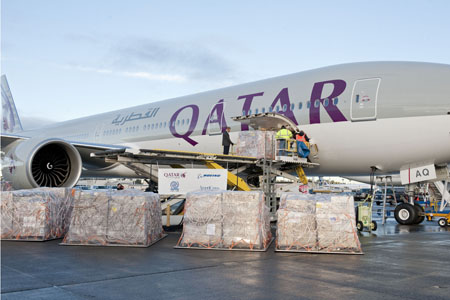
New Qatar Airways 777-300ER carries medical supplies to Pakistan
EVERETT, Wash., Jan. 4, 2011 /PRNewswire/ — Boeing (NYSE: BA) again has partnered with Qatar Airways and the non-profit global health and disaster relief organization AmeriCares to deliver a second consignment of relief supplies to areas in Pakistan that are still recovering from the massive floods that ravaged the country in August. The first shipment was delivered in September 2010.
A consignment of about 35,000 pounds (15.8 metric tones) of medical supplies was loaded into the cargo hold of the new Boeing 777-300ER (extended range) delivered to Qatar Airways. The airline subsequently will ship the relief goods from Doha, Qatar to Pakistan.
“This is the second time in four months that Boeing has partnered with Qatar Airways and AmeriCares to help the people in Pakistan where the need is still great,” said Liz Warman, director of Global Corporate Citizenship Northwest Region, Boeing. “Providing timely medical care is critical; though the floods have receded, the aftereffects such as sickness and disease continue to affect the people in these disaster zones.”
Over the years, Boeing and airline partners as well as non-profit partners in the Humanitarian Delivery Flights (HDF) program have collaborated on many humanitarian missions and the Boeing 777-300ER was used on a number of those missions.
To include the featured image in your Twitter Card, please tap or click their icon a second time.
SAINT-CLOUD, France, January 26, 2011 /PRNewswire/ — Dassault Aviation recently performed a successful flight test to evaluate potential applications of a laminar wing for large business jets. The flight was performed with a Falcon 7X at Dassault’s Flight Test Center in Istres, France. The tests are part of the “Smart Fixed Wing Aircraft”, one of the Integrated Technology Demonstrators of the European Clean Sky initiative. Clean Sky, one of Europe’s largest research initiatives ever, aims to develop technologies for cleaner and quieter next-generation aircraft which will enter service beyond 2020.
The flight evaluated a new infrared (IR) camera technology, developed by FLIR, which is capable of measuring temperature gradients in high altitude/low temperature and pressure environment. The camera measured differences in surface temperatures between laminar and turbulent areas of the horizontal tail plane on the Falcon 7X. While the Falcon 7X is not based on a laminar design, at high altitudes a laminarity of up to 40% was predicted on the upper surface of the horizontal tail. Measurements from the IR camera placed at the top of the vertical tail were performed to provide experimental validation.
“The results, which are still under analysis by Dassault Aviation and ONERA, (the French national aerospace research center) do show laminar extensions as expected,” said Philippe Rostand, Future Falcon Programs Project Manager. “The tests also permitted us to qualify new measurements techniques and equipment that will be used in future test flights to be flown by Dassault, Airbus and the other European partners on an even larger scale, such as the ‘smart laminar wing’ that will be flight tested in 2014 on a modified Airbus A340-300 test aircraft.”
Among other aerodynamic innovations, a laminar wing offers the largest potential for a dramatic decrease in drag. Laminar wings are currently only used on sail planes and small business jets. Initial studies indicate a potential 5-10% drag decrease and corresponding reduction in fuel burn and CO2 emissions with a laminar wing design on a large aircraft. Demonstrations and analysis on a larger scale have yet to be performed to confirm possible efficient and safe application on larger aircraft.
Dassault Aviation previously performed a series of successful test flights with an experimental laminar airfoil from 1986-1989 on a modified Falcon 50. “Today, better measurement tools and production methods are in place to implement what we’ve learned so that we can someday bring these exciting findings into reality,” said Rostand.
To include the featured image in your Twitter Card, please tap or click their icon a second time.
WASHINGTON, Feb. 11, 2011 — The Air Transport Association of America (ATA), the industry trade organization for the leading U.S. airlines, issued a statement commending the strong leadership of Chairman John Mica and the House Committee on Transportation and Infrastructure (T&I) for releasing a Federal Aviation Administration (FAA) reauthorization bill (H.R. 658) that recognizes the airlines’ critical role in the economy and takes measures to enhance the global competitiveness of U.S. airlines.
“ATA applauds Chairman Mica and the House T&I Committee for crafting a bill that recognizes the critically important role that airlines play in driving the economy and job growth and takes measures to promote global competitiveness of the U.S. airlines while not further harming an industry and its customers already overburdened with taxes,” said ATA President and CEO Nicholas E. Calio. “We urge Congress to pass this bill and to invest in a NextGen air traffic management system that will improve the industry’s safety and efficiency, grow jobs and enable U.S. airlines to keep pace with global competitors.”
To include the featured image in your Twitter Card, please tap or click their icon a second time.

 WASHINGTON – The Federal Aviation Administration (FAA) is awarding a contract to ITT Exelis and GE’s Naverus to help accelerate the development of satellite-based procedures that will allow aircraft to fly more directly to their destinations.


 New Qatar Airways 777-300ER carries medical supplies to Pakistan