|

NTSB Holding Family Assistance Symposium

Similar Posts

  • |

    Press Release – FAA Proposes $585,725 Civil Penalty Against Corporate Air

    For Immediate Release
    SEATTLE – The Federal Aviation Administration (FAA) is proposing a $585,725 civil penalty against Corporate Air of Billings, Mont., for allegedly operating a Shorts SD-3-30 twin-turboprop cargo aircraft when it was not in compliance with Federal Aviation Regulations.

    The FAA alleges Corporate Air failed to maintain the aircraft under the company’s general maintenance manual, which requires daily post-flight inspections that include examining the exterior skin for corrosion. In addition, the maintenance manual requires structural inspections on the basis of flight hours or flights.
    The FAA alleges that Corporate Air operated the aircraft in violation of regulations on at least 81 revenue flights between Dec. 21, 2009 and Feb. 4, 2010 with corrosion that had not been detected during the post-flight inspections. The FAA also alleges that structural inspections were not conducted at the required intervals, between Mar. 16, 2006 and Feb. 3, 2010, in violation of federal regulations.

    Corporate Air operates charter and air taxi service under Part 135 of the Federal Aviation Regulations and makes daily feeder cargo flights under contract to a major next-day air package airline.

    “Keeping aircraft well-maintained and in good condition must be a top priority for any operator,” said FAA Administrator Randy Babbitt. “All operators must comply with maintenance requirements.”

    Corporate Air has 30 days from the receipt of the FAA’s enforcement letter to respond to the agency.
    ###

    To include the featured image in your Twitter Card, please tap or click their icon a second time.
  • | |

    NTSB BRIEFING TODAY AT 4:00 PM (ADT) ON AIRCRAFT ACCIDENT IN ALASKA

    The National Transportation Safety Board will hold a press
    briefing on its investigation into last night’s airplane
    crash near Dillingham, Alaska.

    The briefing will take place today at 4:00 p.m. Alaska
    Daylight Time (ADT) at the Signature Flight Support
    Building, 2nd floor conference room, 6231 South Airpark
    Place, Anchorage, Alaska.

    NTSB Chairman Deborah A.P. Hersman will conduct the
    briefing.

    To include the featured image in your Twitter Card, please tap or click their icon a second time.
  • | |

    FAA Announces the Republic of the Philippines’ Aviation Safety Rating

    The U.S. Department of Transportation’s Federal Aviation Administration (FAA) today announced that the Republic of the Philippines complies with international safety standards set by the International Civil Aviation Organization (ICAO) and has been granted a Category 1 rating.

    The country previously held a Category 1 rating until January 2008, when it was downgraded to a Category 2. A Category 2 rating means a country either lacks laws or regulations necessary to oversee air carriers in accordance with minimum international standards, or that its civil aviation authority – equivalent to the FAA for aviation safety matters – is deficient in one or more areas, such as technical expertise, trained personnel, record keeping or inspection procedures.

    The return to Category 1 status is based on a March 2014 FAA review of the Civil Aviation Authority of the Philippines. A Category 1 rating means the country’s civil aviation authority complies with ICAO standards. With the International Aviation Safety Assessment (IASA) Category 1 rating, the Republic of the Philippines’ air carriers can add flights and service to the United States and carry the code of U.S. carriers.

    As part of the FAA’s IASA program, the agency assesses the civil aviation authorities of all countries with air carriers that have applied to fly to the United States, currently conduct operations to the United States or participate in code sharing arrangements with U.S. partner airlines and makes that information available to the public. The assessments determine whether or not foreign civil aviation authorities are meeting ICAO safety standards, not FAA regulations.

    In order to maintain a Category 1 rating, a country must adhere to the safety standards of ICAO, the United Nations’ technical agency for aviation that establishes international standards and recommended practices for aircraft operations and maintenance.

    To include the featured image in your Twitter Card, please tap or click their icon a second time.
  • |

    LUNAR AND PLANETARY CONFERENCE HIGHLIGHTS SOLAR SYSTEM EVOLUTION

    HOUSTON — NASA researchers and other scientists will present findings that provide new insights into the evolution of the solar system during the 42nd annual Lunar and Planetary Science Conference.

    The conference will run March 7-11 at the Woodlands Waterway Marriott Hotel and Convention Center, 1601 Lake Robbins Drive, The Woodlands, Texas.

    Key events include the unveiling of future planetary science strategy; early science results from a Japan Aerospace Exploration Agency mission, called Hayabusa, that returned the first particle samples from an asteroid; presentations about the recent comet Hartley 2 flyby; and the upcoming MESSENGER mission, the first spacecraft to orbit Mercury.

    The conference also will include a briefing about the Planetary Decadal Survey at 5:30 p.m. CST on March 7. The survey is a strategy released by the National Research Council in Washington to prioritize missions, research areas and observations ten or more years into the future. The briefing’s featured speaker will be Steve Squyres of Cornell University. He is the survey’s chair and principal investigator for NASA’s Mars Exploration Rovers.

    News media representatives interested in registering or obtaining more information should visit:

    http://www.lpi.usra.edu/meetings/lpsc2011/

    The conference is hosted by the Lunar and Planetary Institute in . The institute is managed by the Universities Space Research Association, a national, nonprofit consortium of universities chartered in 1969 by the National Academy of Sciences at NASA’s request.

    To include the featured image in your Twitter Card, please tap or click their icon a second time.
  • |

    Press Release – FAA Proposes Sweeping New Rule to Fight Pilot Fatigue

    For Immediate Release
    September 10, 2010
    Contact: Alison Duquette
    Phone: (202) 267-3883

    WASHINGTON — U.S. Transportation Secretary Ray LaHood and Federal Aviation Administration (FAA) Administrator Randy Babbitt today announced a landmark proposal to fight fatigue among commercial pilots by setting new flight time, duty and rest requirements based on fatigue science.

    “This proposal is a significant enhancement for aviation safety,” said Secretary LaHood. “Both pilots and passengers will benefit from these proposed rules that will continue to ensure the safety of our nation’s air transportation system.”

    Last year, Secretary LaHood and Administrator Babbitt identified the issue of pilot fatigue as a top priority during the Airline Safety Call to Action following the crash of Colgan Air 3407 in February 2009. Administrator Babbitt launched an aggressive effort to take advantage of the latest research on fatigue to create a new pilot flight, duty and rest proposal.

    Today’s proposal is compatible with provisions in the Airline Safety and Federal Aviation Administration Extension Act of 2010, which directs the FAA to issue a regulation no later than August 1, 2011, to specify limitations on the hours of pilot flight and duty time to address problems relating to pilot fatigue.

    “I know firsthand that fighting fatigue is a serious issue, and it is the joint responsibility of both the airline and the pilot,” said Administrator Babbitt. “After years of debate, the aviation community is moving forward to give pilots the tools they need to manage fatigue and fly safely.”

    Currently, there are different rest requirements for domestic, international and unscheduled flights. The proposed rule would eliminate these distinctions. The proposal also sets different requirements for pilots based on the time of day and number of scheduled segments, as well as time zones, type of flights, and likelihood that a pilot is able to sleep under different circumstances.
    The proposal defines “flight duty” as the period of time when a pilot reports for duty with the intention of flying an aircraft, operating a simulator or operating a flight training device. A pilot’s entire duty period can include both “flight duty” and other tasks that do not involve flight time, such as record keeping and ground training.
    The FAA proposes to set a nine-hour minimum opportunity for rest prior to the duty period, a one-hour increase over the current rules. The proposed rule would establish a new method for measuring a pilot’s rest period, so that the pilot can have the chance to receive at least eight hours of sleep during that rest period. Cumulative fatigue would be addressed by placing weekly and 28-day limits on the amount of time a pilot may be assigned any type of duty.

    Additionally, 28-day and annual limits would be placed on flight time. Pilots would have to be given at least 30 consecutive hours free from duty on a weekly basis, a 25 percent increase over the current rules.

    Congress recently mandated that all air carriers have a Fatigue Risk Management Plan (FRMP). Each carrier will be able to develop its own set of policies and procedures to reduce the risks of pilot fatigue and improve alertness. The FAA has prepared guidance material to help the airlines develop their FRMP.

    The proposed rule incorporates the work of an Aviation Rulemaking Committee (ARC) comprised of labor, industry, and FAA experts that delivered its recommendations to Administrator Babbitt on September 9, 2009.

    The Notice of Proposed Rulemaking is on display today at the Federal Registerat http://www.archives.gov/federal-register/public-inspection/. It is also available at http://www.faa.gov/regulations_policies/rulemaking/recently_published/.

    The 60-day public comment period closes on Nov. 13, 2010.

    To include the featured image in your Twitter Card, please tap or click their icon a second time.
  • |

    Boeing News Across the board

    • CEO Jim McNerney said that the 5-foot rip in the roof of a Boeing 737 was due to a “workmanship issue” in a single plane. “The initial data that I think we’re all seeing is suggesting a possible workmanship issue on an airplane rather than a design issue across a fleet of airplanes.” It appears that the holes drilled in the plane’s skin were too big for the rivets and were not properly lined up. Other experts do not agree, and believe the problem is unlikely to be a single plane, and more likely to be more widespread.
    • Boeing reports that its Vigilare network centric command and control system has passed its last formal operational test. Testing of the system took place at Royal Australian Air Force Base Williamtown’s Eastern Regional Operations Centre from March 28 to April 8.
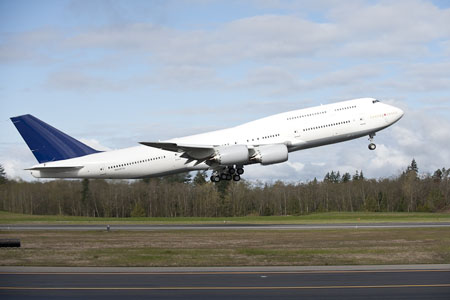
    • In other Boeing news, Piloted by Captains Keith Otsuka and Ron Johnston, with Ralph Chaffin serving as system operator and Greg Lichneckert as flight analyst, the second Boeing 747-8 Intercontinental RC021made a three-hour, twenty-minute flight. This was its first flight, the beginning of 600 hours of flight testing.
    • In response to today’s ruling by Federal District Court in the Central District of California, overturning California Senate Bill 990, a state law governing the cleanup of Santa Susana Field Laboratory, a former federal government rocket engine and energy testing facility in southern California:

      “We are pleased that Federal District Court agreed that the cleanup of Santa Susana should not be treated differently from the cleanup of other sites in California. “We look forward to continuing our ongoing work with the state to clean up the site under the comprehensive Consent Order issued in 2007. We will apply the same standards to Santa Susana that are applied to cleanup sites throughout the state in a manner that also ensures protection of the invaluable natural and cultural resources for future generations. Boeing intends to continue to clean up the site to a suburban residential standard, more stringent than would be required for its future use as open space.”Boeing has met every obligation of our 2007 cleanup agreement with the state, and we will continue our discussions with the state Department of Toxic Substances Control so that we can move toward the goal of cleaning up Santa Susana in the most expeditious manner, which is in the best interest of the public and the state of California.”

    To include the featured image in your Twitter Card, please tap or click their icon a second time.