|

Press Release – FAA Proposes Sweeping New Rule to Fight Pilot Fatigue

Similar Posts

  • | |

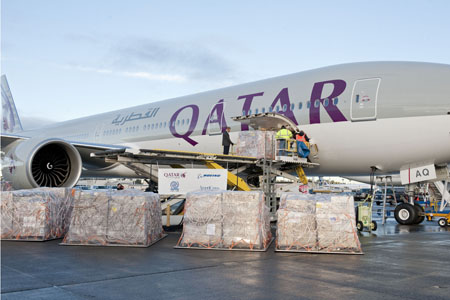
    Boeing, Qatar Airways, AmeriCares Partner for Relief Flight

    New Qatar Airways 777-300ER carries medical supplies to Pakistan
    EVERETT, Wash., Jan. 4, 2011 /PRNewswire/ — Boeing (NYSE: BA) again has partnered with Qatar Airways and the non-profit global health and disaster relief organization AmeriCares to deliver a second consignment of relief supplies to areas in Pakistan that are still recovering from the massive floods that ravaged the country in August. The first shipment was delivered in September 2010.

    A consignment of about 35,000 pounds (15.8 metric tones) of medical supplies was loaded into the cargo hold of the new Boeing 777-300ER (extended range) delivered to Qatar Airways. The airline subsequently will ship the relief goods from Doha, Qatar to Pakistan.

    “This is the second time in four months that Boeing has partnered with Qatar Airways and AmeriCares to help the people in Pakistan where the need is still great,” said Liz Warman, director of Global Corporate Citizenship Northwest Region, Boeing. “Providing timely medical care is critical; though the floods have receded, the aftereffects such as sickness and disease continue to affect the people in these disaster zones.”

    Over the years, Boeing and airline partners as well as non-profit partners in the Humanitarian Delivery Flights (HDF) program have collaborated on many humanitarian missions and the Boeing 777-300ER was used on a number of those missions.

    To include the featured image in your Twitter Card, please tap or click their icon a second time.
  • |

    FAA Proposes Hazmat Civil Penalties Against 11 Companies

    WASHINGTON – The Federal Aviation Administration (FAA) is proposing civil penalties ranging from $54,000 to $91,000 against 11 companies for alleged violations of Department of Transportation Hazardous Materials Regulations.

    For further information on the following cases, please contact Arlene Salac or Jim Peters at 718-553-3015.

    • $91,000 against Boston Scientific Corporation of Natick, Mass, for allegedly offering a fiberboard box containing medical-grade silicone fluid, a flammable liquid, to DHL for transportation by air from Alajuela, Costa Rica, to Boston Scientific headquarters, Oct. 23, 2009. The shipment was undeclared. DHL employees at its Cincinnati sorting hub discovered the leaking package.
    • $78,000 against Westfield Coatings Corp., of Westfield, Mass., for allegedly offering a fiberboard box containing paint, a flammable liquid, for transportation by air from Westfield to Hudson, N.C., August 11, 2009. The shipment was undeclared. UPS workers at the Louisville sorting hub discovered the non-hazardous material leaking from the package.
    • $54,000 against Fragrance Resources, Inc., of Clifton, N.J., for allegedly offering a fiberboard box containing a flammable liquid for transportation by air from Clifton to Ft Lauderdale, Fla., Dec. 23, 2009. The shipment was undeclared. UPS workers at the Louisville sorting hub discovered the package.

    For further information on the following cases, please contact Elizabeth Cory at 847-294-7849/-7427.

    • $65,000 against Flight Options, LLC of Cleveland, for allegedly offering a fiberboard box containing isopropyl alcohol, a flammable liquid, to UPS for transportation by air from Cleveland to Las Vegas, Sept. 9, 2009. The shipment was undeclared. UPS workers at the Louisville sorting hub discovered the leaking package.
    • $54,000 against the Hammelman Corporation, Dayton, Ohio, for allegedly offering a fiberboard box containing methanol, a flammable liquid, for transportation by air from Pompano Beach, Fla., to Dayton, March 23, 2010. The shipment was undeclared. UPS workers at the Louisville sorting hub discovered the leaking package.

    For further information on the following cases, please contact Kathleen Bergen at 404-305-5100.

    • $58,000 against Kemet Electronics Corporation of Simpsonville, S.C. for allegedly offering a fiberboard box containing silver paint, a flammable liquid, to UPS for transportation by air from Brownsville, Texas to Simpsonville, Aug. 20, 2009. The shipment was undeclared. UPS workers at the Louisville sorting hub discovered the leaking package.
    • $56,000 against MSI Aircraft MTC SVS International, GMBH of Ruesselsheim, Germany, for allegedly offering a fiberboard box containing a fuel control unit, to FedEx for transportation by air from Ruesselsheim to Miami, May 22, 2009. The shipment was undeclared. A fuel control unit containing jet fuel is considered a hazardous material. FedEx employees at Fort Lauderdale discovered the shipment was leaking.
    • $65,000 against Federal Express of Memphis, Tenn., for allegedly accepting a fiberboard box containing an unspecified toxic, corrosive liquid classified as a poison, for transportation by air from Oxford, Ala., to Chino Calif., April 1, 2010. An FAA hazardous materials special agent identified the mislabeled shipment before it could be loaded on an aircraft.
    • $54,000 against Vitacost.com of Lexington, N.C., for allegedly offering a fiberboard box containing a flammable liquid and non-hazardous material for transportation by air from Lexington to Boca Raton, Fla., Jan. 29, 2010. The shipment was undeclared. UPS workers at the Louisville sorting hub discovered the leaking package.
    • $91,000 against Cardinal Health of Madison, Miss., for allegedly offering a fiberboard box containing skin care products containing alcohol, a flammable liquid, to DHL for transportation by air from Madison to St. Thomas, U.S. Virgin Islands, Sept. 11, 2009. The shipment was undeclared. DHL workers at the Cincinnati sorting hub discovered the leaking package.

    For information on the following case, please contact Lynn Lunsford at 817-222-4455.

    • $54,000 against PSS Medical of Lubbock, Texas for allegedly offering a fiberboard box containing ammonium nitrate, a corrosive material, to UPS for transportation by air from Lubbock to Las Cruces, N.M., Dec. 31, 2009. The shipment was undeclared. UPS workers at the Louisville sorting hub discovered the package while sorting packages for shipment and delivery.

    In all instances, the companies allegedly offered the hazardous material for transportation (or, in the case of Federal Express, accepted it) when it was not packaged, marked, classed, described, labeled or in condition for shipment as required by regulations.

    Companies have 30 days from receipt of the FAA’s notice of proposed civil penalty to respond to the agency.

    To include the featured image in your Twitter Card, please tap or click their icon a second time.
  • FAA RELEASE: The FAA is Working to Keep U.S. Runways Safe

    July 28 – Pilots can fly into Wittman Regional Airport this week for the EAA AirVenture Fly-In knowing that the FAA is working to keep U.S. runways safe.

    The U.S. aviation system continues to see a decrease in the number and severity of surface incidents and runway incursions. The FAA recorded a 50 percent decrease in the number of serious runway incursions in fiscal year 2009, compared to the previous year. Considering the amount of activity on U.S. runways — the many takeoffs and landings and the movement of vehicles and people across runways — this is great progress. But there is always more we can do. The FAA’s Runway Safety Program continues to work closely with domestic and international aviation stakeholders to keep improving runway safety and to reduce the number of incursions.

    The Next Generation Air Transportation System or NextGen already is playing a role in runway safety. Technology such as ADS-B, ASDE-X, and Runway Status Lights will continue to make runways even safer.

    The FAA is also keenly focused on working with general aviation pilots on runway safety issues, because GA pilots are involved in nearly 80 percent of runway incursions. The agency is working with the Aircraft Owners and Pilots Association (AOPA) to reach its more than 400,000 member pilots and flight instructors. It also has launched national runway safety promotional campaigns aimed at pilots and vehicle drivers. One is called “If You Cross the Line, You’ve Crossed the Line,” highlighting the dangers of unsafe taxiing or driving. The FAA and AOPA also have created online courses to educate pilots on runway safety.

    In 2007, after 25 serious incursions, the FAA launched a Call to Action with aviation leaders from airlines, airports, air traffic control and pilot unions, and aerospace manufacturers to address runway safety issues. As a result, the FAA agreed to expedite the installation of new technology at airports, the airlines developed better surface training programs for pilots, and the airports agreed to speed up improvements in signage and markings.

    The FAA also hosted the first International Runway Safety Summit with participants from 17 countries. In large part, the summit focused on improving communication between pilots and controllers, a significant factor in international runway safety. Soon after that, the FAA implemented new phraseology to align with International Civil Aviation Organization standards

    To include the featured image in your Twitter Card, please tap or click their icon a second time.
  • | | | |

    FAA: Testimony – Statement of Peggy Gilligan

    September 16, 2010
    Statement of Peggy Gilligan, Associate Administrator for Aviation Safety Before the House of Representatives, Committee on Transportation and Infrastructure, Subcommittee on Aviation on Pilot Fatigue

    Chairman Costello, Congressman Petri, Members of the Subcommittee:

    Thank you for inviting me to appear before you this morning to discuss the Federal Aviation Administration’s (FAA) efforts to mitigate the impacts of pilot fatigue to enhance aviation safety. Updating FAA’s regulatory requirements on pilot fatigue has been a high priority for Secretary LaHood and Administrator Babbitt. As you know, Administrator Babbitt was formerly a commercial pilot, so his interest in and insights about pilot fatigue have been longstanding, and were helpful in making rulemaking on this matter an Administration priority. Their assistance and guidance on this matter have been invaluable. I am pleased that their focus has enabled the FAA to publish a Notice of Proposed Rulemaking (NPRM) on September 14, 2010, that proposes changes to the current flight duty and rest regulations. The NPRM represents a comprehensive proposal that is the result of extensive outreach to the aviation industry, labor and the scientific community. Unlike the existing requirements, the proposal would establish a single, scientifically-based regulatory approach for all Part 121 operators, including domestic and international passenger and cargo operations, as well as supplemental carriers.

    While the publication of this NPRM is a huge step forward, I want to stress that it is the latest step in a long history of FAA efforts to mitigate fatigue. We held symposia on fatigue and worked with aviation industry and the scientific community to gather data to meet the scheduling demands of the industry (including ultra long-range flights), without compromising safety. As the science of fatigue matured, we worked to educate the industry to mitigate risks as they were identified. The new proposal reflects our drive to reach consensus across different facets of the aviation industry.

    In the past, I have said something that is worth repeating now: regardless of what regulatory framework is in place, mitigating the effects of fatigue is a shared responsibility. The FAA has the responsibility to put the framework in place. The air carrier has the responsibility to schedule its flight crews responsibly and in accordance with that framework. The pilot has the ultimate responsibility to use the hours set aside for rest to actually rest, to report for duty in a fit condition, and to notify the airline when he or she is too fatigued or otherwise not fit for duty. Nothing about the latest proposal changes those basic responsibilities.

    In the aftermath of the Colgan Air Flight 3407 accident in February 2009, the FAA placed great emphasis on all safety factors that either were, or could have been, a contributing cause to the accident. Secretary LaHood and Administrator Babbitt issued an Airline Safety Call to Action for the foremost aviation safety experts to discuss the best ways to make an already safe industry even safer. Fatigue was clearly a factor of some concern, given that one member of the Colgan flight crew commuted from the West Coast prior to reporting for duty and the evidence suggested that she may not have had sufficient rest.

    In addition to the Call to Action, Administrator Babbitt convened an Aviation Rulemaking Committee (ARC) comprised of representatives from airline management and pilot labor unions to review fatigue-related issues and to make specific scientifically-based recommendations that could be the basis of rulemaking. The ARC delivered its report and recommendations in September 2009. The report and recommendations reflected consensus on many issues, but there were a handful of issues where the ARC did not reach consensus. In addition, the ARC was not charged with performing any type of economic analysis, which the FAA must provide in any rulemaking initiative.

    The NPRM utilizes accepted assumptions as to what causes fatigue and creates a framework that addresses those risks. For example, it is generally accepted that higher levels of activity cause more fatigue and that most people need eight hours of sleep in a 24 hour period in order to perform effectively and remain alert. It is also acknowledged that an average person needs in excess of nine hours of sleep in order to recover from accumulated sleep deprivation and the quality of the sleep an individual gets is usually affected by the time of day in which it occurs, with nighttime sleeping being more restorative.

    Using these assumptions as a basis, the NPRM focuses on the nature of the operation. During a duty period, how many take-offs and landings does the pilot fly? Do the operations involved cross time zones and, if so, how many? Are the operations during the day or at night? The proposal recognizes that basing hourly restrictions solely on the total number of hours of duty time or flight time does not have as much meaning as factoring in what kind of operations were being flown during that period. Different operations result in different fatigue levels and that reality must be recognized in any new regulatory framework.

    The NPRM would impose requirements for rest, flight time, and duty time. There is a proposed nine hour rest requirement prior to flying related duty. In addition, flight time restrictions include limits for every 28-day period, as well as annual limits. The flight time restrictions also reflect all operations flown for the carrier by the pilot, even if some of those flights are ferrying operations or other flights not flown under Part 121. Finally, both the flight time and duty time restrictions proposed would reflect differences in the types of operations flown as well as when they are flown, and require shorter duty periods for certain times of day and quantities of takeoffs and landings.

    The proposal would also gives carriers the option of integrating a Fatigue Risk Management System (FRMS) into their scheduling systems. FRMS is a carrier-specific method of evaluating how best to mitigate fatigue, based on active monitoring and evaluation by the carrier and flightcrew members. In this case, the carrier would model its schedules to determine where there may be risk from fatigue. The carrier would develop mitigation strategies to eliminate or mitigate that risk. The FAA will determine that the FRMS provides an equivalent level of protection as afforded by the rule and approve the carrier’s system. FRMS were strongly supported by both labor and management in the ARC, because it ensures that each schedule is analyzed and proper mitigation is implemented.

    This approach has the potential to provide a cooperative and flexible means of monitoring and mitigating fatigue during operations when the prescriptive approach is not optimal. We are seeking public comments about how best to realize that potential. An FRMS requires a carrier to develop numerous processes and structures within an operation. These measures lead to effective management and mitigation of fatigue on the part of both the carrier and its employees that might affect the operation.

    One area that I know is of great interest to this Committee is pilot commuting, which our NPRM discusses in the preamble. The ARC made no recommendation on commuting. However, the ARC did point out that pilots are required to report to work fit for duty; and that means rested. Although our proposal does not include specific restrictions on commuting, it does make some modifications to ensure that all pilots, including those who commute, are meeting the existing requirements to report fit for duty.

    As I noted at the beginning of this statement, pilot personal responsibility is critical to whatever fatigue rule is ultimately adopted, whether or not commuting restrictions are imposed. Pilots must commute responsibly, but this proposal broadens that responsibility to include the air carrier, who must be aware of how pilots are commuting to work and must make a determination that each pilot is fit for duty. It is unreasonable to assume that a pilot is resting while commuting, either locally or long distance, and our proposal requires air carriers to consider the commuting times pilots needs to reach their home base while still receiving the required opportunity for rest. It also calls on co-workers – other crew members, dispatchers, etc. – to determine that pilots they’re working with are fit for duty. We believe mandating this shared responsibility will address the risks posed by a pilot failing to identify that he or she is not sufficiently rested – and therefore not fit for duty.

    Finally, one of the most challenging issues we have had to resolve in order to move forward with a new fatigue regulatory proposal is that of the costs associated with a new rule compared with the benefits that are expected to accrue from a new requirement. All of us in government and industry associated with aviation are dedicated to enhancing aviation safety. This is what we work for day in and day out. At the same time, we seek to ensure that rules do not impose excessive, unjustified, or unnecessary costs on airlines, airline employees, and consumers. We are required to provide the public with information about the projected costs and benefits associated with any regulatory proposal. Reducing fatigue, through whatever means, may result in the carriers having to add more pilots to comply with new standards, thus adding costs. We believe, however, that carriers will optimize their crew schedules within any new regulatory requirements to continue to be as efficient as possible.

    While we prefer and seek out regulatory options that result in net benefits, there is no absolute requirement that monetary benefits of regulatory proposals outweigh monetary costs. But the benefits, both quantifiable and nonquantifiable, must justify the associated costs. While we have explicitly sought public comments about possible improvements in the proposed rule, we believe it meets that standard. It is important to understand that increasing airline safety creates a number of important social benefits, some of which are hard to quantify.

    Though producing this NPRM did take longer than we expected, we believe we have a solid starting point for a new and better way forward in this area. While this is not the last step in this process, I am extremely proud of the FAA team for this achievement. I would like to thank the many, many members of the Administration, the aviation and labor community, and the scientific community for their tireless efforts to assist Secretary LaHood and Administrator Babbitt in moving forward with the proposed fatigue NRPM. I would also like to acknowledge the support of Congress and the families of victims of the Colgan accident and other family groups in this area.

    There is work to be done in order to make the NPRM ultimately into a final rule, but I am confident that this comprehensive proposal is a step forward and I look forward to receiving public comments and to working with all interested parties, including this Committee, to finalize improved flight duty and rest standards that will enhance safety because that is our shared ultimate goal.

    Thank you for this opportunity to appear before you. I would be happy to answer any questions at this time.

    To include the featured image in your Twitter Card, please tap or click their icon a second time.
  • NTSB ADVISORY

    NTSB SENDING TEAM TO INVESTIGATE AIRPLANE ACCIDENT IN AUSTIN, TEXAS

    The National Transportation Safety Board is sending a team
    to investigate an accident in which a small plane crashed
    into a building in Austin, Texas, this morning.
    NTSB Air Safety Investigator Leah Yeager has been designated
    as Investigator-in-Charge and is traveling to the scene from
    the Safety Board’s regional office near Dallas. Ms. Yeager
    will serve as principal spokesman during the on-scene
    investigation.

    To include the featured image in your Twitter Card, please tap or click their icon a second time.
  • | |

    Boeing Fabricará 3 Satélites para el Gobierno de México

    EL SEGUNDO, California, 20 de diciembre de 2010 — Boeing [NYSE: BA] anunció hoy la adjudicación de un contrato por aproximadamente US$1,000 millones de parte del gobierno mexicano para la entrega de un sistema integral de comunicaciones satelitales. El sistema, denominado MEXSAT, consta de tres satélites, dos estaciones terrenas, los sistemas de operaciones de red correspondientes y terminales de usuario de referencia. MEXSAT proveerá comunicaciones seguras para las necesidades de seguridad nacional de México, así como una cobertura mejorada para las telecomunicaciones civiles.

    “MEXSAT es la cuarta generación de satélites que Boeing ha suministrado a México para comunicaciones satelitales gubernamentales y civiles,” dijo Craig Cooning, director general ejecutivo (CEO) de Boeing Satellite Systems International. “MEXSAT ha sido desarrollado con base en 13 años de experiencia de parte de Boeing en el diseño y la fabricación de avanzados sistemas de satélites geoestacionarios para servicios móviles.”

    Conforme a los términos del contrato, Boeing entregará un sistema llave en mano completo que se compone de dos satélites geoestacionarios para servicios móviles (o “GEO-Mobile”) Boeing 702HP denominados MEXSAT 1 y MEXSAT 2, así como un satélite para banda C extendida y banda Ku, llamado MEXSAT 3, que proveerá servicios satelitales fijos (FSS) desde una órbita geosíncrona. El primer lanzamiento programado es el de MEXSAT 3, a finales de 2012.

    Cada satélite Boeing suministrará 14 kilowatts de potencia mediante alas de arreglos de cinco paneles solares dotadas de celdas fotovoltaicas de arseniuro de galio de triple unión de alta eficiencia. Cada una de las naves transportará un reflector de banda L de 22 metros para servicios satelitales móviles (MSS), complementado por una antena de banda Ku de 2 metros.
    Boeing subcontratará la fabricación del satélite MEXSAT 3 y de un centro de operaciones a su empresa asociada Orbital Sciences Corporation [NYSE: ORB]. MEXSAT 3, un satélite Orbital Star 2.4, brindará cobertura total al territorio mexicano y sus aguas patrimoniales, y transmitirá comunicaciones civiles a fin de coadyuvar al desarrollo socioeconómico del país.

    Asimismo, Boeing desarrollará dos estaciones terrenas equipadas con avanzada tecnología de flexibilidad de conformación del haz para dirigir haces puntuales de usuario móvil a dependencias gubernamentales que operan en México y sus aguas patrimoniales, tanto en el litoral del Pacífico como en el Golfo de México.

    Con anterioridad, Boeing suministró cinco satélites para el gobierno mexicano: los satélites Morelos 1 y Morelos 2, ambos puestos en órbita en 1985; los satélites Solidaridad 1 y Solidaridad 2, lanzados en 1993 y 1994; y el Satmex 5, lanzado en 1998. Solidaridad 2, que ya ha rebasado la vida útil estipulada en el contrato, aún continúa en servicio, y se espera que el satélite Satmex 5 deje de operar en 2012.

    Boeing Defense, Space & Security, una unidad de The Boeing Company, es una de las mayores empresas del mundo en el sector de defensa, espacio y seguridad. Se especializa en ofrecer a sus clientes soluciones innovadoras desarrolladas a partir de capacidades operacionales y es el fabricante más grande y versátil de aeronaves militares en el mundo. Con sede en St. Louis, Boeing Defense, Space & Security es una empresa de US$34,000 millones con una plantilla de 68,000 trabajadores en todo el mundo.

    To include the featured image in your Twitter Card, please tap or click their icon a second time.