Flight 447: Press release N° 7

Similar Posts

  • |

    NASA Data and New Techniques Yield Detailed Views of Solar Storms

    WASHINGTON — NASA spacecraft observations and new data processing techniques are giving scientists better insight into the evolution and development of solar storms that can damage satellites, disrupt communications and cause power grid failures on Earth.

    The solar storms, called Coronal Mass Ejections (CMEs), are being observed from NASA’s twin Solar Terrestrial Relations Observatory, or STEREO, spacecraft launched in 2006. The duo represents a key component within a fleet of NASA spacecraft that enhance the capability to predict solar storms.

    Previous spacecraft imagery did not clearly show the structure of a solar disturbance as it traveled toward Earth. As a result, forecasters had to estimate when storms would arrive without knowing the details of how they evolve and grow. New processing techniques used on STEREO data allow scientists to see how solar eruptions develop into space storms at the Earth.

    “The clarity these new images provide will improve the observational inputs into space weather models for better forecasting,” said Lika Guhathakurta, STEREO program scientist at NASA Headquarters in Washington.

    CMEs are billion-ton clouds of solar plasma launched by the same sun explosions that spark solar flares. When they sweep past Earth, they can cause auroras, radiation storms that can disrupt sensitive electronics on satellites, and in extreme cases, power outages. Better tracking of these clouds and the ability to predict their arrival is an important part of space weather forecasting.

    Newly released images from cameras on the STEREO-A spacecraft reveal detailed features in a large Earth-directed CME in late 2008, connecting the original magnetized structure in the sun’s corona to the intricate anatomy of the interplanetary storm as it hit the planet three days later. When the data were collected, the spacecraft was more than 65 million miles away from Earth.

    The spacecraft’s wide-angle cameras captured the images. They detect ordinary sunlight scattered by free-floating electrons in plasma clouds. When these clouds in CMEs leave the sun, they are bright and easy to see. However, visibility is quickly reduced, as the clouds expand into the void. The clouds are about one thousand times fainter than the Milky Way, which makes direct imaging of them difficult. That also has limited our understanding of the connection between solar storms and the coronal structures that cause them.

    “Separating these faint signals from the star field behind them proved especially challenging, but it paid off,” said Craig DeForest, scientist at the Southwest Research Institute in Boulder, Colo. and lead author of an Astrophysical Journal article released online yesterday. “We have been drawing pictures of structures like these for several decades. Now that we can see them so far from the sun, we find there is still a lot to learn.”

    These observations can pinpoint not only the arrival time of the CME, but also its mass. The brightness of the cloud enabled researchers to calculate the cloud’s gas density throughout the structure, and compare it to direct measurements by other NASA spacecraft. When this technique is applied to future storms, forecasters will be able to say with confidence whether Earth is about to be hit by a small or large cloud, and where on the sun the material originated.

    STEREO’s two observatories orbit the sun, one ahead of Earth and one behind. They will continue to move apart over time. STEREO is the third mission in NASA’s Solar Terrestrial Probes program. The program seeks to understand the fundamental physical processes of the space environment from the sun to Earth and other planets.

    The STEREO spacecraft were built and are operated for NASA by the Johns Hopkins University Applied Physics Laboratory in Laurel, Md. NASA’s Goddard Space Flight Center in Greenbelt, Md., manages the mission, instruments and science center. The STEREO instruments were designed and built by scientific institutions in the U.S., UK, France, Germany, Belgium, Netherlands, and Switzerland.

    To include the featured image in your Twitter Card, please tap or click their icon a second time.
  • |

    United Airlines Launches Paperless Flight Deck With iPad

    FIRST NETWORK CARRIER TO INTRODUCE PAPERLESS AERONAUTICAL NAVIGATION CHARTS; MOVE ENHANCES EFFICIENCY, SAVES FUEL, IMPROVES SAFETY

    CHICAGO, Aug. 23, 2011 — United Continental Holdings, Inc. (NYSE: UAL) today announced that it is converting to paperless flight decks and deploying 11,000 iPads to all United and Continental pilots. The electronic flight bags (EFB) replace paper flight manuals, and as a first for major network carriers, provide pilots with paperless aeronautical navigational charts through an iPad app. Distribution of iPads began earlier this month, and all pilots will have them by year end.  

    “The paperless flight deck represents the next generation of flying,” said Captain Fred Abbott, United’s senior vice president of flight operations. “The introduction of iPads ensures our pilots have essential and real-time information at their fingertips at all times throughout the flight.”

    Navigational Charting App Breaks New Ground

    The iPads are loaded with Jeppesen Mobile FliteDeck, the industry’s premier app featuring interactive, data-driven enroute navigation information and worldwide geo-referenced terminal charts. The enhanced full-color, high-quality information display ensures the right information is displayed at the right time.


    “We are proud to partner with United Airlines on a project of this magnitude with Jeppesen Mobile FliteDeck,” said Mark Van Tine, president and CEO of Jeppesen. “Jeppesen and United share a long and storied history that includes development of numerous innovations for the aviation industry. We look forward to continuing this partnership in integrating our digital mobile solutions that increase efficiency, reduce costs and optimize operations.”    


    Saving 16 Million Sheets of Paper and 326,000 Gallons of Jet Fuel a Year

    Each iPad, which weighs less than 1.5 pounds, will replace approximately 38 pounds of paper operating manuals, navigation charts, reference handbooks, flight checklists, logbooks and weather information in a pilot’s flight bag. A conventional flight bag full of paper materials contains an average of 12,000 sheets of paper per pilot. The green benefits of moving to EFBs are two-fold—it significantly reduces paper use and printing, and, in turn, reduces fuel consumption. The airline projects EFBs will save nearly 16 million sheets of paper a year which is equivalent to more than 1,900 trees not cut down. Saving 326,000 gallons of jet fuel a year reduces greenhouse gas emissions by 3,208 metric tons.


    iPad Improves Efficiency and Safety

    With iPad, pilots are able to quickly and efficiently access reference material without having to thumb through thousands of sheets of paper and reduce clutter on the flight deck. United and Continental pilots’ work will be streamlined as they can immediately download updates on iPad to their electronic flight materials, rather than waiting for paper updates to be printed and distributed. In addition, by eliminating bulky flight bags loaded with paper, pilots will have less to lift and carry through airports and onboard the aircraft, reducing the risk of injury while on duty.

    To include the featured image in your Twitter Card, please tap or click their icon a second time.
  • Flight Attendants Safely Usher Travelers to Holiday Destinations

    Upcoming Anniversary of the 2009 Christmas Day Bomber Reminds All that There is Never a Holiday from Safety and Security Work for Flight Attendants

    WASHINGTON, Dec. 23, 2010 /
    — The Association of Flight Attendants-CWA (AFA), the world’s largest Flight Attendant union, reminds the traveling public of the heroic acts of Flight Attendants to thwart the terror attempt during the final approach of Delta flight 253 into Detroit on December 25, 2009. Flight Attendants are always vigilant and focused on their work as the last line of defense as well as their responsibilities as first responders. The traveling public can fly with confidence in the care of the nation’s Flight Attendants.

    “As the last line of defense, professional Flight Attendants are a vital link in the chain of commercial aviation security,” said AFA International President-Elect Veda Shook. “We are an integral part of a crew that works in concert for the security of each flight. In working to defend the best interests of professional Flight Attendants, AFA is in turn defending the best interests of the flying public and our national security.”

    One year ago on Christmas Day, Umar Farouk Abdulmutallab attempted to take down Delta flight 253 by detonating an explosive. Swift action by the crew stopped the potentially tragic events and saved the lives of everyone on board. The professional Flight Attendants quickly took control of the situation, successfully averting a possible tragedy. Two Flight Attendants, with the assistance of one passenger, extinguished the fire, stripped and searched the offender and ultimately restrained him. In the midst of the chaos, the rest of the Flight Attendant crew acted to maintain control of the cabin and ensure the well-being of all passengers.

    The flight deck remained locked down as Flight Attendants assumed their role as first responders and maintained their role as the last line of defense by taking any and all measures to protect the integrity of the flight deck. Relying on communication with the pilots, their training and on personal judgment, they implemented the appropriate response to the security threat.

    Trained and certified in passenger safety, the nation’s Flight Attendants will not only usher millions of passengers to friends and family over the holidays, but also stand alert and ready to respond to any potential threats in the aircraft cabin.

    To include the featured image in your Twitter Card, please tap or click their icon a second time.
  • | | | | | | | | | | |

    Ryanair under the eye of Spanish and Irish Authorities


    Click to view full size photo at Airliners.net
    Contact photographer Joachim Eichner

    What: Ryanair Boeing 737-800 en route from Bristol to Reus
    Where: Barcelona
    When: Sept 15, 2012
    Who: 171
    Why: On Sept 15, the Bristol-Reus flight diverted to Barcelona after developing an engine problem. Passengers disembarked in Barcelona and were provided alternative transportation.

    This is one of the events that caught the eye of Spanish and Irish aviation bodies. They are initializing an investigation into Ryanair after a number of diversions occurred recently in Spanish airspace.

    The investigation was initiated after a diversion to Madrid during a Paris-tenerife flight, and three landings in Valencia on July 26.

    There are fears that Ryanair is courting disaster by flying with minimal fuel requirements.

    Read the official statement below:

    To include the featured image in your Twitter Card, please tap or click their icon a second time.
  • |

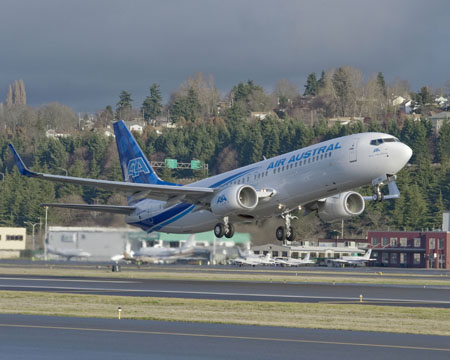
    Boeing Delivers Air Austral’s First Next-Generation 737-800

    SEATTLE, Dec. 20, 2010 — Boeing delivered a Next-Generation 737-800 to Air Austral, as part of the airline’s modernization plan for its medium-haul fleet. The airplane is the first of two the airline ordered to replace one 737-300 and one 737-500 in its fleet. The new airplane continues the Boeing-Air Austral relationship that began 20 years ago with the 737 Classic. The delivery ceremony was attended by Gerard Etheve, president of the directory and chief executive officer of Air Austral. The airline is headquartered in St. Denis, Reunion, a French Department island located east of Madagascar in the Indian Ocean.

    To include the featured image in your Twitter Card, please tap or click their icon a second time.
  • AFA-CWA Files Interference Charges Against Delta Airlines Management

    Washington, DC – The Association of Flight Attendants-CWA (AFA-CWA) today filed formal interference charges with the National Mediation Board (NMB) against Delta Air Lines management alleging unlawful conduct during the recent flight attendant representation election.

    Delta management compromised the secrecy of the ballot by urging flight attendants to vote on company-controlled work computers that could track whether they clicked on the NMB’s internet voting site. In addition, hundreds of Delta/Northwest flight attendants have reported coercive and unfair methods used by management to influence the results of the recent union election. Feedback includes reports of the company’s anti-AFA literature, excessive supervisor surveillance and meddling, and repeated supervisor phone calls to flight attendant homes telling them to vote.

    “Delta and Northwest flight attendants deserve the opportunity to freely participate in an election without being intimidated by management and heavy-handed efforts to keep them from gaining a voice,” said Patricia Friend, AFA-CWA International President. “Delta management launched the largest anti-union campaign in history and spared no expense in attempting to destroy the collective bargaining rights that Northwest flight attendants have worked to maintain for over 60 years. We now call on the NMB to conduct an exhaustive investigation of these charges and hold Delta executives accountable for their actions.”

    If the NMB finds sufficient evidence that election interference occurred, it can order a new election that will allow flight attendants to decide representation in a free and fair manner. On November 3, the NMB counted 9,216 votes in favor of union representation for Delta flight attendants and 9,544 votes against.

    For over 60 years, the Association of Flight Attendants has been serving as the voice for flight attendants in the workplace, in the aviation industry, in the media and on Capitol Hill. More than 42,000 flight attendants at 21 airlines come together to form AFA-CWA, the world’s largest flight attendant union. AFA is part of the 700,000-member strong Communications Workers of America (CWA), AFL-CIO. Visit us at www.afanet.org.

    To include the featured image in your Twitter Card, please tap or click their icon a second time.