Flight 447: Press release N° 6

Similar Posts

  • |

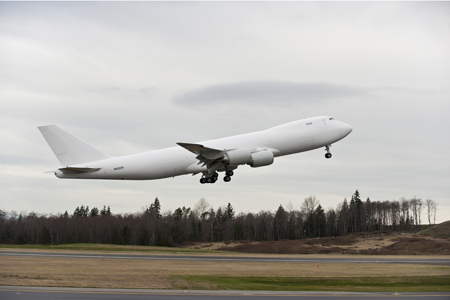
    Fifth Boeing 747-8 Enters Flight-test Program


    EVERETT, Wash., Feb. 4, 2011 /PRNewswire/ — Boeing (NYSE: BA) successfully conducted the first flight of the fifth 747-8 Freighter Thursday. The airplane, coded as RC523, took off from Paine Field in Everett, Wash., for a 3-hour, 30-minute flight before returning to Paine Field.

    The flight included a standard 2-hour, 30-minute “B1” flight profile that Boeing conducts on all production airplanes prior to delivery, plus an hour of engineering testing woven into the profile.

    “The airplane performed well,” said Andy Hammer, test program manager for 747-8. “It was a fine start to the test plan for this airplane.”

    This is the fifth 747-8 Freighter being used in the flight-test program. Each airplane is used for a specific set of tests, with this airplane focusing on functionality and reliability testing.

    The airplane will remain based at Paine Field throughout its test plan.

    To include the featured image in your Twitter Card, please tap or click their icon a second time.
  • |

    Boeing Delivers 1st Aircraft Under US Navy Contract

    ST. LOUIS, March 15, 2012 — Boeing [NYSE: BA] has completed delivery of the U.S. Navy’s first aircraft acquired through the F/A-18E/F and EA-18G Multi-Year Procurement (MYP) III contract, ahead of schedule.
    Aircraft G-57, an EA-18G Growler, was the first of 148 F/A-18E/Fs and EA-18Gs that the Navy will purchase through the contract. The aircraft was delivered to the Navy on Jan. 26 and arrived at its home base at Naval Air Station Whidbey Island on Jan. 30.

    On Sept. 28, 2010, the Navy awarded Boeing the MYP III contract for delivery of 66 F/A-18E/Fs and 58 EA-18Gs, to be purchased through 2013. The Navy has since expanded the contract with the addition of 24 F/A-18E/Fs. The Navy has the option to procure up to 194 F/A-18E/Fs and EA-18Gs under the MYP III contract terms.

    “This program continues to successfully draw on efficiencies from across Boeing to reduce cost, while increasing capability for the men and women who serve this nation around the globe,” said Mike Gibbons, Boeing F/A-18 and EA-18 Programs vice president. “Today’s new Super Hornets provide unequaled air dominance and precision strike capability for the U.S. Navy carrier fleet. At the same time, the EA-18G continues to expand its dominance as the world’s premier airborne electronic attack aircraft, as demonstrated by its recent successes supporting operations in Libya. The Super Hornet and Growler give the U.S. Navy a significant capability for a broad spectrum of anti-access, area-denial missions.”

    Boeing delivered 210 Super Hornets to the Navy during MYP I, which spanned fiscal years 2000 through 2004. The company then received a second multi-year contract that included 213 F/A-18E/F and EA-18G aircraft, and spanned fiscal years 2005 through 2009. Through fiscal year 2009, 44 more aircraft were added to MYP II, including 24 F/A-18Fs acquired by the Royal Australian Air Force under a Foreign Military Sales agreement with the U.S. Navy.

    Procuring aircraft through the first two multi-year contracts generated $1.7 billion in savings for the Navy. The MYP III contract is projected to generate more than $605 million in savings, for total savings of more than $2.3 billion across the three F/A-18E/F and EA-18G contracts.

    To include the featured image in your Twitter Card, please tap or click their icon a second time.
  • Flight School First in US to Cover 100 Percent of Tuition for Veterans

    Upper Limit Aviation partners with Salt Lake Community College to help veterans pay for school in hard economic times

    SALT LAKE CITY, Dec. 7, 2010 — Upper Limit Aviation (ULA), one of four accredited flight schools in the nation, recently announced that it’s able to offer up to 100 percent tuition coverage for eligible vets via the U.S. Veterans’ Benefits Office. This unprecedented move enables military veterans to receive flight training covered under the Post 9/11 G.I. Bill if they qualify for full benefits.

    The special tuition program is a boon to veterans who have wanted to learn to fly, but have been thwarted previously due to financial concerns. ULA is uniquely partnered with the 2nd largest community college in the country, Salt Lake Community College (SLCC), to facilitate a program not only offering flight training but an Associate of Science degree or Commercial Certificate of Completion in the Professional Pilot program upon graduation. The program extends to those who might not be eligible for 100% coverage, or who may need additional assistance via the VA’s Yellow Ribbon Program.

    “We’ve worked hard to bring this program to ULA,” said Lois Reid, school director. “We finally have the chance to offer America’s veterans the chance to train for a career in aviation at virtually no cost to them.”

    As a Part 141 / Part 61 flight school, Upper Limit is one of the only schools in the country operating out of class B airspace, which affords students practical experience with air traffic control in busy, highly regulated airspace. ULA’s flight training program introduces students to flying at high-density altitudes (above 5,000 ft), mountainous terrain, and in associated wind and weather conditions. In addition to training for flight ratings Private – CFII, Veterans are also able to use their benefits to train under Upper Limit Aviation’s special courses such as External Load, Mountain Flying, and Turbine Transition.

    The Accrediting Commission for Career Schools and Colleges (ACCSC) has recognized ULA as a School of Distinction, demonstrating that ULA displays “a commitment to the expectations and rigors of accreditation as well as a commitment to delivering quality educational programs,” said Michael McComis, ACCSC Executive Director.

    To include the featured image in your Twitter Card, please tap or click their icon a second time.
  • |

    Press Release: The MENA Challenge: Coping with Growth

    Date: 20 October 2010

    Cairo – The International Air Transport Association (IATA) called for coordinated efforts to deal with the challenges of growth in the Middle East and North Africa (MENA). “Over the last decade, the carriers of the Middle East and North African region have grown from 5% of global traffic to 11%. Planned aircraft purchases of $200 billion over the next decade will support this growth into the foreseeable future. This expanding global presence brings with it the challenge of playing a larger role in the global aviation community,” said Giovanni Bisignani, IATA’s Director General and CEO.

    The financial situation of the MENA carriers is improving. For 2010, IATA is forecasting a bottom line improvement of $1 billion on the $600 million that the region’s carriers lost in 2009. “We are expecting the region to make $400 million profits this year. A more cautious approach to capacity is helping to drive this improvement. While demand is in line for a 21% increase over last year, the capacity increase has been limited to 15.9%,” said Bisignani in a keynote address to the Arab Air Carriers Organization (AACO) Annual General Meeting in Cairo, Egypt.

    For 2011, IATA expects a fall in global profitability to $5.3 billion from the $8.9 billion that airlines are expected to make in 2010. IATA expects MENA carriers to follow the trend with a reduced 2011 regional profit of $300 million. The small profit will be partially driven by an expected capacity expansion of 10.6% outstripping demand growth of 10.4%.

    Bisignani highlighted four challenges of growth for the region:

    Safety: The region’s hull loss rate for Western built aircraft slipped from zero accidents in 2006 to 3.32 accidents per million flights in 2009. “At 4.6 times the global average of 0.71, that is a concern. The region’s rapid growth must be accompanied with a strong safety record,” said Bisignani who challenged MENA’s governments to adopt IATA’s two safety audits—the IATA Operational Safety Audit (IOSA) and the IATA Safety Audit for Ground Operations (ISAGO)—as part of national requirements. Egypt was the first government in the world to mandate IOSA, joined later by Lebanon, Syria and Bahrain, and soon Jordan. Today, 35 MENA carriers are on the IOSA registry, including all 26 IATA members. MENA has also taken a leadership role on ISAGO. Lebanon will make it mandatory for ground handlers from June 2011 and 13 ground handlers in the region are already on the registry.

    Infrastructure: The MENA region is planning airport construction totaling $100 billion, which includes at least eight new runways in the Gulf region. “The industry and governments are investing in infrastructure to support the economic benefits of aviation’s growth. But what is being built and planned on the ground is not being matched in the air. Military airspace covers 60% of the region, limiting capacity and forcing inefficient routings. We must cooperate to open more of the region’s skies,” said Bisignani. IATA is also working on projects to redesign airspace in the Gulf area, facilitate more traffic for East-West traffic across North Africa, support ultra-long haul operations with more efficient routings, and complete the implementation of reduced vertical separation minima (RVSM) across MENA by bringing Iraq on board.

    Technology for Simplifying the Business: MENA is on target to meet the December deadline for 100% implementation of bar coded boarding passes which promises global savings of $1.5 billion. Airlines are 92% complete while airports are at 90%. The region is home to seven airports that are already operating 100%: Abu Dhabi, Dubai, Bahrain, Muscat, Doha, Kuwait and Sharjah. Two countries in MENA are participating in IATA e-freight—the United Arab Emirates (UAE) and Egypt. The UAE is a global top performer as the originating country for 21% of all e-freight shipments. “Jordan, Kuwait, Qatar and Saudi Arabia have all passed the high-level assessment and are expected to launch in 2011. The only hurdle is for governments to adapt their local regulations to facilitate modern business practices. E-freight is a great competitive advantage with the capability to save the industry $4.9 billion,” said Bisignani.

    Government Involvement: Bisignani urged governments in the region to keep costs in check and create the regulatory framework to balance burgeoning long-haul opportunities with short-haul regional liberalization. Bisignani praised Tunisia’s decision, following an IATA intervention, to eliminate its 10% import tax on jet fuel which conflicted with the Chicago Convention. Bisignani urged the region to set correct precedents with privatized infrastructure. “We are now working with Jordan to curb unilateral increases in taxes and charges that followed privatization of its airports. To keep competitive, governments much ensure meaningful consultation and agreed investments plans,” said Bisignani, who also encouraged the region to take a more proactive approach to liberalization. “I see cutting-edge examples of liberalization as key markets such as Morocco, Jordan and Tunisia build open-sky agreements with Europe. The Damascus Convention of 2004 provides a framework for regional liberalization, but the number of countries ratifying it is disappointing.”

    Environment: Bisignani noted the important outcomes of the 37th Assembly of the International Civil Aviation Organization (ICAO) that placed aviation ahead of all other industries in dealing with climate change. “Governments confirmed ICAO’s leadership role in managing aviation’s emissions and agreed on a collective aspirational goal to improve fuel efficiency by 2% to 2050, while capping emissions from 2020 with carbon-neutral growth. They also agreed to develop a framework for economic measures that minimize market distortions, treat air transport in line with other sectors, ensure that emissions are accounted for only once and recognize past and future efforts,” said Bisignani.

    To include the featured image in your Twitter Card, please tap or click their icon a second time.
  • |

    FAA Takes Aim at Icing with New Ice Protection Proposal

    For Immediate Release
    November 23, 2009
    Contact: Les Dorr, Jr. or Alison Duquette
    Phone: (202) 267-3883

    WASHINGTON – The Federal Aviation Administration is proposing a rule requiring scheduled airlines to either retrofit their existing fleet with ice-detection equipment or make sure the ice protection system activates at the proper time.

    For aircraft with an ice-detection system, the FAA proposes that the system alert the crew each time they should activate the ice protection system. The system would either turn on automatically or pilots would manually activate it.

    For aircraft without ice-detection equipment, the crew would activate the protection system based on cues listed in their airplane’s flight manual during climb and descent, and at the first sign of icing when at cruising altitude.

    “This is the latest action in our aggressive 15-year effort to address the safety of flight in icing conditions,” said FAA Administrator Randy Babbitt. “We want to make sure all classes of aircraft in scheduled service remain safe when they encounter icing.”

    The FAA estimates the rule would cost operators about $5.5 million to implement. Operators would have two years after the final rule is effective to make these changes.

    The proposed rule would apply only to in-service aircraft with a takeoff weight less than 60,000 pounds, because most larger airplanes already have equipment that meets the requirements. In addition, studies show that smaller planes are more susceptible to problems caused by undetected icing or late activation of the ice protection system. The rule technically affects 1,866 airplanes, but all turbojet airliners and many turboprops covered under the rule already have equipment that satisfies the requirements, and the FAA believes others will be retired before the projected compliance date in 2012.

    In August 2009, the FAA changed its certification standards for new transport category airplane designs to require either the automatic activation of ice protection systems or a method to tell pilots when they should be activated.

    Since 1994, the FAA has issued more than 100 airworthiness directives to address icing safety issues on more than 50 specific aircraft types. These orders cover safety issues ranging from crew operating procedures in the icing environment to direct design changes. We also have changed airplane flight manuals and other operating documents to address icing safety, and issued bulletins and alerts to operators emphasizing icing safety issues.

    The latest proposed rule on activation of ice protection systems is at: http://edocket.access.gpo.gov/2009/E9-28036.htm

    To include the featured image in your Twitter Card, please tap or click their icon a second time.
  • |

    Southwest Airlines and Flight Simulator Technicians Ratify Contract Extension

    DALLAS, Dec. 16, 2010 COMTEX/ —

    Southwest Airlines (NYSE: LUV) is pleased to announce that its Flight Simulator Technicians, represented by the International Brotherhood of Teamsters (IBT) Airlines Division, voted to ratify an extension to their current agreement. The agreement is for a two-year contract extension through October 2013. The current contract would have become amendable on November 1, 2011.

    “I want to congratulate both sides for ratification of a contract that delivers mutually beneficial enhancements to pay, benefits, and work rules to our dedicated Flight Simulator Technicians,” said Mike Van de Ven, Southwest Airlines Executive Vice President and Chief Operating Officer. “The negotiating teams were able to balance our competitive needs with our Technicians’ requests to quickly come to an agreement as we head toward our 40th year of operation.”

    After nearly 40 years of service, Southwest Airlines continues to differentiate itself from other low fare carriers–offering a reliable product with exemplary Customer Service. Southwest Airlines is the nation’s largest carrier in terms of originating domestic passengers boarded, now serving 69 cities in 35 states. Southwest also is one of the most honored airlines in the world known for its commitment to the triple bottom line of Performance, People, and Planet. To read more about how Southwest is doing its part to be a good citizen, visit southwest.com/cares to read the Southwest Airlines One Report(TM). Based in Dallas, Southwest currently operates more than 3,100 flights a day and has nearly 35,000 Employees systemwide.

    To include the featured image in your Twitter Card, please tap or click their icon a second time.