Federal Aviation Administration 35th Annual Aviation Forecast Conference

Similar Posts

  • |

    Press Release: American Airlines and Transport Workers Union Agree

    “American Airlines and the Transport Workers Union have reached two tentative agreements in principle for the Simulator Technician workgroup and the Ground School and Simulator Pilot Instructor workgroup.
    “These tentative agreements provide our Simulator Technicians and Ground School and Simulator Pilot Instructors with market-based compensation, including structural increases, and enhancements to other contract items such as vacation and holidays.
    “Both parties worked collaboratively during this negotiating process to reach tentative agreements that address the interests of our TWU-represented employees and the company.
    “It is our understanding the TWU will provide details of the agreements and the voting process to its members in the coming days.

    “American Airlines has more than 50,000 employees represented by unions, including approximately 80 simulator technicians and approximately 160 ground school and simulator pilot instructors.”

    To include the featured image in your Twitter Card, please tap or click their icon a second time.
  • ERUPTION OF EYJAFJALLA VOLCANO IN ICELAND – ICAO SYSTEM EFFECTIVE IN ENSURING THE SAFETY OF AIR TRANSPORT

    ICAO Release-April 15, 2010-

    The International Airways Volcano Watch (IAVW) system, established by ICAO in coordination with the World Meteorological Organization (WMO), proved effective in ensuring the safety of air transport following the eruption of the volcano Eyjafjalla in Iceland on 14 April 2010.

    No incidents or accidents have been reported due to volcanic ash. Disruptions in air traffic, however, are being experienced in the United Kingdom and Scandinavia.

    Since volcanic ash is composed of very abrasive silica materials, it can damage the airframe and flight surfaces, clog different systems, abrade cockpit windows and flame-out jet engines constituting a serious safety hazard. Volcanic ash can also have a serious effect on aerodromes located downwind of a volcanic ash plume since it contaminates runways, ground equipment and aircraft parked or taxiing around the aerodrome.

    The IAVW system is designed to detect and track the movement of volcanic ash in the atmosphere and to warn aircraft in flight about this hazard. The main components of the system are comprised of nine volcanic ash advisory centres responsible for the provision of information related to areas and flight levels affected by volcanic ash and its future movement. These centres are strategically distributed around the globe. They are Anchorage, Buenos Aires, Darwin, London, Montreal, Tokyo, Toulouse, Washington and Wellington. Another important component of the system is the role of area control centres of each State to warn aircraft in flight about the location of the volcanic ash. They work together with selected State Volcano Observatories and the corresponding MET watch offices that are tasked with disseminating the corresponding warnings which are called SIGMETs.

    To include the featured image in your Twitter Card, please tap or click their icon a second time.
  • |

    Boeing Statement on IAM 837 Contract Ratification

    ST. LOUIS, June 27, 2010 — The International Association of Machinists and Aerospace Workers (IAM) 837, which represents about 2,500 employees in the St. Louis area, voted 1,237-838 today to ratify the adjusted best-and-final contract offer that The Boeing Company presented last week. Boeing responded with the following statement:
    “We are very pleased that our employees represented by IAM 837 voted today to ratify the contract we have been discussing over the past several weeks. When we began negotiations, our goal was to produce a contract that recognizes both the significant contributions of our employees and the competitive environment in which we must compete to keep jobs here in St. Louis. This contract does both. The vote by our employees allows us to keep delivering on our commitments to our customers.

    To include the featured image in your Twitter Card, please tap or click their icon a second time.
  • |

    Boeing Statement on El Al’s Selection of Next-Generation 737-900ER

    SEATTLE, Feb. 8, 2011 – Boeing [NYSE: BA} is delighted that El Al Airlines has selected the 737-900ER for its fleet requirements. The 737-900ER’s size and range make it ideally suited for El Al’s network requirements. We look forward to continuing our long-term partnership with El Al and to finalizing the details of this transaction.

    To include the featured image in your Twitter Card, please tap or click their icon a second time.
  • |

    easyJet Unveils Ash Detector to End Large-Scale Disruption

    easyJet, the UK’s largest airline, today unveils a ground breaking technology that will minimise future disruption from volcanic activity.

    easyJet will be the world’s first airline to trial a new technology called AVOID (Airborne Volcanic Object Identifier and Detector). The system, essentially a weather radar for ash, was created by Dr Fred Prata of the Norwegian Institute for Air Research (NILU). AVOID is a system that involves placing infrared technology onto an aircraft to supply images to both the pilots and an airline’s flight control centre.

    These images will enable pilots to see an ash cloud up to 100 km ahead of the aircraft and at altitudes between 5,000ft and 50,000ft. This will allow pilots to make adjustments to the plane’s flight path to avoid any ash cloud. The concept is very similar to weather radars which are standard on commercial airliners today.

    On the ground, information from aircraft with AVOID technology would be used to build an accurate image of the volcanic ash cloud using real time data. This would open up large areas of airspace that would otherwise be closed during a volcanic eruption, which would benefit passengers by minimising disruption.

    easyJet Chief Executive Andy Harrison, said: “This pioneering technology is the silver bullet that will make large-scale ash disruption history. The ash detector will enable our aircraft to see and avoid the ash cloud, just like airborne weather radars and weather maps make thunderstorms visible.”

    Dr Fred Prata, Senior Scientist at the Norwegian Institute for Air Research (NILU) and inventor of the AVOID system added: “AVOID enhances the theory around volcanic ash clouds with live data. easyJet is committed to bring our technology to life.”

    Commenting on today’s news Andrew Haines, Chief Executive of the Civil Aviation Authority said “It is essential that the aviation community works together to develop solutions to minimise disruption, should ash return. The CAA welcomes the fact that airlines are considering innovations such as this and we will do all we can to facilitate them.”

    The first test flight is to be carried out by Airbus on behalf of easyJet within two months, using an Airbus 340 test aircraft. Subject to the results of these tests, easyJet intends to trial the technology on its own aircraft with a view to installing it on enough aircraft to minimise future disruption from ash.

    To include the featured image in your Twitter Card, please tap or click their icon a second time.
  • |

    Boeing Celebrates Premiere of New 747-8 Intercontinental

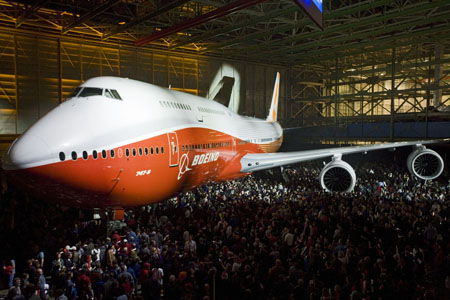
    EVERETT, Wash., Feb. 13, 2011 /PRNewswire/ — Boeing (NYSE: BA) today unveiled its new 747-8 Intercontinental, the new high-capacity passenger airplane that offers airlines the lowest operating costs and best economics of any large passenger airplane while providing enhanced environmental performance.
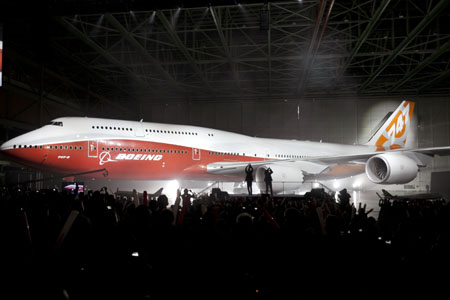
    Approximately 10,000 guests, including customers, Boeing employees, government officials, partners and suppliers, gathered in the factory in Everett, Wash., to witness the premiere of the Intercontinental at an event themed “Incredible, Again.” Boeing Commercial Airplanes President and Chief Executive Officer Jim Albaugh said the newest 747 incorporates technological advancements that make it an extremely productive airplane for customers.
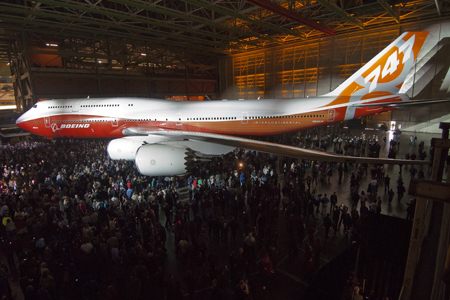
    “The new 747-8 Intercontinental features the latest in innovative technologies — applying many of the breakthroughs also found on the 787 Dreamliner,” said Albaugh. “We think our customers will value the low operating costs and passengers will enjoy the comfort of the striking new interior.”

    “The 747-8 Intercontinental will be a great complement to our fleet, fitting nicely into the 400-seat category, improving our fleet’s eco-efficiency even further,” said Nico Buchholz, executive vice president, Lufthansa Group Fleet Management. “As launch customer, we are looking forward to welcoming this new aircraft to our fleet next year as it adds to our ongoing fleet modernization and environmental efforts.”
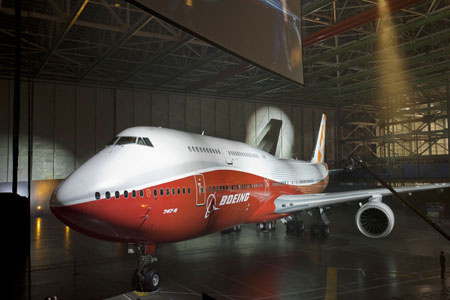
    Korean Air and VIP customers have joined launch customer Lufthansa in ordering a total of 33 747-8 Intercontinentals. First delivery of the 747-8 Intercontinental is scheduled for the fourth quarter.

    “As the only airplane in the 400 to 500-seat market, the 747-8 Intercontinental will give operators an airplane perfectly suited for long, heavily traveled routes around the world,” said Pat Shanahan, vice president and general manager, Airplane Programs, Boeing Commercial Airplanes. “The new 747-8 Intercontinental will set a new standard in economic and environmental performance, while providing a world-class passenger experience.”

    The 747-8 Intercontinental will have the lowest seat-mile cost of any large commercial jetliner, with 12 percent lower costs than its predecessor, the 747-400. The airplane provides 16 percent better fuel economy, 16 percent less carbon emissions per passenger and generates a 30 percent smaller noise footprint than the 747-400. The 747-8 Intercontinental applies interior features from the 787 Dreamliner that includes a new curved, upswept architecture giving passengers a greater feeling of space and comfort, while adding more room for personal belongings.
    The airplane unveiled today is painted in a new Sunrise livery of red-orange that only will appear on the first 747-8 Intercontinental and is a significant departure from Boeing’s standard blue. The new color palette honors many key Boeing customers whose cultures recognize these colors as symbols of prosperity and good luck.

    To include the featured image in your Twitter Card, please tap or click their icon a second time.