FAA Press Release

Similar Posts

  • |

    NASA Data and New Techniques Yield Detailed Views of Solar Storms

    WASHINGTON — NASA spacecraft observations and new data processing techniques are giving scientists better insight into the evolution and development of solar storms that can damage satellites, disrupt communications and cause power grid failures on Earth.

    The solar storms, called Coronal Mass Ejections (CMEs), are being observed from NASA’s twin Solar Terrestrial Relations Observatory, or STEREO, spacecraft launched in 2006. The duo represents a key component within a fleet of NASA spacecraft that enhance the capability to predict solar storms.

    Previous spacecraft imagery did not clearly show the structure of a solar disturbance as it traveled toward Earth. As a result, forecasters had to estimate when storms would arrive without knowing the details of how they evolve and grow. New processing techniques used on STEREO data allow scientists to see how solar eruptions develop into space storms at the Earth.

    “The clarity these new images provide will improve the observational inputs into space weather models for better forecasting,” said Lika Guhathakurta, STEREO program scientist at NASA Headquarters in Washington.

    CMEs are billion-ton clouds of solar plasma launched by the same sun explosions that spark solar flares. When they sweep past Earth, they can cause auroras, radiation storms that can disrupt sensitive electronics on satellites, and in extreme cases, power outages. Better tracking of these clouds and the ability to predict their arrival is an important part of space weather forecasting.

    Newly released images from cameras on the STEREO-A spacecraft reveal detailed features in a large Earth-directed CME in late 2008, connecting the original magnetized structure in the sun’s corona to the intricate anatomy of the interplanetary storm as it hit the planet three days later. When the data were collected, the spacecraft was more than 65 million miles away from Earth.

    The spacecraft’s wide-angle cameras captured the images. They detect ordinary sunlight scattered by free-floating electrons in plasma clouds. When these clouds in CMEs leave the sun, they are bright and easy to see. However, visibility is quickly reduced, as the clouds expand into the void. The clouds are about one thousand times fainter than the Milky Way, which makes direct imaging of them difficult. That also has limited our understanding of the connection between solar storms and the coronal structures that cause them.

    “Separating these faint signals from the star field behind them proved especially challenging, but it paid off,” said Craig DeForest, scientist at the Southwest Research Institute in Boulder, Colo. and lead author of an Astrophysical Journal article released online yesterday. “We have been drawing pictures of structures like these for several decades. Now that we can see them so far from the sun, we find there is still a lot to learn.”

    These observations can pinpoint not only the arrival time of the CME, but also its mass. The brightness of the cloud enabled researchers to calculate the cloud’s gas density throughout the structure, and compare it to direct measurements by other NASA spacecraft. When this technique is applied to future storms, forecasters will be able to say with confidence whether Earth is about to be hit by a small or large cloud, and where on the sun the material originated.

    STEREO’s two observatories orbit the sun, one ahead of Earth and one behind. They will continue to move apart over time. STEREO is the third mission in NASA’s Solar Terrestrial Probes program. The program seeks to understand the fundamental physical processes of the space environment from the sun to Earth and other planets.

    The STEREO spacecraft were built and are operated for NASA by the Johns Hopkins University Applied Physics Laboratory in Laurel, Md. NASA’s Goddard Space Flight Center in Greenbelt, Md., manages the mission, instruments and science center. The STEREO instruments were designed and built by scientific institutions in the U.S., UK, France, Germany, Belgium, Netherlands, and Switzerland.

    To include the featured image in your Twitter Card, please tap or click their icon a second time.
  • | | | |

    CAPTAIN’S INAPPROPRIATE ACTIONS LED TO CRASH OF FLIGHT 3407 IN CLARENCE CENTER, NEW YORK, NTSB SAYS

    NTSB PRESS RELEASE

    National Transportation Safety Board
    Washington, DC 20594

    FOR IMMEDIATE RELEASE: February 2, 2010
    SB-10-02

    CAPTAIN’S INAPPROPRIATE ACTIONS LED TO CRASH OF FLIGHT 3407 IN CLARENCE CENTER, NEW YORK, NTSB SAYS

    The National Transportation Safety Board determined that the
    captain of Colgan Air flight 3407 inappropriately responded
    to the activation of the stick shaker, which led to an
    aerodynamic stall from which the airplane did not recover.
    In a report adopted today in a public Board meeting in
    Washington, additional flight crew failures were noted as
    causal to the accident.

    On February 12, 2009, a Colgan Air, Inc., Bombardier DHC-8-
    400, N200WQ, operating as Continental Connection flight
    3407, was on an instrument approach to Buffalo-Niagara
    International Airport, Buffalo, New York, when it crashed
    into a residence in Clarence Center, New York, about 5
    nautical miles northeast of the airport. The 2 pilots, 2
    flight attendants, and 45 passengers aboard the airplane
    were killed, one person on the ground was killed, and the
    airplane was destroyed by impact forces and a postcrash
    fire. The flight was a 14 Code of Federal Regulations (CFR)
    Part 121 scheduled passenger flight from Newark, New Jersey.
    Night visual meteorological conditions prevailed at the
    time of the accident.

    The report states that, when the stick shaker activated to
    warn the flight crew of an impending aerodynamic stall, the
    captain should have responded correctly to the situation by
    pushing forward on the control column. However, the
    captain inappropriately pulled aft on the control column and
    placed the airplane into an accelerated aerodynamic stall.

    Contributing to the cause of the accident were the
    Crewmembers’ failure to recognize the position of the
    low-speed cue on their flight displays, which indicated that
    the stick shaker was about to activate, and their failure to
    adhere to sterile cockpit procedures. Other contributing
    factors were the captain’s failure to effectively manage the
    flight and Colgan Air’s inadequate procedures for airspeed
    selection and management during approaches in icing
    conditions.

    As a result of this accident investigation, the Safety Board
    issued recommendations to the Federal Aviation
    Administration (FAA) regarding strategies to prevent flight
    crew monitoring failures, pilot professionalism, fatigue,
    remedial training, pilot records, stall training, and
    airspeed selection procedures. Additional recommendations
    address FAA’s oversight and use of safety alerts for
    operators to transmit safety-critical information, flight
    operational quality assurance (FOQA) programs, use of
    personal portable electronic devices on the flight deck, and
    weather information provided to pilots.

    At today’s meeting, the Board announced that two issues that
    had been encountered in the Colgan Air investigation would
    be studied at greater length in proceedings later this year.
    The Board will hold a public forum this Spring exploring
    pilot and air traffic control high standards. This
    accident was one in a series of incidents investigated by
    the Board in recent years – including a mid-air collision
    over the Hudson River that raised questions of air traffic
    control vigilance, and the Northwest Airlines incident last
    year where the airliner overflew its destination airport in
    Minneapolis because the pilots were distracted by non-flying
    activities – that have involved air transportation
    professionals deviating from expected levels of performance.
    In addition, this Fall the Board will hold a public forum
    on code sharing, the practice of airlines marketing their
    services to the public while using other companies to
    actually perform the transportation. For example, this
    accident occurred on a Continental Connection flight,
    although the transportation was provided by Colgan Air.

    A summary of the findings of the Board’s report are
    available on the NTSB’s website at:
    http://www.ntsb.gov/Publictn/2010/AAR1001.htm
    -30-

    To include the featured image in your Twitter Card, please tap or click their icon a second time.
  • |

    Northrop Grumman Provides Air Traffic Surveillance Sys for Greek Airport

    LONDON – March 2, 2011 – Northrop Grumman Corporation’s Europe-based air traffic management subsidiary, Northrop Grumman Park Air Systems, is providing its Advanced Surface Movement Guidance and Control System ( for Greece’s Thessaloniki International Airport.

    Under the contract awarded by Greek consultants ATESE following an international competitive tender process, Northrop Grumman Park Air Systems will deliver its NOVA 9000 A-SMGCS system for operation by the Hellenic Civil Aviation Authority (HCAA). The company has previously supplied a similar system for Athens International Airport.

    “The NOVA 9000 A-SMGCS is widely accepted as a state-of-the-art system; we know it well and have been operating it for many years at our main airport in Athens. We and the controllers in Thessaloniki, look forward to its commissioning before this 2011 winter season”, said D6 director of Hellenic Civil Aviation Authority.

    The air traffic control system has successfully undergone system and sensor testing in Norway, Denmark and Czech Republic. Northrop Grumman Park Air Systems will deliver A-SMGCS to manage the tracking of aircraft and vehicles on the ground and using surveillance systems based on radar and multilateration, it will monitor aircraft at the airport’s two crossing runways. The system will assist the efficient management of air traffic particularly in periods of high volume and during adverse weather conditions.

    “We are pleased that our A-SMGCS capability has been recognised as the system of choice by airport operators”, said Eldar Hauge, managing director for Northrop Grumman Park Air Systems in Norway. “This win maintains our position as a leading supplier of A-SMGCS across Europe.”

    With a 50-year legacy in air traffic management systems ranging from individual airport installations to countrywide, multiple-site turnkey integrated system solutions, Northrop Grumman’s state-of-the-art air traffic management systems are operationally controlling air traffic in numerous countries around the world including recent major programmes in: France, Norway, Brazil, Qatar, Oman, Canada, India, Poland, UAE, U.S. and the U.K., in both civil and military applications.

    Northrop Grumman Park Air Systems, based in Oslo and Horten, Norway, and in Peterborough, U.K., supplies communication, navigation and surveillance systems for air-space operations worldwide.

    Northrop Grumman Corporation is a leading global security company whose 120,000 employees provide innovative systems, products, and solutions in aerospace, electronics, information systems, shipbuilding and technical services to government and commercial customers worldwide. Please visit www.northropgrumman.com for more information.

    To include the featured image in your Twitter Card, please tap or click their icon a second time.
  • |

    NTSB STUDY SHOWS THAT AIRBAGS CAN PROVIDE OCCUPANT PROTECTION IN GENERAL AVIATION ACCIDENTS

    National Transportation Safety Board
    Washington, DC 20594

    FOR IMMEDIATE RELEASE: January 11, 2011
    SB-11-03

    Today the National Transportation Safety Board adopted a study that concluded that general aviation (GA) airplanes equipped with airbags provide additional protection to occupants in accidents involving survivable forward impacts.

    Airbags are designed to mitigate head and upper body injuries and are installed in the lap belt or shoulder harness portions of the restraint system. They were first approved for use in the pilot and co-pilot seats in GA aircraft in 2003. Currently, there are nearly 18,000 airbag- equipped seats in over 7,000 of the 224,000 GA aircraft in the United States.

    “Although airbags have been mandated in automobiles for over a decade, the aviation industry has no such requirement for small aircraft,” said NTSB Chairman Deborah A.P. Hersman. “The good news is that over 30 manufacturers have stepped up to the plate and offer airbags as standard or optional equipment.”

    The study, which examined 88 accidents involving airbag- equipped airplanes that occurred between 2006 and 2009, found no instances where the airbag caused harm in properly restrained occupants. In addition, the study found 10 survivable accidents in which the crash forces were severe enough to cause injury and/or to deploy the airbag.

    Within the group of 10 accidents, 12 occupants experienced airbag deployments, and the study found that the airbag likely mitigated injuries for two of the occupants.

    The study also noted that there were no negative consequences as a result of airbag deployments. For instance, there were no cases in which the airbags were expected to deploy but did not. Nor were there any cases that involved airbags deploying under unexpected circumstances, hindering egress, fueling post-crash fires or interfering with rescue attempts. Yet investigators did uncover some safety issues with restraint systems.

    One such issue involved the incorrect usage or adjustment of seat belts. In certain aircraft types, the seat belts in the left and right seats can become reversed, which could result in the wrong airbag being activated if only one of the seats is occupied.

    There were also concerns with optimal airbag protection for occupants whose body mass indexes (BMI) classified them as either overweight or obese (BMIs of 25 or higher). The NTSB questions whether the airbag-equipped restraints were designed and tested with the high-BMI population in mind.

    An additional finding of this study was the strong affirmation that correctly installed shoulder harness/lap belt combinations provide significantly greater protection in GA accidents than that offered by a lap belt alone. Based on an analysis of over 37,000 GA accidents, the Board concluded that the risk of fatal or serious injury was 50 percent higher when an occupant was only restrained by a lap belt as compared to the combination lap belt and shoulder harness.

    “The simplest and cheapest improvement to the safety of general aviation aircraft occupants is the mandatory installation of shoulder harnesses,” said Hersman.

    The five-Member Board voted to adopt six safety recommendations, all directed to the Federal Aviation Administration:

    1. Require manufacturers to modify restraint systems vulnerable to being used incorrectly in newly built GA airplanes and to modify restraints in existing airplanes.

    2. Revise the guidance and certification standards for restraint systems to reduce the likelihood of misuse.

    3. Modify the guidance to GA airbag manufacturers as to how they should demonstrate that an airbag design provides adequate protection for a greater range of body sizes, including very small and very large individuals.

    4. Require the retrofitting of shoulder harnesses on all general aviation airplanes that are not currently equipped with such restraints.

    5. Evaluate the feasibility of requiring airbag-equipped aircraft to capture and record crash dynamics data to determine whether the system performed as designed.

    6. Develop a system to track safety equipment, such as restraint systems, airbags, and aircraft parachutes, designed to improve crash outcomes.

    The complete safety study will be available at www.ntsb.gov in several weeks.

    To include the featured image in your Twitter Card, please tap or click their icon a second time.
  • | |

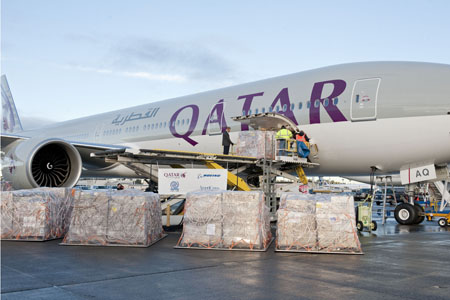
    Boeing, Qatar Airways, AmeriCares Partner for Relief Flight

    New Qatar Airways 777-300ER carries medical supplies to Pakistan
    EVERETT, Wash., Jan. 4, 2011 /PRNewswire/ — Boeing (NYSE: BA) again has partnered with Qatar Airways and the non-profit global health and disaster relief organization AmeriCares to deliver a second consignment of relief supplies to areas in Pakistan that are still recovering from the massive floods that ravaged the country in August. The first shipment was delivered in September 2010.

    A consignment of about 35,000 pounds (15.8 metric tones) of medical supplies was loaded into the cargo hold of the new Boeing 777-300ER (extended range) delivered to Qatar Airways. The airline subsequently will ship the relief goods from Doha, Qatar to Pakistan.

    “This is the second time in four months that Boeing has partnered with Qatar Airways and AmeriCares to help the people in Pakistan where the need is still great,” said Liz Warman, director of Global Corporate Citizenship Northwest Region, Boeing. “Providing timely medical care is critical; though the floods have receded, the aftereffects such as sickness and disease continue to affect the people in these disaster zones.”

    Over the years, Boeing and airline partners as well as non-profit partners in the Humanitarian Delivery Flights (HDF) program have collaborated on many humanitarian missions and the Boeing 777-300ER was used on a number of those missions.

    To include the featured image in your Twitter Card, please tap or click their icon a second time.
  • Official Congo Condolences

    Secretary-General
    SG/SM/11771
    AFR/1742
    Department of Public Information • News and Media Division • New York
    SECRETARY-GENERAL DEEPLY SADDENED BY PLANE CRASH IN DEMOCRATIC REPUBLIC OF CONGO

    The following statement was issued today by the Spokesperson for UN Secretary-General Ban Ki-moon:

    The Secretary-General is deeply saddened by the news of a plane crash in the area of Bukavu in the eastern Democratic Republic of the Congo.

    His thoughts are with the families and colleagues of those United Nations and non-governmental organization aid workers, Congolese officials and crew who were on board the aircraft. He notes that a team from the United Nations Mission in the Democratic Republic of the Congo (MONUC) is making every effort to reach the site of the accident in order to verify the fate of those on board.

    The Secretary-General expresses his gratitude to all the United Nations staff and international aid workers in the Democratic Republic of the Congo who continue to work tirelessly under difficult conditions to support the Congolese people in their efforts to consolidate peace in their country.

    * *** *

    To include the featured image in your Twitter Card, please tap or click their icon a second time.