|

Dassault’s Enhanced Vision System (EVS) Receives FAA Certification for the Falcon 7X

Dassault’s Enhanced Vision System (EVS) Receives FAA Certification for the Falcon 7X

Similar Posts

  • |

    Airbus Press Release: Sichuan Airlines signs first Airbus Flight Hour Services in China

    21 December 2009

    Airbus to provide extended services to airlines in China

    Sichuan Airlines, the first Chinese operator to fly Airbus A320 Family aircraft, has signed a contract with Airbus for customized Flight Hour Services (FHS) for its future fleet of three brand new leased A330s, which are scheduled to be in service from early next year.

    In order to operate the newly built A330 fleet in a more efficient and cost-effective way, Sichuan Airlines has decided to use the Airbus FHS and will become the first customer for Airbus FHS in China.

    The FHS is part of Airbus’ comprehensive portfolio of support, services and solutions that help Airbus customers meet and exceed their business objectives. Airbus will deliver to Sichuan Airlines a tailor-made solution with strong support from Airbus worldwide customer services system. Under the agreement, Airbus guarantees availability of key Line Replaceable Units (LRUs) as well as related logistics and maintenance services for Sichuan Airlines for an initial 13.5-year period.

    Airbus FHS helps minimize aircraft on-the-ground time by providing airlines with even faster and simpler access to spare parts and services at predictable rates, based on stock and flight hour parameters. Airbus already has FHS services in operation with other customers in the Asian region.

    “The introduction of Airbus A330s and the Airbus FHS for the new A330 fleet is a natural choice for Sichuan Airlines as we have been in successful partnership with Airbus for 14 years. Thanks to the tailor-made Airbus Flight Hour Services, we will optimise our investment and deliver better services to our customers,” said Mr. Lan Xinguo, Chairman of Sichuan Airlines.

    “Facing evolving market and customer requirements, Airbus continues to develop innovative and customized services, enabling Airbus customers such as our long lasting customer Sichuan Airlines to focus on their core business,” said Laurence Barron, President of Airbus China.

    “There are now more than 530 Airbus aircraft in operation with Chinese airlines and the Airbus fleet in China are expanding fast. More than ever, our Chinese customers are expecting from us innovative and flexible solutions to enable safe, efficient and profitable operations and this agreement strengthens further our partnership with our long time customer Sichuan Airlines,” said Charles Champion, Executive Vice President Customer Services of Airbus.

    Sichuan Airlines was also the operator of the very first Airbus A320 assembled by Family Final Assembly Line China (FALC) in Tianjin.

    To include the featured image in your Twitter Card, please tap or click their icon a second time.
  • |

    Dassault’s Falcon 2000LX Receives Approval for London City Airport (LCY)

    DUBAI, UAE, December 6, 2010 / — Dassault’s Falcon 2000LX recently has been granted approval for arrivals and departures at the challenging London City Airport (LCY) in England. With this approval, European registered Falcon 2000LXs can connect London City, located in the heart of the city of London, nonstop with all of Europe including Moscow. Dassault is currently developing a program to gain FAA steep approach certification which will also allow American registered aircraft to operate at LCY.

    In order to use London City’s short runway (4,327 ft/1,319 m at landing and 3,934 ft/1,199 m at take off), an aircraft must demonstrate exacting performance. To help achieve this, Dassault developed a unique autobrake feature for the Falcon 2000EX and 2000LX that reduces landing distances by as much as 300 feet on steep approaches, which are required for London City. The steep approach procedures require a glide slope of 5.5 degrees as opposed to the standard 3.0 degrees.

    “Flying into London City is not only a challenge for aircraft performance, aircraft are also required to be good neighbors and must abide by strict noise procedures,” said John Rosanvallon, President and CEO of Dassault Falcon. “Meeting these requirements is not an easy task but the convenience of flying into the heart of downtown London is highly valuable for business jet operators.” The Falcon 2000LX noise level was measured in the same category as smaller turboprop.

    The Falcon 2000LX received EASA and FAA certification in April 2009. The 4,000 nm range 2000LX offers the same spacious, quiet interior as the 2000EX EASy but also the capability to serve a more extensive city pairs. It offers a 10 to 15% better climb speed improvement in comparison to the Falcon 2000EX and allows the aircraft to reach 41,000 ft in just 18 minutes. The Falcon 2000LX comes standard with the award-winning EASy flight deck which has won high marks and praise for its integrated features and intuitive displays.
    In 2009, the Falcon 7X was approved to operate at London City Airport for both EASA and FAA registered aircraft. The Falcon 7X offers the longest range of any business jet qualified for London City with nonstop capability to New York. Additionally, the Falcon 900DX/EX, Falcon 50 and Falcon 10 all have London City approval.

    About Dassault Falcon
    Dassault Falcon is responsible for selling and supporting Falcon business jets throughout the world. It is part of Dassault Aviation, a leading aerospace company with a presence in over 70 countries across five continents. Dassault Aviation produces the Rafale fighter jet as well as the complete line of Falcon business jets. The company has assembly and production plants in both France and the United States and service facilities on multiple continents. It employs a total workforce of over 12,000. Since the rollout of the first Falcon 20 in 1963, 2,000 Falcon jets have been delivered to 67 countries worldwide. The family of Falcon jets currently in production includes the tri-jets-the Falcon 900DX, 900LX, and the 7X-as well as the twin-engine 2000LX.

    To include the featured image in your Twitter Card, please tap or click their icon a second time.
  • | |

    Boeing Expands Training Capability in Europe

    SEATTLE, Jan. 27, 2011 — Boeing Training & Flight Services has signed a long-term agreement with Blue1 to provide 717 training capabilities in Stockholm, Sweden, beginning the first quarter of 2011. Blue1 is a Scandinavian Airlines’ subsidiary based in Helsinki, Finland.

    “Enhancing safe and efficient flight operations, with cost-effective solutions implemented closer to our customer’s home bases is our main priority,” said Roei Ganzarski, chief customer officer, Boeing Training & Flight Services. “Through this partnership with Blue1, we are bringing our 717 training programs closer to our customers.”

    Blue1 operates five Boeing 717s with an additional four scheduled to enter its fleet by the end of March 2011. “As we transitioned to the 717, it became increasingly clear that we would benefit from a regional 717 training solution,” said Mr. Heikki Setala, head of Flight Operations, Blue1. “Boeing, as the original manufacturer of our airplanes, was wholly supportive of our needs and provided an overall cost-reducing solution.”

    The European Aviation Safety Agency-certified 717 full-flight simulator will be relocated from Boeing’s Atlanta campus to a training center in Stockholm. Boeing will continue to support its customers with 717 solutions in North America and Asia Pacific.

    Under the terms of the agreement, Boeing continues to hold the exclusive license to market the Stockholm-based 717 training capacity to third parties.

    Boeing Training & Flight Services offers comprehensive training solutions worldwide through its global network of campuses and other locations that best serve its customers’ needs.

    The Boeing 717 is a proven and reliable 100-seat jetliner, with more than 125 in active service with airlines today.

    To include the featured image in your Twitter Card, please tap or click their icon a second time.
  • |

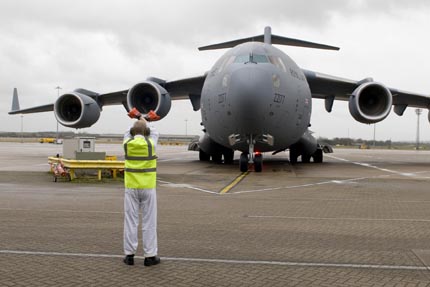
    7th Boeing C-17 for Royal Air Force Arrives in United Kingdom


    LONDON, Jan. 21, 2011 — Boeing and its Boeing Defence UK subsidiary today announced the arrival of the Royal Air Force’s seventh C-17 Globemaster III airlifter at RAF Brize Norton in Oxfordshire, England. The aircraft was officially delivered on Nov. 16 from Boeing’s facility in Long Beach, Calif., and underwent modifications at the company’s San Antonio facility before flying to the United Kingdom.

    “The RAF C-17 fleet, along with the rest of the Airbridge, delivers an incredible capability to our deployed forces on the front line,” said Air Officer Commanding 2 Group, Air Vice-Marshal Philip Osborn, Royal Air Force. “I am also extremely proud of the outstanding contribution that all our aircraft and personnel are making toward continued progress in Afghanistan.”

    Assigned to 99 Squadron at RAF Brize Norton, the UK fleet of C-17s provides critical airlift capability for the nation’s Joint Rapid Reaction Force and has supported humanitarian and disaster-relief missions to Pakistan, Haiti and Chile. 99 Squadron’s C-17s are equipped with upgraded software and avionics, as well as additional fuel tanks that extend the aircraft’s nautical mile range to over 4,000 miles. In normal operations, the aircraft carries a crew of three — two pilots and one air-loadmaster.

    “May 2011 will mark the 10th anniversary of the delivery of the Royal Air Force’s first C-17, which continues to perform superbly — anytime and anywhere,” said Boeing UK C-17 Program Manager Liz Pace. “The RAF uses its C-17s more than any other service today, which is why it has surpassed 60,000 flight hours with just six aircraft.”

    The UK Ministry of Defence announced it would acquire its seventh C-17 in December 2009, less than one year before delivery.

    Boeing supports the RAF’s C-17s through the C-17 Globemaster III Sustainment Partnership, a performance-based logistics program, at RAF Brize Norton, the RAF’s main operating base for strategic air transport and air-to-air refueling. The arrangement provides the RAF with the benefits of complete “virtual fleet” access and an extensive support network. The virtual fleet concept enables C-17 customers, especially those with smaller numbers of aircraft, to benefit from worldwide parts availability and economies of scale when purchasing materials.

    Boeing Defence UK Ltd. is a wholly owned subsidiary of The Boeing Company and a business unit of Boeing Defense, Space & Security. It currently has employees at 20 locations throughout the UK supporting Ministry of Defence and U.S. military programs.

    To include the featured image in your Twitter Card, please tap or click their icon a second time.
  • | |

    Boeing, Netherlands MOD Mark 1st Flight of Royal Netherlands Air Force CH-47F (NL) Chinook

    Ridley Township, Pa., Jan. 26, 2011 — Representatives of Boeing [NYSE: BA], its suppliers and the Netherlands Ministry of Defence marked the first flight of the Royal Netherlands Air Force (RNLAF) CH-47F (NL) Chinook heavy-lift helicopter in a ceremony Jan. 25 at Summit Aviation in Middletown, Del.

    The aircraft made its first flight on Dec. 8 and is scheduled to complete its flight test program in August after approximately 100 flight hours. There are two aircraft in flight test.

    The RNLAF has ordered six CH-47F (NL) Chinooks to enhance its current fleet of 11 CH-47D (NL) aircraft. The new Chinooks are equipped with survivability equipment, a forward-looking infrared system, and fast rope positions, which will be used to support Special Forces operations. The engines will include air particle separators for operation in harsh environments. These additions will make the RNLAF CH-47F a versatile, multi-role aircraft for worldwide operations.

    Boeing expects to begin delivering the aircraft later this year, making the RNLAF the first international customer to field the new CH-47F.

    The flight tests have included assessments of the advanced operational capabilities enabled by the aircraft’s Avionics Control and Management System cockpit and newly integrated Digital Automatic Flight Control System. By the conclusion of the tests, the aircraft will be certified airworthy by the Netherlands Military Aviation Authority.

    “The Chinook has over the years proven itself to be a true workhorse for the Netherlands Air Force,” said Air Commodore Theo ten Haaf, Commanding Officer Defence Helicopter Command of the RNLAF. “The aircraft proved to be ‘the right tool’ for a difficult and challenging job, especially in austere environments and during the combined air and ground operations in Afghanistan. Both ground troops and aircrew speak highly of it.”

    He added, “The CH-47F is a major improvement over the 47D model. The arrival of these new aircraft in the RNLAF will ensure that the RNLAF continues to operate with the best in the field of tactical transport helicopter operations both now and in the future.”

    “Our goal is to use available technology to provide customers with the best solutions while enabling long-term sustainability,” said Leanne Caret, H-47 Programs vice president for Boeing. “We have a long-standing relationship with the Netherlands and this new aircraft is another example of our focus on providing advanced solutions to meet our customers’ growing demands.”

    The Netherlands MOD and Boeing also are evaluating a potential upgrade of the current CH-47D (NL) Chinook fleet to the new CH-47F (NL) configuration.

    To include the featured image in your Twitter Card, please tap or click their icon a second time.
  • |

    Aussie Aviation engineers urged to learn about new rules

    All licensed aircraft maintenance engineers, apprentices and aircraft maintenance engineers are being urged to attend a seminar on Australia’s new aviation maintenance regulations.

    All licensed aircraft maintenance engineers, apprentices and aircraft maintenance engineers are being urged to attend a seminar on Australia’s new aviation maintenance regulations.

    A series of 13 seminars on the new maintenance rules are being held by the Civil Aviation Safety Authority across the nation from mid March to mid April.

    Seminars are being run in all capital cities, except Canberra, as well as Newcastle, Wagga and Cairns.

    The new maintenance regulations come into effect on 27 June 2011.

    All licensed aircraft maintenance engineers (LAMEs) with current licences will have them converted to the new regulations before 27 June 2011. It is expected new licences will be issued in early June.

    LAMEs with licences that expire before the end of June are reminded to renew their existing licence.

    While LAMEs will retain their current privliges under the new rules it is important they understand how the new regulatory system operates and its impact on all sectors of the aviation maintenance industry.

    Apprentices and aircraft maintenance engineers also need an overview of the rule changes.

    Importantly, under the new rules there will be a focus on safety management systems and human factors training will be introduced for maintenance organisations which support regular public transport operations.

    The new maintenance suite of regulations covers all LAMEs, all maintenance training organisations, maintenance organisations maintaining regular public transport aircraft and regular public transport air operators.

    Revised maintenance regulations for other sectors of aviation such as charter, aerial work and private operations will be developed at a later date, after wide consultation with these sectors.

    To include the featured image in your Twitter Card, please tap or click their icon a second time.