National Transportation Safety Board
Washington, DC 20594
July 30, 2010
The National Transportation Safety Board makes the following recommendations to the Federal Aviation Administration:
Conduct research into and document the effects of mountain wave and downslope conditions at airports, such as Denver International Airport, that are located downwind of
mountainous terrain (including, for example, airports in or near Colorado Springs, Colorado; Anchorage, Alaska; Salt Lake City, Utah; and Reno, Nevada), identify potential
mountain-wave-related hazards to ground operations at those airports, and disseminate the results to pilots and airport air traffic control personnel to allow for more informed
runway selection decisions. (A-10-105)
Archive all low-level windshear alert system (LLWAS) data obtained from Denver International Airport and other airports that experience similar wind conditions and make these data available for additional research and the potential future development of an improved LLWAS algorithm for crosswind and gusty wind alerts on air traffic control tower ribbon display terminals. (A-10-106)
Modify Federal Aviation Administration Order 7110.65 to require air traffic controllers at airports with multiple sources of wind information to provide pilots with the maximum wind component, including gusts, that the flight could encounter. (A-10-107)
Review the required documentation for all low-level windshear alert system (LLWAS)-equipped air traffic control towers to ensure that a letter to airmen has been published
and is easily accessible describing the location and designation of the remote sensors, the capabilities and limitations of the system, and the availability of current LLWAS remote sensor wind information on the request of a pilot, in compliance with Federal Aviation Administration Order 7210.3. (A-10-108)
Require air traffic control towers to locally develop and implement written runway selection programs that proactively consider current and developing wind conditions and include clearly defined crosswind components, including wind gusts, when considering operational advantage with respect to runway selection. (A-10-109)
Gather data on surface winds at a sample of major U.S. airports (including Denver International Airport) when high wind conditions and significant gusts are present and use these data to develop realistic, gusty crosswind profiles for use in pilot simulator training programs. (A-10-110)
Require 14 Code of Federal Regulations Part 121, 135, and 91K operators to incorporate the realistic, gusty crosswind profiles developed as a result of Safety Recommendation A- 10-110 into their pilot simulator training programs. (A-10-111)
Once realistic, gusty crosswind profiles as asked for in Safety Recommendation A-10-110 are developed, develop a standard methodology, including pilot-in-the-loop testing, for transport-category airplane manufacturers to establish empirically based, type-specific maximum-gusting-crosswind limitations for transport-category airplanes that account for wind gusts. (A-10-112)
Once a methodology as asked for in Safety Recommendation A- 10-112 has been developed, require manufacturers of transport-category airplanes to develop type-specific, maximum-crosswind takeoff limitations that account for wind gusts. (A-10-113)
Until the actions described in Safety Recommendation A-10-113 are accomplished, require manufacturers of transport- category airplanes to provide operators with interim crosswind takeoff guidelines that account for wind gusts. (A-10-114)
Work with U.S. airline operators to review and analyze operational flight data to identify factors that contribute to encounters with excessive winds and use this information to develop and implement additional strategies for reducing the likelihood of wind-related runway excursions. (A-10-115)
Require cockpit crew seats installed in newly manufactured airplanes that were type certificated before 1988 to meet the crashworthiness standards contained in 14 Code of Federal Regulations 25.562. (A-10-116)
Require operators to perform periodic inspections on the Burns Aerospace model 2501-5 jumpseats for fatigue cracks within the jumpseat structure and replace the jumpseat if fatigue cracks are found. (A-10-117)
Require that operators of transport-category airplanes that use galley latches or latch plates secured solely by adhesives that may degrade over time modify the latches to include mechanical fasteners. (A-10-118)
To include the featured image in your Twitter Card, please tap or click their icon a second time.

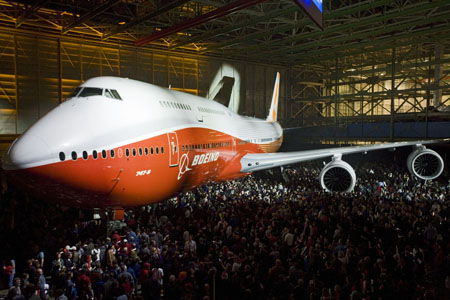 EVERETT, Wash., Feb. 13, 2011 /PRNewswire/ — Boeing (NYSE: BA) today unveiled its new 747-8 Intercontinental, the new high-capacity passenger airplane that offers airlines the lowest operating costs and best economics of any large passenger airplane while providing enhanced environmental performance.
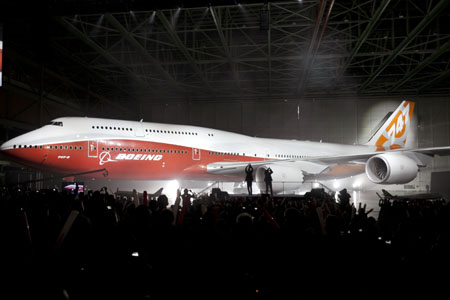 Approximately 10,000 guests, including customers, Boeing employees, government officials, partners and suppliers, gathered in the factory in Everett, Wash., to witness the premiere of the Intercontinental at an event themed “Incredible, Again.” Boeing Commercial Airplanes President and Chief Executive Officer Jim Albaugh said the newest 747 incorporates technological advancements that make it an extremely productive airplane for customers.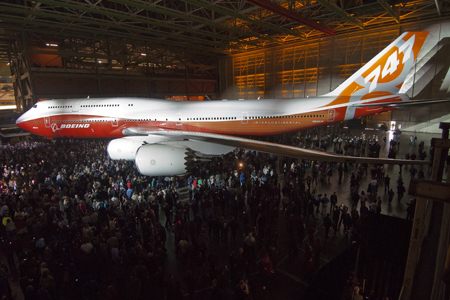
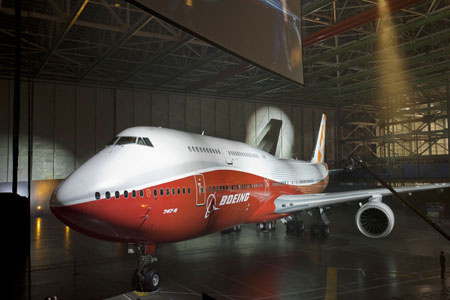 Korean Air and VIP customers have joined launch customer Lufthansa in ordering a total of 33 747-8 Intercontinentals. First delivery of the 747-8 Intercontinental is scheduled for the fourth quarter.
 The Federal Aviation Administration (FAA) is proposing a $445,125 civil penalty against Horizon Air of Seattle for allegedly operating a Bombardier Dash-8-400 aircraft on 45 flights when it was not in compliance with Federal Aviation Regulations. The FAA alleges Horizon failed to comply with an airworthiness directive (AD) that required the airline to inspect for cracked or corroded engine nacelle fittings on its Dash-8-400 aircraft. The AD, with an effective date of March 17, 2011, ordered inspections of the nacelles every 300 operating hours, and repairs as needed.Between March 17 and 23, 2011, Horizon operated the aircraft on at least 45 revenue passenger flights when it had accumulated more than 300 hours of flight time since its last inspection.