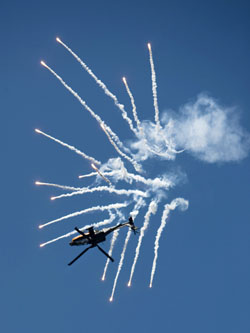
 GILZE-RIJEN AIRBASE, Netherlands, June 16, 2010 — Boeing ] and The Royal Netherlands Air Force (RNLAF) today made aviation history when a Boeing AH-64D Apache became the first rotorcraft in the world to fly using a blend of sustainable bio-kerosene and standard aviation jet fuel.
The 20-minute flight, conducted at Gilze-Rijen Airbase, home of the RNLAF’s combat rotorcraft squadrons, was witnessed by dozens of industry observers and defense journalists.
The sustainable biofuel used in the flight was produced using algae-based biomass and used cooking oil, and processed by UOP, LLC, a Honeywell company, into a Bio-Synthetic Paraffinic Kerosene (Bio-SPK), which has been used in previous commercial biofuel flights. In a series of preflight tests, the 50/50 bio-kerosene and traditional jet fuel blend met or exceeded the JP-8 fuel specifications for the Apache. No engine or airframe modifications were made prior to flight.
“This is a tremendous achievement for the Royal Netherlands Air Force, Boeing, Honeywell, and the engine manufacturer GE Aviation in our efforts to develop sustainable aviation fuel solutions,” said Al Winn, vice president of Apache Programs for Boeing, who attended the demonstration. “Both Boeing’s commercial and military customers are pursuing alternatives to fossil fuels, sharing a vision that was demonstrated flawlessly by our Apache customer today.”
“Today is an important milestone for the more intensive usage of sustainable bio-kerosene in aviation,” said Eimert van Middelkoop, Minister of Defense of the Netherlands.
The RNLAF biofuel flight test program encompasses seven flights that will highlight the technical feasibility of flying rotorcraft using renewable fuels that do not reduce the availability of food crops or water. The Ministry of Defense of the Netherlands, which authorized the flight test program, has publicly stated its commitment to minimizing its environmental footprint of military aircraft.
“This program also will help stimulate market development for aviation biofuel within the Netherlands that can help improve the environmental performance of commercial and military aviation,” said Jan Närlinge, president of Boeing Northern Europe.
Boeing is engaged in sustainable biofuel research around the world and supported the Apache flight and the RNLAF through preflight planning, testing and technical consultation based on a strong body of biofuel experience. The company supplied technical support to a KLM Royal Dutch Airlines biofuel flight aboard a Boeing 747 in November 2009, and also to the U.S. Navy F/A-18 Super Hornet biofuel flight on Earth Day this year. Boeing also supported four previous biofuel flights using varying fixed-wing commercial aircraft and engine types.
Extensive laboratory testing by fuel processors, feedstock providers and engine manufacturers has further shown that aviation biofuels meet or exceed the high performance and quality standards specified for military and commercial jet fuels.
A unit of The Boeing Company, Boeing Defense, Space & Security is one of the world’s largest defense, space and security businesses specializing in innovative and capabilities-driven customer solutions, and the world’s largest and most versatile manufacturer of military aircraft. Headquartered in St. Louis, Boeing Defense, Space & Security is a $34 billion business with 68,000 employees worldwide.
To include the featured image in your Twitter Card, please tap or click their icon a second time.

 Badr Airlines flight J4-662 had to divert and make an emergency landing in Port Sudan, Sudan, on March 1st.
 JetBlue flight B6-2533 made an emergency landing at Stewart International Airport, New York, on January 31st.
 Germania Airlines flight ST-8536 had to return and make an emergency landing in Dresden, Germany, on March 14th.
 Ibex Airlines flight FW-85 made an emergency landing in Fukuoka, Japan, on September 23rd.