#MH370 Statement by Orion Captain regarding #Search Status
In a public statement, after the April 8 day’s search for #MH370, RAAF P3 Orion captain Flt Lt said that he was optimistic about the wreckage being found.
Unlike the AF447 search at a parallel point in the search timeline one month in, there has been no visual confirmation of any wreckage or debris, possibly due to tropical storms in the Indian Ocean. The official statement is that the pings have been narrowed down to a twelve mile radius, but searchers are still trying to narrow this area.
Once the area has been narrowed down, an autonomous underwater vehicle will be deployed in a grid (so-called Mowing Lawn pattern) until wreckage has been located.
If the wreckage is found soon, it will have taken twenty-three months less than the search for Air France 447. So one should be perhaps less optimistic about the search, and more determined.
Most recently, Australia announced the search area down to 75,000 sq km. Searchers plan to keep using the Ocean Shield, because it searches more area faster. Once the area is pinned down, they plan to deploy the AUV.
To include the featured image in your Twitter Card, please tap or click their icon a second time.
What: Qantas B737-400 en route from Adelaide to Melbourne Where: Melbourne When: Jan 24, 2011 Who: 99 passengers and six crew Why: On experiencing an air conditioning problem, (turning off an overheated air conditioning system and the second system shut down), the plane lost cabin pressure. Thirty minutes out of Melbourne, the pilot descended to 10,000 feet, and continued to make a safe landing at Melbourne.
To include the featured image in your Twitter Card, please tap or click their icon a second time.
A feline survivor has been found in the crash of the Beechcraft plane that killed Steve Davis, 60, and Wes Caves, 58.
Zuul the cat emerged from the construction site where the plane impacted residences. Zuul has suffered some minor injuries, but seems to have at least eight lives left.
An AeroMexico flight made an emergency landing at Shannon Airport, Ireland, on June 29.
The Boeing 787 Dreamliner, heading from Mexico City to Paris Charles De Gaulle airport in France, had to be diverted after a fire alarm sounded in cargo hold.
The plane landed uneventfully. All 193 people aboard remained unharmed.
To include the featured image in your Twitter Card, please tap or click their icon a second time.
American Airlines becomes the first U.S. airline to order the 777-300ER
SEATTLE, Jan. 19, 2011 — Boeing (NYSE: BA) and American Airlines today announced the Fort Worth, Texas-based carrier has exercised options for two 777-300ERs (extended range).
“American Airlines is an industry leader whose vision and disciplined approach to growth has made it one of the largest airlines in the world,” said Boeing Commercial Airplanes President and CEO Jim Albaugh. “American is the first carrier in the United States to order the 777-300ER. These new airplanes will complement their large fleet of 777-200ERs offering additional flexibility in serving the nonstop routes, while providing increased efficiency and reliability.”
The Boeing 777 is the world’s most successful twin-engine, long-haul airplane. The 777-300ER extends the 777 family’s span of capabilities, bringing twin-engine efficiency and reliability to the long-range market.
“These additional wide-body aircraft will bolster our network strategy, particularly the international growth opportunities we expect from our joint businesses with oneworld® partners in the transatlantic and transpacific markets,” said Tom Horton, President, AMR Corp., the parent company of American Airlines and American Eagle. “We value the combination of size, range and performance of the 777-300ER, as well as the extensive customer amenities it offers. The seating capability of the aircraft will give us growth flexibility in slot-constrained airports and provide us with greater ability to serve new long-haul markets.”
The Boeing 777-300ER is 19 percent lighter than its closest competitor. It produces 22 percent less carbon dioxide per seat and costs 20 percent less to operate per seat. The airplane can seat up to 365 passengers in a three-class configuration and has a maximum range of 7,930 nautical miles (14,685 km). The 777 family is the world’s most successful twin-engine, twin-aisle airplane.
Boeing incorporated several performance enhancements for the 777-300ER, extending its range and payload capabilities. Excellent performance during flight testing, combined with engine efficiency improvements and design changes that reduce drag and airplane weight, contributed to the increased capability.
To include the featured image in your Twitter Card, please tap or click their icon a second time.
We should remember this auxiliary battery failed after the passengers had disembarked. As the experts explain it, the battery is an auxiliary. This particular failure wouldn’t be likely to happen in the air, which technically makes it non-life threatening, although a tech or firefighter who was injured when the fire was extinguished might feel differently. I’m not trying to minimize the problem, but passengers’ lives were not threatened.
Nevertheless, I’m looking forward to Boeing’s solution to this. All the experts tell me this is what happens with new planes. Just a matter of getting the kinks out. While it’s not unexpected that new approaches (replacing the hydraulics with high powered electrics) need some ironing out, we’ll all sleep a lot better, and fly a lot easier when the situation is addressed.
NTSB Provides Second Investigative Update on Boeing 787 Battery Fire in Boston
January 14, 2013
WASHINGTON – The National Transportation Safety Board today released a second update on its investigation into the Jan. 7 fire aboard a Japan Airlines Boeing 787 at Logan International Airport in Boston.
The lithium-ion battery that powered the auxiliary power unit on the airplane was removed and transported back to the NTSB Materials Laboratory in Washington on Jan. 10. The battery is currently being examined by NTSB investigators, who plan to disassemble it this week.
In advance of that work, under the direction of the NTSB, radiographic examinations of the incident battery and an exemplar battery were conducted this past weekend at an independent test facility. The digital radiographs and computed tomography scans generated from this examination allowed the team to document the internal condition of the battery prior to disassembling it.
In addition, investigators took possession of burned wire bundles, the APU battery charger, and several memory modules. The maintenance and APU controller memory modules will be downloaded to obtain any available data. Investigators also documented the entire aft electronics bay including the APU battery and the nearby affected structure where components and wire bundles were located.
The airplane’s two combined flight data recorder and cockpit voice recorder units were transported to NTSB headquarters and have been successfully downloaded. The information is currently being analyzed by the investigative team.
The airport emergency response group documented the airport rescue and firefighting efforts to extinguish the fire, which included interviews with first responders. Fire and rescue personnel were able to contain the fire using a clean agent (Halotron), however, they reported experiencing difficulty accessing the battery for removal during extinguishing efforts. All fire and rescue personnel responding to the incident had previously received aircraft familiarization training on the Boeing 787.
NTSB photo of the burned auxiliary power unit battery from a JAL Boeing 787 that caught fire on Jan. 7 at Boston’s Logan International Airport. The dimensions are 19×13.2×10.2 inches and it weighs approximately 63 pounds (new).
In accordance with international investigative treaties, the Japan Transport Safety Board and French Bureau d’Enquêtes et d’Analyses pour la sécurité de l’aviation civile have appointed accredited representatives to the investigation. The NTSB-led investigative team is comprised of subject matter groups in the areas of airplane systems, fire, airport emergency response, and data recorders and includes experts from the Federal Aviation Administration, The Boeing Company, US Naval Surface Warfare Center’s Carderock Division, Japan Airlines (aircraft operator), GS Yuasa (battery manufacturer), and Thales Avionics Electrical Systems (APU battery/charger system).
To include the featured image in your Twitter Card, please tap or click their icon a second time.
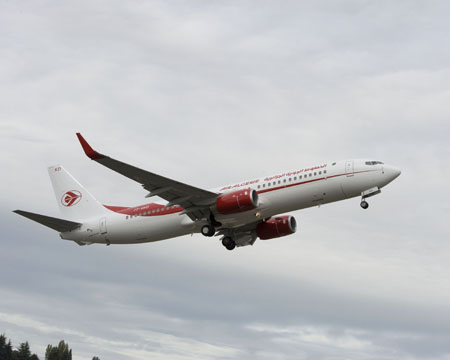
SEATTLE, Sept. 29 — Boeing today delivered to Air Algerie its 11th 737-800.
Air Algerie, the state-owned flag carrier of Algeria, operates a fleet composed primarily of Boeing 737s and some 767s. Boeing is scheduled to deliver two additional 737-800s in 2010 as well as four more in 2011. Air Algerie will be operating 17 737-800s in 2011 for a total of 22 Next-Generation 737 airplanes to complement its fleet.
“The Boeing 737-800 has played an instrumental part in contributing to the success of Air Algerie’s growth in the region,” said Abdelwahid Bouabdallah, director general of Air Algerie.
More than 120 customers around the world have ordered more than 5,000 Next-Generation 737s.
To include the featured image in your Twitter Card, please tap or click their icon a second time.

 said that he was optimistic about the wreckage being found.