| |

CELEBRATE NASA MARS LAUNCH, Public Invited

Similar Posts

  • | |

    Gulfstream International Airlines Fined

    Gulfstream International Airlines is being fined by the FAA for improper scheduling of flight crew duty, installation of unapproved air conditioner compressors and improperly maintained vent blowers on the airline’s fleet of 27 BE-1900-D aircraft.

    See the press release:

    Washington Headquarters Press Release
    For Immediate Release

    May 21, 2009
    Contact: Laura Brown
    Phone: (202) 267-3883

    FAA Proposes $1.3 Million Civil Penalty for Gulfstream International Airlines

    WASHINGTON, D.C. — The Federal Aviation Administration (FAA) has proposed a $1.3 million civil penalty from Florida-based Gulfstream International Airlines, Inc. for violations of the Federal Aviation Regulations.

    The alleged violations include improper scheduling of flight crew duty time, and the installation of unapproved air conditioner compressors and improperly maintained vent blowers on the airline’s fleet of 27 BE-1900-D aircraft.

    An FAA review of the airline’s electronic record-keeping system for tracking crew duty and rest time revealed that Gulfstream International did not accurately input the proper data from its manually generated hard-copy aircraft logbook records into the electronic system. The discrepancies resulted in scheduling crew members in excess of daily and weekly flight time limitations.

    During a June 2008 inspection, the FAA determined that the airline had installed unapproved automotive air conditioner compressors on its aircraft between September 2006 and May 2008. Following the FAA inspection, the airline grounded all of the affected aircraft and replaced the units with approved aircraft air conditioner compressors.

    In the course of a July 2008 inspection of Gulfstream International avionics and component shops in Fort Lauderdale, the FAA discovered that the airline had installed improperly maintained vent blowers on six planes between January 2008 and June 2008. Following that inspection, the airline replaced the blowers with properly maintained units.

    Gulfstream International Airlines has 30 days from the receipt of the civil penalty letter to respond to the FAA.


    #
    (end of release)

    George’s Point of View

    Gulfstream is a former employer of the Captain Marvin Renslow of the ill-fated Continental Connection 3407 flight. If Gulfstream had kept proper records, trained and maintained according to accepted protocol, the Buffalo NY tragedy may never have happened.

    To include the featured image in your Twitter Card, please tap or click their icon a second time.
  • | |

    Comair Crash: Kentucky 2006-Findings

    Lexington: U.S. District Judge Karl Forester ruled that two pilots who took off on the wrong runway were negligent in the August 2006 Comair crash.

    A jury is deciding if punitive damages will apply.

    On August 27, 2006, about 0606:35 eastern daylight time, Comair flight 5191, a Bombardier CL-600-2B19, N431CA, crashed during takeoff from Blue Grass Airport, Lexington, Kentucky. The flight crew was instructed to take off from runway 22 but instead lined up the airplane on runway 26 and began the takeoff roll. The airplane ran off the end of the runway and impacted the airport perimeter fence, trees, and terrain. The captain, flight attendant, and 47 passengers were killed, and the first officer received serious injuries. The airplane was destroyed by impact forces and postcrash fire. The flight was operating under the provisions of 14 Code of Federal Regulations Part 121 and was en route to Hartsfield-Jackson Atlanta International Airport, Atlanta, Georgia. Night visual meteorological conditions prevailed.

    FINDINGS

    1) The captain and the first officer were properly certificated and qualified under Federal regulations. There was no evidence of any medical or behavioral conditions that might have adversely affected their performance during the accident flight. Before reporting for the accident flight, the flight crewmembers had rest periods that were longer than those required by Federal regulations and company policy.

    2) The accident airplane was properly certified, equipped, and maintained in accordance with Federal regulations. The recovered components showed no evidence of any structural, engine, or system failures.

    3) Weather was not a factor in this accident. No restrictions to visibility occurred during the airplane’s taxi to the runway and the attempted takeoff. The taxi and the attempted takeoff occurred about 1 hour before sunrise during night visual meteorological conditions and with no illumination from the moon.

    4) The captain and the first officer believed that the airplane was on runway 22 when they taxied onto runway 26 and initiated the takeoff roll.

    5) The flight crew recognized that something was wrong with the takeoff beyond the point from which the airplane could be stopped on the remaining available runway.

    6) Because the accident airplane had taxied onto and taken off from runway 26 without a clearance to do so, this accident was a runway incursion.

    7) Adequate cues existed on the airport surface and available resources were present in the cockpit to allow the flight crew to successfully navigate from the air carrier ramp to the runway 22 threshold.

    8) The flight crewmembers’ nonpertinent conversation during the taxi, which was not in compliance with Federal regulations and company policy, likely contributed to their loss of positional awareness.

    9) The flight crewmembers failed to recognize that they were initiating a takeoff on the wrong runway because they did not cross-check and confirm the airplane’s position on the runway before takeoff and they were likely influenced by confirmation bias.

    10) Even though the flight crewmembers made some errors during their preflight activities and the taxi to the runway, there was insufficient evidence to determine whether fatigue affected their performance.

    11) The flight crew’s noncompliance with standard operating procedures, including the captain’s abbreviated taxi briefing and both pilots’ nonpertinent conversation, most likely created an atmosphere in the cockpit that enabled the crew’s errors.

    12) The controller did not notice that the flight crew had stopped the airplane short of the wrong runway because he did not anticipate any problems with the airplane’s taxi to the correct runway and thus was paying more attention to his radar responsibilities than his tower responsibilities.

    13) The controller did not detect the flight crew’s attempt to take off on the wrong runway because, instead of monitoring the airplane’s departure, he performed a lower-priority administrative task that could have waited until he transferred responsibility for the airplane to the next air traffic control facility.

    14) The controller was most likely fatigued at the time of the accident, but the extent that fatigue affected his decision not to monitor the airplane’s departure could not be determined in part because his routine practices did not consistently include the monitoring of takeoffs.

    15) The Federal Aviation Administration’s operational policies and procedures at the time of the accident were deficient because they did not promote optimal controller monitoring of aircraft surface operations.

    16) The first officer’s survival was directly attributable to the prompt arrival of the first responders; their ability to extricate him from the cockpit wreckage; and his rapid transport to the hospital, where he received immediate treatment.

    17) The emergency response for this accident was timely and well coordinated.

    18) A standard procedure requiring 14 Code of Federal Regulations Part 91K, 121, and 135 pilots to confirm and cross-check that their airplane is positioned at the correct runway before crossing the hold short line and initiating a takeoff would help to improve the pilots’ positional awareness during surface operations.

    19) The implementation of cockpit moving map displays or cockpit runway alerting systems on air carrier aircraft would enhance flight safety by providing pilots with improved positional awareness during surface navigation.

    20) Enhanced taxiway centerline markings and surface painted holding position signs provide pilots with additional awareness about the runway and taxiway environment.

    21) This accident demonstrates that 14 Code of Federal Regulations 91.129(i) might result in mistakes that have catastrophic consequences because the regulation allows an airplane to cross a runway during taxi without a pilot request for a specific clearance to do so.

    22) If controllers were required to delay a takeoff clearance until confirming that an airplane has crossed all intersecting runways to a departure runway, the increased monitoring of the flight crew’s surface navigation would reduce the likelihood of wrong runway takeoff events.

    23) If controllers were to focus on monitoring tasks instead of administrative tasks when aircraft are in the controller’s area of operations, the additional monitoring would increase the probability of detecting flight crew errors.

    24) Even though the air traffic manager’s decision to staff midnight shifts at Blue Grass Airport with one controller was contrary to Federal Aviation Administration verbal guidance indicating that two controllers were needed, it cannot be determined if this decision contributed to the circumstances of this accident.

    25) Because of an ongoing construction project at Blue Grass Airport, the taxiway identifiers represented in the airport chart available to the flight crew were inaccurate, and the information contained in a local notice to airmen about the closure of taxiway A was not made available to the crew via automatic terminal information service broadcast or the flight release paperwork.

    26) The controller’s failure to ensure that the flight crew was aware of the altered taxiway A configuration was likely not a factor in the crew’s inability to navigate to the correct runway.

    27) Because the information in the local notice to airmen (NOTAM) about the altered taxiway A configuration was not needed for the pilots’ wayfinding task, the absence of the local NOTAM from the flight release paperwork was not a factor in this accident.

    28) The presence of the extended taxiway centerline to taxiway A north of runway 8/26 was not a factor in this accident.

    To include the featured image in your Twitter Card, please tap or click their icon a second time.
  • |

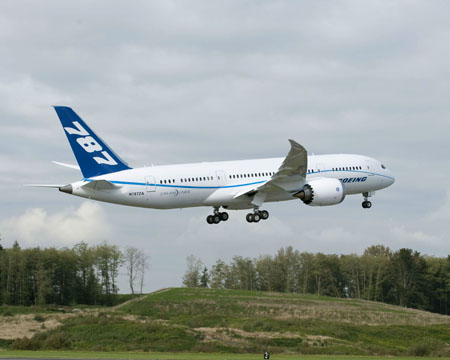
    Sixth Boeing 787 Makes First Flight, Testing Program Making Good Progress

    EVERETT, Wash., Oct. 4 — The final Boeing 787 Dreamliner to join the flight test fleet made its first flight today from Paine Field in Everett, Wash. The airplane, ZA006, is the second 787 equipped with General Electric GEnx engines to fly.

    Captains Christine Walsh and Bill Roberson were at the controls during the 1 hour and 4 minute flight. The airplane landed at Boeing Field at 12:45 p.m. (Pacific time).

    “It’s great to have our last flight test airplane join the fleet,” said Scott Fancher, vice president and general manager of the 787 program. “We have been focused on completing the testing required for certification of the 787 with Rolls-Royce engines, because that is the first model we deliver. A great deal of the testing that we’ve done also applies to the 787s with GE engines and won’t need to be repeated,” said Fancher.

    There is, however, a smaller portion of testing that is unique to the engine/airframe combination. In general, this portion includes noise testing, extreme weather operations, function and reliability, and extended operations. In addition, testing to verify the airplane handles the same regardless of engine type and that the systems work on both models is required.

    Some additional flight tests will be performed on one of the production airplanes, the ninth 787 to be built, but it is not considered a full-time member of the flight test fleet.
    787 Testing Progress Report

    In addition to achieving first flight of ZA006, the Boeing test team has completed a number of flight test milestones in recent weeks.

    Boeing wrapped up a series of natural and artificial icing tests, meeting all requirements with no changes required. Pilots reported that the airplane continues to handle well even in the presence of ice.
    Flight loads survey testing, which demonstrates the pressure distribution on the airplane structure throughout the phases of flight in a variety of configurations, also has been completed. The team conducted this testing on ZA004 primarily at the airport at Victorville, Calif. Analysis of this testing continues.

    A dramatic series of tests that stress the airplane’s brakes, called maximum brake energy testing, was completed in late September at Edwards Air Force Base, also in California. ZA001 conducted this testing as well as a series of extreme takeoff and landing conditions including minimum takeoff speed testing. Earlier in the month, ZA001 completed wet runway testing at Roswell, NM.
    ZA003 flew to Glasgow, Mont., to complete community noise testing. All results were within expectations.

    As a result of these tests and others, all takeoff performance and handling characteristics testing is complete for the initial version of the 787. Additional testing will be required for 787s equipped with GE engines.

    The 787 flight test program has logged more than 1,900 hours over 620 flights and completed more than 65 percent of the flight test conditions for 787s with Rolls-Royce engines.
    Equally important to the testing required in the air is the ground testing required to certify a new airplane. Boeing has completed well over 4,000 hours of ground testing on the same airplanes that are in the flight test program.

    In addition, fatigue testing has started at a test rig in Everett. Fifteen flights have been simulated. Federal regulations require Boeing to conduct twice as many flight cycles as any airplane in revenue service. Boeing plans to have completed 10,000 flight cycles prior to first delivery.
    “We continue to be extremely satisfied with the performance of the 787 in its testing operations,” said Fancher. “This airplane handles wonderfully and will be a valuable tool for our customers.”

    To include the featured image in your Twitter Card, please tap or click their icon a second time.
  • |

    SPACE STATION ASTRONAUTS TO CONNECT WITH CENTRAL FLORIDA STUDENTS

    WASHINGTON — International Space Station residents Scott Kelly, Cady Coleman and Paolo Nespoli will speak on Tuesday, Jan. 11, to 150 students from Kathleen High School’s Central Florida Aerospace Academy (CFAA) in Lakeland, Fla.

    The CFAA prepares students to go into advanced aerospace education or the aerospace industry. In 2009, the academy received an agency grant to develop a NASA-based science, technology, engineering and , or STEM, curriculum.

    The station astronauts will answer student questions on Jan. 11, from 11-11:20 a.m. EST. In preparation for the conversation with astronauts in space, the students have been participating in science activities, exploring careers in science with local scientists and engineers, studying a floor plan of the International Space Station and learning about experiments in microgravity.

    The event will air live on NASA Television and on the agency’s website. Media interested in attending this event should contact Obie Young at 407-341-3072 by 2 p.m. Monday, Jan. 10.

    The live downlink will be shared with other students through the Florida Aviation Network, the Federal Aviation Administration Training Network and the Government Educational Training Network. This will give approximately 93,000 students in Polk County’s K-12 classrooms the opportunity to watch the event.

    NASA astronauts Kelly and Coleman and Nespoli of the European Space Agency are conducting science experiments aboard the space station. Kelly serves as the Expedition 26 commander until March when he returns home. Coleman and Nespoli will complete their station mission in May.

    This live, in-flight education downlink is one in a series with educational organizations in the U.S. and abroad to improve teaching and learning in STEM subjects. It is an integral component of Teaching From Space, a NASA education program. Teaching From Space promotes learning opportunities and builds partnerships with the education community using the unique environment of space and NASA’s human spaceflight program.

    For NASA TV downlink, schedule and streaming video information, visit:

    http://www.nasa.gov/ntv

    To include the featured image in your Twitter Card, please tap or click their icon a second time.
  • |

    Dreamlifter enters Service

    EVERETT, Wash., Feb. 16 /PRNewswire-FirstCall/ — The fourth Boeing (NYSE: BA) Dreamlifter – the final airplane in the fleet of specially modified 747-400s – entered service today. Dreamlifters transport the large composite structures of the 787 Dreamliner from partners around the world to Everett, Wash. for final assembly. The unique airplane, which was modified by Evergreen Aviation Technologies Corp. in Taipei, Taiwan, took off from Paine Field in Everett early this morning. Bound for Wichita, Kan., the Dreamlifter is returning the equipment used to transport the forward fuselage section known as section 41. The airplane’s registry is N718BA.
    Neg. K64881

    To include the featured image in your Twitter Card, please tap or click their icon a second time.
  • FAA Proposes $1.45 Million Civil Penalty against Northwest Airlines

    For Immediate Release
    March 23, 2010

    FAA Proposes $1.45 Million Civil Penalty against Northwest Airlines

    WASHINGTON, D.C. – The Federal Aviation Administration (FAA) has proposed a $1.45 million civil penalty against Northwest Airlines for operating a number of its Boeing 757 aircraft without proper windshield wiring inspections.

    A 1990 FAA airworthiness directive on Boeing 757s required inspections for the presence of undersized wires in the heating system for both the captain’s and first officer’s windows, and replacement if needed. Left uncorrected, the problem could cause overheating, smoking and possibly a fire.

    Northwest wrote maintenance instructions for its mechanics in April 1990 that omitted the required inspection of the wires under the first officer’s window. As a result, 32 of the carrier’s 757s flew more than 90,000 passenger flights between December 1, 2005 and May 27, 2008, while not in compliance with the airworthiness directive.

    “Safety is the number one priority for the Department of Transportation,” said Transportation Secretary Ray LaHood. “The FAA has airworthiness directives for a reason and carriers cannot pick and choose when they want to comply.”

    On May 28, 2008, Northwest discovered it had not performed the proper inspections and revised its maintenance instructions. However, the instructions did not require the work be performed before further flight, but at the next planned overnight layover. As a result, 29 of the 32 aircraft flew 42 passenger-carrying flights while they were still out of compliance with the airworthiness directive.

    “When an air carrier realizes that an airworthiness directive is not being followed the problem must be corrected immediately,” said FAA Administrator Randy Babbitt. “Safety cannot wait for the next scheduled maintenance.”

    The airline has 30 days from the receipt of the FAA’s civil penalty letter to respond to the agency.

    ###

    To include the featured image in your Twitter Card, please tap or click their icon a second time.