FAA Proposes $1.45 Million Civil Penalty against Northwest Airlines

Similar Posts

  • |

    FAA Celebrates Completion of San Francisco International Airport Recovery Act Projects

    For Immediate Release
    August 27, 2010

    SAN FRANCISCO — The U.S. Department of Transportation’s Federal Aviation Administration (FAA) today marked the completion of $14.5 million in runway projects funded by the American Recovery and Reinvestment Act of 2009 (ARRA) that will ensure continued safety for flights at San Francisco International Airport (SFO).
    “The Recovery Act made it possible for this important safety work to happen ahead of schedule,” said U.S Transportation Secretary Ray LaHood. “These projects kept workers in good-paying jobs, and these safety improvements will benefit the airport and passengers for years to come.”

    On Friday, FAA Administrator Randy Babbitt marked the completion of the work at an event at San Francisco International Airport. A $5.5 million ARRA grant allowed the Runway 10L/28R project to be completed a year ahead of schedule. Runway 1R/19L was also completed two years ahead of schedule thanks to a $9 million ARRA grant.
    “Healthy runways are safe runways,” said Administrator Babbitt. “Old pavement can crumble, creating debris that can damage aircraft and shut runways down causing delays for passengers.”

    The Recovery Act-funded projects leveled out two runways that tend to settle over time because of ground conditions. The new asphalt concrete resurface also will prevent unexpected runway shutdowns due to pavement breakdown, and will guard against crumbling pavement creating debris that can damage aircraft. The work also included: paving both runways with asphalt concrete; reconstructing sections of the runways; upgrading the runway and taxiway lighting systems with more energy efficient LED lighting; re-painting runway markings to increase visibility and improve safety for aircraft on the airfield; and improving the surrounding drainage system.
    Granite Rock Company of Watsonville, Calif. was the prime contractor for both projects, which required 92,000 tons of asphalt concrete covering 3.46 million square feet of runways. Work on both runway projects was done on the weekends to minimize disruption to the traveling public.

    The Recovery Act funded an additional $22.4 million in upgrades to airports and facilities in and around the San Francisco Bay Area.

    At Oakland International Airport, $14.9 million in Recovery Act funding is being used in the reconstruction of a large apron area used by airlines and cargo carriers and to reconfigure a taxiway. By replacing old apron pavement, the project will improve efficiency and allow larger aircraft to use the taxiway.

    In San Jose, a $5.17 million Recovery Act grant is funding the extension a taxiway at Norman Y. Mineta San Jose International Airport. This project, which was recommended by an FAA Runway Safety Action Team, will improve safety by eliminating the need for private planes to cross a runway while taxing to an engine run-up area.

    An additional $2.4 million in Recovery Act funds is being employed to modernize and make safety upgrades at area facilities and airports.
    Nationwide, $1.3 billion in Recovery Act money has been made available for both airport improvement projects and air traffic control facility and system upgrades. These Recovery Act grants have been distributed to airports that serve commercial passengers, cargo and general aviation.

    To include the featured image in your Twitter Card, please tap or click their icon a second time.
  • |

    OAG Reports Air Travel Growth, Over 285 Million Seats Offered Worldwide

    WASHINGTON, Feb. 10, 2011 /PRNewswire/ — OAG (www.oag.com), the global leader in aviation intelligence reports that worldwide scheduled airline capacity increased 5% in February, year-on-year, to a total of 285.7 million seats. The number of flights increased 4%, to 2.3 million departures worldwide during the month.
    In its monthly Frequency and Capacity Trend Statistics (FACTS) report, OAG finds all regional markets recorded year-on-year growth in February, with the exception of capacity to and from Central and South America. This region lost 3% of its seat capacity, when compared to the same month last year, feeling the impact again this month of the loss of Mexicana services.

    Although capacity fell in Central and South America, overall; within Lower South America, scheduled capacity increased 12% year-on-year. The Brazilian market is showing the strongest growth in the region, with a 14% increase in domestic capacity in February compared to the same time last year.
    “The current expansion in some South American markets may be at the height of a growth period. The impending rationalization of carriers in the region, and the development of larger alliances such as that proposed by the LAN Group and TAM, could lead to capacity consolidation as network rationalization occurs,” said Peter von Moltke, Chief Executive Officer, UBM Aviation.

    Year-on-year, the two fastest growing markets in the world are those to and from the Middle East, and to and from Asia Pacific, in terms of frequency of service. The total number of flights offered to and from the Middle East grew 13% to a total of 49,014; flights to and from Asia Pacific increased 13% to a total of 55,965.

    Scheduled frequency and capacity to and from Europe was the second fastest growing region among the largest markets with scheduled capacity increasing by 11%, to a total of 21.3 million seats; frequencies increased 10%, to a total of 93,558. Growth within Europe, however, increased a modest 2% in both seat capacity and the total number of flights to a total of 59.5 million seats and 493,150 flights.

    “Medium to long haul carriers continue to build their presence in European markets, with the objective of securing greater shares of the longer haul markets, which traditionally deliver higher yields,” continued von Moltke. “Carriers such as Emirates, Etihad and Qatar Airways will continue to increase flights and open new markets as their development progresses, and increased frequencies to a number of European destinations are expected by these airlines throughout the year.”

    The number of scheduled services both within and to and from North America remained constant year-on-year, although a slight increase in average capacity per flight resulted in more seats being offered. Total capacity to and from this region increased 3%, to a total of 15.5 million.

    This data comes from the February 2011 edition of OAG FACTS (Frequency And Capacity Trend Statistics), a monthly report with interactive graphs to display performance trends of specific airports, routes, countries or regions, sourced from OAG’s consolidated database of global airline schedules. A more detailed review of this month’s OAG FACTS statistics – including information about specific regions, routes and airports – is available to download at: (http://www.oagaviation.com/OAG-FACTS-February-2011-EXECUTIVE-SUMMARY

    To include the featured image in your Twitter Card, please tap or click their icon a second time.
  • |

    Boeing Marks a Milestone With Rollout of 1,000th 767


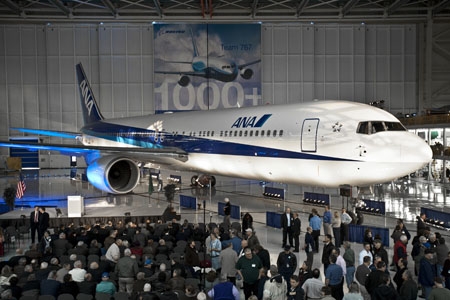
    EVERETT, Wash., Feb. 2, 2011 /PRNewswire/ — Boeing (NYSE: BA) marked a proud moment in the company’s history today at a ceremonial rollout of the 1,000th 767 airplane. Hundreds of current employees, joined by Boeing retirees who worked on the first 767, gathered to celebrate the occasion at the Everett, Wash., factory.

    “It was great to see so many people here today – the engineers, the technicians, the machinists – who have made the 767 the wonderful airplane it is,” said Jim Albaugh, president and CEO of Boeing Commercial Airplanes. “As we salute the 1,000th 767, the next 767 is already being built in a new bay where we can produce airplanes much more efficiently for years to come. We hope many of the new 767s will become U.S. Air Force tankers built right here.”

    The 1,000th airplane is a 767-300ER (extended range) passenger model for ANA (All Nippon Airways) and was the final 767 to complete assembly on the current production line. Final production work already is underway on the 1,001 unit in a new, smaller bay that repositions the production line toward a leaner, more efficient operation.

    Today’s milestone is a chance for the 767 family to celebrate its past, present and future showcased in this video: http://bit.ly/eMZIVv.
    Boeing has offered the 767 as the platform for its NewGen Tanker if it wins the U.S. Air Force KC-X Tanker competition. A decision on the contract award is expected early this year.

    The 767 family is a family of clean, quiet, fuel-efficient airplanes that provide maximum market versatility in the 200- to 300-seat market. The 767 family includes three passenger models – the 767-200ER, 767-300ER and 767-400ER – and a medium-widebody freighter, which is based on the 767-300ER fuselage.

    To include the featured image in your Twitter Card, please tap or click their icon a second time.
  • |

    Press Release – FAA Raises Safety Rating for Croatia

    For Immediate Release
    January 26, 2011

    The FAA Announced that Croatia Complies with International Safety Standards Set by the International Civil Aviation Organization

    WASHINGTON, D.C. – The U.S. Department of Transportation’s Federal Aviation Administration (FAA) today announced that Croatia complies with international safety standards set by the International Civil Aviation Organization (ICAO), based on the results of a reassessment of Croatia’s civil aviation authority.

    Croatiahas made significant progress and is now upgraded from the Category 2 safety rating the country received in September 2008 to Category 1.

    A Category 1 rating means the country’s civil aviation authority complies with ICAO standards. A Category 2 rating means a country either lacks laws or regulations necessary to oversee air carriers in accordance with minimum international standards, or that its civil aviation authority – equivalent to the FAA for aviation safety matters – is deficient in one or more areas, such as technical expertise, trained personnel, recordkeeping or inspection procedures.

    With the International Aviation Safety Assessment (IASA) Category 2 rating, Croatian air carriers could not establish new service to the United States. Now with the Category 1 rating, Croatian air carriers will be able to establish new service to the United States.

    As part of the FAA’s IASA program, the agency assesses the civil aviation authorities of all countries with air carriers that operate or have applied to fly to the United States and makes that information available to the public. The assessments determine whether or not foreign civil aviation authorities are meeting ICAO safety standards, not FAA regulations.

    Countries with air carriers that fly to the United States must adhere to the safety standards of ICAO, the United Nations’ technical agency for aviation that establishes international standards and recommended practices for aircraft operations and maintenance.

    IASA information is at www.faa.gov/about/initiatives/iasa/

    To include the featured image in your Twitter Card, please tap or click their icon a second time.
  • |

    Boeing Production Rate Increase

    SEATTLE, May 17 — Boeing (NYSE: BA) today announced that it will increase production rates on the Next-Generation 737 program to 34 airplanes per month in early 2012. The planned rate increase is aimed at satisfying continued strong demand for the Next-Generation 737. In addition, the company continues to study further potential 737 rate increases, given continued customer demand.

    “With over 5,200 sold to date, the Next-Generation 737 is the workhorse in our customers’ fleets around the world,” said Boeing Commercial Airplanes President and CEO Jim Albaugh. “Even through the global economic downturn, our diverse 737 backlog has remained very strong. Increasing the 737 production rate is the right thing to do to meet the growth and fleet replacement needs of our customers.”
    The current production rate on the 737 program is 31.5 airplanes per month. Suppliers for the 737 program are prepared to support the rate increase. The production rate decision is not expected to have a material impact on 2010 financial results.

    “The global economy continues to recover this year and we believe that airlines will return to profitability in 2011,” said Randy Tinseth, vice president of Marketing for Boeing Commercial Airplanes. “We believe that there will be an increased demand for airplanes – especially in the market served by the Next-Generation 737 – in 2012 and beyond.”
    With more than 2,000 unfilled orders from more than 80 customers around the world, the Next-Generation 737 is the newest and most technologically advanced airplane in its class. Airfinance Journal’s investors’ and operators’ poll consistently ranks the Next-Generation 737 as the most preferred airplane in its class due to its wide market base, superior efficiency and lowest operating costs.

    Forward-Looking Information is Subject to Risk and Uncertainty
    Certain statements in this report may be “forward-looking” within the meaning of the Private Securities Litigation Reform Act of 1995. Words such as “expects,” “intends,” “plans,” “projects,” “believes,” “estimates,” “targets,” “anticipates,” and similar expressions are used to identify these forward-looking statements. Forward-looking statements are based upon assumptions about future events that may not prove to be accurate. These statements are not guarantees of future performance and involve risks, uncertainties and assumptions that are difficult to predict. Actual outcomes and results may differ materially from what is expressed or forecasted in these forward-looking statements. As a result, these statements speak to events only as of the date they are made and we undertake no obligation to publicly update or revise any forward-looking statements, whether as a result of new information, future events or otherwise, except as required by federal securities laws. Specific factors that could cause actual results to differ materially from forward-looking statements include, but are not limited to, statements we make regarding our guidance relating to future financial and operating performance, the effect of economic conditions in the United States and globally, and general industry conditions as they may impact us or our customers, as well as the other important factors disclosed previously and from time to time in our other filings with the Securities and Exchange Commission.

    To include the featured image in your Twitter Card, please tap or click their icon a second time.
  • |

    NTSB PROVIDES INVESTIGATIVE UPDATE AND PHOTO OPPORTUNITY OF LAB WORK RELATED TO BOEING 787 BATTERY FIRE IN BOSTON


    January 23, 2013
    WASHINGTON – Tomorrow, National Transportation Safety Board Chairman Deborah A.P. Hersman will provide an update on the NTSB’s investigation of the Jan. 7 fire aboard a Japan Airlines (JAL) Boeing 787 at Logan International Airport in Boston.

    Chairman Hersman will brief credentialed members of the news media on the progress of the investigation, after which she and senior staff will take questions. Those unable to attend in person can call in to a teleconference line.

    Reporters will then be invited to view the materials laboratory where the battery is being examined. Photography will be allowed but no “stand-ups” or taped reporting from the lab will be permitted.

    For planning purposes, RSVP is required for those planning to either attend in person or call in.

    Location: NTSB Boardroom and Conference Center, 429 L’Enfant Plaza East, SW, Washington, DC

    Date: Thursday, January 24, 2013

    Time: 2:30 p.m.

    Participants: Chairman Deborah A.P. Hersman; John DeLisi, Director of NTSB Office of Aviation Safety; and Dr.
    Joseph Kolly, Director, NTSB Office of Research and Engineering.

    The following factual information has been developed about the battery: It consists of eight cells of 3.7 volts each. All eight cells had varying degrees of thermal damage. Six of eight cells have been CT scanned and have been disassembled to expose their electrodes. All electrode windings in the battery are in the process of being photo-documented and are undergoing microscopic examination. In the coming days, the remaining two cells will undergo the same examination. Additional information will be provided tomorrow.

    To include the featured image in your Twitter Card, please tap or click their icon a second time.