|

Boeing Joins ProActive Technologies Team in Bid for B-52 Aircrew Training System

Similar Posts

  • | | | | |

    Quantas Engine Shut Down


    Click to view full size photo at Airliners.net
    Contact photographer Songyuan Andy Zheng

    What: Qantas Boeing 737-400 en route from Melbourne to Canberra
    Where: Canberra on Mar 14th 2010
    When: Mar 14th 2010
    Who: 147 passengers
    Why: While en route, one engine experienced “thrust loss.” The crew shut down the affected engine, but was able to continue to their destination.

    To include the featured image in your Twitter Card, please tap or click their icon a second time.
  • |

    American Way Magazine Commemorates 45 Years of Publication With a Full Redesign


    FORT WORTH, Texas, Jan. 11, 2011 /PRNewswire/ — American Way, the award-winning inflight magazine of American Airlines and American Eagle, commemorates 45 years of publication with a redesign which debuts with the first issue of 2011, onboard planes now.

    “American Way is still the only inflight magazine published twice monthly, which is a great service to our frequent travelers,” said Susan Gordon, American Airlines Publishing President and Group Publisher. “We pride ourselves on consistently delivering an industry leading magazine to our customers, so it makes sense to redesign the magazine as our culture changes.”

    Most notable will be the new American Way masthead, inspired by the typeface on a 1930s-era American Airlines DC-3. Redesigned departments include the combination of UpFront and DownLow to create a new super-department called Itineraries, as well as the addition of Briefs, which highlights both a celebrity and a destination.

    “The goal was to bring a more contemporary and graphically pleasing palate to the magazine, while continuing to serve our readers as an invaluable source of information and entertainment,” said David Radabaugh, American Way Design Director.

    Other changes include the addition of new maps and helpful widgets, the organization of stories in a more reader-friendly format, and incorporating an unconventional approach to original photography and illustration. Every issue can be found online in its entirety at www.americanwaymag.com.

    To include the featured image in your Twitter Card, please tap or click their icon a second time.
  • | | |

    Caribbean Airlines Flight Makes Emergency Landing in Port of Spain

    Caribbean Airlines flight BW-552 made an emergency landing in Port of Spain, Trinidad and Tobago, on August 29th.

    The Boeing 737-800 plane heading from Saint Vincent, Saint Vincent and the Grenadines, to John F. Kennedy International Airport, New York, was diverted due to a bird strike.

    The plane landed safely. All passengers and crew members remained unharmed.

    To include the featured image in your Twitter Card, please tap or click their icon a second time.
  • |

    NTSB ISSUES UPDATE ON JACKSON HOLE B-757 RUNWAY OVERRUN INCIDENT

    NTSB Advisory
    National Transportation Safety Board
    Washington, DC 20594
    December 31, 2010

    In its continuing investigation of the runway overrun of a jetliner in Jackson Hole, Wyo., the National Transportation Safety Board has developed the following factual information:

    At about 11:38 am MT on Wednesday, December 29, American Airlines flight 2253, a B-757-200 (N668AA) inbound from Chicago O’Hare International Airport, ran off the end of runway 19 in snowy conditions while landing at Jackson Hole Airport. No injuries were reported among the 181 passengers and crew on board.

    The aircraft came to rest in hard packed snow about 350 feet beyond the runway overrun area. An initial inspection did not reveal any structural damage to the aircraft. Shortly after the aircraft came to a stop, in accordance with American Airlines’ procedures, the pilots pulled the circuit breaker to the cockpit voice recorder (CVR) to preserve all of the recorded information for investigators.

    The CVR and DFDR (digital flight data recorder) arrived at the Safety Board’s recorder laboratory on Thursday evening, Dec. 30, where investigators were standing by to download the contents of both recorders. The CVR provided a two-hour recording of excellent quality audio; the voices of each of the pilots on the flight deck were clearly audible. The DFDR provided 1200 recorded parameters of flight data and captured the entire incident.

    The crew, who were interviewed on Thursday evening, indicated that they saw the runway prior to reaching the minimum descent altitude before touchdown. Both crewmembers characterized the flight and approach to landing as uneventful prior to the runway overrun. The first officer was the flying pilot.

    The accident docket, which will contain additional factual information, is expected to be opened in 60-90 days. It will be available on the docket section of the NTSB website at http://go.usa.gov/rjR

    PROTOCALS FOR TRANSPORTING AIRCRAFT RECORDERS IN INCIDENT INVESTIGATIONS

    The Safety Board has long-established protocols for the handling and transportation of CVRs and DFDRs that contain recorded information from a commercial aviation incident, which by definition is one where no serious injuries or substantial damage to the aircraft or other property has occurred.

    In such incident investigations, the Safety Board frequently asks the airline involved to transport the recorders on their own aircraft as such an arrangement often provides the most expeditious means of conveying the devices to Safety Board labs in Washington. The airline is instructed to transport the recorders without delay and without accessing the information contained within them by any means. This practice has worked efficiently and without complication for more than 40 years.

    During this incident investigation, the Safety Board learned that the recorders were flown to Tulsa, Okla., where American Airlines technicians downloaded information from the DFDR; the CVR was not accessed by American.

    “Although a thorough examination by our investigators determined that no information from the DFDR was missing or altered in any way, the breach of protocol by American Airlines personnel violates the Safety Board’s standards of conduct for any organization granted party status in an NTSB investigation,” said NTSB Chairman Deborah A.P. Hersman. “Because maintaining and enforcing strict investigative protocols and procedures is vital to the integrity of our investigative processes, we have revoked the party status of American Airlines and excused them from further participation in this incident investigation.”

    American Airlines has assured the Safety Board that a full review of proper procedures and internal controls would be undertaken to ensure that such an occurrence is not repeated.

    Despite their removal from party standing, the NTSB will provide American Airlines with any and all information needed to ensure a timely response to operational safety deficiencies identified in the course of the investigation.

    To include the featured image in your Twitter Card, please tap or click their icon a second time.
  • | | |

    Dreamliner Test Emergency Landing


    Click to view full size photo at Airliners.net
    Contact photographer Royal S King

    What: Boeing 787 Dreamliner test flight
    Where: Laredo, Texas
    When: Nov 9, 2010 at 2:54 pm
    Who: 42 person crew on board
    Why: Boeing is performing flight tests with Rolls-Royce and with General Electric engines.

    During the test flight, the pilots made an emergency landing. This was sue to smoke in the cabin attributed to electrical problems in the aft electronics bay; and this disabled the primary flight displays in the cockpit.

    The crew disembarked via slides on to the runway with one injury.
    Click below to see video

    To include the featured image in your Twitter Card, please tap or click their icon a second time.
  • |

    Boeing Celebrates Final Assembly of 1,000th 767

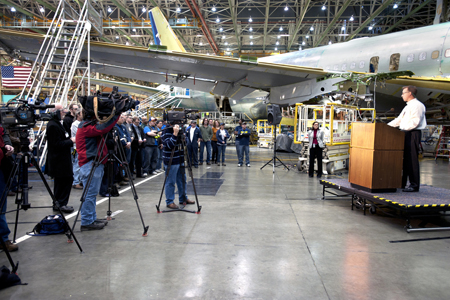
    EVERETT, Wash., Jan. 10, 2011 — Final assembly started today on the 1,000th Boeing (NYSE: BA) 767 airplane. Workers marked the milestone with a celebration at the Everett, Wash. factory.

    “This milestone is a credit to every employee who had a hand in building 767s over the past 30 years,” said Kim Pastega, vice president and general manager of the 767 program, Boeing Commercial Airplanes. “It is a testament to engineering a high-quality product that continues to improve through the years.”

    Final assembly is the last step of the production process before the airplane rolls out of the factory on its way to the paint hangar and the Everett Delivery Center for ground and flight tests. The 1,000th airplane – a 767-300ER (extended range) passenger model for ANA (All Nippon Airways) – is the last 767 to complete final assembly in its current home. Beginning with line number 1001 – also a 767-300ER for ANA – all future 767s will complete that step in a new, smaller bay where production is scheduled to increase in 2011.

    The 1,000th airplane is scheduled for delivery next month. ANA, a long-time Boeing customer, has taken delivery of 89 767s since placing its first order in 1979.

    Boeing will use the 767 as the platform for its NewGen Tanker if it wins the U.S. Air Force KC-X Tanker competition. That contract award currently is scheduled for early this year.

    The 767 family is a family of clean, quiet, fuel-efficient airplanes that provide maximum market versatility in the 200- to 300-seat market. The 767 family includes three passenger models — the 767-200ER, 767-300ER and 767-400ER — and a medium-widebody freighter, which is based on the 767-300ER fuselage.

    To include the featured image in your Twitter Card, please tap or click their icon a second time.