NTSB SENDING TEAM TO ASSIST GOVERNMENT OF LIBYA IN AVIATION ACCIDENT INVESTIGATION

Similar Posts

  • IATA Release: Global Traffic Falls 2.4% in April – Volcano Dents Recovery

    Geneva – The International Air Transport Association (IATA) announced international scheduled air traffic results for April 2010. Passenger demand slumped by 2.4% as a result of massive flight cancellations centered in Europe during the six days in April following the eruptions of an Icelandic volcano. The fall in traffic interrupted the industry’s recovery from the global financial crisis.

    International scheduled cargo traffic, less impacted by the cancellations, saw the pace of its recovery slow to 25.2% growth in April (down from the 28.1% improvement recorded in March).

    “The ash crisis knocked back the global recovery – impacting carriers in all regions. Last month, we were within 1% of pre-crisis traffic levels in 2008. In April, that was pushed back to 7%,” said Giovanni Bisignani, IATA’s Director General and CEO.

    “European carriers bore the worst of the volcano’s impact. Their 11.7% drop in passenger traffic could not have come at a worse time. Europe’s slow recovery from the global financial crisis and its currency crisis are already a huge burden on the profitability of its airlines. The uncoordinated and excessive cancellations and unfairly onerous passenger care requirements rubbed salt into the European industry’s wounds,” said Bisignani.

    The April drop in demand in Europe can be attributed to both the flight cancellations (two-thirds of the total decline) and follow-on cancellations due to uncertainty of the availability of air travel (one-third). Early indications for May show a rebound in travel from the disrupted levels in April.

    Looking ahead, Bisignani challenged Europe to reform its air traffic management. “The ash crisis was an embarrassing wake-up call for European governments. We need leadership to deliver the Single European Sky, fair passenger rights legislation and continent-wide coordination,” said Bisignani.

    The scale of the ash crisis saw global load factors drop to 76.9% from the 78.0% recorded in March. Freight load factors also dipped to 55.3% from the 57.1% recorded in the previous month. While March traffic was within 1% of pre-crisis levels for both passenger and cargo, this slipped to 7% for passenger and 3% for cargo in April.

    International Passenger Demand
    The ash crisis accentuated the asymmetrical nature of the economic rebound.

    European carriers posted an 11.7% demand drop in April (compared to a 6.2% increase in March). Uncertainty of service reliability in the aftermath of the ash cancellations and major unrest in Greece as a result of the currency crisis added to the weaker European demand during the month. Limited GDP growth expectations of 0.9% continue to dampen demand across the continent.
    North American carriers posted a 1.9% decline in demand, primarily as a result of the impact of the ash crisis on North Atlantic routes. This is a major step backwards from the 7.8% growth recorded in March. This fall in demand was less than half the 4.5% cut in capacity, pushing load factors to 80.2%.
    Asia-Pacific carriers saw their strong growth slow to 3.5% (from the 12.9% growth recorded in March). Robust GDP growth of 7% (Asia excluding Japan) is supporting the strong recovery.
    Middle Eastern airlines recorded the strongest traffic growth at 13.0%, which is about half the 25.9% increase of the previous month.
    African carriers also saw their recovery slow to 8.6% growth in April, down from the 16.9% growth recorded during the previous month.
    Latin American carriers posted a 1.2% increase for the month, a quarter of the 4.6% growth recorded in March, which was already a weak month as a result of the Chilean earthquake.
    International Cargo Demand
    Air freight was also impacted by the ash crisis, although less dramatically than passenger traffic. The global purchasing managers’ index rose to its second highest level ever in April, indicating that the fundamentals of the air freight business were not impacted by the crisis. We are, however, nearing the end of the inventory cycle and would expect freight growth to slow down over the rest of the year.

    European carriers showed the weakest growth at 8.3%, down from the 11.5% growth recorded in March. Poor economic performance prior to the ash crisis had seen European airlines lagging behind the rebound experienced by other regions.
    North American carriers recorded a 23.8% increase. While impressive, this was still below the 29.0% recorded in March.
    Asia-Pacific carriers, which make up 46% of international cargo operations, recorded growth of 33.2%, slightly below the 35.4% recorded during March.
    Middle Eastern carriers saw their growth rate slow to 25.9% from the 35.5% recorded in March.
    Latin American carriers saw the largest increase in cargo demand for the second straight month with a 63.0% increase – an improvement on the 47.9% recorded in March.
    African carriers also showed an improvement, from 51.4% in March to 54.6% in April.
    “The ash crisis was a shock. While there is always a danger of the consequences of renewed volcanic eruptions, the impact on passenger confidence should be limited. Unfortunately, we are trading ash for two additional uncertainties – strikes and a growing currency crisis – both of which are also focused on Europe,” said Bisignani.

    “The labor unrest plaguing Europe this year is unbelievable. It’s a tough competitive world. Airlines need to reduce costs to be competitive. Labor must realize that their pay checks are supported by the performance of the company. The middle of a very fragile recovery is not the time for striking. This mentality is divorced from reality,” said Bisignani.

    To include the featured image in your Twitter Card, please tap or click their icon a second time.
  • Press Release: Aviation and climate change the focus of ICAO Environmental Colloquium

    From 11 to 14 May, strategies and programmes of ICAO, industry, academic/research institutions and international organizations to harness technological, scientific and economic solutions in the global fight against climate change will be reviewed. This includes key developments from the 15th Conference of the Parties (COP/15) of the United Nations Framework Convention on Climate Change, as well as two ICAO events – the Conference on Aviation and Alternative Fuels and the 8th Meeting of the Committee on Aviation Environmental Protection.

    The Colloquium provides a timely context for the exchange of views on aviation and climate change in anticipation of environment-related discussions and high-level decision-making at the 37th Session of the ICAO Assembly in September 2010.

    A one-day tutorial on 11 May will present a broad overview of aviation greenhouse gas emissions (GHG) and familiarize participants with the vocabulary and concepts used in the description, measurement, regulation, and management of aviation GHG emissions.

    Visit the home of the third ICAO Environmental Colloquium

    To include the featured image in your Twitter Card, please tap or click their icon a second time.
  • |

    Azerbaijan Airlines Orders Boeing 767-300 Passenger and Freighter Models

    FARNBOROUGH, United Kingdom, July 22 /PRNewswire-FirstCall/ — Boeing (NYSE: BA) and Azerbaijan Airlines have signed an agreement to substitute two Next-Generation 737 airplanes for one 767-300ER (extended range) and two 767 Freighters, a new model type for the Baku, Azerbaijan-based airline. The substitution has been updated on Boeing’s Orders and Deliveries website.

    “With our centralized geographic location, Azerbaijan is becoming a busy hub in the region between east and west and north and south,” said Jahangir Askerov, president of Azerbaijan Airlines. “We are capitalizing on this development by expanding our long-haul passenger fleet and growing our cargo business with the proven efficiencies of the 767 Freighter.”
    Including today’s announcement, Azerbaijan Airlines has a total of eight Boeing airplanes on order: two 767-300ERs, two 767 Freighters, two Next-Generation 737s and two 787-8s.

    “With the economic recovery gaining momentum at various speeds around the world, our customers are making changes to their fleets to accommodate the upturn,” said Marlin Dailey, vice president of Sales, Boeing Commercial Airplanes. “We have worked with Azerbaijan Airlines to make changes to its order book that meet its needs.”
    The Boeing 767 family is a complete family of clean, quiet, fuel-efficient airplanes that provide maximum market versatility in the 200- to 300-seat market. The Boeing 767 family includes three passenger models — the 767-200ER, 767-300ER and 767-400ER — and a medium-widebody freighter, which is based on the 767-300ER fuselage.

    To include the featured image in your Twitter Card, please tap or click their icon a second time.
  • | |

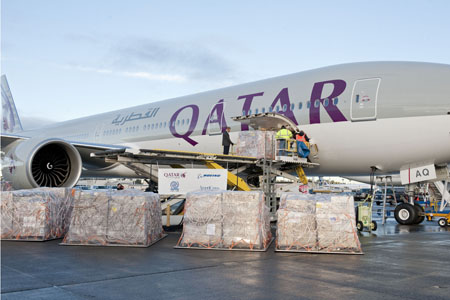
    Boeing, Qatar Airways, AmeriCares Partner for Relief Flight

    New Qatar Airways 777-300ER carries medical supplies to Pakistan
    EVERETT, Wash., Jan. 4, 2011 /PRNewswire/ — Boeing (NYSE: BA) again has partnered with Qatar Airways and the non-profit global health and disaster relief organization AmeriCares to deliver a second consignment of relief supplies to areas in Pakistan that are still recovering from the massive floods that ravaged the country in August. The first shipment was delivered in September 2010.

    A consignment of about 35,000 pounds (15.8 metric tones) of medical supplies was loaded into the cargo hold of the new Boeing 777-300ER (extended range) delivered to Qatar Airways. The airline subsequently will ship the relief goods from Doha, Qatar to Pakistan.

    “This is the second time in four months that Boeing has partnered with Qatar Airways and AmeriCares to help the people in Pakistan where the need is still great,” said Liz Warman, director of Global Corporate Citizenship Northwest Region, Boeing. “Providing timely medical care is critical; though the floods have receded, the aftereffects such as sickness and disease continue to affect the people in these disaster zones.”

    Over the years, Boeing and airline partners as well as non-profit partners in the Humanitarian Delivery Flights (HDF) program have collaborated on many humanitarian missions and the Boeing 777-300ER was used on a number of those missions.

    To include the featured image in your Twitter Card, please tap or click their icon a second time.
  • |

    Boeing’s India Commitment

    NEW DELHI, Feb. 9, 2010 — Boeing [NYSE: BA] will present world-class products and services including the F/A-18IN Super Hornet, C-17 Globemaster III, P-8I, AH-64D Apache and CH-47F Chinook to Indian government officials, military officers, and other valued stakeholders at Defexpo 2010. The exhibition takes place Feb. 15-18 at the Pragati Maidan complex in New Delhi.

    “This is an important year for Boeing Defense, Space & Security (BDS) in India,” said Vivek Lall, BDS vice president and India country head. “Many of our products and platforms are currently in competition or under active consideration by the government, and we are looking forward to demonstrating how they will quickly contribute to India’s defense modernization and bring long-term industrial benefits to the nation.”

    Boeing is kicking off its Defexpo participation with a preshow briefing for the media at noon on Thursday, Feb. 11, at the Taj Mansingh Hotel. During the show, BDS executives will invite stakeholders into an F/A-18IN Super Hornet cockpit simulator to demonstrate the aircraft’s advanced features, including its superior air-to-ground and air-to-air capabilities. Boeing also will provide media briefings on the C-17 Globemaster III and on two Boeing Rotorcraft products in current competitions — the CH-47F Chinook and AH-64D Apache. An Airborne Battle Management briefing will cover Airborne Early Warning and Control as well as the P-8I long-range maritime patrol and anti-submarine aircraft. India selected the P-8I for its navy last year; the first of eight aircraft is scheduled to enter the fleet in 2013.

    Boeing’s online press kit at www.boeing.com/bds/mediakit/2010/defexpo will be updated throughout the show with presentations from the briefings and schedule changes, if any. The site also contains program backgrounders, executive biographies and a link to high-resolution photos.

    Note: All briefing times are local to New Delhi.

    Thursday, Feb. 11 – Taj Mansingh Hotel
    1200: Boeing India overview with Boeing India President Dinesh Keskar and BDS Vice President and Country Head Vivek Lall

    Tuesday, Feb. 16 – Defexpo Conference Hall
    1445: C-17 Globemaster III briefing with Business Development lead Patrick Druez

    Wednesday, Feb. 17 – Defexpo Conference Hall
    1200: Rotorcraft briefing with Business Development leads Dean Millsap and Wes Spreen

    1400: Airborne Battle Management briefing with New Business Development Director Tim Norgart

    A unit of The Boeing Company, Boeing Defense, Space & Security is one of the world’s largest defense, space and security businesses specializing in innovative and capabilities-driven customer solutions, and the world’s largest and most versatile manufacturer of military aircraft. Headquartered in St. Louis, Boeing Defense, Space & Security is a $34 billion business with 68,000 employees worldwide.

    # # #

    To include the featured image in your Twitter Card, please tap or click their icon a second time.
  • |

    FAA Reauthorization Critical to Civil Challenges

    ARLINGTON, Va., Feb. 9, 2011 /PRNewswire-USNewswire/ — The Next Generation Air Transportation System is at the nexus of accomplishing two significant goals facing the U.S. civil aviation industry today—expanding our national airspace system and addressing growing environmental and energy concerns, said AIA President and CEO Marion C. Blakey in testimony today.
    “Our industry has employed the people, developed the technology and manufactured the products that have helped make the U.S. air transportation system the world’s gold standard for more than half a century,” Blakey said at a hearing of the House Transportation and Infrastructure Subcommittee on Aviation. “But to remain so, we need to bring our system into the 21st Century.”

    One of the challenges to realizing the benefits of NextGen is establishing a sound business case for equipping aircraft with upgraded avionics systems. AIA recommends equipage-funding legislation that encourages private-sector investment capital and government-guaranteed loan arrangements, including outcome-based performance metrics to reduce investment risk. This will allow for innovative ways to incentivize retrofitting of commercial and general aviation aircraft with NextGen compatible equipment.

    “Equipping aircraft is, as I’ve said before, the long pole in the tent,” said Blakey. “It’s an expensive undertaking, but it’s as much a part of the infrastructure as GPS satellites. Quite frankly, without equipage there is no NextGen.”

    Blakey also recommended that the existing environmental review process—the National Environmental Policy Act or NEPA process—be streamlined. The certification of thousands of new terminal area procedures are required for full NextGen implementation and including procedure development and certification in the Vision 100 Aviation Streamlining process will simplify that process.

    Other areas addressed by Blakey in her testimony included establishing integration of unmanned aircraft systems into the national airspace system, commercialization of sustainable fuels and foreign repair station oversight. T

    To include the featured image in your Twitter Card, please tap or click their icon a second time.