Victorian aerodrome flight safety checks
Special flight safety checks are being carried out at 18 Victorian aerodromes next week.
There will be a series of low-level flights at each aerodrome to make sure flight paths continue to operate safely.
A twin-engine Cessna Conquest aircraft will be used to conduct the safety checks within an area up to 35 kilometres from each aerodrome.
The two pilots flying the aircraft will ensure navigation aids are operational and not suffering interference, as well as looking for any new obstacles that could be a danger to aviation safety.
The Civil Aviation Safety Authority requires these checks to be carried out every three years to maintain a high level of air safety at aerodromes.
Low-level flying is an essential part of the safety exercise, with the aircraft down as low as several hundred feet at times.
Local residents may notice an uncommon flying pattern, but this is to make sure obstacles are accurately marked on charts and no new obstacles exist. Obstacles can be towers, trees, masts or buildings that can be a danger to aircraft.
The checks are scheduled to be carried out between Saturday 11 December and Sunday 19 December 2010.
If poor weather or other factors do not allow the safety checks to go ahead on the planned days they will be carried out as soon as possible.
CASA has contracted the operation of the special check flights out to Radiola Aerospace Pty Ltd – a company with wide international expertise in these specialist operations.
Naracoorte aerodrome flight safety checks
Special flight safety checks are being carried out at Naracoorte aerodrome next week.
There will be a series of low-level flights to make sure flight paths at the aerodrome continue to operate safely.
A twin-engine Cessna Conquest aircraft will be used to conduct the safety checks within an area up to 35 kilometres from the aerodrome.
The two pilots flying the aircraft will ensure navigation aids are operational and not suffering interference, as well as looking for any new obstacles that could be a danger to aviation safety.
The Civil Aviation Safety Authority requires these checks to be carried out every three years to maintain a high level of air safety at Naracoorte aerodrome.
Low-level flying is an essential part of the safety exercise, with aircraft down as low as several hundred feet at times.
Local residents may notice an uncommon flying pattern, but this is to make sure obstacles are accurately marked on charts and no new obstacles exist. Obstacles can be towers, trees, masts or buildings that can be a danger to aircraft.
The checks are scheduled to be carried out in the week starting Sunday 12 December 2010.
If poor weather or other factors do not allow the safety checks to go ahead on the planned days they will be carried out as soon as possible.
CASA has contracted the operation of the special check flights out to Radiola Aerospace Pty Ltd – a company with wide international expertise in these specialist operations.
Mount Gambier aerodrome flight safety checks
Special flight safety checks are being carried out at Mount Gambier aerodrome next week.
There will be a series of low-level flights to make sure flight paths at the aerodrome continue to operate safely.
A twin-engine Cessna Conquest aircraft will be used to conduct the safety checks within an area up to 35 kilometres from the aerodrome.
The two pilots flying the aircraft will ensure navigation aids are operational and not suffering interference, as well as looking for any new obstacles that could be a danger to aviation safety.
The Civil Aviation Safety Authority requires these checks to be carried out every three years to maintain a high level of air safety at Mount Gambier aerodrome.
Low-level flying is an essential part of the safety exercise, with aircraft down as low as several hundred feet at times.
Local residents may notice an uncommon flying pattern, but this is to make sure obstacles are accurately marked on charts and no new obstacles exist. Obstacles can be towers, trees, masts or buildings that can be a danger to aircraft.
The checks are scheduled to be carried out in the week starting Sunday 12 December 2010.
If poor weather or other factors do not allow the safety checks to go ahead on the planned days they will be carried out as soon as possible.
CASA has contracted the operation of the special check flights out to Radiola Aerospace Pty Ltd – a company with wide international expertise in these specialist operations.
To include the featured image in your Twitter Card, please tap or click their icon a second time.

 PARIS 21 July 2010 – MICHELIN andAIR FRANCE have signed a long term contract. Michelin has also signed a long term contract with the airline companiesKLM.
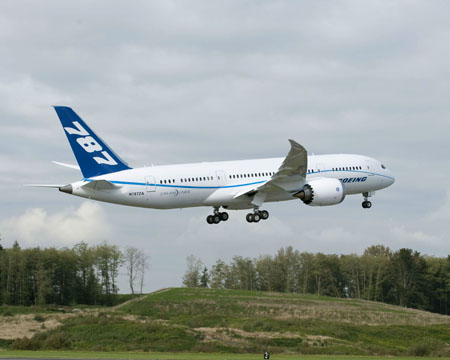 EVERETT, Wash., Oct. 4 — The final Boeing 787 Dreamliner to join the flight test fleet made its first flight today from Paine Field in Everett, Wash. The airplane, ZA006, is the second 787 equipped with General Electric GEnx engines to fly.
 Air France flight AF-4001 rejecting taking-off at Martinique Aimé Césaire International Airport, Forte de France, Martinique, France, on April 16th.