|

Massive flight cancellations into and out of Frankfurt – German domestic flights and connections to European destinations equally affected – Long-haul flights still being flown

Similar Posts

  • NTSB ASSISTS GOVERNMENT OF LEBANON IN AVIATION ACCIDENT


    NTSB Advisory
    National Transportation Safety Board
    Washington, DC 20594
    January 25, 2009

    NTSB ASSISTS GOVERNMENT OF LEBANON IN AVIATION ACCIDENT

    The National Transportation Safety Board will dispatch an aviation investigator to assist the government of Lebanon in its investigation of the crash of an Ethiopian Airlines B- 737-800 (ET-ANB) off the coast of Lebanon.

    At approximately 2:30 a.m. local time on January 25, the aircraft crashed into the Mediterranean Sea shortly after takeoff.

    NTSB Chairman Deborah A.P. Hersman has designated senior investigator Dennis Jones as the U.S. Accredited Representative. His team will include technical advisors from the Federal Aviation Administration and Boeing.

    The investigation is being conducted by the Directorate General of Civil Aviation of the Government of Lebanon, which will release all information on the progress of the investigation. The agency’s phone number in Lebanon is (961) 1 628195 and the agency’s email address is: dgca@beirutairport.gov.lb.

    To include the featured image in your Twitter Card, please tap or click their icon a second time.
  • |

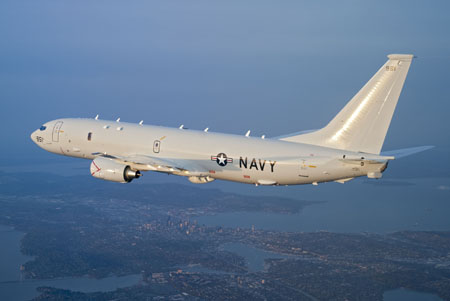
    Boeing Receives $1.6B Contract for P-8A Poseidon Low-Rate Initial Production


    SEATTLE, Jan. 25, 2011 — Boeing [NYSE: BA] on Jan. 21 received a $1.6 billion contract from the U.S. Navy for low-rate initial production (LRIP) of the P-8A Poseidon aircraft. The LRIP 1 contract is for six P-8A aircraft, spares, logistics and training devices.

    The Navy plans to purchase 117 of the Boeing 737-based P-8A anti-submarine warfare, anti-surface warfare, intelligence, surveillance and reconnaissance aircraft to replace its P-3 fleet. Initial operational capability is planned for 2013.

    “Providing these production aircraft to the Navy fleet on schedule is our No. 1 goal,” said Chuck Dabundo, Boeing vice president and P-8 program manager. “This is an exciting day for Boeing and the Navy and a testament to the P-8 team’s hard work and determination.”

    “This first production contract represents a significant commitment by the U.S. Navy to recapitalize its force of long-range maritime patrol and reconnaissance aircraft,” said Capt. Leon Bacon, P-8A deputy program manager for the Navy. “Ensuring that this capability arrives on schedule and within budget remains our primary objective.”

    Boeing will begin final assembly of the first LRIP aircraft at its Renton, Wash., facility this summer. The Poseidon team is using a first-in-industry in-line production process that draws on Boeing’s Next-Generation 737 production system. All P-8A-unique aircraft modifications will be made in sequence during fabrication and assembly.

    “The in-line approach we’ve incorporated on this military derivative aircraft is already paying the dividends we expected by helping us improve efficiency and reduce costs,” said John Pricco, Boeing Commercial Airplanes P-8 program manager.

    As part of the U.S. Navy System Development and Demonstration contract awarded to Boeing in 2004, the team is building and testing six flight-test and two ground-test aircraft. The first three flight-test planes, T1, T2 and T3, are completing testing at Naval Air Station Patuxent River, Md. The program’s static test plane, S1, recently completed its test program, which began in May 2009; S2, the fatigue test plane, will begin testing later this year.

    A derivative of the Next-Generation 737-800, the Poseidon is built by a Boeing-led industry team that includes CFM International, Northrop Grumman, Raytheon, Spirit AeroSystems, BAE Systems and GE Aviation.

    To include the featured image in your Twitter Card, please tap or click their icon a second time.
  • IATA PR: IATA e-freight Goes Live In US Domestic Market

    Washington – The International Air Transport Association (IATA) announced today the dawn of a new era for the air cargo supply chain in the domestic United States market. IATA e-freight for domestic shipments went live in the US earlier this month and is currently operational at 58 US airports.

    IATA e-freight, one of the Simplifying the Business projects, improves service and cuts costs by taking the paper out of the air cargo supply chain. Facilitated by IATA, the project is an industry-wide initiative involving customs authorities, carriers, freight forwarders, ground handlers and shippers. IATA e-freight effectively eliminates the need to send paper documents with air cargo shipments, hence streamlining processes, improving speed and reliability.

    The IATA e-freight implementation team was led by American Airlines Cargo in close cooperation with DB Schenker Logistics.

    International e-freight in the US went live in October 2008 and operates at Chicago, New York JFK and Miami for both imports and exports, and Atlanta, Dallas/Fort Worth and Los Angeles for imports only. There are plans to increase the number of US ports for both export and import over the coming months.

    IATA e-freight is also operational in Australia, Austria, Canada, Chile, China, Chinese Taipei, Denmark, Dubai, Egypt, Finland, France, Germany, Hong Kong, Iceland, Japan, Luxembourg, Malaysia, Mauritius, Netherlands, New Zealand, Norway, Singapore, South Korea, Spain, Sweden, Switzerland, United Kingdom and United States.

    To include the featured image in your Twitter Card, please tap or click their icon a second time.
  • |

    FAA, Georgia Tech Sign NextGen Research Agreement

    July 6 – The FAA has reached an agreement with Georgia Tech to research how the increased sophistication on the flight deck under the Next Generation Air Transportation System (NextGen) will affect flight crewmembers and controllers. The agreement is the first of several the FAA expects to announce in the coming months with universities that specialize in aviation-related human factors research. For the FAA, the work will be conducted by the Human Factors Research and Engineering Group, which is part of the Research and Technology Development Office.

    Amy Pritchett, an associate professor in Georgia Tech’s School of Aerospace Engineering, will lead a study of pilot response to alerts from the Traffic Alert and Collision Avoidance System (TCAS) under NextGen. TCAS warns pilots about potential mid-air collisions and gives specific instructions on evasive action to both pilots. Pritchett’s team will examine how pilots should respond to these alerts in the future, when the increased safety and efficiency that comes with NextGen’s satellite-based technologies means that aircraft may be operating closer together.

    Frank Durso, an Engineering Psychology professor, will lead a team exploring how flight crews and controllers interact with automation. Specifically, Durso’s team will focus on how roles will evolve with NextGen technology. Durso will first lay the groundwork by examining how pilots and controllers work with today’s automation. His team will then see how pilots and controllers in the future can use automation to manage their workloads and to improve their situational awareness and performance. Research results will also help FAA develop guidance for aviation safety oversight of NextGen operations.

    Georgia Tech, which has conducted important aviation-related human factors research for the FAA and the National Aeronautics and Space Administration, was chosen after the FAA conducted a thorough market survey of schools with expertise in this area. In addition to an outstanding staff and students, the school has a wide range of aviation research capabilities including air traffic control simulators and an Airbus flight deck simulator.

    The research done by Georgia Tech will be shared with the public through presentations of research findings at national and international symposia in order to foster a broad understanding of how NextGen will enhance the ability of pilots and controllers to effectively use new technologies and procedures.

    To include the featured image in your Twitter Card, please tap or click their icon a second time.
  • | | | | |

    Airbus a Hot Mess over Geneva


    Contact photographer Mark Kwiatkowski
    What: Lufthansa A321-100, registration en route from Munich Germany to Lisbon Portugal
    Where: Diverted to Geneva Switzerland
    When: May 9th 2009
    Who: 147 passengers
    Why: En route, the airbus was hit by clear air turbulence. Twelve passengers were injured, and 2 crew members. 5 were taken to the hospital.

    George’s Point of View

    Turbulence does not necessarily result in a plane being taken out of commission. The passengers were delayed for five hours while replacement transportation was procured. There is no indication why.

    This makes me question why the passengers had to switch planes.

    • Was this just a precaution?
    • Was the turbulence so bad that it damaged the plane?
    • Did they get jostled around much the galley contents (or during mealtime) that it made a 5+ hour mess?
    • Did something on the plane go on the fritz before during or after?
    • Inquiring minds want to know…

    Update: Meal service was in progress at the time of the turbulence.

    To include the featured image in your Twitter Card, please tap or click their icon a second time.
  • |

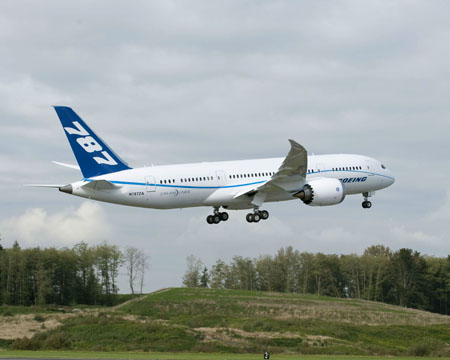
    Sixth Boeing 787 Makes First Flight, Testing Program Making Good Progress

    EVERETT, Wash., Oct. 4 — The final Boeing 787 Dreamliner to join the flight test fleet made its first flight today from Paine Field in Everett, Wash. The airplane, ZA006, is the second 787 equipped with General Electric GEnx engines to fly.

    Captains Christine Walsh and Bill Roberson were at the controls during the 1 hour and 4 minute flight. The airplane landed at Boeing Field at 12:45 p.m. (Pacific time).

    “It’s great to have our last flight test airplane join the fleet,” said Scott Fancher, vice president and general manager of the 787 program. “We have been focused on completing the testing required for certification of the 787 with Rolls-Royce engines, because that is the first model we deliver. A great deal of the testing that we’ve done also applies to the 787s with GE engines and won’t need to be repeated,” said Fancher.

    There is, however, a smaller portion of testing that is unique to the engine/airframe combination. In general, this portion includes noise testing, extreme weather operations, function and reliability, and extended operations. In addition, testing to verify the airplane handles the same regardless of engine type and that the systems work on both models is required.

    Some additional flight tests will be performed on one of the production airplanes, the ninth 787 to be built, but it is not considered a full-time member of the flight test fleet.
    787 Testing Progress Report

    In addition to achieving first flight of ZA006, the Boeing test team has completed a number of flight test milestones in recent weeks.

    Boeing wrapped up a series of natural and artificial icing tests, meeting all requirements with no changes required. Pilots reported that the airplane continues to handle well even in the presence of ice.
    Flight loads survey testing, which demonstrates the pressure distribution on the airplane structure throughout the phases of flight in a variety of configurations, also has been completed. The team conducted this testing on ZA004 primarily at the airport at Victorville, Calif. Analysis of this testing continues.

    A dramatic series of tests that stress the airplane’s brakes, called maximum brake energy testing, was completed in late September at Edwards Air Force Base, also in California. ZA001 conducted this testing as well as a series of extreme takeoff and landing conditions including minimum takeoff speed testing. Earlier in the month, ZA001 completed wet runway testing at Roswell, NM.
    ZA003 flew to Glasgow, Mont., to complete community noise testing. All results were within expectations.

    As a result of these tests and others, all takeoff performance and handling characteristics testing is complete for the initial version of the 787. Additional testing will be required for 787s equipped with GE engines.

    The 787 flight test program has logged more than 1,900 hours over 620 flights and completed more than 65 percent of the flight test conditions for 787s with Rolls-Royce engines.
    Equally important to the testing required in the air is the ground testing required to certify a new airplane. Boeing has completed well over 4,000 hours of ground testing on the same airplanes that are in the flight test program.

    In addition, fatigue testing has started at a test rig in Everett. Fifteen flights have been simulated. Federal regulations require Boeing to conduct twice as many flight cycles as any airplane in revenue service. Boeing plans to have completed 10,000 flight cycles prior to first delivery.
    “We continue to be extremely satisfied with the performance of the 787 in its testing operations,” said Fancher. “This airplane handles wonderfully and will be a valuable tool for our customers.”

    To include the featured image in your Twitter Card, please tap or click their icon a second time.