|

INVESTIGATION OF BOEING 787 BATTERY FIRE IN BOSTON

Similar Posts

  • |

    Press Release – FAA Proposes Sweeping New Rule to Fight Pilot Fatigue

    For Immediate Release
    September 10, 2010
    Contact: Alison Duquette
    Phone: (202) 267-3883

    WASHINGTON — U.S. Transportation Secretary Ray LaHood and Federal Aviation Administration (FAA) Administrator Randy Babbitt today announced a landmark proposal to fight fatigue among commercial pilots by setting new flight time, duty and rest requirements based on fatigue science.

    “This proposal is a significant enhancement for aviation safety,” said Secretary LaHood. “Both pilots and passengers will benefit from these proposed rules that will continue to ensure the safety of our nation’s air transportation system.”

    Last year, Secretary LaHood and Administrator Babbitt identified the issue of pilot fatigue as a top priority during the Airline Safety Call to Action following the crash of Colgan Air 3407 in February 2009. Administrator Babbitt launched an aggressive effort to take advantage of the latest research on fatigue to create a new pilot flight, duty and rest proposal.

    Today’s proposal is compatible with provisions in the Airline Safety and Federal Aviation Administration Extension Act of 2010, which directs the FAA to issue a regulation no later than August 1, 2011, to specify limitations on the hours of pilot flight and duty time to address problems relating to pilot fatigue.

    “I know firsthand that fighting fatigue is a serious issue, and it is the joint responsibility of both the airline and the pilot,” said Administrator Babbitt. “After years of debate, the aviation community is moving forward to give pilots the tools they need to manage fatigue and fly safely.”

    Currently, there are different rest requirements for domestic, international and unscheduled flights. The proposed rule would eliminate these distinctions. The proposal also sets different requirements for pilots based on the time of day and number of scheduled segments, as well as time zones, type of flights, and likelihood that a pilot is able to sleep under different circumstances.
    The proposal defines “flight duty” as the period of time when a pilot reports for duty with the intention of flying an aircraft, operating a simulator or operating a flight training device. A pilot’s entire duty period can include both “flight duty” and other tasks that do not involve flight time, such as record keeping and ground training.
    The FAA proposes to set a nine-hour minimum opportunity for rest prior to the duty period, a one-hour increase over the current rules. The proposed rule would establish a new method for measuring a pilot’s rest period, so that the pilot can have the chance to receive at least eight hours of sleep during that rest period. Cumulative fatigue would be addressed by placing weekly and 28-day limits on the amount of time a pilot may be assigned any type of duty.

    Additionally, 28-day and annual limits would be placed on flight time. Pilots would have to be given at least 30 consecutive hours free from duty on a weekly basis, a 25 percent increase over the current rules.

    Congress recently mandated that all air carriers have a Fatigue Risk Management Plan (FRMP). Each carrier will be able to develop its own set of policies and procedures to reduce the risks of pilot fatigue and improve alertness. The FAA has prepared guidance material to help the airlines develop their FRMP.

    The proposed rule incorporates the work of an Aviation Rulemaking Committee (ARC) comprised of labor, industry, and FAA experts that delivered its recommendations to Administrator Babbitt on September 9, 2009.

    The Notice of Proposed Rulemaking is on display today at the Federal Registerat http://www.archives.gov/federal-register/public-inspection/. It is also available at http://www.faa.gov/regulations_policies/rulemaking/recently_published/.

    The 60-day public comment period closes on Nov. 13, 2010.

    To include the featured image in your Twitter Card, please tap or click their icon a second time.
  • |

    Pratt & Whitney’s JT8D Engine Receives FAA Certification for Engine Enhancements

    EAST HARTFORD, Conn., Jan. 10, 2011 /PRNewswire/ — Pratt & Whitney, a United Technologies Corp. (NYSE: UTX) company, today announced the certification of several enhancements for the JT8D-219 engine. These enhancements successfully completed 150 hours of endurance testing in May, clearing the way for Federal Aviation Administration certification of the upgrades in early November.

    “The JT8D is a major part of Pratt & Whitney’s history; improving its reliability and modernizing its capability will keep it a viable engine for years to come,” says Rick Krueger, chief engineer for Pratt & Whitney’s Operational Commercial Engines.

    The overall project includes several configuration updates: a nickel high-pressure compressor rotor system that provides enhanced corrosion resistance, external changes to accommodate mounting the engine under the wing, an enhanced bleed override system, and higher load-carrying towershaft and gearbox elements to accommodate increased power extraction.

    The JT8D-219 engine will be offered to support B707 re-engining via the Supplemental Type Certificate approved by the FAA for Pratt & Whitney’s Joint Venture partner, Seven Q Seven, on July 20, 2010. Seven Q Seven is a San Antonio, Texas-based company that converts and upgrades aircraft, primarily Boeing 707s, for commercial and military support applications.

    The first enhanced JT8D-219 engine is on track to be delivered to Northrop Grumman in February, in support of re-engining the USAF E-8C Joint Surveillance Target Attack Radar System (Joint STARS) aircraft. The E-8C is a modified B707-300.

    “Pratt & Whitney is excited to provide the enhanced JT8D-219 configuration, which will provide improved mission capability to the Joint STARS platform,” says Bev Deachin, vice president Military Engines and Customer Support. “Joint STARS will benefit from the significantly reduced fuel consumption and additional thrust. Joint STARS is the only all weather, long-range, real-time Wide Area Surveillance (WAS) and Battle Management System. The fleet operates out of Robins Air Force Base, Georgia, and plays a significant role in supporting ground and airborne forces.”

    The JT8D-219 engines will be assembled and tested in Pratt & Whitney’s Middletown, Conn., facility. If the U.S. Air Force chose to retrofit its entire Joint STARS fleet, production quantities could result in excess of 80 engines.
    Pratt & Whitney is a world leader in the design, manufacture and service of aircraft engines, space propulsion systems and industrial gas turbines. United Technologies, based in Hartford, CT, is a diversified company providing high technology products and services to the global aerospace and building industries.

    This press release contains forward-looking statements concerning future business opportunities and operational engine performance. Actual results may differ materially from those projected as a result of certain risks and uncertainties, including but not limited to changes in funding related to the JSTARS aircraft and JT8D engines, changes in government procurement priorities and practices or in the number of aircraft to be built; challenges in the design, development, production and support of advanced technologies; as well as other risks and uncertainties, including but not limited to those detailed from time to time in United Technologies Corp.’s Securities and Exchange Commission filings.

    To include the featured image in your Twitter Card, please tap or click their icon a second time.
  • |

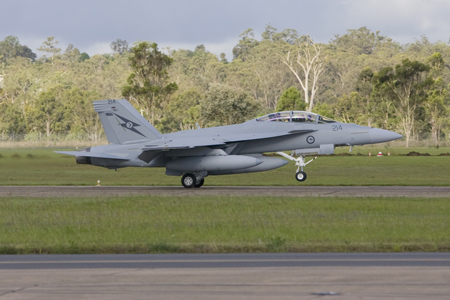
    Boeing Delivers 4 More Super Hornets to Australia Ahead of Schedule

    Milestone Reached as RAAF F/A-18Fs Achieve Initial Operating Capability

    AMBERLEY, Queensland, Jan. 6, 2011 — Boeing [NYSE: BA] delivered four new F/A-18F Super Hornets to Royal Australian Air Force (RAAF) Base Amberley in December, expanding the RAAF’s fleet of the advanced multirole fighters to 15. The delivery enabled the RAAF’s achievement of Initial Operating Capability (IOC) with its first Super Hornet squadron, the Amberley-based No. 1.

    Boeing has delivered all 15 Super Hornets to Australia ahead of schedule.

    “Early delivery of our new Super Hornets at Amberley has been a vital part of our path toward IOC for our first Super Hornet squadron, which we have now achieved ahead of schedule,” said RAAF Group Capt. Steve Roberton, Officer Commanding 82 Wing, which operates the Super Hornet. “As we’ve continued to hit our marks on time — or early, in many instances — with the Super Hornet program, we’ve enabled the RAAF to ensure Australia’s regional air superiority as we transition from the F-111 and classic Hornet.”

    The December arrival was the third Super Hornet delivery to the base during 2010. Three aircraft in the latest delivery were prewired for potential conversion to electronic attack capability during production at Boeing facilities in St. Louis; the remaining nine aircraft in the contract will be prewired in the same way before delivery to the RAAF’s No. 6 Squadron.

    “The Boeing Super Hornet team has surpassed expectations by delivering 15 aircraft to the RAAF in 2010 instead of the 12 originally scheduled,” said Carolyn Nichols, Australian Super Hornet program manager for Boeing. “Additionally, each aircraft has been delivered within budget. We are fully committed to ensuring the same delivery success and budget excellence throughout 2011. We congratulate the men and women of the RAAF on the outstanding achievement of reaching No. 1 Squadron’s Super Hornet IOC ahead of schedule.”

    The Australian government announced in March 2007 that it would acquire 24 of the advanced Block II versions of the Super Hornet, all of which are equipped with the Raytheon-built APG-79 Active Electronically Scanned Array (AESA) radar.

    The Boeing Super Hornet is a multirole aircraft, able to perform virtually every mission in the tactical spectrum, including air superiority, day/night strike with precision-guided weapons, fighter escort, close air support, suppression of enemy air defenses, maritime strike, reconnaissance, forward air control and tanker missions. Boeing has delivered more than 440 F/A-18E/Fs to the U.S. Navy. Every Super Hornet produced has been delivered on or ahead of schedule and on budget.

    To include the featured image in your Twitter Card, please tap or click their icon a second time.
  • |

    Aerospace Industries Association Supports FAA Reauthorization Act

    ARLINGTON, Va., Feb. 15, 2011 /PRNewswire-USNewswire/ — AIA supports the FAA Reauthorization and Reform Act of 2011 (H.R. 658) as introduced by the House Transportation and Infrastructure Subcommittee on Aviation Feb. 11.

    “We’re very pleased with the Committee’s decision to address environmental streamlining, third-party performance-based navigation procedure design and the establishment of NextGen performance metrics,” said AIA President and CEO Marion C. Blakey. “These policies will make our air transportation system more efficient and also protect the investment of the American taxpayer.”

    Blakey’s testimony before the subcommittee Feb. 9, outlined a number of initiatives to improve FAA efficiency and capitalize on the experience of the private sector.
    “This is a good bill,” said Blakey. “It’s fiscally responsible to fully fund programs like NextGen, which have a strong economic and environmental return on investment and help the FAA carry out its fundamental safety mission.”

    AIA also commended the committee’s acknowledgement of the benefits of bilateral aviation safety agreements and a risk-based inspection regime when applied to repair station oversight. These carefully negotiated agreements make FAA more efficient, enhance the agency’s international safety oversight and help protect U.S. jobs.

    Facebook  /  Flickr  /  LinkedIn  /  Twitter  /  YouTube

    Founded in 1919 shortly after the birth of flight, the Aerospace Industries Association is the most authoritative and influential trade association representing the nation’s leading manufacturers and suppliers of civil, military and business aircraft, helicopters, unmanned aircraft systems, space systems, aircraft engines, homeland and cybersecurity systems, materiel and related components, equipment services and information technology.

    To include the featured image in your Twitter Card, please tap or click their icon a second time.
  • |

    NTSB Warns Old Weather Data on Pilot Displays Can Contribute to Plane Crashes

    The NTSB has sent out a safety alert concerning weather information that is up to twenty minutes old, although it may be advertised as real time data. The discrepancy in time can be fatal when weather conditions are in rapid flux. The NTSB has related this old weather information to two recent crashes that occurred at night:

    • March 2010 med-evac helicopter Tennessee crash where the pilot was racing to home base trying to beat a storm
    • December 2011 Piper PA-32 Bryan Texas where the plane broke up in stormy weather.

    In both these crashes, “the time stamps indicated the one-minute time interval used to create the image, and not the actual age of the data used to create the image.”

    The Tennessee crash involved information five minutes old; the Texas crash involved information six to eight minutes old.

    The night crashes in particular are affected by old data. Pilots need to be aware that the data can be old, and not use the weather display to navigate around bad weather.

    To include the featured image in your Twitter Card, please tap or click their icon a second time.
  • |

    Record Number of Passengers Expected at DFW Airport on Post-Game Monday

    FORT WORTH, Texas, Feb. 4, 2011 /PRNewswire/ — Monday, Feb. 7, may be the busiest day in the history of Dallas/Fort Worth International Airport. At American Airlines and American Eagle as many as 25 percent more passengers than normal will board our aircraft. DFW International Airport is expecting three times its normal bus traffic, so airport entry plazas and roadways could be as crowded as terminals.

    Given the expected crowds, American’s DFW customer service staff recommends arriving at the airport at least three hours, or more, before your scheduled departure. Checking in on AA.com and printing boarding passes prior to arrival will help ease the journey through crowded terminals.

    Travelers Monday at DFW should expect longer lines at:

    Airport Entry Plazas
    Rental Car Returns
    Ticket Counters/Check-in Kiosks
    Baggage drop-offs (Curbside and Ticket Counters)
    TSA Security Checkpoints

    To help ease the backlog:

    Terminal D and part of American Eagle’s Terminal B will be open all night Sunday evening into Monday morning, including:

    Ticket Counters
    Security Checkpoints
    Concessions

    American’s Terminals A and C will open at 3 a.m. Monday.

    To include the featured image in your Twitter Card, please tap or click their icon a second time.