Geneva – The International Air Transport Association (IATA) reported international scheduled traffic results for September 2009. Passenger demand was essentially unchanged, increasing 0.3% compared to September 2008. Demand for international cargo was 5.4% below September 2008 levels. Load factors for passenger and cargo have returned to pre-crisis levels of 77.1% and 50.8%, respectively.
The apparent year-over-year improvement in demand is misleading. It is largely due to comparisons with an exceptionally weak September 2008 when traffic fell sharply (-2.9% for passenger and -7.7% for cargo). Seasonally adjusted statistics show a 0.3% drop in passenger volumes and a 1.4% fall in cargo volumes for September 2009 compared with August 2009. This reflects the pause seen in the economic recovery in the US and elsewhere in the past few months.
“It is far too early to call this a recovery. The worst may be over in terms of the fall in demand, but yields continue to be a disaster and costs are rising. The airline industry remains firmly in the red with a fragile business environment,” said Giovanni Bisignani, IATA’s Director General and CEO.
Airlines continue to carefully manage capacity. Seasonally adjusted passenger capacity has remained unchanged throughout the year while cargo capacity has edged up only slightly in the last two months. Load factors have risen to pre-crisis levels which should help to correct the precipitous fall in yields (-14% for economy, -18% for premium and –20% in cargo).
Rising costs are a concern. As airlines adjust capacity to match demand, aircraft are flying fewer hours (-3% for some aircraft types). This is raising non-fuel unit costs. At the same time, oil prices have risen to above US$75 per barrel (Brent) considerably higher than the US$43 per barrel level at the start of the year.
International Scheduled Passenger Demand
Passenger demand is now 5% better than the low point reached in March 2009, but 6% below the peak recorded in early 2008.
Asia-Pacific carriers recorded the most significant improvement, from -1.6% in August to +2.1% in September. Bucking the global trend, seasonally adjusted passenger volumes grew almost 1% from August to September. Three factors are influencing this relative strength. Government stimulus packages in the major economies are driving production increases, the region’s banking system is relatively strong and the region’s consumers are not as burdened by debt as those in Europe and the US.
By contrast, European carriers saw a deterioration in demand from -2.8% in August to -4.2% in September. This partly reflects a loss of market share by network carriers on short-haul routes to low-cost carriers. More significantly, there has been a deterioration in demand on long-haul routes. For routes to Asia, this appears to be the influence of “home-carrier-bias” which has seen Asia-Pacific carriers reap the benefit of stronger regional economies. On routes to North America, lower demand in general is related to the dip in consumer and business confidence in economies on both sides of the North Atlantic.
North American carriers saw demand largely unchanged (-2.4% in September compared to -2.5% in August). This flattening-out is related to a dip in consumer and business confidence.
Middle Eastern carriers experienced an 18.2% year-on-year increase in September. This was distorted by the shifting of the Ramadan period, which started in August 2009, compared with September last year. Growth is driven primarily by market share gains on long-haul routes via Middle Eastern hubs. Weaker oil revenues continue to depress economic growth and travel within the region.
Latin American carriers experienced a jump in demand from -2.3% in August to +3.4% in September based on relatively robust regional economies.
African carriers also saw a marginal improvement from -4.9% in August to -4.2% in September. While African economies have been relatively resilient in the recession, the region’s carriers continue to struggle to maintain market share.
International Scheduled Cargo Demand
Cargo traffic is 12% above the December 2008 low point, but remains 17% below the early 2008 peak.
Middle Eastern carriers showed the strongest performance of any region with a 3.6% year-on-year improvement.
Latin American carriers also reported growth of 1.8%, but this was a decline from the previous month’s growth of 3.9%.
Carriers in Asia-Pacific, Europe and North America recorded improvements over August performance, but remained in negative territory at -3.1%, -13% and -5.0% respectively. Improvements were broadly in line with improved economic activity in each region.
African carriers’ cargo operations declined further into negative territory from -5.1% in August to -6.9% in September.
The UK Air Passenger Duty hike is the wrong response to the industry trauma. “The policies of some governments in light of the industry’s trauma are disappointing. The UK is a case in point of a government detached from reality. The global economic crisis makes cost reduction a matter of survival. And the upcoming Copenhagen meeting on climate change demands attention on measures to reduce emissions. What is the UK government doing? From 1 November it is increasing its Air Passenger Duty (APD) to collect GBP 2.5 billion annually from air travelers in the name of the environment. They have it all wrong. Taxes won’t reduce emissions. And making travel more expensive will not stimulate the economy,” said Bisignani.
The GBP 2.5 billion APD is completely disproportionate to the GBP572 million that it would cost to offset the entire carbon footprint of UK aviation. “Charging travelers over four times for their emissions makes absolutely no sense. Instead of raising taxes, the UK government should get behind the aviation industry’s ambitious targets to fight climate change, namely (1) improving fuel efficiency by an average of 1.5% annually to 2020, (2) stabilizing emissions from 2020 with carbon neutral growth and (3) cutting net emissions in half by 2050 compared to 2005 levels,” said Bisignani.
View full September traffic results
For more information, please contact:
Anthony Concil
Director Corporate Communications
Tel: +41 22 770 2967
Email: corpcomms@iata.org
To include the featured image in your Twitter Card, please tap or click their icon a second time.

 The Federal Aviation Administration (FAA) is proposing a $206,550 civil penalty against Martinaire Aviation, of Addison, Texas, for violating U.S. Department of Transportation Hazardous Materials Regulations.
 EVERETT, Wash., Feb. 13, 2011 /PRNewswire/ — Boeing (NYSE: BA) today unveiled its new 747-8 Intercontinental, the new high-capacity passenger airplane that offers airlines the lowest operating costs and best economics of any large passenger airplane while providing enhanced environmental performance.
 Approximately 10,000 guests, including customers, Boeing employees, government officials, partners and suppliers, gathered in the factory in Everett, Wash., to witness the premiere of the Intercontinental at an event themed “Incredible, Again.” Boeing Commercial Airplanes President and Chief Executive Officer Jim Albaugh said the newest 747 incorporates technological advancements that make it an extremely productive airplane for customers.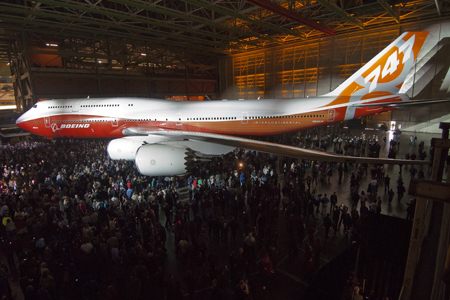
 Korean Air and VIP customers have joined launch customer Lufthansa in ordering a total of 33 747-8 Intercontinentals. First delivery of the 747-8 Intercontinental is scheduled for the fourth quarter.