Boeing

  • | | | | |

    Thomson Flight Lands on One Engine


    Click to view full size photo at Airliners.net
    Contact photographer Roberto Bianchi

    What: Thomson Airways Boeing 757-200 from London to Paphos Cyprus
    Where: Paphos Cyprus
    When: Oct 13 2010
    Who: 200 aboard
    Why: On approach to Paphos, the pilot had to shut down an engine. The captain issued a distress signal and landed with one engine, with emergency vehicles on standby.

    They made a safe landing. The plane’s return run is postponed until after Inspectors flying in from the UK to inspect the plane.

  • |

    Boeing Delivers First 777-300ER to Turkish Airlines

    EVERETT, Wash., Oct. 14 — Boeing today delivered the first 777-300ER (Extended Range) to Turkey’s flag carrier Turkish Airlines.

    The milestone delivery marks many firsts for the airline.  The new airplane is Turkish Airlines’ first 777 directly purchased from Boeing. It is the first of 12 777-300ERs Turkish Airlines has on order with Boeing from 2009 and serves as the platform for introducing Turkish Airlines’ new "Comfort Class" cabin for the first time.

    "Turkish Airlines continues to grow as a global airline with the 777 helping us to expand into new markets in Asia and the Americas," said Hamdi Topcu, Chairman of Turkish Airlines. "The addition of new Boeing 777-300ERs exemplifies our commitment to delivering high quality service and comfort to our passengers, while enabling us to continue our profitable growth."  

    The 777-300ER brings new twin-engine efficiency to the airline’s long-haul fleet. The airplane is powered by General Electric GE90-115BLs, the world’s largest and most powerful commercial jet engines.

    "Turkish Airlines has demonstrated an exceptional commitment to set world-class standards for their operations," said Marlin Dailey, vice president of Sales, Boeing Commercial Airplanes. "The 777-300ER is a great choice for Turkish, as the 777’s high efficiency, spacious cabin, and industry-leading reliability combine to help the airline provide a superior passenger experience."  

    With this delivery, Boeing is scheduled to deliver four additional 777-300ERs to Turkish Airlines by the end of 2010.

    The Boeing 777-300ER is 19 percent lighter than its closest competitor, greatly reducing its fuel requirement. It produces 22 percent less carbon dioxide per seat and costs 20 percent less to operate per seat. The airplane can seat up to 365 passengers in a three-class configuration and has a maximum range of 7,930 nautical miles (14,685 km). The 777 family is the world’s most successful twin-engine, twin-aisle airplane. Sixty-one customers around the world have ordered more than 1,100 777s.

    About Turkish Airlines

    Established in 1933 with a fleet of only five airplanes, Star Alliance member, Turkish Airlines is today a four-star airline company with a fleet of 145 aircraft flying to 166 destinations around the world, comprising 39 domestic and 127 international destinations.  

  • | | | | |

    Emirates: Flight Called Due to Hydraulics


    Click to view full size photo at Airliners.net
    Contact photographer Szabo Gabor

    What: Emirates Boeing 777-200 en route from Kochi to Dubai
    Where: Kochi India
    When: Oct 12, 2010 4.20 a.m.
    Who: 205 passengers, 14 crew
    Why: After takeoff, the flight developed hydraulic problems with the landing gear.

    The plane had to return to Kochi. After landing, 75 passengers were accommodated on the 10:30 flight. The rest of the passengers were accommodated at hotels and promised the next available flights out.

  • | | | | |

    Westjet Emergency Landing in Winnipeg


    Click to view full size photo at Airliners.net
    Contact photographer Randall Johnson

    What: Westjet Boeing 737-700 en route from Montreal to Calgary
    Where: Winnipeg
    When: Oct 6 2010
    Who: 105 aboard
    Why: While en route, the plane emitted an alert, and subsequently made an emergency descent and landing. Although they received an emergency indicator engaged, there were no problems with the landing. Emergency services were on standby.

    Maintenance determined that the problem was due to a faulty sensor, and replaced same.

  • |

    Boeing Reports Third-Quarter Deliveries

    CHICAGO, Oct. 7 — The Boeing Company ) announced today deliveries across its commercial and defense operations for the third quarter of 2010.

    Major Programs

    3rd Quarter
    2010

    Year-to-Date
    2010

    Commercial Airplanes Programs

    737 Next Generation

    100

    281

    747

    767

    3

    9

    777

    21

    56

    Total

    124

    346

    Defense, Space & Security Programs

    AEW&C

    3

    Apache (New Builds)

    2

    11

    Chinook (New Builds)

    5

    13

    C-17

    4

    10

    Delta II – Commercial

    Delta IV – Commercial

    1

    F-15

    3

    10

    F/A-18E/F and EA-18G

    15

    39

    Satellites (Government & Commercial)

    3

    767 Tanker (International)

  • | | |

    American Airlines Flight Diverts to Yakima


    Click to view full size photo at Airliners.net
    Contact photographer Kevin Koske

    What: American Airlines Boeing 737-800 en route from Seattle to Chicago
    Where: Yakima
    When: Oct 04 2010
    Who: 149 passengers and 6 crew, 1 ill passenger
    Why: When a passenger on the flight became ill, the flight diverted to Yakima, where the passenger was taken to Yakima Valley Memorial Hospital after a safe landing. The landing was uneventful except for brakes overheating.

    After a 7.5 hour delay, passengers were back en route.

  • |

    Boeing, Air Lease Corporation Finalize Order for Up to 60 Next-Generation 737s


    SEATTLE, Oct. 4 — Boeing and new leasing company Air Lease Corporation (ALC) have finalized an order for up to 60 Next-Generation 737-800s.
    The order, first announced at the Farnborough Airshow in July, is for deliveries through 2017. In addition to 54 firm orders the deal includes six additional airplanes to be reconfirmed.

    “Our management team has been working closely with Boeing for more than 30 years,” said Steven F. Udvar-Hazy, chairman and CEO of Air Lease Corporation. “This order for Next-Generation 737-800s continues that great tradition. With this large and long-term commitment we’ll be able to offer our clients a most economical, fuel-efficient and versatile airplane, suitable for a variety of profitable missions.”

    “The Next-Generation 737 is one of the world’s best-selling airplanes for a number of very good reasons,” said Jim Albaugh, president and CEO, Boeing Commercial Airplanes. “Airlines and lessors remain confident in the airplane’s ability to deliver outstanding, dependable operational and financial performance across the widest range of missions. We look forward to providing that continued value to Air Lease Corporation and its clients and to a long and successful continued partnership with Steven Udvar-Hazy and his new leasing company.”

    About Air Lease Corporation
    Air Lease Corporation (ALC), based in Los Angeles, Calif., was founded in February 2010, and is led by two airline industry veterans, Steven F. Udvar-Hazy and John L. Plueger. ALC is a well capitalized and airline-customer-focused operating lessor and market-maker, committed to providing optimized jet fleet solutions to airline clients worldwide.

  • |

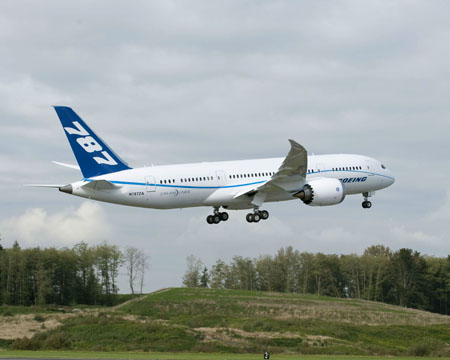
    Sixth Boeing 787 Makes First Flight, Testing Program Making Good Progress

    EVERETT, Wash., Oct. 4 — The final Boeing 787 Dreamliner to join the flight test fleet made its first flight today from Paine Field in Everett, Wash. The airplane, ZA006, is the second 787 equipped with General Electric GEnx engines to fly.

    Captains Christine Walsh and Bill Roberson were at the controls during the 1 hour and 4 minute flight. The airplane landed at Boeing Field at 12:45 p.m. (Pacific time).

    “It’s great to have our last flight test airplane join the fleet,” said Scott Fancher, vice president and general manager of the 787 program. “We have been focused on completing the testing required for certification of the 787 with Rolls-Royce engines, because that is the first model we deliver. A great deal of the testing that we’ve done also applies to the 787s with GE engines and won’t need to be repeated,” said Fancher.

    There is, however, a smaller portion of testing that is unique to the engine/airframe combination. In general, this portion includes noise testing, extreme weather operations, function and reliability, and extended operations. In addition, testing to verify the airplane handles the same regardless of engine type and that the systems work on both models is required.

    Some additional flight tests will be performed on one of the production airplanes, the ninth 787 to be built, but it is not considered a full-time member of the flight test fleet.
    787 Testing Progress Report

    In addition to achieving first flight of ZA006, the Boeing test team has completed a number of flight test milestones in recent weeks.

    Boeing wrapped up a series of natural and artificial icing tests, meeting all requirements with no changes required. Pilots reported that the airplane continues to handle well even in the presence of ice.
    Flight loads survey testing, which demonstrates the pressure distribution on the airplane structure throughout the phases of flight in a variety of configurations, also has been completed. The team conducted this testing on ZA004 primarily at the airport at Victorville, Calif. Analysis of this testing continues.

    A dramatic series of tests that stress the airplane’s brakes, called maximum brake energy testing, was completed in late September at Edwards Air Force Base, also in California. ZA001 conducted this testing as well as a series of extreme takeoff and landing conditions including minimum takeoff speed testing. Earlier in the month, ZA001 completed wet runway testing at Roswell, NM.
    ZA003 flew to Glasgow, Mont., to complete community noise testing. All results were within expectations.

    As a result of these tests and others, all takeoff performance and handling characteristics testing is complete for the initial version of the 787. Additional testing will be required for 787s equipped with GE engines.

    The 787 flight test program has logged more than 1,900 hours over 620 flights and completed more than 65 percent of the flight test conditions for 787s with Rolls-Royce engines.
    Equally important to the testing required in the air is the ground testing required to certify a new airplane. Boeing has completed well over 4,000 hours of ground testing on the same airplanes that are in the flight test program.

    In addition, fatigue testing has started at a test rig in Everett. Fifteen flights have been simulated. Federal regulations require Boeing to conduct twice as many flight cycles as any airplane in revenue service. Boeing plans to have completed 10,000 flight cycles prior to first delivery.
    “We continue to be extremely satisfied with the performance of the 787 in its testing operations,” said Fancher. “This airplane handles wonderfully and will be a valuable tool for our customers.”

  • | | | |

    Bristol: Hard Landing


    Click to view full size photo at Airliners.net
    Contact photographer Paul Markman

    What: Thomson Airways Boeing 767-300 en route from Cancun (Mexico) to Bristol,EN (UK),
    Where: Bristol
    When: Oct 3 2010
    Why: On Sept 16, the same plane had had another hard landing causing damage.

    On this flight, the plane accelerated for reasons unknown during a hard landing on arrival at Bristol. Unspecified damages occurred, no injuries reported.

  • | | |

    Singapore Airlines bomb threat

    What: Singapore Airlines B773 en route from Moscow to Singapore
    Where: Netaji Subhash Chandra Bose Airport
    When: Oct 3 2010, midnight
    Who: 262 passengers
    Why: The flight was en route when Moscow police contacted the pilots and told them there was a possible bomb on board.

    Delhi, the nearest airport, refused to allow them to land due to the Commonwealth Games, but they were permitted to divert to Netaji Subhash Chandra Bose Airport where they made a safe landing around midnight.

    Passengers disembarked, and the plane was isolated and the baggage searched.

  • | | | | |

    British Airways Door Ajar Aborts flight


    Click to view full size photo at Airliners.net
    Contact photographer Galen Burrows

    What: British Airways Boeing 747-400 en route from London to New York
    Where: London
    When: Oct 2 2010
    Who: 296 aboard
    Why: The plane took off, spent eleven minutes in the air and returned to make a safe landing in London.
    After takeoff, a warning light notified the crew that a door was not firmly closed.

    Passengers were rebooked on an alternative flight. The problem in the plane was traced not to an open door but a sequence glitch which occurred when a door handle moved enough to set off an alarm, and was logistically unable to be secured.

  • | | | |

    Fly Air Tatarstan. Standing UP

    What: Tatarstan Airlines en route from Antalya, Turkey to Ekaterinburg, Russia
    Where: aboard the plane
    Why: Instead of the 148-seat Boeing 737 that was booked, they had a 142-seat 737; and 6 passengers were given the choice of waiting for the next flight or flying standing up. During turbulence, the passengers sat on the floor. The airline offered them $200 in compensation. The passengers are asking for $4,700.

    (Can you imagine how much they’d be asking if they were in the US?)

    What is this, a third world country where there are no rules and laws about flight safety? Well, Tatarstan flies out of Kazan, Tatarstan, Russia.

  • | | |

    LAX Turbulence Injures Flight Attendant

    What: Southwest Airlines Boeing 737-700 en route from San Francisco to Los Angeles
    Where: Los Angeles
    When: Sep 29th 2010
    Who: flight attendant
    Why: On approach to LA, the Boeing encountered turbulence. A flight attendant sustained minor injuries.

  • |

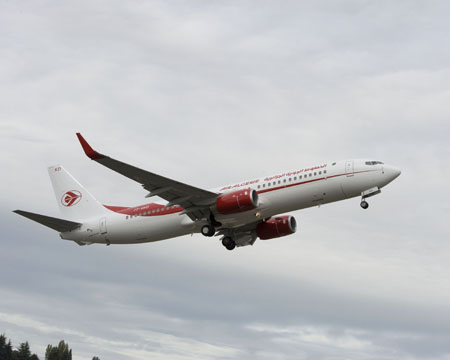
    Press Release: Boeing Delivers 11th 737-800 Airplane to Air Algerie


    SEATTLE, Sept. 29 — Boeing today delivered to Air Algerie its 11th 737-800.

    Air Algerie, the state-owned flag carrier of Algeria, operates a fleet composed primarily of Boeing 737s and some 767s. Boeing is scheduled to deliver two additional 737-800s in 2010 as well as four more in 2011. Air Algerie will be operating 17 737-800s in 2011 for a total of 22 Next-Generation 737 airplanes to complement its fleet.

    “The Boeing 737-800 has played an instrumental part in contributing to the success of Air Algerie’s growth in the region,” said Abdelwahid Bouabdallah, director general of Air Algerie.

    More than 120 customers around the world have ordered more than 5,000 Next-Generation 737s.

  • |

    Boeing, Air China Announce Order for Boeing 777s

    SEATTLE, Sept. 27 Boeing and Air China today announced an order for four 777-300ERs (Extended Range), which have a total average list price value of $1.1 billion at current list prices.

    “This is a great day in the history of our long and enduring partnership with Air China,” said Marlin Dailey, vice president of Sales & Marketing for Boeing Commercial Airplanes. “Today’s order of 777s also underscores Air China’s confidence in the world’s most successful twin-engine, long-haul airplane.”

    Air China, the flag carrier of the People’s Republic of China, will use the airplanes to expand its international routes.

    “The 777-300ER will be the backbone of our long-haul international fleet,” said Fan Cheng, vice president of Air China. “The airplane’s high efficiency and performance features will enable Air China to launch more direct long-haul routes to meet the increasing demand of our passengers.”

    The Boeing 777 is the world’s most successful twin-engine, long-haul airplane. The 777-300ER extends the 777 family’s span of capabilities, bringing twin-engine efficiency and reliability to the long-range market. The airplane carries 365 passengers up to 7,930 nautical miles (14,685 km).

    Boeing incorporated several performance enhancements for the 777-300ER, extending its range and payload capabilities. Excellent performance during flight-testing, combined with engine efficiency improvements and design changes that reduce drag and airplane weight, contributed to the increased capability.

  • |

    Bell Boeing V-22 Program Delivers 6th Osprey Trainer to US Marines

    ST. LOUIS, Sept. 27, 2010 — The Bell Boeing V-22 Program, a strategic alliance between Boeing [NYSE: BA] and Bell Helicopter, has delivered the sixth and final MV-22 Osprey Containerized Flight Training Device (CFTD) to the U.S. Marines. In the past year, the team has delivered five CFTDs to the Marines, as well as upgrades to two trainers delivered previously.

    The CFTD trains aircrew on basic aircraft familiarization and handling qualities. Additional training capabilities include systems/subsystems operation, communication, malfunctions, day and night flying, use of night-vision goggles, formation flying, aerial refueling and landing on ships. The device is intended to train crews for any task that might be performed in the aircraft, while limiting the monetary and environmental costs and safety risks of in-flight training.

    The sixth device was delivered to Marine Corps Air Station (MCAS) New River, N.C., on Aug. 16, six weeks early. MCAS New River has six devices, including the first CFTD — delivered in 2007 — plus three full-flight, motion-based simulators and one non-motion-based flight training device. MCAS Miramar, Calif., has four CFTDs. An upgrade delivered to Miramar this month brought all CFTDs to full concurrency with the Osprey aircraft.

    "The V-22 Integrated Product Team has made all of these early deliveries possible,” said Mark McGraw, vice president, Boeing Training Systems & Services. “They delivered three devices on this contract early, and all of them for the lowest per-unit cost our customer has seen."

    All CFTDs can be locally networked to allow for more robust training capabilities. The CFTDs at MCAS New River also are able to network with AV-8 Harriers at MCAS Cherry Point, N.C.

    The V-22 Osprey is a tiltrotor aircraft manufactured by Boeing and Bell Helicopter, a Textron Inc. [NYSE: TXT] company. Bell and Boeing are teamed in a Strategic Alliance Agreement for the design, production and sustainment of the V-22.

    Bell Helicopter, a wholly owned subsidiary of Textron Inc., is an industry-leading producer of commercial and military, manned and unmanned vertical lift aircraft and the pioneer of the revolutionary tiltrotor aircraft. Globally recognized for world-class customer service, innovation and superior quality, Bell’s global work force serves customers flying Bell aircraft in more than 120 countries. More information is available at www.bellhelicopter.com.

    Textron Inc. is a multi-industry company that leverages its global network of aircraft, defense, industrial and finance businesses to provide customers with innovative solutions and services. Textron is known around the world for its powerful brands such as Bell Helicopter, Cessna Aircraft Company, Jacobsen, Kautex, Lycoming, E-Z-GO, Greenlee, and Textron Systems. More information is available at www.textron.com.

  • |

    Boeing NewGen Tanker Win Would Bring 11,000 Jobs, $693 Million to Washington

    EVERETT, Wash., Sept. 27, 2010 — The Boeing Company today announced that the state of Washington will benefit from an estimated 11,000 total jobs and generate an estimated $693 million in annual economic impact if the Boeing NewGen Tanker is selected as the U.S. Air Force’s next aerial refueling aircraft.

    Boeing submitted its proposal July 9 to replace 179 of the Air Force’s 400 Eisenhower-era KC-135 aircraft. The Air Force is expected to award a contract later this year.

    "The Boeing team in Washington state has an outstanding track record meeting the needs of U.S. warfighters by delivering the finest military derivatives of commercial aircraft in the world," said Dennis Muilenburg, president and CEO of Boeing Defense, Space & Security. "I am confident that the thousands of men and women at Boeing and our suppliers working on the NewGen Tanker will carry on that same tradition of excellence for many years to come."

    "One of the great strengths of Boeing is our unique ability to form teams made up of both commercial and defense personnel to find innovative and best-value solutions for our customers," said Jim Albaugh, president and CEO of Boeing Commercial Airplanes. "Nowhere is this more apparent than here in Puget Sound, where we have been supporting both commercial and military customers for nearly 100 years."

    Currently, Boeing has 72,000 employees in Washington and works with more than 2,700 suppliers/vendors, delivering a total $3.3 billion in annual economic impact.

    The NewGen Tanker is a widebody, multi-mission aircraft based on the proven Boeing 767 commercial airplane and updated with the latest and most advanced technology. Capable of fulfilling the Air Force’s needs for transport of fuel, cargo, passengers and patients, the combat-ready NewGen Tanker will meet or exceed the 372 mandatory requirements described in the service’s final KC-X Request for Proposal released Feb. 24.

    The NewGen Tanker will be made with a low-risk approach to manufacturing that relies on existing Boeing facilities in Washington state and Kansas as well as U.S. suppliers throughout the nation, with decades of experience delivering dependable military tanker and derivative aircraft. Nationwide, the NewGen Tanker program will support approximately 50,000 total U.S. jobs with Boeing and more than 800 suppliers in more than 40 states.

    The Boeing NewGen Tanker also will be more cost-effective to own and operate than a larger, heavier tanker. It will save American taxpayers more than $10 billion in fuel costs over its 40-year service life because it burns 24 percent less fuel than the competitor’s airplane.

    Boeing has been designing, building, modifying and supporting tankers for decades. These include the KC-135 that will be replaced in the KC-X competition, and the KC-10 fleet. The company also has delivered four KC-767Js to the Japan Air Self-Defense Force and is on contract to deliver four KC-767As to the Italian Air Force.

    The Boeing Aerial Refueling Technology demonstrator (BART) will be on display at Westlake Park (401 Pine St.) in Seattle on Sept. 28 from 9 a.m. to 3:30 p.m. BART’s tour schedule is available at www.UnitedStatesTanker.com/TankerTrek. More information on Boeing’s NewGen Tanker, including video clips and an interactive tour of the aircraft, is available at www.UnitedStatesTanker.com. For more information on joining the company’s efforts, visit www.RealAmericanTankers.com.

  • | | | |

    Bomb Scare


    Click to view full size photo at Airliners.net
    Contact photographer TonySilgrim

    What: PIA Pakistan International Airlines Boeing 777-200 en route from Toronto, to Karachi Pakistan
    Where: Stockholm
    When: Sep 25th 2010
    Who: 273 passengers
    Why: After Canadian police received a phone call that there was a bomb aboard, the flight diverted to Stockholm where it made a safe landing. The passengers disembarked and one man was temporarily detained. When the plane, passenger and luggage were searched and no explosives were found, the investigation turned toward the Canadian crank caller.

    The flight was eventually allowed to continue.

  • | | | | | | |

    Germany: Southern Air Transport Engine Blows


    Click to view full size photo at Airliners.net
    Contact photographer Markus Altmann

    What: Malaysian Airlines/Southern Air Transport Boeing 747-200 freighter en route from Frankfurt Germany to Tashkent Uzbekistan
    Where: Frankfurt
    When: Sep 24 2010
    Why: On takeoff, the right engine (3) suffered engine failure. The pilot aborted the takeoff. Engine debris caused some damage to the plane.

  • | | | | | | |

    Dubai Investigation Continuing. Cargo Under Scrutiny


    Click to view full size photo at Airliners.net
    Contact photographer Timo Jäger

    General Civil Aviation Authority released a report that the black boxes indicated smoke or fire on the main deck and “lower aft cargo compartment” towards the back of the doomed aircraft. The GCAA says investigators are still uncertain of the causes of the crash. Capt Doug Lampe and First Officer Matthew Bell, reported smoke in the cockpit 28 minutes after taking off. UPS Flight 6 was unable to change radio frequency and could not communicate with ATC. During their descent, pilots had difficulty seeing the flight instruments because of thick smoke.

    The memorial service for captain Doug Lampe will be held at two o’clock on Monday at Southeast Christian Church, Louisville.

    Funeral service for Matthew Carl Bell at 3 p.m. on Sunday, September 26, 2010, at Immanuel Lutheran Church, 3214 Golf Road, Eau Claire, WI.

    What: United Parcel Service Boeing 747-400 cargo plane en route from Dubai to Cologne
    Where: Dubai inside an Emirati air base between Dubai’s Emirates Highway and nearby Al-Ain Road 10 miles southeast of Dubai’s international airport
    When: September 3 2010, noon New York time
    Who: Two pilots
    Why: Read More

  • | | | | | | |

    Delta Emergency Landing in Manchester


    Click to view full size photo at Airliners.net
    Contact photographer

    What: Delta Airlines Boeing 767-400 en route from New York to Athens
    Where: Manchester England
    When: Midnight (E.T.)
    Who: 231 passengers and 12 crew
    Why: While en route over the Irish sea, smoke was detected in the cockpit. The crew diverted to Manchester where they made a safe landing.

    Passengers were provided hotel rooms. They would have been able to leave earlier but for an ATC strike in France.http://avstop.com/news_sept_2010/air_traffic_control_strike_affecting_traffic_in_and_out_of_france.htm The passengers were scheduled to fly out Friday morning at 8:00 a.m.

  • |

    Boeing Receives Florida Governor’s Business Expansion Award

    TALLAHASSEE, Fla., Sept. 22, 2010 — The Boeing Company [NYSE: BA] today received the Governor’s Business Expansion Award from Enterprise Florida at the Governor’s 2010 Business Diversification Awards ceremony in Tallahassee. The Boeing operation at Cecil Field in Jacksonville, Fla., won the award after the site received the consolidated U.S. Navy F/A-18 work and the U.S. Air Force QF-16 contract. The consolidation and contract win will add approximately 75 jobs to the Cecil Field facility.

    “This expansion to our work scope will allow us to be even more responsive to our customers by colocating related programs in one spot,” said Gary Phillips, Cecil Field site executive for Boeing. “We’re honored that the governor’s office has recognized our expansion as a significant contribution to the community of Jacksonville and the Duval County area.”
    “Florida’s entrepreneurs and business leaders are major contributors to the state’s economic growth,” said Enterprise Florida President and CEO John Adams Jr. “Today, we recognized some of their exemplary accomplishments in creating marketable products and services, which are increasing Florida’s competitiveness and building a future economy that will serve all segments of our population very well.”
    With the addition of the F/A-18 Structural Repair Facility, Cecil Field’s capabilities now include avionics repairs and upgrades; aircraft modification and maintenance; structural and composite component repair; and full nondestructive inspection. The Boeing team at Cecil Field draws on a decade of experience to support Navy and Marine Corps F/A-18A-F aircraft service, repair and modification programs. The facility, located at Cecil Commerce Center, includes 479,000 square feet of maintenance, manufacturing, warehousing and office space.
    “Boeing is proud to be part of the Jacksonville community,” Phillips said. “With our growth now and in the future, we look forward to making a positive impact here for many years to come.”
    A unit of The Boeing Company, Boeing Defense, Space & Security is one of the world’s largest defense, space and security businesses specializing in innovative and capabilities-driven customer solutions, and the world’s largest and most versatile manufacturer of military aircraft. Headquartered in St. Louis, Boeing Defense, Space & Security is a $34 billion business with 68,000 employees worldwide.

  • | |

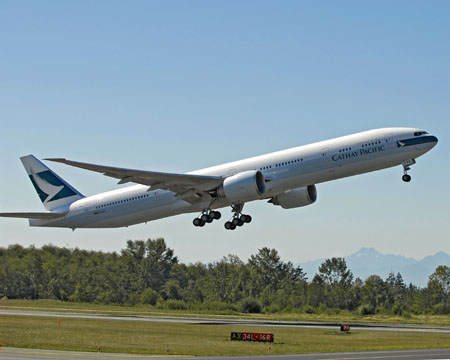
    Boeing, Cathay Pacific Airways Finalize Contract for Six 777-300ERs

    SEATTLE, Sept. 22 — Boeing and Cathay Pacific Airways today announced the Hong Kong-based carrier has exercised existing purchase rights for six additional Boeing 777-300ERs (extended range).

    The six new airplanes, with an estimated value of US$1.6 billion at Boeing list prices, will increase Cathay Pacific’s 777-300ER future fleet from 30 to 36.
    Cathay Pacific, one of the world’s largest operators of the popular jetliner, also operates 12 Boeing 777-300s and five 777-200s.

    “Cathay Pacific is a valued long-time Boeing customer. The global reach of Cathay Pacific’s 777 fleet showcases the airplane’s exceptional performance features and its passenger appeal around the world,” said Marlin Dailey, vice president of Sales for Boeing Commercial Airplanes. “This additional commitment from a world-class operator like Cathay Pacific is a testament to the greater efficiency, economics and reliability of the 777-300ER.”

    Cathay Pacific first announced its selection of the 777-300ER in 2005. This announcement is Cathay Pacific’s fourth increase in its acquisition plans for the long-range jetliner.

    “We are very pleased to confirm this purchase of six more Boeing 777-300ERs – a superb aircraft that already has significantly enhanced our operations on key long-haul routes,” said Cathay Pacific Chief Executive Tony Tyler. “We have been very impressed by the operating economics of these aircraft, while their high efficiency has resulted in a reduced environmental impact. As we continue to enhance our fleet, the 777-300ER will play a crucial role in our operations in the years to come.”
    The Boeing 777 is the world’s most successful twin-engine, long-haul airplane. The 777-300ER extends the 777 family’s span of capabilities, bringing twin-engine efficiency and reliability to the long-range market.

    Boeing incorporated several performance enhancements for the 777-300ER, extending its range and payload capabilities. Excellent performance during flight testing, combined with engine efficiency improvements and design changes that reduce drag and airplane weight, contributed to the increased capability.

    In addition to Boeing 777s, Cathay Pacific operates 47 747-400s in both passenger and cargo versions. The airline also has ordered 10 Boeing 747-8 Freighters. The highly efficient new cargo airplane will augment the airline’s fleet of 25 747 Freighters used to connect Hong Kong to a wide range of international markets.
    Sixty-one customers around the world have ordered more than 1,100 777s.

  • |

    Boeing Projects Steady Growth for Commercial Airplanes Market in Africa

    More than 700 airplanes, worth $80 billion, needed in region over 20 years

    CAPE TOWN, South Africa, Sept. 21 — Boeing forecasts that air carriers in Africa will experience steady growth over the next 20 years as air travel in Africa continues to grow with the economy.

    The African economy is projected to grow 4.8 percent in 2010 following 2.9 percent growth in 2009. This strong growth results from worldwide recovery stimulating demand for African exports as well as imports into the continent. West Africa shows the strongest growth with foreign interest in petroleum development.

    “As the demand for African commodities grows and foreign development and tourism increase, African carriers will require a modernized fleet in order to compete on routes historically dominated by foreign carriers,” said Mike Warner, senior market analyst for Boeing Commercial Airplanes, today at a media briefing in Cape Town.

    “Africa’s current fleet is nearly 20 years old on average in a market that demands newer, more fuel-efficient airplanes to help offset the rising cost of fuel.”

    Boeing’s forecast calls for the delivery of more than 700 airplanes with a value of approximately $80 billion for the African airplane market over the next 20 years.

    Growth in the airline market, along with the demand to replace older, less fuel-efficient single-aisle airplanes and regional jets with new-generation, more fuel-efficient models, will drive new airplane deliveries.

    Strong demand exists to support increased non-stop routes between Africa and Europe, the United States, the Middle East, India, and China. Twin-aisle fleets will evolve in the region as airlines continue to expand international services. Boeing forecasts that twin-aisle airplanes will account for 32 percent of new airplanes delivered to African carriers over the next 20 years compared to 23 percent worldwide. Single-aisle airplanes will represent 60 percent of the African new-airplane market, compared to 69 percent worldwide.

    Newer airplane types such as the Next-Generation 737 and 787 Dreamliner offer significant advantages in environmental performance as well as improved capabilities, fuel efficiency and maintenance costs.
    Today’s market update was part of a series of briefings that highlight Boeing’s airplane capabilities and advantages as well as discuss the African aviation market for the next 20 years. Boeing kicked off the effort at last month’s Aviation & Allied Business Leaders conference in Gaborone, Botswana. Later this year, Boeing will participate in the Airlines Association of South Africa Annual General Meeting in Manzini, Swaziland, in October and the African Airlines Association General Assembly and conference in Addis Ababa, Ethiopia, in November.

  • | | | | |

    Budapest: Bird Strike


    Click to view full size photo at Airliners.net
    Contact photographer Kristóf Csemniczky

    What: Malev Hungarian Airlines Boeing 737-600 en route from Budapest to Istanbul
    Where: Budapest
    When: Sept 21 2010
    Who: 100 passengers
    Why: After the jet suffered a bird strike, the pilot rejected takeoff. The plane was examined for damages, resulting in a delay, but was subsequently judged undamaged and allowed to depart. The plane made a safe landing in Istanbul, several hours late.