|

AeroTurbine Signs Three Year Exclusive Engine Management Agreement with Webjet Linhas Aereas

Similar Posts

  • |

    Boeing, LAN Airlines Announce Order for Three 767s

    Additional 767-300ER airplanes part of the airline’s fleet expansion plans

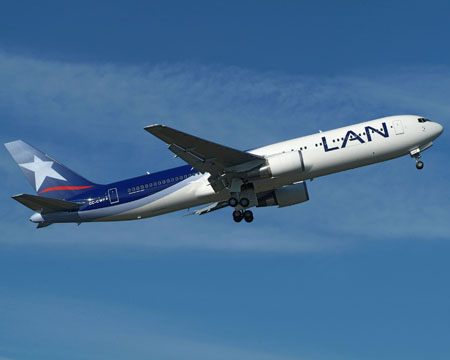
    EVERETT, Wash., Feb. 18, 2011 /PRNewswire/ — Boeing (NYSE: BA) announced today that Chile’s LAN Airlines ordered three additional 767-300ER airplanes valued at $493 million at today’s list prices. Today’s order brings the total number of 767s ordered from LAN to 33.

    “This order for additional 767s builds on the long-standing relationship between Boeing and LAN,” said Marlin Dailey, vice president of Sales & Marketing for Boeing Commercial Airplanes. “LAN is one of the world’s premier airlines and we are happy to help them expand and grow their long-haul fleet.”

    The 767 family of airplanes is sized between the single-aisle 737 Next-Generation and the twin-aisle 777. As one of the most fuel-efficient airplanes in operation today, the 767 offers improved environmental performance and operating economics over competing jetliners.

    “The versatility, comfort, range and increased payload capabilities continue to make the 767 a staple in the fleets of today’s leading airlines,” said Dailey. “The 767 has benefited from years of technological improvements for greater efficiency and passenger comfort.”

    LAN’s fleet currently consists of 28 767-300ERs and 11 767-300 freighters. The airline has used Boeing’s product advancements to drive operational efficiencies into their long-haul fleet and increase passenger comfort including the passenger-pleasing Boeing Signature Interior.

    The Boeing 767 family is a complete family of clean, quiet, fuel-efficient airplanes that provide maximum market versatility in the 200- to 300-seat market. The Boeing 767 family includes three passenger models — the 767-200ER, 767-300ER and 767-400ER — and a medium-widebody freighter, which is based on the 767-300ER fuselage.

    To include the featured image in your Twitter Card, please tap or click their icon a second time.
  • |

    easyJet Unveils Ash Detector to End Large-Scale Disruption

    easyJet, the UK’s largest airline, today unveils a ground breaking technology that will minimise future disruption from volcanic activity.

    easyJet will be the world’s first airline to trial a new technology called AVOID (Airborne Volcanic Object Identifier and Detector). The system, essentially a weather radar for ash, was created by Dr Fred Prata of the Norwegian Institute for Air Research (NILU). AVOID is a system that involves placing infrared technology onto an aircraft to supply images to both the pilots and an airline’s flight control centre.

    These images will enable pilots to see an ash cloud up to 100 km ahead of the aircraft and at altitudes between 5,000ft and 50,000ft. This will allow pilots to make adjustments to the plane’s flight path to avoid any ash cloud. The concept is very similar to weather radars which are standard on commercial airliners today.

    On the ground, information from aircraft with AVOID technology would be used to build an accurate image of the volcanic ash cloud using real time data. This would open up large areas of airspace that would otherwise be closed during a volcanic eruption, which would benefit passengers by minimising disruption.

    easyJet Chief Executive Andy Harrison, said: “This pioneering technology is the silver bullet that will make large-scale ash disruption history. The ash detector will enable our aircraft to see and avoid the ash cloud, just like airborne weather radars and weather maps make thunderstorms visible.”

    Dr Fred Prata, Senior Scientist at the Norwegian Institute for Air Research (NILU) and inventor of the AVOID system added: “AVOID enhances the theory around volcanic ash clouds with live data. easyJet is committed to bring our technology to life.”

    Commenting on today’s news Andrew Haines, Chief Executive of the Civil Aviation Authority said “It is essential that the aviation community works together to develop solutions to minimise disruption, should ash return. The CAA welcomes the fact that airlines are considering innovations such as this and we will do all we can to facilitate them.”

    The first test flight is to be carried out by Airbus on behalf of easyJet within two months, using an Airbus 340 test aircraft. Subject to the results of these tests, easyJet intends to trial the technology on its own aircraft with a view to installing it on enough aircraft to minimise future disruption from ash.

    To include the featured image in your Twitter Card, please tap or click their icon a second time.
  • FAA Controllers in Philadelphia Transition to Next Generation Air Transportation System Technology

    For Immediate Release
    April 26, 2010
    Contact: Tammy L. Jones or Paul Takemoto
    Phone: (202) 267-3883

    WASHINGTON, D.C. — As part of the Federal Aviation Administration’s (FAA) plan to modernize the national airspace system, controllers in the Philadelphia area now have the capability to use a satellite-based system to more efficiently and safely track and separate aircraft.

    “This new technology is a tremendous leap forward in transforming the current air traffic control system,” said FAA Administrator Randy Babbitt. “The operational benefits in Philadelphia extend as far as Washington, DC, and New York, which has some of the most congested airspace in the world.”

    Called Automatic Dependent Surveillance-Broadcast (ADS-B), the new system is a core technology under the Next Generation Air Transportation System (NextGen). By using ADS-B, air traffic controllers have more precise information while separating aircraft in the sky and on the runways, leading to greater efficiency and safety benefits. Controllers who have access to ADS-B receive one-second update rates compared to four-and-a- half second update rates with radar.

    Potentially, they will be able to reduce separation in the en route environment from the current five nautical miles to three, saving both time and money for the airlines while reducing the carbon footprint. Pilots flying aircraft equipped with ADS-B know precisely where they are and are able to see other properly equipped aircraft. They also have access to better information on area weather and receive flight information electronically, such as airmen notices and temporary flight restrictions.

    Philadelphia is one of four key sites that the FAA selected to demonstrate ADS-B services. The other sites include Houston, Louisville, KY, and Juneau, AK. The sites were selected because of their unique airspace environments and local needs.

    ADS-B coverage at Philadelphia extends 60 nautical miles out and approximately 10,000 feet up. It also covers the surface area and the approach corridors to the runways. Philadelphia was selected because of its current automation platform that is used by air traffic controllers, called the Standard Terminal Automated Replacement System. Also, UPS has equipped for ADS-B services and a large amount of their operations are conducted at Philadelphia International Airport. In addition, US Airways is in the process of equipping its aircraft to use ADS-B.

    Philadelphia Airport also has Airport Surface Detection Equipment (ASDE-X), which provides detailed coverage of movement on runways and taxiways allowing controllers to detect potential conflicts. The ASDE-X at Philadelphia has been upgraded to receive ADS-B data. Additionally, the ASDE-X surveillance data will be used as a Traffic Information Service – Broadcast (TIS-B) source so pilots can see non-ADS-B targets on their cockpit displays.

    FAA is installing the ground infrastructure for ADS-B. The agency has proposed that airlines and private aircraft install ADS-B avionics by 2020. Some airlines and private aircraft have already started equipping in advance of that date. ADS-B is expected to be available nationwide by 2013.

    To include the featured image in your Twitter Card, please tap or click their icon a second time.
  • |

    Australia: flight safety checks

    Victorian aerodrome flight safety checks

    Special flight safety checks are being carried out at 18 Victorian aerodromes next week.

    There will be a series of low-level flights at each aerodrome to make sure flight paths continue to operate safely.

    A twin-engine Cessna Conquest aircraft will be used to conduct the safety checks within an area up to 35 kilometres from each aerodrome.

    The two pilots flying the aircraft will ensure navigation aids are operational and not suffering interference, as well as looking for any new obstacles that could be a danger to aviation safety.

    The Civil Aviation Safety Authority requires these checks to be carried out every three years to maintain a high level of air safety at aerodromes.

    Low-level flying is an essential part of the safety exercise, with the aircraft down as low as several hundred feet at times.

    Local residents may notice an uncommon flying pattern, but this is to make sure obstacles are accurately marked on charts and no new obstacles exist. Obstacles can be towers, trees, masts or buildings that can be a danger to aircraft.

    The checks are scheduled to be carried out between Saturday 11 December and Sunday 19 December 2010.

    If poor weather or other factors do not allow the safety checks to go ahead on the planned days they will be carried out as soon as possible.

    CASA has contracted the operation of the special check flights out to Radiola Aerospace Pty Ltd – a company with wide international expertise in these specialist operations.

    Naracoorte aerodrome flight safety checks

    Special flight safety checks are being carried out at Naracoorte aerodrome next week.

    There will be a series of low-level flights to make sure flight paths at the aerodrome continue to operate safely.

    A twin-engine Cessna Conquest aircraft will be used to conduct the safety checks within an area up to 35 kilometres from the aerodrome.

    The two pilots flying the aircraft will ensure navigation aids are operational and not suffering interference, as well as looking for any new obstacles that could be a danger to aviation safety.

    The Civil Aviation Safety Authority requires these checks to be carried out every three years to maintain a high level of air safety at Naracoorte aerodrome.

    Low-level flying is an essential part of the safety exercise, with aircraft down as low as several hundred feet at times.

    Local residents may notice an uncommon flying pattern, but this is to make sure obstacles are accurately marked on charts and no new obstacles exist. Obstacles can be towers, trees, masts or buildings that can be a danger to aircraft.

    The checks are scheduled to be carried out in the week starting Sunday 12 December 2010.

    If poor weather or other factors do not allow the safety checks to go ahead on the planned days they will be carried out as soon as possible.

    CASA has contracted the operation of the special check flights out to Radiola Aerospace Pty Ltd – a company with wide international expertise in these specialist operations.

    Mount Gambier aerodrome flight safety checks

    Special flight safety checks are being carried out at Mount Gambier aerodrome next week.

    There will be a series of low-level flights to make sure flight paths at the aerodrome continue to operate safely.

    A twin-engine Cessna Conquest aircraft will be used to conduct the safety checks within an area up to 35 kilometres from the aerodrome.

    The two pilots flying the aircraft will ensure navigation aids are operational and not suffering interference, as well as looking for any new obstacles that could be a danger to aviation safety.

    The Civil Aviation Safety Authority requires these checks to be carried out every three years to maintain a high level of air safety at Mount Gambier aerodrome.

    Low-level flying is an essential part of the safety exercise, with aircraft down as low as several hundred feet at times.

    Local residents may notice an uncommon flying pattern, but this is to make sure obstacles are accurately marked on charts and no new obstacles exist. Obstacles can be towers, trees, masts or buildings that can be a danger to aircraft.

    The checks are scheduled to be carried out in the week starting Sunday 12 December 2010.

    If poor weather or other factors do not allow the safety checks to go ahead on the planned days they will be carried out as soon as possible.

    CASA has contracted the operation of the special check flights out to Radiola Aerospace Pty Ltd – a company with wide international expertise in these specialist operations.

    To include the featured image in your Twitter Card, please tap or click their icon a second time.
  • |

    Boeing to Highlight the Products and Services Australia Depends on at Avalon 2011

    MELBOURNE, Victoria, Feb. 22, 2011 — The Boeing Company [NYSE: BA] will highlight the products and services that the Australian Defence Force (ADF) depends on every day during this year’s Avalon 2011 Australian International Airshow. The show begins March 1 at Avalon Airport near Melbourne and coincides with the 90th anniversary of the Royal Australian Air Force (RAAF).
    “Boeing is committed to providing products and services that allow the ADF to carry out vital operations in-country and overseas,” said Bill Profilet, Boeing Defense, Space & Security vice president, Australia Business Development. “We’re proud of our 85-year relationship with the RAAF and look forward to furthering this partnership for years to come.”

    Boeing products on display during the show include the RAAF’s F/A-18F Super Hornet, F/A-18A Hornet, C-17 Globemaster III and 737 Wedgetail Airborne Early Warning & Control (AEW&C) aircraft and the Insitu ScanEagle unmanned aircraft system. Boeing-manufactured aircraft displayed by other countries will include a U.S. Air Force KC-135 Stratotanker and C-17 Globemaster III, and a Royal New Zealand Air Force Boeing 757.
    The Boeing-sponsored Afternoon Airshow and Night Alight Finale on March 4 will feature the RAAF’s new advanced, multirole Boeing F/A-18F Super Hornets. Boeing will hold a series of briefings on key products and programs throughout the show. Each day, media can check the briefing schedule at the media center and Boeing chalet for updates.

    To include the featured image in your Twitter Card, please tap or click their icon a second time.
  • | |

    CASA Media Release – Pilots urged to keep Shoalhaven skies safe

    Shoalhaven pilots are being urged to attend an important air safety workshop next month.

    The workshop will give local pilots special training to improve their flying and safety skills.

    The Civil Aviation Safety Authority is holding the workshop to help make the skies over Nowra and the Shoalhaven even safer.

    Safety issues to be covered at the workshop include aircraft maintenance and new rules for flying at regional aerodromes. There will also be the opportunity for pilots to ask questions and raise issues about local flying.

    CASA’s Peter Gibson says the workshop is part of a national regional air safety campaign.

    “Giving pilots from the Shoalhaven extra training will lift their safety skills to even higher levels,” Mr Gibson says.

    “All pilots receive comprehensive training but this workshop means they will be even better equipped to fly safely at all times and deal with emergencies.

    “Nowra and the Shoalhaven have a good air safety record but accidents do happen and everyone in aviation must work hard to keep local skies safe.”

    The workshop is being held at the Albatross Aero Club Museum Building on Tuesday 1 February 2011, starting at 6:00pm.

    CASA is providing free refreshments for everyone on the night.

    To include the featured image in your Twitter Card, please tap or click their icon a second time.