
SAID released

Similar Posts

  • |

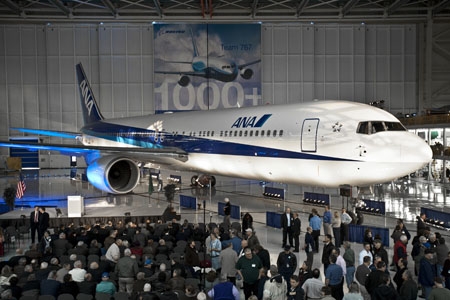
    Boeing Marks a Milestone With Rollout of 1,000th 767


    EVERETT, Wash., Feb. 2, 2011 /PRNewswire/ — Boeing (NYSE: BA) marked a proud moment in the company’s history today at a ceremonial rollout of the 1,000th 767 airplane. Hundreds of current employees, joined by Boeing retirees who worked on the first 767, gathered to celebrate the occasion at the Everett, Wash., factory.

    “It was great to see so many people here today – the engineers, the technicians, the machinists – who have made the 767 the wonderful airplane it is,” said Jim Albaugh, president and CEO of Boeing Commercial Airplanes. “As we salute the 1,000th 767, the next 767 is already being built in a new bay where we can produce airplanes much more efficiently for years to come. We hope many of the new 767s will become U.S. Air Force tankers built right here.”

    The 1,000th airplane is a 767-300ER (extended range) passenger model for ANA (All Nippon Airways) and was the final 767 to complete assembly on the current production line. Final production work already is underway on the 1,001 unit in a new, smaller bay that repositions the production line toward a leaner, more efficient operation.

    Today’s milestone is a chance for the 767 family to celebrate its past, present and future showcased in this video: http://bit.ly/eMZIVv.
    Boeing has offered the 767 as the platform for its NewGen Tanker if it wins the U.S. Air Force KC-X Tanker competition. A decision on the contract award is expected early this year.

    The 767 family is a family of clean, quiet, fuel-efficient airplanes that provide maximum market versatility in the 200- to 300-seat market. The 767 family includes three passenger models – the 767-200ER, 767-300ER and 767-400ER – and a medium-widebody freighter, which is based on the 767-300ER fuselage.

    To include the featured image in your Twitter Card, please tap or click their icon a second time.
  • |

    FAA Marks the Opening of Recovery Act Funded Airfield Upgrade at Chattanooga Metropolitan Airport

    FAA Marks the Opening of Recovery Act Funded Airfield Upgrade at Chattanooga Metropolitan Airport

    WASHINGTON, D.C. – The U.S. Department of Transportation’s Federal Aviation Administration celebrated the opening of an airfield upgrade at Chattanooga Metropolitan Airport paid for with $3 million in American Recovery and Reinvestment Act (Recovery Act) funds.

    “Airports are critical to our nation’s economy,” said U.S. Transportation Secretary Ray LaHood. “Recovery Act dollars are helping to make needed safety enhancements and upgrades at airports all across the country.”

    Recovery Act money helped Chattanooga Airport complete this project. The new aircraft parking area will help relieve congestion at the airport.

    Under ARRA, $1.1 billion has been made available to over 360 projects at airports nationwide. Because of low construction bids on projects, Recovery Act dollars were available for additional projects. ARRA grants have been distributed to airports that support not only passenger and cargo service, but general aviation as well.

    “Every air passenger’s trip begins and ends at an airport. Recovery Act dollars are helping airports of all sizes maintain and improve their critical infrastructure,” said FAA Administrator Randy Babbitt.

    Recovery Act grants are being used at both urban and rural airports to pay for a variety of different projects including facility construction, safety enhancements and the rehabilitation of runways, taxiways and other infrastructure.

    To include the featured image in your Twitter Card, please tap or click their icon a second time.
  • |

    FAA: Helicopter Air Worthiness Directive


    DEPARTMENT OF TRANSPORTATION
    Federal Aviation Administration
    14 CFR Part 39
    AD 2010-02-51

    Agusta Model A109A, A109A II, A109C, and A109K2 helicopters

    Regulatory Information
    This Emergency Airworthiness Directive (AD) is prompted by a mandatory continuing airworthiness information (MCAI) AD issued by the European Aviation Safety Agency (EASA), which is the Technical Agent for the Member States of the European Community. The MCAI states that 2 of the 3 installed main rotor scissor fitting assembly fixing bolts (fixing bolts) on a Model A109K2 helicopter had cracked in flight. Investigation by the manufacturer revealed that the crack was caused by inadequate instructions for installing the bolts. Improper installation of the main rotor scissor fitting assembly, if not detected and corrected, could result in a crack in a fixing bolt, failure of the fixing bolt, and subsequent loss of control of the helicopter.

    We have reviewed Agusta Alert Bollettino Tecnico (ABT) No. 109K-53 for Model A109K2 helicopters and ABT No. 109-131 for Model A109A, A109A II, and A109C helicopters, both dated December 18, 2009. The ABTs specify a one-time inspection to verify the correct installation of the main rotor scissor fitting assembly, part number (P/N) 109-0110-67 or P/N 109-0101-58, to determine if 2 washers are installed under the head of each fixing bolt. If 2 washers are not installed under the head of each fixing bolt, the ABTs specify replacing each fixing bolt with an airworthy fixing bolt, P/N 109-0101-78-5, and installing 2 washers under the head of each fixing bolt.

    EASA has issued AD No. 2009-0274-E, dated December 18, 2009, to correct an unsafe condition for the specified Agusta model helicopters. EASA advises that failure of a fixing bolt could lead to loss of control of the helicopter.

    These helicopter models have been approved by the aviation authority of Italy and are approved for operation in the United States. Pursuant to our bilateral agreement with Italy, EASA, their technical agent, has notified us of the unsafe condition described in the MCAI AD.
    We are issuing this AD because we evaluated all information provided by EASA and determined the unsafe condition exists and is likely to exist or develop on other helicopters of these same type designs. Therefore, this AD requires, within 5 hours time-in-service (TIS), inspecting the main rotor scissor fitting assembly to determine if there are 2 washers installed under the head of each fixing bolt. If there are 2 washers installed under the head of each fixing bolt, no further action is required. If there are not 2 washers installed under the head of each fixing bolt, this AD requires, within 25 hours TIS after complying with paragraph (a) of this AD, replacing each fixing bolt and installing 2 washers under the head of each fixing bolt.

    This AD differs from the MCAI AD in that we refer to “flight hours” as “hours TIS”. Also, we do not allow an optional date for replacing the fixing bolts.

    This rule is issued under 49 U.S.C. Section 44701 pursuant to the authority delegated to me by the Administrator, and is effective immediately upon receipt of this emergency AD.

    2010-02-51 AGUSTA S.p.A: Directorate Identifier 2010-SW-05-AD.

    Applicability: Model A109A, A109A II, A109C, and A109K2 helicopters, certificated in any category.

    Compliance: Required as indicated, unless previously accomplished.

    To prevent a crack in a main rotor scissor fitting assembly fixing bolt (fixing bolt), failure of a fixing bolt, and subsequent loss of control of the helicopter, do the following:

    (a) Within 5 hours time-in-service (TIS), inspect the main rotor scissor fitting assembly, part number (P/N) 109-0110-67 and P/N 109-0110-58, to determine if there are 2 washers installed under the head of each fixing bolt, P/N 109-0101-78-5, as depicted in Figure 1 of Agusta Alert Bollettino Tecnico (ABT) No. 109K-53 for Model A109K2 helicopters, and ABT No. 109-131 for Model A109A, A109A II, and A109C helicopters, both dated December 18, 2009, as applicable.

    (1) If there are 2 washers installed under the head of each fixing bolt, no further action is required.

    (2) If there are not 2 washers installed under the head of each fixing bolt, within 25 hours TIS after complying with paragraph (a) of this AD, replace each fixing bolt, P/N 109-0101-78-5, and install 2 washers under the head of each fixing bolt as depicted in Figures 1 and 2 of the applicable ABT, by following the Compliance Instructions, Part II, paragraphs 1. through 3.5., of the applicable ABT.

    (b) To request a different method of compliance or a different compliance time for this AD, follow the procedures in 14 CFR 39.19. Contact the Manager, Safety Management Group, ATTN: DOT/FAA Southwest Region, Sharon Miles, ASW-111, Aviation Safety Engineer, Rotorcraft Directorate, Regulations and Policy Group, 2601 Meacham Blvd., Fort Worth, Texas 76137, telephone (817) 222-5122, fax (817) 222-5961, for information about previously approved alternative methods of compliance.

    (c) Joint Aircraft System/Component (JASC) Code 6220: Main Rotor Head.

    (d) Copies of the applicable service information may be obtained from Agusta, Via Giovanni Agusta, 520 21017 Cascina Costa di Samarate (VA), Italy, telephone 39 0331-229111, fax 39 0331-229605/222595, or at http://customersupport.agusta.com/technical_advice.php.

    (e) Emergency AD 2010-02-51, issued January 13, 2010, becomes effective upon receipt.

    Note: The subject of this AD is addressed in European Aviation Safety Agency AD No. 2009-0274-E, dated December 18, 2009.

    FOR FURTHER INFORMATION CONTACT: DOT/FAA Southwest Region, Sharon Miles, ASW-111, Aviation Safety Engineer, Rotorcraft Directorate, Regulations and Policy Group, 2601 Meacham Blvd., Fort Worth, Texas 76137, telephone (817) 222-5122, fax (817) 222-5961.

    To include the featured image in your Twitter Card, please tap or click their icon a second time.
  • |

    Boeing Projects Steady Growth for Commercial Airplanes Market in Africa

    More than 700 airplanes, worth $80 billion, needed in region over 20 years

    CAPE TOWN, South Africa, Sept. 21 — Boeing forecasts that air carriers in Africa will experience steady growth over the next 20 years as air travel in Africa continues to grow with the economy.

    The African economy is projected to grow 4.8 percent in 2010 following 2.9 percent growth in 2009. This strong growth results from worldwide recovery stimulating demand for African exports as well as imports into the continent. West Africa shows the strongest growth with foreign interest in petroleum development.

    “As the demand for African commodities grows and foreign development and tourism increase, African carriers will require a modernized fleet in order to compete on routes historically dominated by foreign carriers,” said Mike Warner, senior market analyst for Boeing Commercial Airplanes, today at a media briefing in Cape Town.

    “Africa’s current fleet is nearly 20 years old on average in a market that demands newer, more fuel-efficient airplanes to help offset the rising cost of fuel.”

    Boeing’s forecast calls for the delivery of more than 700 airplanes with a value of approximately $80 billion for the African airplane market over the next 20 years.

    Growth in the airline market, along with the demand to replace older, less fuel-efficient single-aisle airplanes and regional jets with new-generation, more fuel-efficient models, will drive new airplane deliveries.

    Strong demand exists to support increased non-stop routes between Africa and Europe, the United States, the Middle East, India, and China. Twin-aisle fleets will evolve in the region as airlines continue to expand international services. Boeing forecasts that twin-aisle airplanes will account for 32 percent of new airplanes delivered to African carriers over the next 20 years compared to 23 percent worldwide. Single-aisle airplanes will represent 60 percent of the African new-airplane market, compared to 69 percent worldwide.

    Newer airplane types such as the Next-Generation 737 and 787 Dreamliner offer significant advantages in environmental performance as well as improved capabilities, fuel efficiency and maintenance costs.
    Today’s market update was part of a series of briefings that highlight Boeing’s airplane capabilities and advantages as well as discuss the African aviation market for the next 20 years. Boeing kicked off the effort at last month’s Aviation & Allied Business Leaders conference in Gaborone, Botswana. Later this year, Boeing will participate in the Airlines Association of South Africa Annual General Meeting in Manzini, Swaziland, in October and the African Airlines Association General Assembly and conference in Addis Ababa, Ethiopia, in November.

    To include the featured image in your Twitter Card, please tap or click their icon a second time.
  • NTSB TO EXAMINE SAFETY EFFECTS OF ‘GLASS COCKPITS’ IN SMALL LIGHT AIRPLANES

    Press Release-March 4, 2010 The National Transportation Safety Board will hold a public Board meeting to consider a study on what effect the introduction of glass cockpits into small light general aviation airplanes is having on the safety record of those
    aircraft.

    In 2000, almost all new single engine light airplanes were manufactured with conventional analog flight instruments. Today almost all new light planes come equipped with digital flight display avionic systems, also known as “glass cockpits.” The enhanced function and information capabilities of these systems represent a significant change and potential improvement in the way general aviation pilots monitor information needed to control their aircraft.

    The NTSB initiated this study to determine if the transition to glass cockpits in light aircraft would improve the safety record of those planes.

    For more information…

    To include the featured image in your Twitter Card, please tap or click their icon a second time.
  • |

    Press Release – FAA Mandates Crew Resource Management Training for On-Demand Charters

    For Immediate Release
    January 20, 2011

    WASHINGTON – The Federal Aviation Administration (FAA) has finalized a rule that requires non-scheduled charter airlines and air taxis to train pilots and flight attendants in Crew Resource Management (CRM), a well-established concept that helps reduce human error in commercial aviation by teaching pilots, flight attendants and other aviation workers to act as a team.

    Air carriers affected by the final rule must establish initial and recurrent CRM training for crewmembers within two years of the effective date of the rule. The training must address the captain’s authority; intra-crew communications; teamwork; managing workload, time, fatigue and stress; and decision-making skills.

    “This type of training is critical for the safety of flight crews and passengers,” said U.S. Secretary of Transportation Ray LaHood.
    The FAA has required CRM training for air carriers operating larger airplanes since December 1995.

    “I know the value of making Crew Resource Management part of the safety culture from my days as an airline pilot,” said FAA Administrator Randy Babbitt. “A crew that works as a team is a better crew, regardless of the size of the plane or the size of the airline.”

    CRM training focuses on the interactions among personnel including pilots, flight attendants, operations personnel, mechanics, air traffic controllers and flight service stations. This training in communications and teamwork can help prevent errors such as runway incursions, misinterpreting information from air traffic controllers, crewmembers’ loss of situational awareness, and failure to fully prepare for takeoff or landing.

    This final rule responds to a 2003 National Transportation Safety Board recommendation that is currently on the Board’s “Most Wanted” list of safety improvements.

    To include the featured image in your Twitter Card, please tap or click their icon a second time.