NTSB SENDS TEAM TO ASSIST GOVERNMENT OF JAMAICA IN AVIATION ACCIDENT

Similar Posts

  • |

    Dubai-based flydubai receives first interior on Next-Generation 737-800

    SEATTLE, Oct. 27 — Boeing and Dubai-based flydubai today celebrated delivery of the first Next-Generation 737 with the new, passenger-inspired Boeing Sky Interior.

    “The superior passenger experience of this exciting new interior is the result of many years’ work by Boeing employees and suppliers,” said Beverly Wyse, 737 vice president and general manager. “Our airline customers will draw value from the many practical improvements we have made in the new design.”

    Since the Next-Generation 737 was introduced in 1997, customers have taken advantage of continuous improvements to this best-selling airplane that have made it ever more efficient, reliable and passenger-friendly. Boeing Sky Interior is the latest in a series of improvements to the airplane. The next to come will be a package of performance improvements that will reduce fuel consumption and carbon emissions by 2 percent – making the airplane a full 7 percent more efficient than the first Next-Generation 737 delivered. The performance improvements to the airframe and engine are beginning certification test soon, and will be fully in service by early 2012.

    With the new 737 Boeing Sky Interior, airlines will welcome their passengers into a cabin featuring modern, sculpted sidewalls and window reveals. The ingenious design of the new, larger stow bins allows them to accommodate even more bags than before, while taking up less space in the cabin. The innovative assist mechanism of the new bins gives easy access, and as they pivot up and out of the way, there is much more headroom around the aisle seats and a greater sense of space in the cabin.

    Airlines will select from different lighting schemes that range from a welcoming, soft blue overhead sky simulation to a calm, relaxing, pallet of sunset colors.

    LEDs (light emitting diodes) are brighter and replace incandescent signage, attendant and halogen reading lights. With an estimated 40,000 hours between replacements, LEDs last 10 times longer than the previous standard of lights.

    Other features that passengers particularly will appreciate are a quieter cabin, intuitive placement of switches and call buttons, and improved sound quality and clarity through new speakers in each passenger row.

    “We are very proud to be the first to offer our passengers an enhanced onboard experience with the brand new Boeing Sky Interior,” said Ghaith Al Ghaith, CEO, flydubai. “We have achieved much in our first 16 months of service and will continue to bring our passengers the best product offerings on one of the newest 737 fleets in service.” The airplane, a Next-Generation 737-800, will enter service in November.

    A total of 46 airlines and leasing companies have ordered the 737 Boeing Sky Interior for more than 1,200 of their airplanes. flydubai is the first of five airlines that will receive Next-Generation 737s with the new interior this year.

    To include the featured image in your Twitter Card, please tap or click their icon a second time.
  • |

    NTSB ISSUES UPDATE ON JACKSON HOLE B-757 RUNWAY OVERRUN INCIDENT

    NTSB Advisory
    National Transportation Safety Board
    Washington, DC 20594
    December 31, 2010

    In its continuing investigation of the runway overrun of a jetliner in Jackson Hole, Wyo., the National Transportation Safety Board has developed the following factual information:

    At about 11:38 am MT on Wednesday, December 29, American Airlines flight 2253, a B-757-200 (N668AA) inbound from Chicago O’Hare International Airport, ran off the end of runway 19 in snowy conditions while landing at Jackson Hole Airport. No injuries were reported among the 181 passengers and crew on board.

    The aircraft came to rest in hard packed snow about 350 feet beyond the runway overrun area. An initial inspection did not reveal any structural damage to the aircraft. Shortly after the aircraft came to a stop, in accordance with American Airlines’ procedures, the pilots pulled the circuit breaker to the cockpit voice recorder (CVR) to preserve all of the recorded information for investigators.

    The CVR and DFDR (digital flight data recorder) arrived at the Safety Board’s recorder laboratory on Thursday evening, Dec. 30, where investigators were standing by to download the contents of both recorders. The CVR provided a two-hour recording of excellent quality audio; the voices of each of the pilots on the flight deck were clearly audible. The DFDR provided 1200 recorded parameters of flight data and captured the entire incident.

    The crew, who were interviewed on Thursday evening, indicated that they saw the runway prior to reaching the minimum descent altitude before touchdown. Both crewmembers characterized the flight and approach to landing as uneventful prior to the runway overrun. The first officer was the flying pilot.

    The accident docket, which will contain additional factual information, is expected to be opened in 60-90 days. It will be available on the docket section of the NTSB website at http://go.usa.gov/rjR

    PROTOCALS FOR TRANSPORTING AIRCRAFT RECORDERS IN INCIDENT INVESTIGATIONS

    The Safety Board has long-established protocols for the handling and transportation of CVRs and DFDRs that contain recorded information from a commercial aviation incident, which by definition is one where no serious injuries or substantial damage to the aircraft or other property has occurred.

    In such incident investigations, the Safety Board frequently asks the airline involved to transport the recorders on their own aircraft as such an arrangement often provides the most expeditious means of conveying the devices to Safety Board labs in Washington. The airline is instructed to transport the recorders without delay and without accessing the information contained within them by any means. This practice has worked efficiently and without complication for more than 40 years.

    During this incident investigation, the Safety Board learned that the recorders were flown to Tulsa, Okla., where American Airlines technicians downloaded information from the DFDR; the CVR was not accessed by American.

    “Although a thorough examination by our investigators determined that no information from the DFDR was missing or altered in any way, the breach of protocol by American Airlines personnel violates the Safety Board’s standards of conduct for any organization granted party status in an NTSB investigation,” said NTSB Chairman Deborah A.P. Hersman. “Because maintaining and enforcing strict investigative protocols and procedures is vital to the integrity of our investigative processes, we have revoked the party status of American Airlines and excused them from further participation in this incident investigation.”

    American Airlines has assured the Safety Board that a full review of proper procedures and internal controls would be undertaken to ensure that such an occurrence is not repeated.

    Despite their removal from party standing, the NTSB will provide American Airlines with any and all information needed to ensure a timely response to operational safety deficiencies identified in the course of the investigation.

    To include the featured image in your Twitter Card, please tap or click their icon a second time.
  • |

    New DOT Consumer Rule Limits Airline Tarmac Delays, Provides Other Passenger Protections

    DOT 199-09
    Monday, December 21, 2009
    Contact: Olivia Alair
    Tel.: (202) 366-4570

    New DOT Consumer Rule Limits Airline Tarmac Delays, Provides Other Passenger Protections

    U.S. Transportation Secretary Ray LaHood today announced a new rule that significantly strengthens protections afforded to consumers by, among other things, establishing a hard time limit after which U.S. airlines must allow passengers to deplane from domestic flights.

    “Airline passengers have rights, and these new rules will require airlines to live up to their obligation to treat their customers fairly,” Secretary LaHood said.

    The new rule prohibits U.S. airlines operating domestic flights from permitting an aircraft to remain on the tarmac for more than three hours without deplaning passengers, with exceptions allowed only for safety or security or if air traffic control advises the pilot in command that returning to the terminal would disrupt airport operations. U.S. carriers operating international flights departing from or arriving in the United States must specify, in advance, their own time limits for deplaning passengers, with the same exceptions applicable.

    Carriers are required to provide adequate food and potable drinking water for passengers within two hours of the aircraft being delayed on the tarmac and to maintain operable lavatories and, if necessary, provide medical attention.

    This rule was adopted in response to a series of incidents in which passengers were stranded on the ground aboard aircraft for lengthy periods and also in response to the high incidence of flight delays and other consumer problems. In one of the most recent tarmac delay incidents, the Department fined Continental Airlines, ExpressJet Airlines and Mesaba Airlines a total of $175,000 for their roles in a nearly six-hour ground delay at Rochester, MN.

    The rule also:

    • Prohibits airlines from scheduling chronically delayed flights, subjecting those who do to DOT enforcement action for unfair and deceptive practices;
    • Requires airlines to designate an airline employee to monitor the effects of flight delays and cancellations, respond in a timely and substantive fashion to consumer complaints and provide information to consumers on where to file complaints;
    • Requires airlines to display on their website flight delay information for each domestic flight they operate;
    • Requires airlines to adopt customer service plans and audit their own compliance with their plans; and
    • Prohibits airlines from retroactively applying material changes to their contracts of carriage that could have a negative impact on consumers who already have purchased tickets.

    Today’s final rule was adopted following a review of public comments on a proposal issued in November 2008. The Department also plans to begin another rulemaking designed to further strengthen protections for air travelers. Among the areas under consideration are: a requirement that airlines submit to the Department for review and approval their contingency plans for lengthy tarmac delays; reporting of additional tarmac delay data; disclosure of baggage fees; and strengthening requirements that airline ads disclose the full fare consumers must pay for tickets.

    The rule goes into effect 120 days after date of publication in the Federal Register. The rule may be obtained on the Internet at www.regulations.gov, docket DOT-OST-2007-0022.

    To include the featured image in your Twitter Card, please tap or click their icon a second time.
  • FAA OKs Four More Portable Oxygen Concentrators

    WASHINGTON — The Federal Aviation Administration (FAA) announced today that passengers needing medical oxygen now have the option of using four additional portable oxygen concentrators while traveling, bringing the total number of approved units to 11.

    The newly authorized devices are DeVilbiss Healthcare’s iGo, International Biophysics Corporation’s LifeChoice, Inogen’s Inogen One G2 and Oxlife’s Independence Oxygen Concentrator.

    “This is our latest step toward making air travel more accessible for people who need medical oxygen,” said FAA Administrator Randy Babbitt. “We want these passengers to have as many options as possible while ensuring all of our safety guidelines are being met.”

    Portable oxygen concentrators are small, portable devices that separate oxygen from nitrogen and other gases in the air and provide oxygen to users at greater than 90 percent concentration. They do not use compressed or liquid oxygen, which the government classifies as hazardous material.

    The Department of Transportation requires that U.S. carriers allow passengers to use portable oxygen concentrators approved by the FAA during all phases of a flight – including taxiing, takeoff and landing – if the unit displays a manufacturer’s label that indicates it meets FAA requirements for portable medical electronic devices, is properly stowed, and meets certain other applicable safety-related conditions.

    For example, passengers must ensure the unit is in good working order and must be able to respond to the unit’s warning alarms. They must protect extra batteries in carry-on baggage from short circuits and physical damage. Carriers also must let passengers operate these FAA-approved concentrators while moving about the cabin whenever the captain turns off the “Fasten Seat Belt” sign.

    Carriers can legally refuse to allow inflight use of an FAA-approved portable oxygen concentrator that does not have a manufacturer’s label indicating that the device complies with FAA requirements. However, the Department encourages airlines to voluntarily allow the inflight use of such devices. Inflight use of an FAA-approved portable oxygen concentrator, whether labeled or not, poses no safety danger so long as carriage of the device is in accordance with instructions provided by the FAA.

    The FAA previously approved these portable oxygen concentrators for use:

    Delphi Medical Systems RS-00400
    Invacare XPO2
    AirSep Lifestyle
    AirSep Freestyle
    Inogen One
    SeQual Eclipse
    Respironics EverGo
    ###

    To include the featured image in your Twitter Card, please tap or click their icon a second time.
  • |

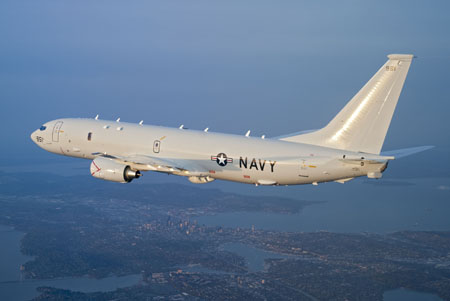
    Boeing Receives $1.6B Contract for P-8A Poseidon Low-Rate Initial Production


    SEATTLE, Jan. 25, 2011 — Boeing [NYSE: BA] on Jan. 21 received a $1.6 billion contract from the U.S. Navy for low-rate initial production (LRIP) of the P-8A Poseidon aircraft. The LRIP 1 contract is for six P-8A aircraft, spares, logistics and training devices.

    The Navy plans to purchase 117 of the Boeing 737-based P-8A anti-submarine warfare, anti-surface warfare, intelligence, surveillance and reconnaissance aircraft to replace its P-3 fleet. Initial operational capability is planned for 2013.

    “Providing these production aircraft to the Navy fleet on schedule is our No. 1 goal,” said Chuck Dabundo, Boeing vice president and P-8 program manager. “This is an exciting day for Boeing and the Navy and a testament to the P-8 team’s hard work and determination.”

    “This first production contract represents a significant commitment by the U.S. Navy to recapitalize its force of long-range maritime patrol and reconnaissance aircraft,” said Capt. Leon Bacon, P-8A deputy program manager for the Navy. “Ensuring that this capability arrives on schedule and within budget remains our primary objective.”

    Boeing will begin final assembly of the first LRIP aircraft at its Renton, Wash., facility this summer. The Poseidon team is using a first-in-industry in-line production process that draws on Boeing’s Next-Generation 737 production system. All P-8A-unique aircraft modifications will be made in sequence during fabrication and assembly.

    “The in-line approach we’ve incorporated on this military derivative aircraft is already paying the dividends we expected by helping us improve efficiency and reduce costs,” said John Pricco, Boeing Commercial Airplanes P-8 program manager.

    As part of the U.S. Navy System Development and Demonstration contract awarded to Boeing in 2004, the team is building and testing six flight-test and two ground-test aircraft. The first three flight-test planes, T1, T2 and T3, are completing testing at Naval Air Station Patuxent River, Md. The program’s static test plane, S1, recently completed its test program, which began in May 2009; S2, the fatigue test plane, will begin testing later this year.

    A derivative of the Next-Generation 737-800, the Poseidon is built by a Boeing-led industry team that includes CFM International, Northrop Grumman, Raytheon, Spirit AeroSystems, BAE Systems and GE Aviation.

    To include the featured image in your Twitter Card, please tap or click their icon a second time.
  • | |

    Airbus Press Release: Airblue flight ED 202 accident in Islamabad

    First Release
    28 July 2010

    Airbus regrets to confirm that an Airbus A321 operated by airblue was involved in an accident shortly after 9.45 am local time. The aircraft was operating a scheduled service, Flight ED 202, from Karachi to Islamabad, Pakistan.

    The aircraft involved in the accident, registered under AP-BJB, was MSN (Manufacturer Serial Number) 1218, initially delivered from the production line in 2000. The aircraft is leased to airblue in January 2006. The aircraft had accumulated approximately 34,000 flight hours in some 13,500 flights. It was powered by IAE V2533 engines. At this time no further factual information is available.

    In line with international convention, Airbus will provide full technical assistance to the Authorities of Pakistan, who will be responsible for the investigation into the accident.

    The A321 is a twin-engine single-aisle seating 185 passengers in a standard two-class configuration. The first A321 entered service in January 1994. To date, some 610 A321’s are in service with nearly 70 operators. The entire fleet has accumulated some 10.6 million flight hours in some 5.8 million flights. The A321 is part of the A320 Family which has achieved over 50 million take offs and landings since the first model, the A320, entered commercial service in 1988. Today, more than 4,300 aircraft are in operations to some 310 customers and operators worldwide.

    Airbus will make further factual information available as soon as the details have been confirmed.

    The concerns and sympathy of the Airbus employees go to the families, friends and loved ones affected by the accident of Flight ED 202.

    * * *

    For further information, please contact:
    AIRBUS – MEDIA RELATIONS
    Tel.: (33) 05.61.93.10.00

    To include the featured image in your Twitter Card, please tap or click their icon a second time.