
The International Air Transport Association (IATA) called on public and private stakeholders to work together to address critical priorities to enable aviation to do more to drive economic growth in Africa.
“Aviation supports 6.7 million jobs and some $68 billion of economic activity in Africa. Those numbers are impressive but I am convinced aviation has an even bigger role to play in providing the connectivity that drives economic growth and development,” said Tony Tyler, IATA’s Director General and CEO.
Speaking at Aviation Day Africa, Tyler said that, “Africa is poised for rapid development and great changes. Half of the top 20 fastest growing economies over the next five years are expected to be on this continent. Aviation’s part in driving growth and development will become even more prominent.”
In order for this to occur, however, Africa must address major challenges in safety, infrastructure, and liberalization.
Safety:
“Safety is our top priority. And Africa’s performance is well below what we are achieving globally,” said Tyler. In 2012 African airlines had one accident (with a Western-built jet aircraft) for every 270,000 flights. Globally, the industry average was 1 accident for every 5 million flights. However, no IATA member experienced a Western-built jet hull loss accident last year and that includes the 25 member airlines based in Africa. Likewise, none of the 384 airlines on the IATA Operational Safety Audit (IOSA) registry had a hull loss with a Western-built jet—also including those carriers based in Africa. “It is clear that IOSA is making a difference—not just in Africa, but in safety globally,” said Tyler.
The Abuja Declaration, which was endorsed by the African Union Summit this year, sets out a comprehensive approach to reaching world-class safety levels by 2015. Completion of IOSA by all African carriers is a condition of the Declaration and Tyler urged African governments to make IOSA mandatory for airlines. IATA is sponsoring 10 airlines with in-house training to achieve IOSA registration.
In addition to IOSA participation, the Abuja Declaration calls for:
- The establishment of independent and sufficiently funded civil aviation authorities
- Implementation of effective and transparent safety oversight systems by all African states
- Implementation of accident prevention measures focused on runway safety and loss of control
- Implementation of flight data analysis
- And implementation of safety management systems by all service providers
“Meeting the Abuja Declaration’s commitments will require a major effort across the continent. We have a lot of ground to cover and we cannot lose momentum. IATA is a committed partner and we must work together as a team of stakeholders to deliver world class safety to Africa,” said Tyler.
Infrastructure
“Infrastructure is also a major challenge. Some of the challenges are physical—infrastructure in many parts of Africa needs to improve,” said Tyler. Several infrastructure projects are ongoing in the region—upgrades at Lagos Airport, Performance-Based Navigation investments for Nigerian air traffic management and ambitious airport infrastructure re-development in Ghana.
Nonetheless, there are some infrastructure challenges including the reliability of fuel supply in Lagos. “We must find a sustainable long-term solution. The vandalized pipeline is no longer in use. And trucking fuel from Apapa terminal through dense traffic is inefficient and costly. The same can be said of building extra capacity to store fuel on site. Without minimizing the challenges involved, providing security on a few kilometers of pipeline is not an impossible task. We are working with the oil industry to find a solution. And we will be seeking the government’s political will to help us make it happen. Ensuring fuel reliability is critical to Lagos’s future as a hub for connectivity across South-West Africa.,” said Tyler.
Infrastructure costs and charging policy are also hindering African connectivity. “Just as with safety, global standards exist to provide guidance on charges, as developed and recommended by the International Civil Aviation Organization. These include cost-relatedness, non-discrimination and transparency. It is also recommended that charges be developed in consultation with users. And there should be no pre-financing,“ said Tyler.
“Governments must also recognize that every dollar counts. If we average the entire industry’s profits for 2012, airlines retained about $2.50 for every passenger. And African airlines have been basically hovering around break-even for a decade or more. Without sustainable income, airlines cannot expand to meet rising demand and in fact, they may have to reduce services,” said Tyler.
Liberalization
“Africa’s economic development needs aviation connectivity. And for that to further develop, airlines need to be able to access markets. Ironically, connectivity from Africa to other continents is more developed than connectivity within the continent. From Lagos there are daily flights to Atlanta but not to Dakar or Abidjan—and Lagos is one of the better connected cities in Africa. Africa has a visionary framework for growing connectivity across the continent in the now epic story of the Yamoussoukro Declaration which started in 1988. There has been some progress. But it is far from being transformational. It is interesting to see that African governments find it somehow easier to expand bilateral arrangements with long-haul trading partners than within the region,” said Tyler.
To include the featured image in your Twitter Card, please tap or click their icon a second time.

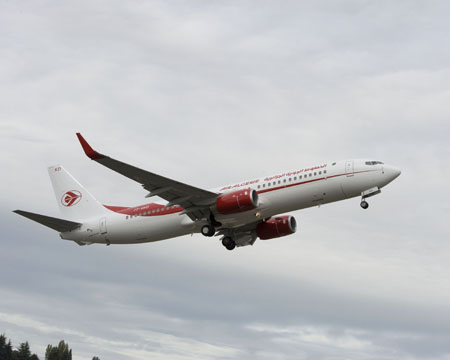
 July 21–How does an airport suddenly go from being 2,000 feet to more than a mile high? Barring a “Hollywood-style” seismic event at your airport, the answer is density altitude; in other words, how high an aircraft “thinks” it is. When density altitude is high as a result of temperatures above standard at a given altitude, the air is less dense than normal. This means an aircraft will perform as if at a higher altitude with degraded climb performance and acceleration; two pretty important factors on a hot, humid day with a short runway and 50-foot pine trees looming at the end.
 The FAA is soliciting bids from companies interested in competing for NextGen support contracts with an approximate combined value of $7 billion, the largest award in the agency’s history. Under the umbrella awards, called System Engineering 2020 (SE2020), the FAA will award as many as five separate contracts for research and development and systems engineering work that will help the agency deliver NextGen.