|

Southwest Airlines and Its Stock Clerks Announce New Tentative Agreement

Similar Posts

  • Mexican Interjet to Install Mechtronix A320 Level D Simulator

    Fast Expanding Airlines Continue to Adopt Mechtronix Train@Home Business Model

    MONTREAL, Dec. 6, 2010 /PRNewswire/ — Mechtronix Systems Inc., an MWC company, a world leading manufacturer of Flight Simulation Training Devices (FSTD), today announced that Mexican Interjet is opening a brand new training facility in Toluca, equipped with an A320 FFS X™ to train their pilots at their operations base. This will be Interjet’s first FFS and the first A320 full motion simulator to be installed in Mexico in twelve years. Interjet’s pilots will have unlimited access to the device at their home base of operation in Toluca; optimizing crew coverage while lowering training costs by reducing time off the line and travel expenses. The state-of-the-art unit provides an easier access to training and enables Interjet to perform 100% of initial and recurrent training at their base of operations. It will be evaluated by the Mexican Aviation Authorities, Direccion General de Aviacion Civil, following FAA 14 CFR Part 60 standard for Level D.

    “Our current A320 fleet of 22 plus the 12 to come justify having our own training center. Now we can cut drastically our crews training costs and enhance productivity. Other A320 operators in the region can also benefit from our state-of-the art facility and Toluca’s convenient location. We selected Mechtronix after a careful examination of FSTD manufacturers. We’re delighted with their professionalism, product quality and technical skills demonstrated throughout the different stages of the project and today,” said Jose Luis Garza, Interjet CEO.

    “We are thankful for the trust granted to Mechtronix by the very senior management of Interjet; and installing an A320 FFS X™ in Mexico is another achievement from Mechtronix as it adds up to our Airbus references worldwide and strengthens our presence in this dynamic part of the world,” explained Mechtronix President Xavier Herve. “Our Train@Home business model allows growing airlines’ pilots to train at operations home base in ground-breaking simulation technology at a reasonable cost. Interjet’s fast growing fleet of 22 A320 aircraft justified the investment in a Level D FFS and with such innovative equipment, Interjet will offer top-quality A320 flight training, thus contributing to the further raising of training standards in Mexico. It was a real pleasure working together on this project and we trust Interjet will be highly satisfied with their new simulator.”

    The A320 FFS X™, a highly cost-effective and easy-to-operate platform, enables the airline to save time and money. Built to Airbus standard 1.6, the A320 unit offers the highest Level D fidelity together with an electric motion system and a collimated visual system that comes with a library of specifically customized airports including Mexican cities to which the airline provides service — Mexico, Toluca, Monterrey, among others.

    To include the featured image in your Twitter Card, please tap or click their icon a second time.
  • |

    Press Release – FAA Proposes $330,000 Civil Penalty Against American Eagle Airlines

    For Immediate Release

    FORT WORTH – The Federal Aviation Administration (FAA) is proposing a $330,000 civil penalty against American Eagle Airlines Inc., of Fort Worth, for operating an Embraer 135 regional jet on 12 revenue passenger flights when it was not in compliance with Federal Aviation Regulations.

    The FAA alleges American Eagle mechanics failed to note broken passenger seats and armrests on two aircraft during a Dec. 18, 2008 inspection and did not follow the approved maintenance manual instructions during those inspections. FAA inspectors discovered seats on two aircraft that would not raise and stow into the upright and locked position for takeoffs and landings. FAA inspectors also found damaged center arm rests that would not stow in the upright and locked position.

    The FAA further alleges that American Eagle used one of the aircraft on 12 revenue passenger flights between the inspection and eventual repair of the seats and armrests. The other aircraft did not fly again until the airline completed the required work.

    American Eagle has 30 days from receipt of the FAA’s enforcement letter to respond to the agency.

    To include the featured image in your Twitter Card, please tap or click their icon a second time.
  • |

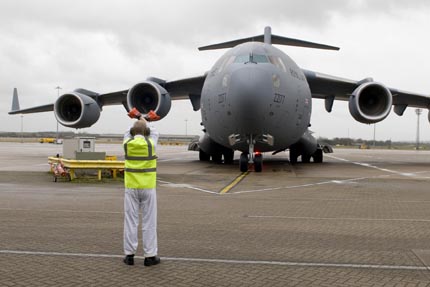
    7th Boeing C-17 for Royal Air Force Arrives in United Kingdom


    LONDON, Jan. 21, 2011 — Boeing and its Boeing Defence UK subsidiary today announced the arrival of the Royal Air Force’s seventh C-17 Globemaster III airlifter at RAF Brize Norton in Oxfordshire, England. The aircraft was officially delivered on Nov. 16 from Boeing’s facility in Long Beach, Calif., and underwent modifications at the company’s San Antonio facility before flying to the United Kingdom.

    “The RAF C-17 fleet, along with the rest of the Airbridge, delivers an incredible capability to our deployed forces on the front line,” said Air Officer Commanding 2 Group, Air Vice-Marshal Philip Osborn, Royal Air Force. “I am also extremely proud of the outstanding contribution that all our aircraft and personnel are making toward continued progress in Afghanistan.”

    Assigned to 99 Squadron at RAF Brize Norton, the UK fleet of C-17s provides critical airlift capability for the nation’s Joint Rapid Reaction Force and has supported humanitarian and disaster-relief missions to Pakistan, Haiti and Chile. 99 Squadron’s C-17s are equipped with upgraded software and avionics, as well as additional fuel tanks that extend the aircraft’s nautical mile range to over 4,000 miles. In normal operations, the aircraft carries a crew of three — two pilots and one air-loadmaster.

    “May 2011 will mark the 10th anniversary of the delivery of the Royal Air Force’s first C-17, which continues to perform superbly — anytime and anywhere,” said Boeing UK C-17 Program Manager Liz Pace. “The RAF uses its C-17s more than any other service today, which is why it has surpassed 60,000 flight hours with just six aircraft.”

    The UK Ministry of Defence announced it would acquire its seventh C-17 in December 2009, less than one year before delivery.

    Boeing supports the RAF’s C-17s through the C-17 Globemaster III Sustainment Partnership, a performance-based logistics program, at RAF Brize Norton, the RAF’s main operating base for strategic air transport and air-to-air refueling. The arrangement provides the RAF with the benefits of complete “virtual fleet” access and an extensive support network. The virtual fleet concept enables C-17 customers, especially those with smaller numbers of aircraft, to benefit from worldwide parts availability and economies of scale when purchasing materials.

    Boeing Defence UK Ltd. is a wholly owned subsidiary of The Boeing Company and a business unit of Boeing Defense, Space & Security. It currently has employees at 20 locations throughout the UK supporting Ministry of Defence and U.S. military programs.

    To include the featured image in your Twitter Card, please tap or click their icon a second time.
  • | |

    NTSB COMPLETES DATA COLLECTION FOR EXPERIMENTAL- AMATEUR-BUILT AIRCRAFT ACCIDENT Study

    National Transportation Safety Board
    Washington, DC 20594

    Throughout the 2011 calendar year, the NationalTransportation Safety Board has been conducting a study ofExperimental Amateur-Built (E-AB) aircraft to evaluate thesafety of this growing and innovative segment of general aviation. In addition to using the information gathered during its accident investigations, the NTSB has been working with the Federal Aviation Administration (FAA), the Experimental Aircraft Association (EAA), and individual owners and builders to evaluate a range of issues unique to this popular segment of general aviation.

    “The cooperation we have received from EAA and the E-AB community has been tremendous,” said NTSB Chairman Deborah A.P Hersman. “Through this study, we hope that we’ll be ableto give the innovators and aviators in the community
    information about accidents that will result in a real and immediate safety payoff for them when they are flying these aircraft.”

    As part of the study, NTSB investigators have conducted in-depth investigations of 222 E-AB aircraft accidents that occurred during 2011. Fifty-four of these accidents resulted in 67 fatalities. Most of these accidents (93%) involved
    amateur-built airplanes, the remaining accidents involved gyroplanes (4%), helicopters (2%), and gliders (1%). These accidents occurred in 44 states, with California (18 accidents), Texas (16 accidents), and Florida (14 accidents)
    accounting for the most. More than half (53%) of the E-AB accidents investigated in 2011 involved E-AB aircraft that were bought used, as opposed to having been built by the current owner.

    The EAA has supported the study by conducting a web-based survey of E-AB owners and builders. More than 5,000 E-AB owners and builders responded to EAA’s survey, and 4,923 of these responses were sufficiently complete to use in
    analyses. Most respondents (97%) described E-AB airplanes, while gliders, gyrocopters, and helicopters were each described by slightly less than 1% of the respondents. Sixty-three percent of respondents had already built their
    E-AB aircraft, 13% were currently building their E-AB aircraft, and nearly 24% had bought used E-AB aircraft. More than 340 distinct makes of amateur-built aircraft were reported, although kit manufacturers accounted for more than 55% of the reported aircraft.

    “The NTSB is extremely pleased with the number of respondents who participated in the survey,” said Dr. Joseph Kolly, Director of the Office of Research and Engineering. “The survey data provides us with quantifiable, factual
    information that enriches our understanding of how E-AB aircraft are built and operated.”

    The safety study is scheduled to be completed in the spring of 2012.

    To include the featured image in your Twitter Card, please tap or click their icon a second time.
  • | |

    Southwest Airlines Plane Suffers Bird Strike Near Sacramento Airport

    Southwest Airlines flight WN-1940 suffered a bird strike near Sacramento International Airport, California, on December 6th.

    The incident happened when the Boeing 737-700 plane coming from Santa Ana, California, was on approach to Sacramento Airport.

    The plane continued for a safe landing. Everyone aboard remained unharmed.

    To include the featured image in your Twitter Card, please tap or click their icon a second time.
  • | |

    Statement from the FAA

    Statement from the FAA in Response to the Associated Press Story about Temporary Flight Restrictions over the Gulf of Mexico
    For Immediate Release
    June 17, 2010

    WASHINGTON, D.C. — Today’s story by the Associated Press contains a number of inaccuracies with regard to the government’s oversight of flyovers in and around the oil spill in the Gulf of Mexico. Since May 28th, the FAA has approved every request to fly over the area–more than 176 requests. While the temporary flight restriction requires pilots to stay above 3,000 feet, the FAA is working with news organizations and granting exceptions so that pilots can fly at lower altitudes throughout the day.

    The reason for these requirements is safety, pure and simple. So far, there have been a number of reported near misses over the Gulf due to heavy traffic and pilots flying above the oil spill to give their passengers a closer look.

    On Sunday, a helicopter carrying a member of the Associated Press violated the temporary flight restriction around the oil clean-up efforts in the Gulf of Mexico. The helicopter operator was not authorized to fly into the restricted area and was flying at various altitudes well below 3,000 feet. For over 30 minutes, the pilot was not in communication with the Border Patrol aircraft that is providing traffic advisories for all participating aircraft. Border Patrol was forced to divert other traffic in the area, creating a dangerous situation for everyone involved. When the pilot was finally reached he was told to leave the area.

    A pilot deviation (an action that results in the violation of a Federal Aviation Regulation) is being filed against the helicopter pilot.

    To include the featured image in your Twitter Card, please tap or click their icon a second time.