|

Pet Airways Appoints Andrew Warner as President and Chief Financial Officer

Similar Posts

  • |

    Boeing Celebrates Final Assembly of 1,000th 767

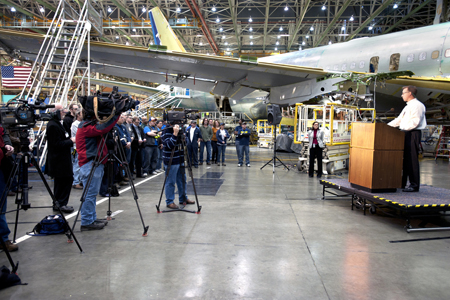
    EVERETT, Wash., Jan. 10, 2011 — Final assembly started today on the 1,000th Boeing (NYSE: BA) 767 airplane. Workers marked the milestone with a celebration at the Everett, Wash. factory.

    “This milestone is a credit to every employee who had a hand in building 767s over the past 30 years,” said Kim Pastega, vice president and general manager of the 767 program, Boeing Commercial Airplanes. “It is a testament to engineering a high-quality product that continues to improve through the years.”

    Final assembly is the last step of the production process before the airplane rolls out of the factory on its way to the paint hangar and the Everett Delivery Center for ground and flight tests. The 1,000th airplane – a 767-300ER (extended range) passenger model for ANA (All Nippon Airways) – is the last 767 to complete final assembly in its current home. Beginning with line number 1001 – also a 767-300ER for ANA – all future 767s will complete that step in a new, smaller bay where production is scheduled to increase in 2011.

    The 1,000th airplane is scheduled for delivery next month. ANA, a long-time Boeing customer, has taken delivery of 89 767s since placing its first order in 1979.

    Boeing will use the 767 as the platform for its NewGen Tanker if it wins the U.S. Air Force KC-X Tanker competition. That contract award currently is scheduled for early this year.

    The 767 family is a family of clean, quiet, fuel-efficient airplanes that provide maximum market versatility in the 200- to 300-seat market. The 767 family includes three passenger models — the 767-200ER, 767-300ER and 767-400ER — and a medium-widebody freighter, which is based on the 767-300ER fuselage.

    To include the featured image in your Twitter Card, please tap or click their icon a second time.
  • |

    Previously announced increase to 35 per month to be extended to 38 per month in second quarter 2013

    SEATTLE, Sept. 16 — Boeing announced today its production rate for the Next-Generation 737 program will increase to 38 airplanes per month in the second quarter of 2013. This decision comes just months after announcing a rate increase on the company’s best-selling commercial jetliner from 31.5 to 35 airplanes per month in early 2012.

    "Increasing production is in response to customer demand for this airplane," said Boeing Commercial Airplanes President and CEO Jim Albaugh. "Airlines want this innovative airplane sooner to renew their fleets to serve their customers. We made this decision after careful evaluation by Boeing and our supplier partners."

    Key factors to the rate decision include the company’s current backlog of more than 2,000 Next-Generation 737s, current options that customers are expected to exercise and ongoing sales campaigns. The rate increase is not expected to have a material impact on 2010 financial results.

    Next-Generation 737 customers have benefited from continuous innovation of the airplane since its introduction in 1997. The first five airlines will receive the new 737 Boeing Sky Interior by the end of this year. Customers will gain from a two percent reduction in the airplane’s fuel consumption by early 2012, through a combination of airframe and engine improvements.

    The 2010 Current Market Outlook, Boeing’s long-term forecast of air traffic volumes and commercial airplane demand, projects a market of over 21,000 single-aisle airplanes over the next 20 years, accounting for an anticipated 69 percent of the airplanes delivered and an estimated 47 percent of the $3.6 trillion total market value.

    Forward-Looking Statements

    Certain statements in this report may be "forward-looking" within the meaning of the Private Securities Litigation Reform Act of 1995. Words such as "expects," "intends," "plans," "projects," "believes," "estimates," "targets," "anticipates," and similar expressions are used to identify these forward-looking statements. Forward-looking statements are based upon assumptions about future events that may not prove to be accurate. These statements are not guarantees of future performance and involve risks, uncertainties and assumptions that are difficult to predict. Actual outcomes and results may differ materially from what is expressed or forecasted in these forward-looking statements. As a result, these statements speak to events only as of the date they are made and we undertake no obligation to publicly update or revise any forward-looking statements, whether as a result of new information, future events or otherwise, except as required by federal securities laws. Specific factors that could cause actual results to differ materially from forward-looking statements include, but are not limited to, statements we make regarding our guidance relating to future financial and operating performance, the effect of economic conditions in the United States and globally, and general industry conditions as they may impact us or our customers, as well as the other important factors disclosed previously and from time to time in our other filings with the Securities and Exchange Commission.

    To include the featured image in your Twitter Card, please tap or click their icon a second time.
  • |

    Updated Boeing Statement on 787 Dreamliner ZA002 Incident

    EVERETT, Wash., Nov. 11, 2010 Boeing continues to investigate Monday’s incident on ZA002. We have determined that a failure in the P100 panel led to a fire involving an insulation blanket. The insulation self-extinguished once the fault in the P100 panel cleared. The P100 panel on ZA002 has been removed and a replacement unit is being shipped to Laredo. The insulation material near the unit also has been removed.

    Damage to the ZA002 P100 panel is significant. Initial inspections, however, do not show extensive damage to the surrounding structure or other systems. We have not completed our inspections of that area of the airplane.

    The P100 panel is one of several power panels in the aft electronics bay. It receives power from the left engine and distributes it to an array of systems. In the event of a failure of the P100 panel, backup power sources – including power from the right engine, the Ram Air Turbine, the auxiliary power unit or the battery – are designed to automatically engage to ensure that those systems needed for continued safe operation of the airplane are powered.

    The backup systems engaged during the incident and the crew retained positive control of the airplane at all times and had the information it needed to perform a safe landing.

    Molten metal has been observed near the P100 panel, which is not unexpected in the presence of high heat. The presence of this material does not reveal anything meaningful to the investigation.

    Inspection of the surrounding area will take several days and is ongoing. It is too early to determine if there is significant damage to any structure or adjacent systems.

    As part of our investigation, we will conduct a detailed inspection of the panel and insulation material to determine if they enhance our understanding of the incident.

    We continue to evaluate data to understand this incident. At the same time, we are working through a repair plan. In addition, we are determining the appropriate steps required to return the rest of the flight test fleet to flying status.

    Boeing will continue to provide updates as new understanding is gained.

    To include the featured image in your Twitter Card, please tap or click their icon a second time.
  • |

    LUNAR AND PLANETARY CONFERENCE HIGHLIGHTS SOLAR SYSTEM EVOLUTION

    HOUSTON — NASA researchers and other scientists will present findings that provide new insights into the evolution of the solar system during the 42nd annual Lunar and Planetary Science Conference.

    The conference will run March 7-11 at the Woodlands Waterway Marriott Hotel and Convention Center, 1601 Lake Robbins Drive, The Woodlands, Texas.

    Key events include the unveiling of future planetary science strategy; early science results from a Japan Aerospace Exploration Agency mission, called Hayabusa, that returned the first particle samples from an asteroid; presentations about the recent comet Hartley 2 flyby; and the upcoming MESSENGER mission, the first spacecraft to orbit Mercury.

    The conference also will include a briefing about the Planetary Decadal Survey at 5:30 p.m. CST on March 7. The survey is a strategy released by the National Research Council in Washington to prioritize missions, research areas and observations ten or more years into the future. The briefing’s featured speaker will be Steve Squyres of Cornell University. He is the survey’s chair and principal investigator for NASA’s Mars Exploration Rovers.

    News media representatives interested in registering or obtaining more information should visit:

    http://www.lpi.usra.edu/meetings/lpsc2011/

    The conference is hosted by the Lunar and Planetary Institute in . The institute is managed by the Universities Space Research Association, a national, nonprofit consortium of universities chartered in 1969 by the National Academy of Sciences at NASA’s request.

    To include the featured image in your Twitter Card, please tap or click their icon a second time.
  • |

    Press Release: Boeing Assembles First 747-8 Intercontinental Forward Fuselage

    EVERETT, Wash., Sept. 14 — Boeing achieved another significant milestone for the first 747-8 Intercontinental Sunday night with the assembly of the airplane’s forward fuselage. The 89-foot, 2-inch (27.2 meters) fuselage section, featuring the airplane’s signature upper deck, was moved from the assembly tool for sealing and testing before beginning systems installation.
    The 747-8 features a stretched fuselage compared to that of the 747-400. It is 18 feet, 4 inches (5.6 meters) longer than its predecessor. Much of the stretch — 13 feet, 4 inches (4.1 meters) — is located in the forward fuselage. The remaining additional 5 feet (1.5 meters) are located aft of the wing. The 747-8’s stretched fuselage provides for 51 additional seats to accommodate 467 passengers in a typical three-class configuration and 26 percent more cargo volume.

    The Boeing 747-8 Intercontinental is the new, high-capacity 747 that offers the lowest operating costs and best economics of any large passenger airplane, while providing enhanced environmental performance.

    To include the featured image in your Twitter Card, please tap or click their icon a second time.
  • |

    FAA Penalty Against Circor Aerospace


    WASHINGTON – The Federal Aviation Administration (FAA) is proposing a civil penalty of $205,250 against Circor Aerospace, Inc., a Sylmar, Calif.-based aircraft repair station, for allegedly violating FAA drug and alcohol testing regulations.
    The FAA alleges Circor failed to conduct required pre-employment drug tests and receive verified negative drug test results before hiring 29 people to perform safety-sensitive aircraft maintenance work.
    The FAA also alleges the company failed to include two individuals in its random drug and alcohol testing pool.
    The FAA discovered the alleged violations during a December 2011 inspection of Circor’s antidrug and alcohol misuse prevention program. The alleged violations took place between September 2010 and December 2011.

    To include the featured image in your Twitter Card, please tap or click their icon a second time.