|

NTSB MEETS TO CONSIDER SAFETY STUDY ON THE USE OF AIRBAGS IN GENERAL AVIATION AIRCRAFT

Similar Posts

  • |

    Press Release – Pilots and Air Traffic Controllers Share Safety Data

    For Immediate Release
    September 22, 2010

    WASHINGTON — The Federal Aviation Administration (FAA) today announced a safety program that for the first time will integrate voluntary safety information self-reported by pilots and air traffic controllers. This data-sharing program will give the FAA a more complete picture of the national airspace system by collecting, assessing and reviewing safety events from the perspective of both pilots and air traffic controllers.

    United Airlines and its pilots have the first agreement in place to participate in a demonstration program. The FAA expects to sign similar agreements with other carriers in the future.

    “Safety is our number-one priority,” said U.S. Transportation Secretary Ray LaHood. Having pilots and controllers provide information abut potential air safety problems will help us correct them before they become accidents.”

    “This revolutionary program will give us an incredible amount of data that will help us find problems, make corrections and avoid incidents,” said FAA Administrator Randy Babbitt. “I applaud air traffic controllers, pilots and airlines for their dedication to keeping our aviation system as safe as possible.”

    For the first time, information from the Aviation Safety Action Program (ASAP) and the Air Traffic Safety Action Program (ATSAP) will be merged, so input from both pilots and controllers can help guide safety decisions. The program will develop processes and policies to share and analyze relevant safety information in a non-punitive way, consistent with the basic principles of Safety Management Systems. These systems are widely used within the FAA and the aviation industry.

    ASAP encourages aviation employees to voluntarily report safety information that may help identify potential precursors to accidents. The ASAP process resolves safety issues through corrective action rather than through punishment or discipline. Each program is based on a safety partnership that includes the FAA and the aviation operator, and usually includes a third party, such as the reporting employee’s labor organization. In today’s agreement, the airline’s labor organization is the United chapter of the Air Line Pilots Association (ALPA). Today, 73 air carriers have 169 ASAP programs for pilots, mechanics, flight attendants, and dispatchers.

    ATSAP is an agreement between the FAA and the National Air Traffic Controllers Association (NATCA) that is designed to foster a voluntary, cooperative, non-punitive environment for FAA air traffic employees to openly report safety concerns As a result of ATSAP, all parties have access to valuable safety information that otherwise might never have been discovered or reported. The FAA analyzes the information to develop skill enhancements or system corrective actions that will help solve safety problems.

    Voluntary reporting programs have significantly contributed to the nation’s impressive aviation safety record, including improvements to training and enhanced operations and maintenance procedures.

    To include the featured image in your Twitter Card, please tap or click their icon a second time.
  • |

    NTSB ANNOUNCES AGENDA FOR AIRLINE CODE-SHARING SYMPOSIUM

    The National Transportation Safety Board has published the agenda for the symposium on airline code-sharing, which will take place on October 26-27 in the NTSB Board Room and Conference Center (429 L’Enfant Plaza, SW, Washington, DC 20594). The symposium is open to all and free to attend (there is no registration). The event will also be webcast live on www.ntsb.gov.

    A description of the symposium, a detailed agenda, and biographies of the presenters, panelists and moderator are all available at http://go.usa.gov/aZ6

    The media advisory announcing the symposium is available athttp://go.usa.gov/aZF

    To include the featured image in your Twitter Card, please tap or click their icon a second time.
  • |

    American Way Magazine Commemorates 45 Years of Publication With a Full Redesign


    FORT WORTH, Texas, Jan. 11, 2011 /PRNewswire/ — American Way, the award-winning inflight magazine of American Airlines and American Eagle, commemorates 45 years of publication with a redesign which debuts with the first issue of 2011, onboard planes now.

    “American Way is still the only inflight magazine published twice monthly, which is a great service to our frequent travelers,” said Susan Gordon, American Airlines Publishing President and Group Publisher. “We pride ourselves on consistently delivering an industry leading magazine to our customers, so it makes sense to redesign the magazine as our culture changes.”

    Most notable will be the new American Way masthead, inspired by the typeface on a 1930s-era American Airlines DC-3. Redesigned departments include the combination of UpFront and DownLow to create a new super-department called Itineraries, as well as the addition of Briefs, which highlights both a celebrity and a destination.

    “The goal was to bring a more contemporary and graphically pleasing palate to the magazine, while continuing to serve our readers as an invaluable source of information and entertainment,” said David Radabaugh, American Way Design Director.

    Other changes include the addition of new maps and helpful widgets, the organization of stories in a more reader-friendly format, and incorporating an unconventional approach to original photography and illustration. Every issue can be found online in its entirety at www.americanwaymag.com.

    To include the featured image in your Twitter Card, please tap or click their icon a second time.
  • |

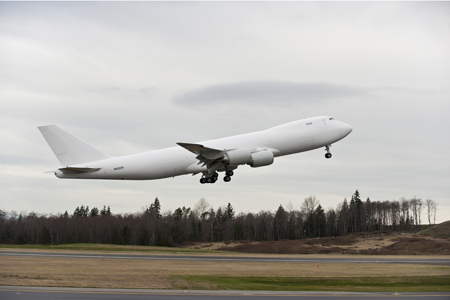
    Fifth Boeing 747-8 Enters Flight-test Program


    EVERETT, Wash., Feb. 4, 2011 /PRNewswire/ — Boeing (NYSE: BA) successfully conducted the first flight of the fifth 747-8 Freighter Thursday. The airplane, coded as RC523, took off from Paine Field in Everett, Wash., for a 3-hour, 30-minute flight before returning to Paine Field.

    The flight included a standard 2-hour, 30-minute “B1” flight profile that Boeing conducts on all production airplanes prior to delivery, plus an hour of engineering testing woven into the profile.

    “The airplane performed well,” said Andy Hammer, test program manager for 747-8. “It was a fine start to the test plan for this airplane.”

    This is the fifth 747-8 Freighter being used in the flight-test program. Each airplane is used for a specific set of tests, with this airplane focusing on functionality and reliability testing.

    The airplane will remain based at Paine Field throughout its test plan.

    To include the featured image in your Twitter Card, please tap or click their icon a second time.
  • |

    Dassault Falcon Announces 2011 Regional M&O Seminar Series

    SAINT-CLOUD, France, February 10, 2011 /PRNewswire/ — Dassault Falcon’s Regional Maintenance & Operations Seminar (M&O) series will continue again in 2011, with a total of 13 seminars to be held in eight countries around the globe. The M&O Seminar series gives Falcon operators an opportunity to communicate face-to-face with Dassault’s specialists and engineering teams on a variety of topics.
    “The goal of our M&O Seminar series is to provide a forum for the exchange of information,” said Jacques Chauvet, Senior Vice President of Worldwide Customer Service. “Operators not only get to hear from Dassault specialists, but we are equally as receptive to their feedback. Each year we work closely with our Operator Advisory Board (OAB) to find ways to make the M&O meetings more productive and valuable. That effort has been well received by our Falcon family as reflected in 2010’s attendance figures which were up 20% over 2009.”
    Falcon Regional M&O Seminars focus both on operational and technical issues and are designed to help aircraft operators improve the efficiency, reliability and safety of their operations. Topics range from the latest customer service and engineering support initiatives to enhancements in troubleshooting and product reliability. The one-day sessions include interaction with model and support specialists as well as Authorized Service Centers, vendors and partners. Certificates of attendance can also be issued to participants to serve as credit for recurrent maintenance training.
    “Since we launched the regional seminar format three years ago, it has become very popular among our operators not only because of the content, but because our team travels to meet with our customers, limiting their time spent away from their office. That allows more customers to attend and leads to a more successful experience,” said Frank Youngkin, Senior Vice President of Customer Service. “And, as the series continues to evolve and grow, we will work closely with our Operator Advisory Board (OAB) to find ways to make the M&O meetings even more productive and valuable into the future.”
    2011 Regional M&O Series Locations and Dates:

    Rome, Italy – March 16
    Phoenix, AZ – March 22
    Seattle, WA – March 24
    Dallas, TX – April 5
    Geneva, Switzerland – April 6
    Toluca, Mexico – April 7
    Beijing, China – April 18
    Atlanta, GA – April 19
    Mahwah, NJ – April 21
    Chicago, IL – May 3
    Mumbai, India – May 4
    Toronto, Canada – May 5
    Sao Paulo, Brazil – August 11

    To include the featured image in your Twitter Card, please tap or click their icon a second time.
  • Press Release: NTSB issues update on its investigation of Flight 188 that overflew intended Minneapolis Airport

    In its continuing investigation of an Airbus A320 that overflew the Minneapolis-St Paul International/Wold-Chamberlain Airport (MSP), the National Transportation Safety Board has developed the following factual information: On Wednesday, October 21, 2009, at 5:56 pm mountain daylight time, an Airbus A320, operating as Northwest Airlines (NWA) flight 188, became a NORDO (no radio communications) flight at 37,000 feet. The flight was operating as a Part 121 flight from San Diego International Airport, San Diego, California (SAN) to MSP with 144 passengers, 2 pilots and 3 flight attendants.

    Both pilots were interviewed separately by NTSB investigators yesterday in Minnesota. The following is an overview of the interviews:

    The first officer and the captain were interviewed for over 5 hours combined.
    The Captain, 53 years old, was hired in 1985. His total flight time is about 20,000 hours, about 10,000 hours of A-320 time of which about 7,000 was as pilot in command.
    The First Officer, 54 years old, was hired in 1997. His total flight time is about 11,000 hours, and has about 5,000 hours on the A-320.
    Both pilots said they had never had an accident, incident or violation.
    Neither pilot reported any ongoing medical conditions.
    Both pilots stated that they were not fatigued. They were both commuters, but they had a 19-hour layover in San Diego just prior to the incident flight. Both said they did not fall asleep or doze during the flight.
    Both said there was no heated argument.
    Both stated there was a distraction in the cockpit. The pilots said there was a concentrated period of discussion where they did not monitor the airplane or calls from ATC even though both stated they heard conversation on the radio. Also, neither pilot noticed messages that were sent by company dispatchers. They were discussing the new monthly crew flight scheduling system that was now in place as a result of the merger. The discussion began at cruise altitude.
    Both said they lost track of time.
    Each pilot accessed and used his personal laptop computer while they discussed the airline crew flight scheduling procedure. The first officer, who was more familiar with the procedure was providing instruction to the captain. The use of personal computers on the flight deck is prohibited by company policy.
    Neither pilot was aware of the airplane’s position until a flight attendant called about 5 minutes before they were scheduled to land and asked what was their estimated time of arrival (ETA). The captain said, at that point, he looked at his primary flight display for an ETA and realized that they had passed MSP. They made contact with ATC and were given vectors back to MSP.
    At cruise altitude – the pilots stated they were using cockpit speakers to listen to radio communications, not their headsets.
    When asked by ATC what the problem was, they replied “just cockpit distraction” and “dealing with company issues”.
    Both pilots said there are no procedures for the flight attendants to check on the pilots during flight.
    The Safety Board is interviewing the flight attendants and other company personnel today. Air traffic control communications have been obtained and are being analyzed. Preliminary data from the cockpit voice recorder (CVR) revealed the following:

    The CVR recording was 1/2 hour in length.
    The cockpit area microphone channel was not working during this recording. However, the crew’s headset microphones recorded their conversations.
    The CVR recording began during final approach, and continued while the aircraft was at the gate.
    During the hours immediately following the incident flight, routine aircraft maintenance provided power to the CVR for a few minutes on several occasions, likely recording over several minutes of the flight.
    The FDR captured the entire flight which contained several hundred aircraft parameters including the portion of flight where there was no radio communication from the flight crew. Investigators are examining the recorded parameters to see if any information regarding crew activity during the portion of flight where radio contact was lost can be obtained.

    The Safety Board’s investigation continues.

    -30-

    NTSB Media Contact: Keith Holloway
    hollowk@ntsb.gov
    (202) 314-6100

    To include the featured image in your Twitter Card, please tap or click their icon a second time.