Public Statement

  • |

    Air Transport Association Congratulates Senate on FAA Bill Passage That Furthers NextGen and Creates Thousands of U.S. Jobs

    WASHINGTON, Feb. 17, 2011 /PRNewswire-USNewswire/ — The Air Transport Association of America (ATA), the industry trade organization for the leading U.S. airlines, today congratulated Chairman Jay Rockefeller, Ranking Member Kay Bailey Hutchison and the Senate for passage of the FAA Air Transportation Modernization and Safety Improvement Act (S.223), which will help create jobs and modernize the air traffic control system. A modernized air traffic management system will improve operational efficiency, reduce fuel consumption and emissions, and lower airline operating costs.

    “This bill moves the United States toward our goal of enabling a safe, sustainable and profitable airline industry that provides good value to customers and promotes global competitiveness,” said ATA President and CEO Nicholas E. Calio. “We applaud the leadership and significant work to pass a bill that reflects a continued commitment to safety and modernization of the air traffic control system by requiring that FAA establish and track performance metrics.”

  • |

    Boeing Donates ‘Legends of Flight’ Proceeds to Washington State LASER

    Washington State Leadership & Assistance for Science Education Reform (LASER) assists school districts with research-based science programs

    SEATTLE, Feb. 17, 2011 /PRNewswire/ — Boeing (NYSE: BA) on Wednesday made a surprise donation of $26,000 to Washington State Leadership & Assistance for Science Education Reform (LASER). Boeing’s donation comes from proceeds from its sponsorship of the IMAX film “Legends of Flight.” The presentation took place during the monthly executive board meeting at the Pacific Science Center in Seattle, Wash.
    “Boeing is delighted to be able to support this great organization in its effort to give teachers and principals the training and resources they need to improve science instruction statewide and beyond,” said Tim Copes, vice president of Manufacturing and Quality, Boeing Commercial Airplanes, and board member at the Pacific Science Center. “We expect this to be the first of many donations to educate, engage and motivate children in science as the film continues to open at theaters around the world.”

    Additional financial donations will be made to support science-related initiatives as “Legends of Flight” continues to play at theaters around the world. Boeing receives 10 cents for each ticket sold.
    The film highlights legendary 20th century airplanes, as well as the manufacturing, testing, rollout and first flight of the 787 Dreamliner, the first all-new airplane of the 21st century.

    “The film is a tribute to all of the people who made the 787 possible,” said Scott Fancher, vice president and general manager of the 787 program. “And through the great work of Washington LASER, the film is now assisting schools with research-based science programs. We see this donation as an investment in creating a future workforce that is inspired to launch the next generation of discoveries, innovations and inventions.”

    “Legends of Flight” opened on June 8, 2010, and is currently running in more than 30 theaters around the world. For a complete listing of theaters playing “Legends of Flight,” go to http://www.legendsofflightfilm.com/.

    Washington State LASER is a partnership program that started in 1999 with the National Science Resources Center (NSRC), the Washington State Office of the Superintendent of Public Instruction, Pacific Northwest National Laboratories, Pacific Science Center and Educational Service Districts and lead school districts from across Washington state. For more information, go to http://www.wastatelaser.org/.

  • |

    Boeing Announces $5M Donation to Air Force Museum Foundation

    Gift Will Enable New Exhibits and Educational Programs

    ST. LOUIS, Feb. 17, 2011 — The Boeing Company announced today that it will donate $5 million to the Air Force Museum Foundation in three installments over the next three years. The foundation will deliver the funds to the U.S. Air Force for the benefit of the National Museum of the U.S. Air Force at Wright-Patterson Air Force Base near Dayton, Ohio.

    “Boeing’s people and products have built enduring bonds with generations of airmen, so it is only fitting that we demonstrate our support for the Air Force Museum Foundation and the U.S. Air Force in this way,” said Chris Raymond, vice president of Business Development for Boeing Defense, Space & Security. “Boeing’s continuing commitment to this nationally important museum will help preserve the legacy of the Air Force’s contributions to freedom and ensure that its stories and lessons are shared with future generations.”

    The Air Force will use Boeing’s donation to help construct a fourth building at the National Museum of the U.S. Air Force. The new, 200,000-square-foot building will house exhibits covering three areas: the history of America’s space program; the museum’s collection of presidential aircraft; and the story of Air Force global reach, featuring cargo and tanker aircraft.

    “We are extremely grateful for this major gift from The Boeing Company,” said retired Lt. Gen. Richard V. Reynolds, president of the Air Force Museum Foundation. “This extraordinary act of generosity is a huge step in the effort to fund construction of the new building, and will ultimately enable the museum to do an even more phenomenal job of educating visitors on the U.S. Air Force.”

    The new building will allow the museum to develop much broader educational content. The museum plans to collaborate with NASA and a variety of educational organizations and institutions to develop programming focused on history, science, technology, engineering and math.

    The National Museum of the U.S. Air Force is the service’s national institution for preserving and presenting the Air Force story. Each year, more than 1 million visitors come to the museum to learn about the mission, history and evolving capabilities of America’s Air Force. For more information on the museum, visit www.nationalmuseum.af.mil.

    The Air Force Museum Foundation was established in 1960 as a philanthropic, nonprofit organization to assist the museum when federal funds are not available. For more information on the Air Force Museum Foundation, visit www.afmuseum.com.

  • |

    Press Release – FAA Proposes $585,725 Civil Penalty Against Corporate Air

    For Immediate Release
    SEATTLE – The Federal Aviation Administration (FAA) is proposing a $585,725 civil penalty against Corporate Air of Billings, Mont., for allegedly operating a Shorts SD-3-30 twin-turboprop cargo aircraft when it was not in compliance with Federal Aviation Regulations.

    The FAA alleges Corporate Air failed to maintain the aircraft under the company’s general maintenance manual, which requires daily post-flight inspections that include examining the exterior skin for corrosion. In addition, the maintenance manual requires structural inspections on the basis of flight hours or flights.
    The FAA alleges that Corporate Air operated the aircraft in violation of regulations on at least 81 revenue flights between Dec. 21, 2009 and Feb. 4, 2010 with corrosion that had not been detected during the post-flight inspections. The FAA also alleges that structural inspections were not conducted at the required intervals, between Mar. 16, 2006 and Feb. 3, 2010, in violation of federal regulations.

    Corporate Air operates charter and air taxi service under Part 135 of the Federal Aviation Regulations and makes daily feeder cargo flights under contract to a major next-day air package airline.

    “Keeping aircraft well-maintained and in good condition must be a top priority for any operator,” said FAA Administrator Randy Babbitt. “All operators must comply with maintenance requirements.”

    Corporate Air has 30 days from the receipt of the FAA’s enforcement letter to respond to the agency.
    ###

  • |

    Safety from the Ground Up

    February 17, 2011–GA pilots know that flight preparation takes a good deal of planning and coordination. With so many checklists and steps, it is easy to overlook another important component of a safe flight: ground safety. In his article, “Safety from the Ground Up,” pilot, mechanic, and FAA Safety Briefing associate editor Tom Hoffman walks you through some essential ramp risk management strategies to ensure a smooth take-off. Beginning at home, before you even head out to the airport, start by picking the right clothes appropriate for the weather and to protect yourself from ramp safety hazards. Look out for foreign object debris on ramps and taxiways to avoid damage to your aircraft. Use and be attentive to signals indicating that aircraft propellers are moving to avoid devastating accidents. Read about these and other essential components of ground safety on page 11 of the January/February 2011 issue of FAA Safety Briefing at www.faa.gov/news/safety_briefing/.

  • |

    FAA Needs To Improve Risk Assessment Processes For Its Air Transportation Oversight System


    Office of Inspector General Report

    On December 16, 2010, we issued our report on the Federal Aviation Administration’s (FAA) Air Transportation Oversight System (ATOS). FAA uses ATOS to conduct surveillance of nearly 100 airlines that transport more than 90 percent of U.S. airline passenger and cargo traffic. While ATOS is conceptually sound, our prior reports have found that FAA needs to strengthen national oversight of the system. Following safety lapses at a major airline in 2008, the Senate Committee on Science, Commerce, and Transportation and the House Committee on Transportation and Infrastructure asked us to assess weaknesses systemwide. Accordingly, our audit objectives were to determine (1) whether FAA has completed timely ATOS inspections of air carriers’ policies and procedures for their most critical maintenance systems; (2) how effective ATOS performance inspections have been in testing and validating that these critical maintenance systems are working properly; and (3) how well FAA implemented ATOS for the remaining Part 121 air carriers and what, if any, oversight challenges FAA inspection offices face.

    While FAA has worked to continuously improve ATOS, we found that FAA inspectors did not complete ATOS inspections of air carriers’ maintenance policies and procedures or systems performance on time. In addition, FAA transitioned all of its Part 121 inspection offices to ATOS at the end of 2007, but–due in part to training gaps–some inspectors for smaller air carriers had difficulty adapting ATOS to those carriers’ operations. We made seven recommendations to FAA to improve its data, training, and risk assessment processes for ATOS. FAA concurred with four of our seven recommendations and partially concurred with three.

    Read the full .PDF report here

  • | |

    Adoption of Security Roadmap Key Step In Countering Terrorism

    MONTRÉAL, 15 February 2011 – The adoption of a roadmap by 14 ICAO Member States to further protect global air transport from terrorist and other security threats was praised today by the Secretary General of the International Civil Aviation Organization, Raymond Benjamin, at the conclusion of a two-day regional aviation security conference in New Delhi.

    Among the measures included in the roadmap are actions that States will take to strengthen security screening procedures by ensuring that professionals are appropriately trained and equipped. Air cargo security will be enhanced through working with Customs authorities on common goals. Capacity-building assistance to States in need in cooperation with ICAO, other States and the aviation industry is emphasized in the roadmap.

    The conference was the first in a series on implementing the ICAO Declaration on Aviation Security, unanimously adopted by the Organization’s Assembly last October to deal with known, new and emerging threats to civil aviation.

    “The challenge, OUR challenge, is to turn commitment into action. Terrorism is a global problem that requires global solutions,” Mr. Benjamin emphasized when urging participants to develop the roadmap during the opening of the conference.

    “This roadmap is a key step in addressing the security challenge and can serve as a model for other regional aviation security conferences, culminating in a global security conference planned for next year at ICAO Headquarters in Montréal,” Mr. Benjamin indicated.

    In support of the roadmap’s initiatives, Mr. Benjamin pointed to ICAO’s ongoing collaboration with the air transport industry on a security checkpoint of the future concept to improve the effectiveness of passenger and carry-on baggage screening at airports. ICAO is also working with the World Customs Organization to establish best practices for air cargo security.

    The Government of India, through the Minister of Civil Aviation, is to play a leading role in the implementation of the roadmap in the region through technical cooperation and other initiatives.
    Attachments
    EN.pdf

  • |

    AeroTurbine Signs Three Year Exclusive Engine Management Agreement with Webjet Linhas Aereas

    AMSTERDAM and MIAMI, Feb. 14, 2011 — AerCap Holdings N.V. announced today that its subsidiary AeroTurbine Inc., Miami, has signed a three year exclusive agreement with Webjet Linhas Aereas S.A. Under this agreement, AeroTurbine will provide engine management services to Webjet.

    AeroTurbine will manage all “off-wing” engine maintenance events for Webjet’s growing CFM56-3 engine fleet which currently consists of 45 CFM56-3 engines. Webjet will be the launch customer for AeroTurbine’s newly introduced AeroTurbine Flexible Engine Care Solutions (AFECS), which provides customers with a tailored engine fleet maintenance product based on the individual operational and financial goals of the client.

    “We are excited that the marketplace has responded so quickly to our new AFECS service offering,” said Michael King, AeroTurbine President and Chief Executive Officer. “AeroTurbine is proud to have developed a first-in-industry approach to managing older power plants. We are a market leader in the CFM56-3 engine segment for material supply, engine leasing, and engine exchanges. I am pleased that we were able to successfully combine these products into a viable service solution that minimizes engine downtime and maintenance expense. We look forward to working with Webjet on this program and being part of their continued success in the coming years.”

  • |

    Butler National Expands Presence in Brazil With Significant New Orders From OceanAir

    OLATHE, Kan., Feb. 15, 2011 — Butler National Corporation (OTC Bulletin Board: BUKS), a leader in the growing global market for structural modification, maintenance, repair and overhaul (MRO) has been retained by OceanAir, a Brazilian MRO company, to perform special mission modifications on three Learjet Model 35 airplanes. OceanAir is part of Synergy Group.

    “This is a highly specialized modification and electronics integration package,” said Jose Efromovich. “We would only entrust such technically sophisticated work to Butler’s Avcon Group. We have been working with Butler for three years and look forward to our continued relationship as we keep expanding in the rapidly growing Latin American market.”

    Christian Vila, Director of Latin & South American sales for Butler National added, “Avcon is the leading provider of Learjet modifications in Brazil. We believe we will see strong demand for this and other Avcon modifications in the future including commercial aircraft.” Synergy Group, which is the parent company of OceanAir, also owns 67% of AviancaTaca with approximately 150 aircraft.

    Butler National’s expanded presence in Brazil continues its effort to leverage a major global growth trend in aviation. According to recently published reports the global deliveries of new aircraft are projected to total 56,900 by 2029 and the total global fleet will approach 70,000 for commercial and business aircraft. This represents more than $3 trillion in value with most of the growth coming from Latin American, Asia and the Middle East.

  • |

    Aerospace Industries Association Supports FAA Reauthorization Act

    ARLINGTON, Va., Feb. 15, 2011 /PRNewswire-USNewswire/ — AIA supports the FAA Reauthorization and Reform Act of 2011 (H.R. 658) as introduced by the House Transportation and Infrastructure Subcommittee on Aviation Feb. 11.

    “We’re very pleased with the Committee’s decision to address environmental streamlining, third-party performance-based navigation procedure design and the establishment of NextGen performance metrics,” said AIA President and CEO Marion C. Blakey. “These policies will make our air transportation system more efficient and also protect the investment of the American taxpayer.”

    Blakey’s testimony before the subcommittee Feb. 9, outlined a number of initiatives to improve FAA efficiency and capitalize on the experience of the private sector.
    “This is a good bill,” said Blakey. “It’s fiscally responsible to fully fund programs like NextGen, which have a strong economic and environmental return on investment and help the FAA carry out its fundamental safety mission.”

    AIA also commended the committee’s acknowledgement of the benefits of bilateral aviation safety agreements and a risk-based inspection regime when applied to repair station oversight. These carefully negotiated agreements make FAA more efficient, enhance the agency’s international safety oversight and help protect U.S. jobs.

    Facebook  /  Flickr  /  LinkedIn  /  Twitter  /  YouTube

    Founded in 1919 shortly after the birth of flight, the Aerospace Industries Association is the most authoritative and influential trade association representing the nation’s leading manufacturers and suppliers of civil, military and business aircraft, helicopters, unmanned aircraft systems, space systems, aircraft engines, homeland and cybersecurity systems, materiel and related components, equipment services and information technology.

  • | |

    U.S. Army, Lockheed Martin Highlight M-TADS/PNVS Performance as Production Reaches 1,000 Systems

    ORLANDO, Fla., Feb. 16, 2011 — Lockheed Martin (NYSE: LMT) marked the delivery of the 1,000th Modernized Target Acquisition Designation Sight/Pilot Night Vision Sensor (M-TADS/PNVS) system to the U.S. Army at ceremonies held today at Lockheed Martin facilities in Ocala and Orlando, FL. M-TADS/PNVS, also known as Arrowhead®, is the advanced targeting and pilotage system for the U.S. Army’s AH-64D Apache attack helicopter.

    “The M-TADS/PNVS is a game-changer on the battlefield and has ensured Longbow Apaches remain dominant in support of our ground soldiers,” said Col. Shane Openshaw, U.S. Army project manager for Apache Attack Helicopter. “This combat-tested system has shown, through over five years of continuous combat operations since the first unit was fielded, that an Apache equipped with M-TADS/PNVS is the most lethal and survivable attack helicopter in the world.”

    M-TADS/PNVS provides Apache pilots with the most advanced long-range, electro-optical precision engagement and pilotage capabilities to ensure mission success and flight safety in day, night and adverse weather missions. It employs state-of-the-art forward-looking infrared sensors to provide Apache pilots with enhanced image resolution, giving them the complementary benefits of significant standoff range and unrivaled targeting capabilities. M-TADS/PNVS improves performance and reliability over legacy TADS/PNVS systems by more than 150 percent, reduces maintenance actions by nearly 60 percent, and will save the U.S. Army nearly $1 billion in operation and support costs over its 20-year system life.

    “Teamwork has been the secret to the success of this program,” said David Belvin, director of Apache programs at Lockheed Martin Missiles and Fire Control. “The U.S. Army, Lockheed Martin and its suppliers worked together as a team to achieve an unprecedented rapid development and production program to support the warfighter.”
    “U.S. Apaches are nearly completely equipped with this incredible system, and we will have retrofitted all of our Longbows in the field by the summer of 2011,” added Col. Openshaw. “In addition, many allied force Apaches around the world are M-TADS/PNVS-equipped, greatly enhancing their capability to conduct attack operations and to integrate with U.S. and NATO forces. This production milestone, the delivery of M-TADS/PNVS number 1,000, is another tremendous achievement for this outstanding program.”

    The U.S. Army awarded Lockheed Martin the original M-TADS/PNVS contract in 2003. The first system was delivered to a U.S. Army Apache in theater in 2005. Previous milestones include the 250th system delivery in 2007 and the 500th delivery in 2008. During this period, M-TADS/PNVS was delivered at a rate of over 20 units per month. The 1,000th delivery ceremony signifies another important step in Lockheed Martin’s support of Army Aviation. Additional domestic and international deliveries will continue through 2014. Electronics assembly of M-TADS/PNVS is performed at the Lockheed Martin facility in Ocala, FL. Final assembly is performed at Lockheed Martin’s facility in Orlando, FL.

    Headquartered in Bethesda, Md., Lockheed Martin is a global security company that employs about 132,000 people worldwide and is principally engaged in the research, design, development, manufacture, integration and sustainment of advanced technology systems, products and services. The Corporation’s 2010 sales from continuing operations were $45.8 billion.

  • |

    Frustrated US Airways Flight Attendants to Picket Airports Across the Country This Thursday

    Nationwide Day of Action Highlights Management’s Failure to Negotiate a Merged Contract

    WASHINGTON, Feb. 16, 2011 /PRNewswire-USNewswire/ — US Airways Flight Attendants, represented by the Association of Flight Attendants-CWA (AFA), will conduct a nationwide protest over the failure of US Airways management to negotiate a merged Flight Attendant contract. After five years of protracted contract negotiations and the announcement of US Airways’ second biggest profit in the airline’s history, Flight Attendants are united in their effort to reach a fair contract that reflects the sacrifices they made for the success of the airline.

    Last week, the AFA Joint Negotiating Committee (JNC) broke off talks after US Airways management presented a proposal that contained concessions in healthcare and sick benefits, gutted scope and merger protections for Flight Attendants, and contained no meaningful wage increases. AFA wants to reach a merged agreement but management has failed to provide the financial resources necessary to do so.

    LOCATIONS ON THURSDAY, FEBRUARY 17
    Charlotte Douglas Airport (CLT)- 11:00 a.m. – 1:00 p.m. EST – Outside, Departures, Upper Level US Airways

    Washington National Airport (DCA) – 11:00 a.m. – 1:00 p.m. EST – Outside, Departures, US Airways

    Philadelphia International Airport (PHL) – 11:00 a.m. – 1:00 p.m. EST – Outside Concourse A West

    Phoenix Sky Harbor International Airport (PHX) 9:00 a.m. – 11:00 a.m. MST – Level 2 North Curb West End

    In the first of a series of events, AFA is holding a system-wide Day of Action on February 17, in all Flight Attendant bases, to show management and the public that Flight Attendants are united in their effort to reach a fair merged contract. Tempe-based America West Airlines merged with US Airways in September 2005 and the Flight Attendants have been in merged contract negotiations since January 2006.

  • |

    Delta Eliminates SkyMiles Expiration

    SkyMiles members gain new industry-leading benefit
    Feb 15, 2011

    ATLANTA, Feb. 15, 2011 /PRNewswire/ — Delta Air Lines (NYSE: DAL) today announced it has eliminated the SkyMiles mileage expiration, creating a new industry-leading benefit for all members. This program change is effective for all accounts as of Jan. 1, 2011, and makes Delta the only major U.S. carrier without mileage expiration.

    Previously, miles expired 24 months after a member’s last qualifying mileage activity, which required a member to earn or redeem miles within that period.

    “Now that our massive frequent flyer program integration is complete, we are focused on smart ways to improve the SkyMiles program for all members,” said Jeff Robertson, Delta’s vice president – SkyMiles. “We know how much customers value their miles, so eliminating mileage expiration is a major win for them. This is yet another benefit that sets us apart from the pack, making Delta a clear leader in loyalty program benefits.”

    This change is the latest of several enhancements made to the SkyMiles program in the last year including the new Diamond Medallion tier with complimentary lounge access and Rollover Medallion Qualification Miles. These features complement other recent changes such as the elimination of all award redemption fees and a free first checked bag on Delta flights for Gold, Platinum and Reserve Delta SkyMiles credit card holders from American Express.

    Members can look forward to more in 2011, including significant improvements to delta.com such as an upgraded award travel calendar, improved booking process and better flight information displays. Additionally, Diamond, Platinum and Gold Medallion members can expect several new benefits when flying select alliance partner airlines – including Air France, KLM, Alitalia and Alaska Airlines.

    Now in its 30th year, SkyMiles is one of the longest-running and most successful loyalty programs in the travel industry. Last year, frequent flyers redeemed more than 264 billion miles in the SkyMiles program for more than 12 million award redemptions. In 2010, 8.3 percent of revenue miles flown on Delta were for award travel. Delta offers more ways to redeem frequent flyer miles than any other airline, including airline tickets, mileage upgrades, car rentals, hotel stays, Delta Sky Club memberships, merchandise and more than 30 types of gift cards. SkyMiles was named “Best Domestic Frequent Flyer program” for 2007 through 2010 by readers of Executive Travel magazine and “Best Frequent Flyer Program” for 2006 through 2010 by Business Traveler magazine. For more information on the SkyMiles program, Medallion status and mileage redemption options, visit delta.com/skymiles.

    Delta Air Lines serves more than 160 million customers each year. With an industry-leading global network, Delta and the Delta Connection carriers offer service to 357 destinations in 66 countries on six continents. Headquartered in Atlanta, Delta employs more than 75,000 employees worldwide and operates a mainline fleet of more than 700 aircraft. A founding member of the SkyTeam global alliance, Delta participates in the industry’s leading trans-Atlantic joint venture with Air France-KLM and Alitalia. Including its worldwide alliance partners, Delta offers customers more than 13,000 daily flights, with hubs in Amsterdam, Atlanta, Cincinnati, Detroit, Memphis, Minneapolis-St. Paul, New York-JFK, Paris-Charles de Gaulle, Salt Lake City and Tokyo-Narita. The airline’s service includes the SkyMiles frequent flier program, the world’s largest airline loyalty program; the award-winning BusinessElite service; and more than 50 Delta Sky Clubs in airports worldwide. Delta is investing more than $2 billion through 2013 in airport facilities and global products, services and technology to enhance the customer experience in the air and on the ground. Customers can check in for flights, print boarding passes, check bags and review flight status at delta.com.

    All SkyMiles program rules apply to SkyMiles program membership, miles, offers, mile accrual, mile redemption and travel benefits. The rules are subject to change. To review the rules, please visit delta.com/memberguide. Taxes for Award Travel are the responsibility of the passenger and must be paid at the time the ticket is booked. Award Travel seats are limited and may not be available on all flights or in all markets. Alliance partner airline benefits subject to change and subject to the terms and conditions of each partner. Offers and benefits subject to change without notice.

  • |

    Southwest Airlines and Its Stock Clerks Announce New Tentative Agreement

    Southwest Airlines (NYSE: LUV) and the International Brotherhood of Teamsters (IBT) Airlines Division, representing the carrier’s Stock Clerks, announced today that the two parties have reached a tentative agreement. The tentative agreement is for a new, five-year contract through August 16, 2013. The current contract became amendable on August 16, 2008. One year ago, Southwest and the Teamsters agreed to seek assistance from the National Mediation Board through the mediation process as defined by the Railway Labor Act.

    “Hard work and persistence have definitely paid off during this mediation process,” said Mike Van de Ven, Southwest Airlines Executive Vice President and Chief Operating Officer. “The negotiation teams worked together to address several work rule changes in reaching this mutually beneficial, forward thinking tentative agreement, which delivers wage and benefit enhancements in exchange for work rule improvements and contract flexibility.”
    In the upcoming weeks, the IBT membership will be given the full details of the agreement and have the opportunity to vote on ratification. IBT represents more than 170 Southwest Airlines Employees.

    In its 40th year of service, Southwest Airlines continues to differentiate itself from other low-fare carriers–offering a reliable product with exemplary Customer Service. Southwest Airlines serves Milwaukee with 12 daily departures and is the nation’s largest carrier in terms of originating domestic passengers boarded, now serving 69 cities in 35 states. Beginning March 13, 2011, Southwest will initiate service to Charleston and Greenville/Spartanburg, South Carolina, and on March 27, 2011, service will begin to Newark Liberty International Airport. Southwest also is one of the most honored airlines in the world known for its commitment to the triple bottom line of Performance, People, and Planet. To read more about how Southwest is doing its part to be a good citizen, visit southwest.com/cares to read the Southwest Airlines One Report(TM). Based in Dallas, Southwest currently operates more than 3,200 flights a day and has nearly 35,000 Employees systemwide.

  • |

    UPS Expands Boeing Airplane Health Management to MD-11 Fleet

    SEATTLE, Feb. 15, 2011 /PRNewswire/ — Boeing (NYSE: BA) today announced that UPS will expand its Boeing’s Airplane Health Management (AHM) coverage to include its MD-11 Freighter fleet, in addition to the 747-400 Freighter fleet, which already utilizes AHM. AHM is an information-driven system that helps airlines better prepare and manage unscheduled maintenance events.

    The expanded agreement covers 38 MD-11 Freighters and 13 747-400 Freighter and Boeing Converted Freighter airplanes.

    “AHM allows aircraft maintenance personnel to be prepared to work unexpected aircraft exceptions when the aircraft arrives and will greatly streamline our operation,” said Warren Johnson, vice president, Maintenance and Engineering, UPS Airlines.
    “This will help increase the fleet’s on-time performance which is a great benefit to our customers,” said Mitch Nichols, UPS Airlines president.

    The large UPS freighters will feature the AHM Real Time Fault Management Module, which communicates in-flight information to ground stations for diagnosis and real-time operational decisions, using troubleshooting and historical fix success data. The airline uses this information to organize any needed maintenance operations and position the necessary people, parts and equipment.

    “Airlines need to have their aircraft generating revenue, so maintenance efficiency is an important initiative,” said Dennis Floyd, vice president of Fleet Services for Commercial Aviation Services, Boeing Commercial Airplanes. “AHM delivers relevant information whenever and wherever it is needed while the airplane is still en route.”
    Airplane Health Management works through the MyBoeingFleet.com portal. Alerts and notifications are delivered to airline personnel through the Internet, fax, personal digital assistants, e-mail and pager services.

    Airplane Health Management is a key component in Boeing’s larger vision of the e-enabled airline, where information technology, connectivity and strategic integration promise greater efficiency and improved airline operations.

    UPS is the world’s largest package delivery company and a global leader in supply chain and freight services. With more than a century of experience in transportation and logistics, UPS is a leading global trade expert equipped with a broad portfolio of solutions. The company is headquartered in Atlanta, Ga., and can be found on the Web at UPS.com.

  • |

    Boeing and Fluor Team to Pursue Sandia National Laboratories Contract

    ST. LOUIS, Feb. 15, 2011 — Boeing [NYSE: BA] and Fluor Corp. [NYSE: FLR] have formed a team to pursue a contract to manage and operate the Sandia National Laboratories if the U.S. Department of Energy (DOE) decides to hold a competition.

    Sandia is a government-owned, contractor-operated facility that is managed on behalf of the DOE’s National Nuclear Security Administration (NNSA). Sandia has major facilities in Albuquerque, N.M., and Livermore, Calif., and an annual operating budget of approximately $2.5 billion. The current contract expires in September 2012.

    “The Boeing Company has a long history of managing large-scale research and development programs,” said Greg Deiter, vice president of Boeing Defense & Government Services. “We will draw on that experience to offer innovative approaches to meet the NNSA’s objectives of strengthening performance on national security missions; reducing costs; and supporting operations as an integrated Nuclear Security Enterprise.

    “We also offer a unique capability to evolve our support to broader national security tasks in a way that will be complementary to the nuclear security mission,” Deiter added.
    Boeing has supported national nuclear programs at Sandia and elsewhere for more than five decades.

    Fluor, a longtime DOE contractor, applies its program management expertise to provide safe, dependable, and value-added operations services across the department’s complex at Savannah River in South Carolina, Hanford in Washington state, and Portsmouth in Piketon, Ohio. For more than six decades, Fluor has assisted the DOE and international government agencies in addressing their urgent national nuclear priorities.

    “We believe that the complementary resources and skill sets of two world-class companies like Fluor and Boeing offer the NNSA an extremely compelling value proposition,” said Greg Meyer, senior vice president of Fluor Government Group. “Fluor’s work as a preeminent DOE contractor positions our company well to be able to understand the needs of Sandia and the nuclear security enterprise. We look forward to bringing our experience from across the DOE complex along with our unmatched operations expertise to support the team.”

    Fluor Corporation designs, builds and maintains many of the world’s most challenging and complex projects. Through its global network of offices on six continents, the company provides comprehensive capabilities and world-class expertise in the fields of engineering, procurement, construction, commissioning, operations, maintenance and project management. Headquartered in Irving, Texas, Fluor is a FORTUNE 200 company and had revenues of $22 billion in 2009.

    A unit of The Boeing Company, Boeing Defense, Space & Security is one of the world’s largest defense, space and security businesses specializing in innovative and capabilities-driven customer solutions, and the world’s largest and most versatile manufacturer of military aircraft. Headquartered in St. Louis, Boeing Defense, Space & Security is a $32 billion business with 66,000 employees worldwide. Follow us on Twitter: @BoeingDefense.

  • |

    Boeing-built LightSquared Space-Based Network Ready to Begin Service

    EL SEGUNDO, Calif., Feb. 14, 2011 — Boeing [NYSE: BA] today announced that it has completed the post-launch testing and on-orbit handover of the first LightSquared satellite and Space-Based Network (SBN). The satellite system has been accepted by LightSquared and is ready to begin service.

    “Boeing has delivered LightSquared’s SkyTerra 1 satellite after integrating the satellite’s communications with the ground segment to form the first integrated wireless broadband and satellite network,” said Craig Cooning, vice president and general manager of Boeing Space & Intelligence Systems. “The LightSquared SBN is an end-to-end satellite communications system that draws on Boeing’s proven performance on large-scale integration programs. It demonstrates again that Boeing is the first choice to provide next-generation satellite systems to customers seeking leading-edge communications solutions.”

    The LightSquared SBN will combine satellite and terrestrial technologies to enable high-capacity data use for standard cell phones, PDAs and other wireless devices. The SkyTerra 1 satellite carries a 22-meter L-band antenna — the largest commercial antenna reflector in space. The SkyTerra 1 satellite will relay high-data-rate radio frequency (RF) signals to four ground stations in the United States and Canada that use state-of-the-art beam-forming equipment to seamlessly direct transmissions to the complete wireless network.

    The SkyTerra 1 satellite was launched Nov. 14 on an International Launch Services Proton vehicle from the Baikonur Cosmodrome in Kazakhstan.

    Boeing, the prime contractor for LightSquared’s satellites, built SkyTerra 1 at its integration and test complex in El Segundo. Harris Corp. of Melbourne, Fla., developed the satellite’s L-band reflector. ViaSat’s Comsat Laboratories in Germantown, Md., provided the ground-based beam-forming equipment, the uplink beacon stations and the ground stations’ control and monitoring system. SED Systems of Saskatoon, Canada, provided the antennas, RF elements and integration services at the gateway stations.

  • |

    FAA Forecast Predicts Air Travel to Double in Two Decades

    “NextGen” Investments Necessary to Meet Airspace Demands

    WASHINGTON, D.C. – The Federal Aviation Administration (FAA) released its annual forecast today predicting that air travel will more than double in the next 20 years. This report underscores the need to keep the Next Generation Air Transportation System (NextGen) on track to accommodate future growth.

    “We need to invest in aviation today to make sure America’s economy remains competitive,” said U.S. Secretary of Transportation Ray LaHood. “Innovative NextGen technology will help meet the demands of the future by getting passengers to their destinations safely and more quickly.”

    Today’s release of the FAA Aerospace Forecast Fiscal Years 2011-2031 predicts that U.S. airlines will reach the one billion passengers-per-year mark by 2021, two years earlier than last year’s prediction of 2023.

    Through NextGen, the FAA is transforming the U.S. aviation system from radar- to satellite-based systems that will help passengers reach their destinations more quickly and will increase capacity and safety. New, more precise routes will also reduce fuel burn, carbon emissions and noise.

    “We are already seeing the tangible safety and efficiency benefits of NextGen,” said FAA Administrator Randy Babbitt. “Only a modernized air transportation system will be able to keep up with our forecasted demand.”

    The aviation standard to measure air travel volume is Revenue Passenger Miles (RPM) or one paying passenger traveling one mile. According to the forecast, RPMs are projected to more than double over the next two decades, from 787 billion in 2010 to 1.7 trillion in 2031.

    The FAA 20-year forecast predicts the number of passengers traveling on U.S. airlines will increase by 3.5 percent from last year to 737.4 million passengers in 2011. That figure is projected to grow an average of 2.8 percent each year during the remaining forecast period to 1.3 billion by 2031.

    Total landings and takeoffs at FAA towered airports are forecast to slightly decrease in 2011, and then grow at an average annual rate of 1.6 percent each year, reaching 69.4 million in 2031.

    Additional details on the forecast, including a detailed breakdown on general or private aviation, cargo demand, and landing and takeoff operations at airports and FAA facilities can be found in the FAA Forecast Fact Sheet Fiscal Years 2011-31 .

  • |

    CASA: Pilots urged to keep Hay skies safe; Pilots urged to keep Griffith skies safe

    Hay pilots are being urged to attend an important air safety workshop next week.

    The workshop will give local pilots special training to improve their flying and safety skills.

    The Civil Aviation Safety Authority is holding the workshop to help make the skies over Hay even safer.

    Safety issues to be covered at the workshop include recent changes to procedures at local aerodromes. There will also be the opportunity for pilots to ask questions and raise issues about local flying.

    CASA’s Peter Gibson says the workshop is part of a national regional air safety campaign.

    “Giving pilots from Hay extra training will lift their safety skills to even higher levels,” Mr Gibson says.

    “All pilots receive comprehensive training but this workshop means they will be even better equipped to fly safely at all times and deal with emergencies.

    “Hay has a good air safety record but accidents do happen and everyone in aviation must work hard to keep local skies safe.”

    The workshop is being held at the Hay Golf Club on Wednesday 23 February 2011, starting at 6:00pm.

    CASA is providing free refreshments for everyone on the night.
    —-
    Pilots urged to keep Griffith skies safe

    Griffith pilots are being urged to attend an important air safety workshop next week.

    The workshop will give local pilots special training to improve their flying and safety skills.

    The Civil Aviation Safety Authority is holding the workshop to help make the skies over Griffith even safer.

    Safety issues to be covered at the workshop include recent changes to procedures at local aerodromes. There will also be the opportunity for pilots to ask questions and raise issues about local flying.

    CASA’s Peter Gibson says the workshop is part of a national regional air safety campaign.

    “Giving pilots from Griffith extra training will lift their safety skills to even higher levels,” Mr Gibson says.

    “All pilots receive comprehensive training but this workshop means they will be even better equipped to fly safely at all times and deal with emergencies.

    “Griffith has a good air safety record but accidents do happen and everyone in aviation must work hard to keep local skies safe.”

    The workshop is being held at the Griffith Aero Club on Tuesday 22 February 2011, starting at 6:00pm.

    CASA is providing free refreshments for everyone on the night.

  • | |

    Actions Needed To Meet FAA’s Long-Term Goals for NextGen

    On February 16, 2011, the Inspector General of the U.S. Department of Transportation testified before the House Subcommittee on Space and Aeronautics regarding the Federal Aviation Administration’s (FAA) efforts to develop and transition to the Next Generation Air Transportation System (NextGen). The Inspector General noted significant challenges FAA faces in achieving its long-term goals for NextGen across two areas: (1) addressing schedule delays and cost overruns with the En Route Automation Modernization (ERAM) program–without ERAM, other programs intended to provide more efficient data sharing and airspace routes will not be possible–and (2) reaching consensus with partner agencies on key research and development efforts that will affect the cost, schedule, and capabilities of NextGen. The Inspector General also highlighted several management actions that FAA can take now to strengthen FAA’s management of long-term NextGen initiatives. These include clarifying responsibility within FAA for critical NextGen development areas, finalizing performance goals and metrics for NextGen, establishing an integrated budget document to align and track all partner agencies’ NextGen resources, and fully leveraging the technology portfolios of partner agencies to assist with NextGen development.

    See the Statement of the Honorable Calvin L. Scovel III Inspector General U.S. Department of Transportation

  • | |

    Rolls-Royce wins $2.2bn TotalCare® deal from Emirates

    Monday, 14 February 2011—

    Rolls-Royce, the global power systems company, has won a $2.2bn TotalCare® long term services contract from Emirates, covering Trent engines for 70 Airbus A350XWB aircraft. The agreement will bring the airline’s Rolls-Royce powered fleet of 128 aircraft, in service and on order, under TotalCare® arrangements.

    Tim Clark, President – Emirates Airline, said: “Emirates’ 70 A350XWB aircraft on order will play an important role in our growth when they come online in the next few years. This TotalCare® contract with Rolls-Royce is an important step in ensuring our A350XWB engine life cycle costs are managed effectively and maintained to the highest standards. Already current users of TotalCare®, we look forward to maintaining this relationship with Rolls-Royce to drive additional operational improvements.”

    Mark King, Rolls-Royce, President  – Civil Aerospace, said: “We are delighted to sign this contract with Emirates, a valued customer with three Trent engine family members already in service. With this contract all of Emirates’ Rolls-Royce powered fleet are, or will be, supported by TotalCare® packages that add significant value and allow customers to optimise their operations.”

    TotalCare® long term service agreements, in place on 90 per cent of all Trent engines, are designed to minimise customer financial risk and enhance operational performance and reliability, allowing operators to concentrate on their core business.

    The new TotalCare® contract for Trent XWB engines comes two months after Rolls-Royce won a $1.2bn TotalCare® contract for Trent 700 engines powering 27 Airbus A330s and Trent 800 engines powering 21 Boeing 777s.

    1. 1. Rolls-Royce is a world-leading provider of power systems and services for use on land, at sea and in the air, and has established a strong position in global markets – civil aerospace, defence aerospace, marine and energy.
    2. As a result of this strategy, Rolls-Royce has a broad customer base comprising more than 500 airlines, 4,000 corporate and utility aircraft and helicopter operators, 160 armed forces, more than 2,500 marine customers, including 70 navies, and energy customers in nearly 120 countries, with an installed base of 54,000 gas turbines.
    3. Annual underlying revenues were over £11 billion in 2010, of which more than half came from the provision of services. The firm and announced order book stood at £59.2 billion at 31 December 2010, providing visibility of future levels of activity.
    4. Rolls-Royce employs 39,000 skilled people in offices, manufacturing and service facilities in over 50 countries.  Over 11,000 of these employees are engineers.
    5. In 2010, Rolls-Royce invested £923 million on research and development, two thirds of which had the objective of further improving the environmental performance of its products, in particular reducing emissions.
    6. Rolls-Royce supports a global network of 28 University Technology Centres, which connect the company’s engineers with the forefront of scientific research. 
    7. The Group has a strong commitment to apprentice and graduate recruitment, and to further developing employee skills.
  • |

    Boeing Celebrates Premiere of New 747-8 Intercontinental

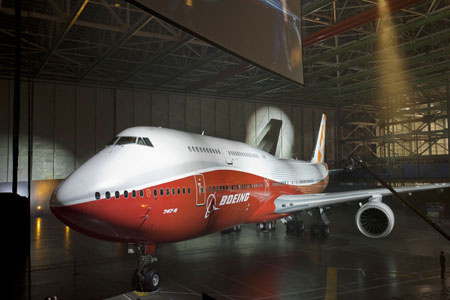
    EVERETT, Wash., Feb. 13, 2011 /PRNewswire/ — Boeing (NYSE: BA) today unveiled its new 747-8 Intercontinental, the new high-capacity passenger airplane that offers airlines the lowest operating costs and best economics of any large passenger airplane while providing enhanced environmental performance.
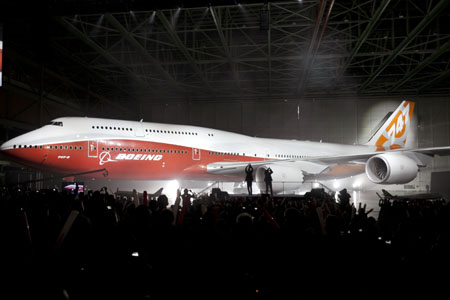
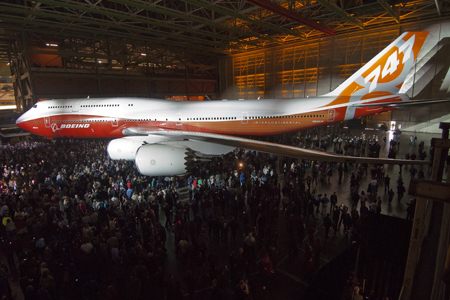
    Approximately 10,000 guests, including customers, Boeing employees, government officials, partners and suppliers, gathered in the factory in Everett, Wash., to witness the premiere of the Intercontinental at an event themed “Incredible, Again.” Boeing Commercial Airplanes President and Chief Executive Officer Jim Albaugh said the newest 747 incorporates technological advancements that make it an extremely productive airplane for customers.
    “The new 747-8 Intercontinental features the latest in innovative technologies — applying many of the breakthroughs also found on the 787 Dreamliner,” said Albaugh. “We think our customers will value the low operating costs and passengers will enjoy the comfort of the striking new interior.”

    “The 747-8 Intercontinental will be a great complement to our fleet, fitting nicely into the 400-seat category, improving our fleet’s eco-efficiency even further,” said Nico Buchholz, executive vice president, Lufthansa Group Fleet Management. “As launch customer, we are looking forward to welcoming this new aircraft to our fleet next year as it adds to our ongoing fleet modernization and environmental efforts.”

    Korean Air and VIP customers have joined launch customer Lufthansa in ordering a total of 33 747-8 Intercontinentals. First delivery of the 747-8 Intercontinental is scheduled for the fourth quarter.

    “As the only airplane in the 400 to 500-seat market, the 747-8 Intercontinental will give operators an airplane perfectly suited for long, heavily traveled routes around the world,” said Pat Shanahan, vice president and general manager, Airplane Programs, Boeing Commercial Airplanes. “The new 747-8 Intercontinental will set a new standard in economic and environmental performance, while providing a world-class passenger experience.”

    The 747-8 Intercontinental will have the lowest seat-mile cost of any large commercial jetliner, with 12 percent lower costs than its predecessor, the 747-400. The airplane provides 16 percent better fuel economy, 16 percent less carbon emissions per passenger and generates a 30 percent smaller noise footprint than the 747-400. The 747-8 Intercontinental applies interior features from the 787 Dreamliner that includes a new curved, upswept architecture giving passengers a greater feeling of space and comfort, while adding more room for personal belongings.
    The airplane unveiled today is painted in a new Sunrise livery of red-orange that only will appear on the first 747-8 Intercontinental and is a significant departure from Boeing’s standard blue. The new color palette honors many key Boeing customers whose cultures recognize these colors as symbols of prosperity and good luck.

  • | | | | |

    Newfoundland Sikorsky Crash: Final


    Pictured: Couger-owned Sikorsky S-61N Helicopter
    Click to view full size photo at Airliners.net
    Contact photographer Phil Earle
    On March 12, 2009, about 0926 ADT, Atlantic Daylight Time, a Sikorsky S-92A helicopter, Canadian registry C-GZCH, operated by Cougar Helicopters, impacted the waters of the North Atlantic about 28 miles east of Cape Spear near St. John’s, Newfoundland. There were two pilots, Pilot Matthew William Thomas Davis, 34, of St. John’s, Newfoundland and Labrador and First Officer Tim Lanouette, 48, of Comox, British Columbia, both of whomdied in the accident, and 16 passengers on board the helicopter. One passenger, Robert Decker, survived with serious injuries, but the other occupants were fatally injured. The helicopter was en route from St. John’s International Airport (CYYT) to an offshore oil platform in the Hibernia oil field. The pilot made a MAYDAY call due to a mechanical difficulty, and was returning to St. John’s at the time of the accident. Visual meteorological conditions prevailed at the time of the accident, and the sea state had 3 – 5 meter swells. An instrument flight rules (IFR) flight plan was filed.

    The NTSB has recommended that any gearbox losing oil pressure should have the capacity to run dry for 30 minutes before failure. In the case of Flight 491, the elapsed time between the warning light and the ditching of the aircraft in the sea was 11 minutes. Two of the three main gearbox mounting studs were broken. When they broke, the helicopter lost oil rapidly and the gears began to overheat.

    On March 23, 2009, Sikorsky released a bulletin that most of the world’s S-92TM helicopter fleet already had complied with the company notice to retrofit the aircraft’s gearbox oil bowl with steel mounting studs.

  • |

    Dassault’s Enhanced Vision System (EVS) Receives FAA Certification for the Falcon 7X

    SAINT-CLOUD, France, February 11, 2011 — Dassault Falcon has received operational certification from the FAA for the Falcon 7X Enhanced Vision System (EVS). This follows certification received from EASA in July, 2010.

    Dassault’s EVS provides an image on the Head-Up Display (HUD) and flight deck displays that enables the pilots to see the terrain and airport environment in low visibility situations such as in fog, haze, snow or at night. It incorporates LCD HUD technology and offers a high quality, brighter video presentation with a unique two-mode setting that optimizes the video for either an approach configuration (to enhance approach and runway lights), or a general purpose configuration. It also takes advantage of special IR video processing developed specifically to minimize visual artifacts and distortion.

    “Incorporating technology that enhances safety and situational awareness is a prime goal in the continuing development of all our programs,” said John Rosanvallon, President and CEO of Dassault Falcon. “This additional certification is further affirmation that we are achieving this goal. Our fully integrated EVS offers advanced features not available on any other system, and has already generated a great deal of interest among the Falcon family,” Rosanvallon added. EVS significantly improves situational awareness, not only during take-off, approach and landing, but also during ground maneuvering.

    In addition to enhanced situational awareness, the Falcon 7X EVS system provides operational credit towards reduced minima in low visibility landing conditions from the published IFR minima down to a minimum of 100 feet above the threshold elevation. This provides minima equivalent to Cat II minimums even on Cat I standard instrument approaches and on non-precision approaches.
    A one day pilot training course, consisting of ground instruction and full flight simulator training (including at least six approaches) is required for operators using EVS.

  • |

    AirTran Flight Attendants Announce Six-Week Picketing Schedule in Six Cities

    WASHINGTON, Feb. 11, 2011 /PRNewswire-USNewswire/ — AirTran Flight Attendants, represented by the Association of Flight Attendants-CWA (AFA), today announced a “Six Cities in Six Weeks” picketing tour. As frustrations escalate over management’s continued stalling of contract negotiations, AirTran Flight Attendants will begin a series of public protests on Monday, February 14 in Atlanta and conclude on April 1 in Baltimore. If a tentative agreement is not reached by April 1, then picketing will continue in six additional cities.

    Six Cities in Six Weeks Picketing Tour
    Monday, February 14 – Atlanta Hartsfield-Jackson International Airport (ATL)
    Tuesday, March 1 – Orlando International Airport (MCO)
    Wednesday, March 9 – Dallas/Fort Worth International Airport (DFW)
    Thursday, March 17 – Chicago Midway International Airport (MDW)
    Wednesday, March 23 – Orlando – AirTran Shareholders Meeting
    Friday, March 25 – General Mitchell International Airport (MKE)
    Friday, April 1 – Baltimore/Washington International Thurgood Marshall Airport (BWI)

    Following the announcement of the acquisition by Southwest Airlines, AirTran management approached AFA requesting an abbreviated list of the Flight Attendants’ greatest concerns in order to expedite negotiations. When presented with the union’s “short list” proposal, company management responded with a minimal counterproposal that failed to address the most basic work, duty and rest provisions. AFA rejected management’s proposal and filed for mediation services from the National Mediation Board the following day.

    “While we do not want to have to take our struggle to the street, our Flight Attendants deserve fair work rule improvements now,” said Stephen Grimaldi, AirTran Flight Attendant and AFA Chairperson of Flight Attendant Mobilization. “Management has been dragging their feet for too long – enough is enough.”
    Ready to begin focusing on the transition to Southwest Airlines, AirTran Flight Attendants may continue to work under the AFA contract for at least another two years. Under the Railway Labor Act, this future change in ownership does not negate the carrier’s obligation to negotiate now with its Flight Attendants in good faith.