What: US Airways/PSA Airlines Canadair CRJ-200 en route from Charlotte,NC to Lexington,KY Where: Charlotte-Douglas International Airport When: Apr 6 2010 Who: 14 passengers and 3 crew Why: After takeoff, the left engine failed. The crew returned to Charlotte and made a safe cautionary landing 20 minutes after it left.
What: American Airlines Boeing 767-200 en route from New York JFK to Los Angeles Where: Dulles, Washington When: Apr 6th 2010 Who: 152 passengers Why: While en route, the systems detected an indication that a cargo door was “not fully secure”. The flight diverted to Dulles where it made an unscheduled stop, and landed safely. The cargo door problem was promptly taken care of by mechanics before the flight continued on to LA.
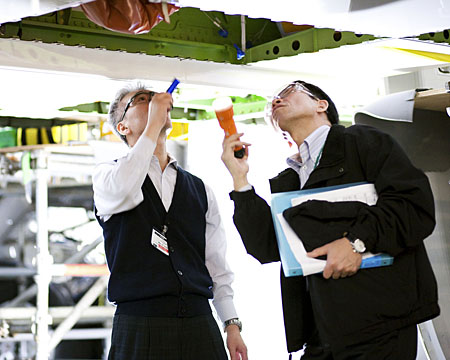
Boeing Completes First 787 Dreamliner Maintenance Training Class EVERETT, Wash., April 6 — Boeing (NYSE: BA) today announced that it has completed the first maintenance training class for the 787 Dreamliner. The class consisted of 10 mechanics from 787 launch customer ANA (All Nippon Airways) and two regulators from the Japan Civil Aviation Bureau (JCAB).
The mechanics, who completed the training last week, are the first of 150 ANA mechanics to be trained by Boeing over the next seven months. They spent more than 30 days learning how to maintain the world’s most advanced commercial jetliner, including 20 days of theoretical training, two days of engine runs and taxi testing, five days of practical training and five days of troubleshooting exercises. To conclude the training, students conducted component identification exams on production airplanes, as well as troubleshooting exams in the full flight simulator.
To support the all-new 787, Boeing Training & Flight Services, a division of Commercial Aviation Services, Boeing Commercial Airplanes, has developed an all-digital, Internet-based teaching system for maintenance training, along with training tools that connect real-time to a virtual airplane and airplane systems.
“Getting our mechanics trained and prepared is essential to being ready to take delivery of the airplane later this year,” said Michihide Kono, vice president of Engineering and Maintenance for ANA. “This is an important milestone for our ANA team and we are delighted to see the continued progress on the program.”
The curriculum is designed to focus on performance-based training that incorporates real-world simulated maintenance scenarios for a more immersive training experience.
“The use of personal tablet computers, interactive computer-based training, three-dimensional images and desktop simulation makes it possible to deliver training more efficiently,” said Sherry Carbary, vice president of Boeing Training & Flight Services, Commercial Aviation Services, Boeing Commercial Airplanes. “Our team is committed to providing our customers with the resources and tools they need to be successful.”
The 787 comes with digital tools and databases that replace volumes of printed materials. The graphic and textual database has point-and-click features for more details, allowing mechanics to navigate through documents quickly to get the information they need to do their jobs.
“This milestone is another important step along the way to being service-ready,” said Mike Fleming, director of 787 Services and Support, Boeing Commercial Airplanes. “Our goal is to make entry into service a seamless experience for our customers.”
Fifty-seven customers around the world have ordered 866 787s since the program was launched in April 2004, making the Dreamliner the fastest-selling new commercial jetliner in history. Delivery of the first 787 is planned for the fourth quarter of 2010.
What: SAS Scandinavian Airlines McDonnell Douglas MD-82 en route from Pristina Kosovo to Copenhagen Where: Berlin When: Apr 3rd 2010 Who: 89 passengers and 5 crew Why: After takeoff from Kosovo, a part fell from the engine. the crew diverted to Berlin and made a safe landing.
What: Front Range Helicopters Where: near Mount Morrison When: April 04, 2010 Who: Pilot instructor 29-year-old Jesse Whitsett of Fort Collins and student Michael McDonald Why: The student was practicing a “remote site landing,” a move required for a license. McDonald was practicing to get his license.
After the crash, the pilot radioed in his location. Neither instructor nor student was seriously injured, although McDonald did go to the hospital.
What: Qantas Boeing 747-400 en route from Bangkok to London Where: Bangkok When: Apr 6th 2010 Who: 335 passengers Why: After takeoff, engine four had an engine surge. The crew decided to return to Bangkok where they circled, dumped fuel and made a safe landing. Passengers were provided accommodations, and an alternative flight. There were no injuries.
What: Egypt Air Airbus A330-200 en route from Cairo to Hurghada Where: Cairo When: Apr 2nd 2010 Who: 195 passengers Why: Prior to take-off, there was crew error on the ground, and the plane impacted two runway light poles. The wings were damaged; the streetlights collapsed. Passengers were transferred to another plane.
What: American Eagle Embraer ERJ-145 en route from Tulsa to Chicago O’Hare Where: Dane County Regional Airport When: 9:46 p.m. Sunday April 4 2010 Who: 27 passengers on board Why: While en route, the pilot detected smoke/electrical fumes in the cockpit and decided to divert to Madison.
Passengers were provided overnight accomodations by the airline and continued to Chicago on Monday.
What: Anlægsselskabet Dansk Nybyg Piper PA-28-151 Warrior en route from Laesoe island. Where: between Solsbæk and Sæby, North Jutland, Denmark When: April 5 2010 Who: Two were hospitalized; remains of Niels and Bente Birch Nielsen recovered on the scene Why: The 35-year-old Piper PA-28-151 Warrior crashed into trees near Solsbæksvej (Solsbæksroad), between Solsbæk and Sæby, North Jutland. The parents were were killed and the two daughters (17 and 25) were taken to hospital with serious injuries. At the time of the crash, visibility was not good, and according to witnesses, the plane was flying low.
What: Qantas Boeing 747 en route from Los Angeles to Melbourne Where: Melbourne When: Apr 5 2010 Why: While en route over Canberra, a crack developed in the outer pane of the first officer’s windshield. The flight landed safely, and was temporarily taken out of circulation/rotation for repairs.
What: Jetblue Airbus A320-200 en route from Newark to Fort Lauderdale Where: Newark Liberty International Airport When: Apr 5th 2010 Who: 134 passengers Why: During takeoff, the airbus lost the left engine cowling.
Distressed panicked passengers smelled smoke and said they could see inside the engine.
Less than a quarter of an hour later, it had landed back at the airport, where the fallen parts had to be gathered.
The NY Daily news reported that passengers were offered refunds and a free round trip.
What: Miami Air International Boeing 737-400 en route from Minneapolis to Miami Where: Chicago When: Apr 4th 2010 Who: the “Miami Heat” Why: While en route, the flight’s mechanic became sick. The flight diverted to Chicago for an hour where the mechanic was hospitalized in a diabetic coma.
What: Norwegian Air Shuttle Boeing 737-800 en route from Alicante to Stockholm Where: Alicante When: Apr 2nd 2010 Who: 106 passengers Why: After takeoff, passengers smelled smoke, and one of the indicators detected fire in a wheel well. The plane returned to Alicante, and made a safe landing. During emergency evacuation, four passengers were injured. Passengers were provided hotel accommodations and Boeing brought in another plane to transport them.
What: United Airlines B744 en route from Chicago to Tokyo Where: Tokyo When: Apr 1st 2010 Who: 348 passengers, Why: On landing, the left landing gear erupted in white smoke. Emergency services found no fire or damage.
What: Poelking Air LLC Beechcraft B36TC Bonanza taking off from Wright Brothers Airport to Chicago Where: Ohio: 741 along Penny Royal Road, Dayton-Wright Brothers Airport., When: April 1 2010 Who: 2 fatalities, 2 occupants Why: After takeoff, the Beechcraft Bonanza experienced problems. On the pilot’s attempted landing, the plane’s right wing struck the runway. The plane cartwheeled and exploded 1,000 feet south of the runway, killing both aboard.
The pilot was Tom Hausfeld; the passenger was his daughter Kacie Hausfeld.
JetBlue has corrected an earlier report that the plane sustained hail damage. The airline is now saying that a tail strike on take-off caused the damage and subsequently the emergency landing.
What: Jetblue Airbus A320-200 en route from New York to Long Beach Where: New York When: Mar 28th 2010 Who: 144 on board Why: Leaving the runway, the plane’s tail impacted either hail or a bird or had a tail strike (reports conflict); the flight returned to JFK and made a safe landing so that the damage could be checked out. Passengers debarked, and boarded an alternative plane some time later.
What: Cessna 182 Where: Monocacy National Battlefield When: March 30, 2010 Who: Pilot, Bethany Chase, 40, of Germantown, Md and passenger Gregory Windham 57, of Olney Why: The pilot was making traffic surveys. She intended to land at Montgomery Airport, but there was a problem there with wind shear, and she redirected to Frederick Municipal airport, but her plane lost power. The plane flipped, and landed on Urbana Pike. No one was injured seriously. The passenger refused treatment, and the pilot was hospitalized with minor injuries.
What: THY Turkish Airlines Airbus A340-300 en route from Bangkok to Istanbul Where: Mumbai When: Apr 1st 2010 Who: 289 passengers Why: While en route, one of the engines developed problems, and the crew had to shut it down and decided to divert to Mumbai. The flight made a safe landing, and was towed to the gate.
140 passengers were directed to alternative airlines, and the rest were provided hotel accommodations and given a seat on a Turkish Airlines Friday flight.
What: Delta Airlines Boeing 757-200 en route from New York to San Francisco Where: Lambert-St. Louis International Airport When: Mar 30 Who: 171 aboard (165 passengers and 6 crew) Why: When smoke fill the cabin, the crew diverted the flight to St Louis. They made a safe landing with no reported injuries.
Passengers disembarked on the runway and were bussed to the gate.
What: Qantas Airbus A380-800 en route from Singapore to Sydney Where: Sydney When: Mar 31st 2010 Who: 244 passengers Why: On landing, the plane blew its left tires; and there were sparks and and a brief fire from the brakes. The plane left a rubber trail. Damage assessment was made on the tarmac by engineers, with the plane sitting on its rims.
Qantas denies classifying this as an “emergency” landing.
George’s Point of View
I’m thinking how smart Boeing is to have held up release of their big jumbo, especially when I see A 380 incidents.
I am reminded of all the flaws that popped in the Airbus A310 (reputedly a rush copy of the Boeing 737); and I also remember reading about Airbus struggling to get the A-380 shipshape before Airbus rushed it to market. In development, Airbus wrestled with a plane that was severely overweight, withstructural, and production problems. Remember the trouble the A-380 had getting launched:
On Dec 4 2009, QANTAS Airbus A380-842 (VH-OQA) Singapore to London- On the runway, the plane’s nose gear became unsteereable. The plane was towed to the gate and spare parts had to be flown in to deal with the problem.
On July 4 2009, Qantas Airbus A380-842 (VH-OQA) Singapore to London- the approach was aborted due to nosegear problems. On landing, steering failed.
In March of 2008, Qantas removed all 3 of its A-380s due to fuel system problems (two unserviceable with a ‘”fuel tank indication system problem”.)
The A380 is a part of the Air France, Emirates, Qantas and Singapore airlines fleets , and in which fuel gauge problems, nosegear problems and braking problems are becoming known issues. Problems also arise because the prohibitive size of the plane limits where it can land.
Some Worrisome Airbus History
In 2004, Joseph Mangan, an Airbus whistleblower told European aviation authorities of flaws on a computer chip on the Airbus A380. (These were microprocessor flaws that could cause the valves that maintain cabin pressure on the A380 to accidentally open during flight, allowing air to leak out so rapidly that everyone aboard could lose consciousness within seconds.)
Mangan was chief engineer for the Viennese company TTTech Computertechnik, which supplied the chips and software controlling the A380 cabin-pressurization system assembled at the French Airbus plant. TTTech fired Mangan, filed civil and criminal charges against him for revealing proprietary company documents. Austrian law has no whistleblower protection, and there is currently a gag order imposed on Mangan. They claim his allegations have been disproved.
What did he know? Have the problems behind his concerns been addressed? What elsedo we not know? Without transparency, how can we ever know?
What: United Airlines Boeing 777-200 en route from San Francisco to Beijing Where: San Francisco When: Mar 27 2010 Who: 251 passengers and 17 crew Why: After takeoff, the Boeing’s Traffic and Collision Avoidance System issued a traffic advisory, recognizing an Aeronca too close. From a lower altitude, the Boeing crew only saw a portion of Aeronca that was passing between 200-300 feet away. TCAS warned them to drop their altitude to increase separation. The Aeronca was directed to take a “hard left”
What: Southwest Airlines Boeing 737-300 en route from Fort Lauderdale,FL to Chicago Where: Tampa International Airport When: Mar 30th 2010 Who: 136 passengers Why: After takeoff, the landing gear remained stuck in the down position. After circling the airport for half an hour, the flight landed safely at the Tampa airport, with emergency vehicles on standby.
What: Qantas Boeing 747-400 en route Sydney to Singapore Where: Sydney When: Mar 30th 2010 Who: 414 aboard Why: While en route, a right engine experienced an engine surge. That engine had to be shut down. The crew had to dump fuel and return to Sydney where they made a safe landing about an hour after departure. Passengers were provided a replacement plane.
What: Mexicana Boeing 767-300 en route from Sao Paulo to Mexico City Where: Brasilia When: Mar 28 2010 Why: While en route, the flight developed an oil leak, which prompted the crew to shut down the left engine. The crew diverted the flight to Brasilia and made a safe landing. Passengers were rebooked.
A Reuters release announces that the relatives of passengers killed in an Air France crash off Brazil have filed nearly two dozen wrongful death lawsuits against Airbus, alleging that aircraft maker’s A330 crashed because of flaws in the plane and its U.S.-made components.
The search for the black boxes is supposed to be continuing now that investigators have decided on the likeliest location where they may be found. The plane originally went down 680 miles off the coast of Brazil, but in the past ten months since the tragedy, water currents dispersing the wreckage will have made the search more difficult.
An Airbus Americas spokesman has said they “will be moving to have (the lawsuit) dismissed.”
Lawyers from the Miami-based firm Podhurst Orseck has not yet responded to Airbus statements.