Boeing

  • | | | |

    Egypt Air Emergency Landing in Mumbai


    Click to view full size photo at Airliners.net
    Contact photographer Roland Bergmann-Spotterteam Graz

    What: Egypt Air Boeing 737-800 en route from Cairo Egypt to Mumbai
    Where: Mumbai
    When: Dec 29th 2010
    Who: 124 passengers, 7 crew
    Why: On approach to Mumbai, the flight crew noted a cargo fire alert. The flight landed safely and when emergency services found no fire, taxied to the gate where passengers disembarked. All cargo was removed and no fire was found.

  • | | | |

    Ethiopia 409: Almost A Year Later


    Click to view full size photo at Airliners.net
    Contact photographer Alastair T. Gardiner

    Update:

    It has been 11 months since the crash, and families of the 90 people who died in the crash are fretting over delays in their insurance settlement. Families approaching the EIC (Ethiopian Insurance Corporation) plead for their compensation to no avail. At least the families who have hired foreign lawyers have some auxiliary power to help supplement their efforts.

    The cause of the delays have been attributed to the insurance companies trying to avoid “controversial” claims, time-consuming paperwork, and waiting for the final findings of the official accident report, which is slated to be released on Jan 25 2011, exactly a year after the tragedy.

    What: Ethiopian Airlines Boeing 737 en route from Beirut to Addis Ababa
    Where: 2 miles west of the coastal village of Na’ameh.
    When: Jan 25 2010
    Who: 7 crew 83 passengers
    Why: Shortly after taking off in stormy weather and heavy lightning, Lebanese ATC lost contact. The plane disappeared from radar 45 minutes after leaving Beirut. Witnesses on the coast saw the plane as it crashed into the sea.

  • | | | |

    Air Busan Runway Incursion


    Click to view full size photo at Airliners.net
    Contact photographer JangSu Lee – Korea Aero Photos

    What: Air Busan Boeing 737-400 en route from Fukuoka (Japan) to Busan (South Korea)
    Where: Fukuoka Japan
    When: Dec 26th 2010
    Who: 153 aboard
    Why: When cleared for takeoff, the Air Busan flight was taxiing when it went performed a runway incursion as a Jal Express Boeing was on final approach. The incursion casued a collision hazard/ loss of separation with an aircraft taking off, intending to take off, landing or intending to land. The Jal had to perform a go-around, but landed safely less than half an hour later. Then the Air Busan flight took off normally.

  • |

    Boeing Resumes 787 Flight Testing

    – Interim solution verified through extensive testing
    – Schedule assessment expected to conclude in January

    EVERETT, Wash., Dec. 23, 2010 — Boeing will resume flight test activities on the 787 Dreamliner later today. The company has installed an interim version of updated power distribution system software and conducted a rigorous set of reviews to confirm the flight readiness of ZA004, the first of the six flight test airplanes that will return to flight.

    “Initially, we will resume a series of Boeing tests that remain to be completed in the flight test program. That testing will be followed later by a resumption of certification testing,” said Scott Fancher, vice president and general manager of the 787 program. Today’s testing will include an intentional deployment of the Ram Air Turbine (RAT), which is a small turbine that is deployed when back-up power is required.

    Boeing and Hamilton Sundstrand completed testing of the interim software updates earlier this week. Verification of the system included laboratory testing of standalone components, integration testing with other systems, flight simulator testing and ground-based testing on a flight test airplane.

    In the last several weeks, the company continued ground testing as part of the certification program. Additional ground testing will be done by the company on the production version of the airplane to further verify performance of the changes being made.

    “As we return to flight test and determine the pace of that activity, we remain focused on developing a new program schedule,” Fancher added. “We expect to complete our assessment of the program schedule in January.”

    Flight testing of the 787 was suspended last month following an in-flight electrical incident on a test flight in Laredo, Texas.

  • | | |

    Fumes Instigate Emergency Disembarkation


    Click to view full size photo at Airliners.net
    Contact photographer Roger Oldfield

    What: Ryanair Boeing 737-800 en route from London Stansted to Kerry Ireland
    Where: Kerry Ireland
    When: Dec 21st 2010
    Who: 160 passengers
    Why: On landing, the plane was taxiing on the runway when those inside were subjected to fumes. The pilots stopped on the runway and instituted evacuation procedures. Passengers disembarked via slides, (two of whom were injured.)

    The fumes appear to have been from de-icing compound,

  • |

    Boeing Receives US Air Force Contract for C-17 Training Devices

    ST. LOUIS, Dec. 22, 2010 — The Boeing Company today announced it has received a contract from the U.S. Air Force to deliver C-17 training devices to three sites. The contract value is $44 million initially and up to $72 million if two options are exercised.

    The first set of devices is an Integrated Training Center (ITC) to be delivered to Wright-Patterson Air Force Base, Ohio, in the first quarter of 2012. The ITC will consist of a weapon systems trainer, pilot and co-pilot station, loadmaster station and related courseware and support equipment. A second weapon systems trainer will be installed at McChord Air Force Base, Wash., in the third quarter of 2012 and a third ITC will go to a new C-17 training site in early 2013.

    “Wright-Patterson is set to receive its first of eight C-17s next year and McChord has 54,” said Mark McGraw, Boeing vice president for Training Systems & Services. “We are proud to add to the Air Force’s training capability and support warfighter readiness with these new devices.”

    The ITCs support pilot and co-pilot instruction in flight operations, mission planning and emergency procedures through computer-based training, advanced aircraft simulation and other desktop training devices. C-17 loadmasters also receive computer-based and aircraft training in addition to training on the loadmaster station, cargo loading models and cargo compartment trainer. Additionally, maintenance personnel can use the ITCs for training on engine run procedures.

  • |

    Boeing Completes Acquisition of Summit Aeronautic Group in Montana

    SEATTLE, Dec. 21, 2010 / — Boeing announced today the completion of the acquisition of the business and operations conducted by Summit Aeronautics Group in Helena, Montana. Terms of the transaction, announced on Nov. 22, were not disclosed.

    The newly acquired business will be named Boeing Helena. It will become part of Boeing Fabrication, a division of Boeing Commercial Airplanes. Boeing Helena will manufacture titanium and other hard-metal structures for Boeing commercial aircraft including the 747-8, 767 and 787.

    Forward-Looking Information Is Subject to Risk and Uncertainty
    Certain statements in this release may be “forward-looking” within the meaning of the Private Securities Litigation Reform Act of 1995. Words such as “may,” “will,” “should,” “expects,” “plans,” “intends,” “projects,” “believes,” “estimates,” “targets,” “anticipates,” and similar expressions are used to identify these forward-looking statements. Examples of forward-looking statements regarding the proposed acquisition of Summit include, but are not limited to, statements regarding the expected timetable for completing the transaction, future business prospects, our guidance relating to 2010 and 2011 financial and operating performance, product development and benefits and synergies of the transaction, as well as any other statement that does not directly relate to any historical or current fact. Forward-looking statements are based upon assumptions about future events that may not prove to be accurate. These statements are not guarantees of future performance and involve risks, uncertainties and assumptions that are difficult to predict. Actual outcomes and results may differ materially from what is expressed or forecasted in these forward-looking statements. As a result, these statements speak to events only as of the date they are made and we undertake no obligation to publicly update or revise any forward-looking statements, whether as a result of new information, future events or otherwise, except as required by federal securities laws. Specific factors that could cause actual results to differ materially from forward-looking statements include, but are not limited to, the effect of economic conditions in the United States and globally, the ability of the parties to satisfy the transaction conditions and complete the acquisition, the risk that competing offers will be made, our ability to successfully integrate Summit’s business and realize anticipated synergies, and other important factors disclosed previously and from time to time in our filings with the Securities and Exchange Commission.

  • |

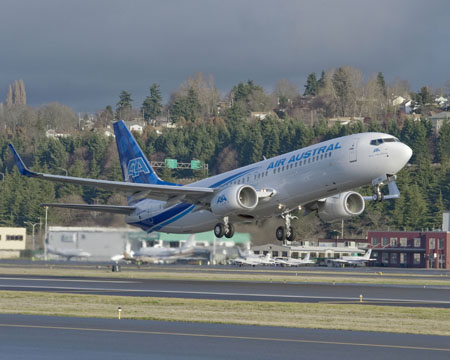
    Boeing Delivers Air Austral’s First Next-Generation 737-800

    SEATTLE, Dec. 20, 2010 — Boeing delivered a Next-Generation 737-800 to Air Austral, as part of the airline’s modernization plan for its medium-haul fleet. The airplane is the first of two the airline ordered to replace one 737-300 and one 737-500 in its fleet. The new airplane continues the Boeing-Air Austral relationship that began 20 years ago with the 737 Classic. The delivery ceremony was attended by Gerard Etheve, president of the directory and chief executive officer of Air Austral. The airline is headquartered in St. Denis, Reunion, a French Department island located east of Madagascar in the Indian Ocean.

  • | |

    Boeing Fabricará 3 Satélites para el Gobierno de México

    EL SEGUNDO, California, 20 de diciembre de 2010 — Boeing [NYSE: BA] anunció hoy la adjudicación de un contrato por aproximadamente US$1,000 millones de parte del gobierno mexicano para la entrega de un sistema integral de comunicaciones satelitales. El sistema, denominado MEXSAT, consta de tres satélites, dos estaciones terrenas, los sistemas de operaciones de red correspondientes y terminales de usuario de referencia. MEXSAT proveerá comunicaciones seguras para las necesidades de seguridad nacional de México, así como una cobertura mejorada para las telecomunicaciones civiles.

    “MEXSAT es la cuarta generación de satélites que Boeing ha suministrado a México para comunicaciones satelitales gubernamentales y civiles,” dijo Craig Cooning, director general ejecutivo (CEO) de Boeing Satellite Systems International. “MEXSAT ha sido desarrollado con base en 13 años de experiencia de parte de Boeing en el diseño y la fabricación de avanzados sistemas de satélites geoestacionarios para servicios móviles.”

    Conforme a los términos del contrato, Boeing entregará un sistema llave en mano completo que se compone de dos satélites geoestacionarios para servicios móviles (o “GEO-Mobile”) Boeing 702HP denominados MEXSAT 1 y MEXSAT 2, así como un satélite para banda C extendida y banda Ku, llamado MEXSAT 3, que proveerá servicios satelitales fijos (FSS) desde una órbita geosíncrona. El primer lanzamiento programado es el de MEXSAT 3, a finales de 2012.

    Cada satélite Boeing suministrará 14 kilowatts de potencia mediante alas de arreglos de cinco paneles solares dotadas de celdas fotovoltaicas de arseniuro de galio de triple unión de alta eficiencia. Cada una de las naves transportará un reflector de banda L de 22 metros para servicios satelitales móviles (MSS), complementado por una antena de banda Ku de 2 metros.
    Boeing subcontratará la fabricación del satélite MEXSAT 3 y de un centro de operaciones a su empresa asociada Orbital Sciences Corporation [NYSE: ORB]. MEXSAT 3, un satélite Orbital Star 2.4, brindará cobertura total al territorio mexicano y sus aguas patrimoniales, y transmitirá comunicaciones civiles a fin de coadyuvar al desarrollo socioeconómico del país.

    Asimismo, Boeing desarrollará dos estaciones terrenas equipadas con avanzada tecnología de flexibilidad de conformación del haz para dirigir haces puntuales de usuario móvil a dependencias gubernamentales que operan en México y sus aguas patrimoniales, tanto en el litoral del Pacífico como en el Golfo de México.

    Con anterioridad, Boeing suministró cinco satélites para el gobierno mexicano: los satélites Morelos 1 y Morelos 2, ambos puestos en órbita en 1985; los satélites Solidaridad 1 y Solidaridad 2, lanzados en 1993 y 1994; y el Satmex 5, lanzado en 1998. Solidaridad 2, que ya ha rebasado la vida útil estipulada en el contrato, aún continúa en servicio, y se espera que el satélite Satmex 5 deje de operar en 2012.

    Boeing Defense, Space & Security, una unidad de The Boeing Company, es una de las mayores empresas del mundo en el sector de defensa, espacio y seguridad. Se especializa en ofrecer a sus clientes soluciones innovadoras desarrolladas a partir de capacidades operacionales y es el fabricante más grande y versátil de aeronaves militares en el mundo. Con sede en St. Louis, Boeing Defense, Space & Security es una empresa de US$34,000 millones con una plantilla de 68,000 trabajadores en todo el mundo.

  • |

    Boeing to Build 3-Satellite System for Government of Mexico

    EL SEGUNDO, Calif., Dec. 20, 2010 — Boeing today announced that it has received a contract for approximately $1 billion from the government of Mexico to deliver an end-to-end satellite communications system. The system, known as MEXSAT, will consist of three satellites, two ground sites, associated network operations systems and reference user terminals. MEXSAT will provide secure communications for Mexico’s national security needs, as well as enhanced coverage for the country’s civil telecommunications.

    “MEXSAT is the fourth generation of satellites Boeing has provided to Mexico for government and civilian satellite communications,” said Craig Cooning, chief executive officer of Boeing Satellite Systems International. “MEXSAT builds on Boeing’s 13 years of experience in designing and delivering advanced geomobile systems.”

    Under the contract, Boeing will deliver a complete turnkey satellite system comprised of Boeing 702HP geomobile satellites MEXSAT-1 and MEXSAT-2 and one extended C- and Ku-band satellite, MEXSAT-3, which will provide fixed satellite services from geosynchronous orbit. MEXSAT-3 is scheduled to launch first, at the end of 2012.

    Each Boeing 702HP satellite will supply 14 kilowatts of power through five-panel solar array wings that use high-efficiency, ultra triple-junction gallium arsenide solar cells. Both satellites will carry a 22-meter L-band reflector for mobile satellite services, complemented by a 2-meter Ku-band antenna.

    Boeing will procure MEXSAT-3 and a spacecraft operations center from its supplier partner Orbital Sciences Corporation [NYSE: ORB]. MEXSAT-3, an Orbital Star 2.4 satellite, will provide full coverage of Mexico and its patrimonial seas and relay civil communications for socioeconomic development.

    Boeing also will develop two ground sites in Mexico with advanced beam-forming flexibility to direct mobile user spot beams to government agencies operating in Mexico and its patrimonial seas, including the Pacific Ocean and Gulf of Mexico.

    Boeing has previously provided five satellites that serve Mexico, beginning with Morelos 1 and Morelos 2, both launched in 1985; the Solidaridad 1 and Solidaridad 2 satellites, launched in 1993 and 1994; and Satmex 5, which was launched in 1998. Solidaridad 2, which has exceeded its contract life, is still in service, and Satmex 5 is expected to end its service life in 2012.

    A unit of The Boeing Company, Boeing Defense, Space & Security is one of the world’s largest defense, space and security businesses specializing in innovative and capabilities-driven customer solutions, and the world’s largest and most versatile manufacturer of military aircraft. Headquartered in St. Louis, Boeing Defense, Space & Security is a $34 billion business with 68,000 employees worldwide.

  • |

    Boeing-built C-17 Fleet Surpasses 2 Million Flight Hours


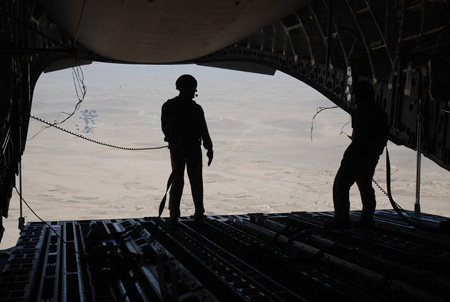
    LONG BEACH, Calif., Dec. 20, 2010 — The worldwide fleet of C-17 Globemaster III airlifters built by The Boeing Company [NYSE: BA] surpassed 2 million flying hours during an airdrop mission over Afghanistan on Dec. 10. Reaching 2 million flight hours equates to 1.13 billion nautical miles – the equivalent of a C-17 flying to the moon and back 2,360 times.
    The representative mission, flown by a U.S. Air Force C-17, airdropped 74,000 pounds of jet fuel in support of U.S. and coalition troops just south of Kabul.

    The C-17 has a mission readiness rate of more than 85 percent. It is the world’s only strategic airlifter with tactical capabilities that allow it to fly between continents, land on short, austere runways, and airdrop supplies precisely where they are needed.

    “There’s tremendous satisfaction in knowing that in those 2 million hours, the C-17 fleet has saved countless lives around the world,” said Bob Ciesla, Boeing C-17 program manager. “Boeing congratulates the U.S. Air Force and our international C-17 customers on reaching this milestone. We’re very proud that the C-17 continues to exceed expectations for performance and reliability.”

    The C-17 fleet, now in its 17th year of service, has supported humanitarian and disaster-relief missions worldwide. With 226 airlifters in service around the world, the C-17 fleet continues to operate at an accelerated rate due to the recent troop surge in Afghanistan, reaching the 2 million flight-hours milestone less than five years after reaching 1 million flight hours in March 2006, when 152 C-17s were in service. This year, lifesaving aeromedical evacuations of wounded troops from Afghanistan and Iraq, along with relief missions for natural disasters such as earthquakes in Pakistan, Chile and Haiti, have intensified the C-17’s normal workload.

    Boeing helps keep the C-17 flying through a worldwide support and sustainment program. “Boeing has had the honor of supporting the entire C-17 fleet since the delivery of the first aircraft to Charleston Air Force Base in 1993,” said Gus Urzua, program manager for the Boeing C-17 Globemaster III Sustainment Partnership. “Through innovative Performance-Based Logistics contracting and partnering with the Air Force, we have maintained the highest level of aircraft readiness while continuously reducing the cost of ownership.”

    While providing relief to Haiti in January and February, C-17s delivered nearly 14,000 short tons of cargo and transported some 25,000 passengers and 280 patients. C-17s also played a key role in a record year for airdrops in support of Operation Enduring Freedom in Afghanistan. As of Oct. 31, C-17s and other airlifters have airdropped more than 45 million pounds of cargo to troops in remote locations.

    Boeing has delivered 20 C-17s to international customers. The U.S. Air Force — including active duty, National Guard, and Air Force Reserve units — has taken delivery of 206. Other customers include the U.K. Royal Air Force, the Canadian Forces, the Royal Australian Air Force, the United Arab Emirates Air Force, the Qatar Emiri Air Force, and the 12-member Strategic Airlift Capability initiative of NATO and Partnership for Peace nations. India is expected to be the next C-17 customer.

    A unit of The Boeing Company, Boeing Defense, Space & Security is one of the world’s largest defense, space and security businesses specializing in innovative and capabilities-driven customer solutions, and the world’s largest and most versatile manufacturer of military aircraft. Headquartered in St. Louis, Boeing Defense, Space & Security is a $34 billion business with 68,000 employees worldwide. Follow us on Twitter: @BoeingDefense.

  • |

    Boeing to Increase 777 Production Rate

    SEATTLE, Dec. 20, 2010 — Boeing ( today announced its production rate for the 777 program will increase to 8.3 airplanes per month in the first quarter 2013. This is the second production increase announced for the program this year. In March the program announced it would increase production from five to seven airplanes per month beginning in mid-2011.
    “In response to strong customer demand globally, we are increasing our yearly production to 100 777s,” said Boeing Commercial Airplanes President and CEO Jim Albaugh. “The 777 is the twin-aisle market leader because of its superior operating economics, unmatched range and preference among travelers’ needs.”

    The 777 has a large installed operator base, and a track record of proven performance including 1,163 orders, 907 deliveries and a backlog of more than 250 airplanes. Suppliers are prepared to support the rate increase.
    Watch a video on what customers have to say about the 777 airplane: http://bit.ly/elmgWE.

    The current production rate decision is not expected to have a material impact on 2010 financial results.

    Forward-Looking Statements
    Certain statements in this report may be “forward-looking” within the meaning of the Private Securities Litigation Reform Act of 1995. Words such as “expects,” “intends,” “plans,” “projects,” “believes,” “estimates,” “targets,” “anticipates,” and similar expressions are used to identify these forward-looking statements. Forward-looking statements are based upon assumptions about future events that may not prove to be accurate. These statements are not guarantees of future performance and involve risks, uncertainties and assumptions that are difficult to predict. Actual outcomes and results may differ materially from what is expressed or forecasted in these forward-looking statements. As a result, these statements speak to events only as of the date they are made and we undertake no obligation to publicly update or revise any forward-looking statements, whether as a result of new information, future events or otherwise, except as required by federal securities laws. Specific factors that could cause actual results to differ materially from forward-looking statements include, but are not limited to, statements we make regarding our guidance relating to future financial and operating performance, the effect of economic conditions in the United States and globally, and general industry conditions as they may impact us or our customers, as well as the other important factors disclosed previously and from time to time in our other filings with the Securities and Exchange Commission.

  • | | |

    Delta Flight from Manila Cancelled


    Click to view full size photo at Airliners.net
    Contact photographer Jjss

    What: Delta Airlines Boeing 747-400 en route from Manila to Nagoya
    Where: Manila
    When: Dec 19th 2010
    Who: 300+ passengers and crew
    Why: After taking off for Detroit, the plane developed technical problems and the pilot returned to Manila where it made a safe landing with airport’s medical and Fire and Rescue teams on standby.

    After being in the air less than an hour, the pilot returned to land at Ninoy Aquino International Airport.

    There were no injuries, but passengers complained of waiting long hours for travel solutions to being stranded. The exact nature of the technical problem of the plane was not released.

  • |

    Boeing and Ethiopian Airlines Partner With Non-Profits to Deliver Needed Medical Supplies


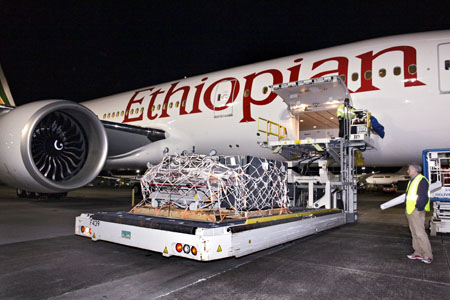
    Ethiopian Airlines’ 777-200LR carries more than $500K worth of anesthesia equipment to Ethiopia’s largest hospital

    EVERETT, Wash., Dec. 17, 2010 — Boeing partnered with Ethiopian Airlines and Seattle Anesthesia Outreach (SAO) for this week’s 777-200LR (longer range) delivery to Ethiopian Airlines to transport much needed anesthesia equipment to Black Lion Hospital – Ethiopia’s largest hospital.

    “Boeing and its airline partners have been working together to fill what is sometimes empty cargo space to help bring relief to people around the globe,” said Liz Warman, director of Boeing Global Corporate Citizenship for the Northwest region. “Our company has a history in humanitarian efforts. Our Humanitarian Delivery Flights program is another way we can continue leveraging our resources to help those in need.”

    “Since its inception, Ethiopian Airlines has been engaged in various corporate social responsibility activities, which support community initiatives and development efforts,” said Ato Girma Wake, CEO of Ethiopian Airlines. “We see our airplanes as not only a resource for our airline, but also a source of vital service for the people of Ethiopia and when we can use that resource in a manner such as this; it truly reaffirms our commitment to undertake social responsibilities whenever and wherever we can.”

    Ethiopian Airlines’ new 777-200LR (its second of five 777-200LRs on order) will deliver approximately 12,000 pounds (5,443 kg) of medical supplies, mainly anesthesia machines, monitors and books, from Seattle Anesthesia Outreach to Black Lion Hospital in Addis Ababa, Ethiopia. Black Lion Hospital is the largest hospital in Ethiopia as well as the largest teaching hospital for the University of Addis Medical School.

    “We’re thrilled at the opportunity to work with Boeing and Ethiopian Airlines to use this flight to support our efforts in Ethiopia,” said Dr. Mark Cullen, vice president and co-founder of SAO. “These supplies will prove critical when a group of 20 doctors travel to Ethiopia in February as part of our ongoing humanitarian trips to the region.”

    A majority of the medical supplies being shipped to Ethiopia were donated by Swedish Medical Center, which is the largest and most comprehensive non-profit health provider in the greater Seattle area. In addition to the donation of medical supplies, 12 affiliated physicians and clinical staff from Swedish have donated vacation time to volunteer as part of SAO’s humanitarian trips to Ethiopia.

    The Boeing Humanitarian Delivery Flights (HDF) program is a collaboration effort between Boeing, airline customers and non-profit organizations to deliver humanitarian aid throughout the world to communities in need or crisis. The humanitarian items are loaded into the empty cargo space of new airplanes being delivered and transported to the customer’s home destination.
    Ethiopian Airlines as a responsible corporate firm is committed to support worthy social activities, which are designed to help build sustainable livelihoods for individuals, the community and the society in general. In doing so, it has left its mark on major social initiatives.

  • |

    Boeing and Fujitsu Form Strategic Alliance in Airline Information Maintenance Services

    SEATTLE, Dec. 17, 2010 — Boeing and Fujitsu have established a strategic alliance in which the companies will develop a service to enable greater efficiency in aircraft maintenance operations. The partnership will employ unique tools such as Radio Frequency Identification Devices (RFID) and Contact Memory Buttons (CMB) to allow customers to use these technologies without needing to retrofit their own fleets. Airlines can reduce costs by reducing inventory and manual data entry errors without having to create new processes.

    Under the new alliance, Fujitsu will provide Boeing with a globally-shared platform that includes automated identification technology devices, device readers, software applications and a system integration and deployment service. Boeing will tailor solutions for each customer’s needs, integrate those solutions into the customer’s operational environment and establish a long-range plan that will expand automated identification technology solutions across the customer’s enterprise. Boeing plans to launch this service (with a formal name) for airlines in the first quarter of 2012. The service will be available for Boeing and non-Boeing fleets and will be rapidly adaptable to any customer.

    “We have been working with Boeing for more than five years to promote RFID implementation in the aviation industry and we are very excited to start this project jointly,” said Mitsutoshi Hirono, corporate vice president Fujitsu Limited.

    The Boeing Transformation Service will enable customers to better manage aircraft components, equipment and materials by retrofitting them with automated identification technology devices, allowing automated data management and highly visible supply chain related maintenance processes. Prior to the launch of the new service in early 2012, the service will undergo three phases of beta testing through deployment with a launch customer.

    “Our customers have told us they need these types of innovative solutions to improve operational efficiency,” said Per Noren, vice president, Boeing Commercial Aviation Services, Information Services. “We see an opportunity for the aviation industry that surpasses past expectations in establishing this partnership with Fujitsu.”

  • | | | | |

    One Arkefly Jet; 2 Incidents


    Click to view full size photo at Airliners.net
    Contact photographer Adrián Alonso Lemes

    What: Arkefly Boeing 737-800 en route from Amsterdam to Hurgada Egypt
    Where: Stuttgart
    When: December 17, 2010
    Who: 183 aboard
    Why: While en route from Amsterdam, smoke was detected in the cabin, apparently originating from a galley fire. The flight, which made a safe landing in Germany is believed to be the same plane which diverted to Amsterdam today after passengers were suffering from fumes from De-icing fluid. The jet was ferried back to Amsterdam.

  • | | | | | |

    Arkefly Lands due to Fumes


    Click to view full size photo at Airliners.net
    Contact photographer Adrián Alonso Lemes

    What: Arkefly Boeing 737-800 en route from Amsterdam to Lanzarote,CI
    Where: Amsterdam
    When: Dec 16th 2010
    Who: 178 passengers
    Why: About half an hour into the flight, people aboard began complaining they were being affected by fumes aboard the plane. Both passengers and crew complained of nausea. Returning to Amsterdam, the plane made a safe landing and those affected were treated at the airport. The fumes were assumed to be from de-icing compounds.

  • | | | |

    Air Canada Boeing Returns to Vancouver

    What: Air Canada Boeing 777 en route from Vancouver to Toronto
    Where: Vancouver International Airport
    When: Dec 16, 2010
    Who: 224 passengers
    Why: While en route, the Boeing developed an oil pressure problem (indicator) in one of the engines. No smoke was reported.

    The pilots returned to Vancouver and made a safe landing. No injuries were reported. Passengers disembarked and boarded another plane which left for Toronto around noon.

  • | | |

    Hawaiian Airlines Flight Encounters Turbulence


    Click to view full size photo at Airliners.net
    Contact photographer Royal S King

    What: Hawaiian Airlines Boeing 767-300 en route from Pago Pago American Samoa to Honolulu,HI
    Where: Pago Pago
    When: Dec 2nd 2010
    Who: 173 passengers 12 crew
    Why: While en route, the flight encountered unanticipated turbulence. The sky was clear but storms were reported in the area.

    Three flight attendants and one passenger were injured; one flight attendant broke her leg.

    The flight continued to Honolulu and made an uneventful landing.

  • |

    TUIfly Receives First Next-Generation 737 With New Boeing Sky Interior

    SEATTLE, Dec. 14, 2010 /PRNewswire/ — Boeing (NYSE: BA) and Hannover, Germany-based TUIfly last week celebrated the delivery of the airline’s first Next-Generation 737-800 with the all-new Boeing Sky Interior.

    TUIfly, which offers scheduled flights and charter services from cities in Germany to destinations in Europe and Northern Africa, has scheduled this airplane’s first passenger flight on Dec. 15 from Hannover, Germany, to Las Palmas on the Canary Islands.
    The 737 Boeing Sky Interior features new, modern-sculpted sidewalls and window reveals, larger stow bins and more headroom around the aisle seats. Other features include a quieter cabin, intuitive placement of switches and call buttons, improved sound quality and different interior lighting schemes. Boeing designed this series of enhancements to improve the overall travel experience for passengers, making the cabin more spacious and comfortable.

    Go on board the TUIfly 737-800 for a video tour of the Boeing Sky Interior presented by one of TUIfly’s flight attendants. The video is available in English: http://www.twitvid.com/4YR9L and in German: http://twitvid.com/5MINX.

    A total of 60 airlines and leasing companies have ordered the 737 Boeing Sky Interior for more than 1,400 airplanes.

  • | |

    Boeing Delivers 200th Airplane to Air France

    Wash., Dec. 10, 2010 Boeing and Air France celebrated on Wednesday the 200th direct delivery of a Boeing jetliner – a 777-300ER (extended range) – to the Paris-based carrier.

    “The 777 is the backbone of our long-haul fleet. This new aircraft will support Air France’s projected growth on long-haul destinations and confirm the Air France-KLM Group’s European leadership position on the international network. With this latest delivery, Air France continues to upgrade its fleet, one of the youngest in Europe, and launches its new business class seat,” said Bruno Matheu, chief commercial officer of Air France.

    “The delivery of this 777-300ER, our 200th airplane delivered to Air France, is a tribute to the 777 and the long-term relationship between Air France and Boeing,” said Marlin Dailey, vice president of Sales & Marketing for Boeing Commercial Airplanes. “The 777 offers an unbeatable combination of economics and passenger comfort that will continue to give Air France a competitive advantage in the marketplace.”

    Air France’s new 777-300ER has 383 seats including 42 business class lie-flat seat beds measuring over 78.74 inches (2 m) in length, plus an in-seat entertainment system with 15-inch (38 cm) wide screens in 16:9 format. Air France is a member of Sky Team, and will operate this 777-300ER between Paris and Montreal. In January 2011, it will be operated on the new direct route between Paris and Ho Chi Minh City, Vietnam.

    The first Boeing jet, a 707, was delivered to Air France in 1959. The airline also has operated 727s, 737s and 767s and ordered its first 747s in 1966. Air France first ordered 777-200ERs in 1996 and was a launch customer for the 777-300ER in 2000 and for the 777 Freighter in 2005.
    For the 2011 summer season, Air France will be operating a total of 61 777s making it one of the largest 777 passenger fleets in the world. The airline also operates two 777 Freighters and 12 747s. Boeing is scheduled to deliver to Air France one 777 Freighter in 2011 and 11 additional 777-300ERs through 2015. In addition to their direct purchase of Boeing airplanes, Air France has successfully operated many other Boeing airplanes on lease for many years.

    The 777-300ER is 19 percent lighter than its closest competitor, greatly reducing its fuel requirement. It produces 22 percent less carbon dioxide per seat and costs 20 percent less to operate per seat. The airplane has a maximum range of 7,930 nautical miles (14,685 km). The 777 family is the world’s most successful twin-engine, twin-aisle airplane. Sixty-one customers around the world have ordered more than 1,100 777s.

  • | | | | | | |

    Delta Galley Fire

    What: Delta Airlines Boeing 747-400 en route from New York to Tel Aviv
    Where: New York
    When: Dec 11th 2010
    Who: 399 aboard
    Why: After takeoff from JFK, the crew reported a fire in galley 2. While burning off fuel to land, the fire went out; but additional problems with fuel pumps were reported. The flight dumped fuel and landed an hour and a half after departure.

    There was also a degree of interference with messaging between the plane and ATC caused by bleedover from a commercial station but not enough to cause problems.

  • |

    Norwegian Air Shuttle Takes First 737 With Boeing Sky Interior


    SEATTLE, Dec. 10, 2010 — Boeing (NYSE: BA) and Norwegian Air Shuttle, which operates commercially as Norwegian, yesterday celebrated the delivery of the airline’s first Next-Generation 737-800 with the new Boeing Sky Interior. Norwegian has scheduled this airplane’s inaugural flight almost immediately following its delivery in mid-December.

    Norwegian, based in Oslo, is the second-largest airline in Scandinavia and has a route portfolio that spans across Europe into North Africa and the Middle East.
    The 737 Boeing Sky Interior features new, modern-sculpted sidewalls and window reveals, larger stow bins and more headroom around the aisle seats. Other features include a quieter cabin, intuitive placement of switches and call buttons, improved sound quality and different interior lighting schemes.

    To date, a total of 60 airlines and leasing companies have ordered the 737 Boeing Sky Interior for more than 1,400 airplanes.