| |

NTSB TO HOLD A PUBLIC FORUM

Similar Posts

  • |

    New FAA System Improves Air Safety at Juneau

    For Immediate Release
    May 4, 2010

    New FAA System Improves Air Safety at Juneau

    ANCHORAGE – A new surveillance technology called the Wide-Area Multilateration System (WAM) is now allowing air traffic controllers to track aircraft along the difficult approach to Juneau – a mountainous area where radar coverage isn’t possible.

    “This technology will allow more aircraft to fly into Juneau and it will give air traffic controllers the tools they need to safely and efficiently handle these flights,” said FAA Administrator Randy Babbitt.

    Air traffic controllers can now see aircraft approaching Juneau, something that wasn’t possible before WAM because of the rugged terrain surrounding the city. The mountains make radar coverage impossible since radar signals cannot pass through solid objects. Without radar coverage, controllers had to separate aircraft approaching Juneau by large distances in order to provide the appropriate safety margins. Air traffic controllers are now able to safely decrease the separation between them to five nautical miles.

    WAM is comprised of a network of small sensors deployed around Juneau. The sensors send out signals that are received and sent back by aircraft transponders. No other aircraft equipment is required. The system triangulates the returning signals to determine the precise location of each aircraft. Controllers are able to see those aircraft on their screens as if they were radar targets.

    WAM is being used in the near term while the agency rolls out Automatic Dependent Surveillance – Broadcast (ADS-B), the satellite-based surveillance system that will be deployed nationwide in 2013. WAM will then serve as a backup to ADS-B in the event of a GPS outage and provide an additional source of traffic broadcast to properly equipped aircraft. A WAM system is also operating in Colorado.

    To include the featured image in your Twitter Card, please tap or click their icon a second time.
  • |

    NTSB FOR IMMEDIATE RELEASE: March 11, 2009 SB-09-11

    FOR IMMEDIATE RELEASE: March 11, 2009 SB-09-11

    NTSB ISSUES URGENT SAFETY RECOMMENDATION TO ADDRESS ENGINE THRUST ROLLBACK EVENTS ON B-777 AIRCRAFT

    Washington, DC – Following two engine thrust rollback events on Boeing 777 aircraft powered by Rolls-Royce engines, the National Transportation Safety Board issued an urgent safety recommendation today calling for the redesign of a Rolls- Royce engine component. The Safety Board also recommended that, after the redesign is completed, the new system be installed on all affected B-777 airplanes at the next maintenance check or within six months.

    These recommendations are being issued in response to the findings in two investigations – an accident and an incident – involving engine thrust rollbacks on Boeing 777-200ER airplanes powered by Rolls-Royce RB211 Trent 800 Series engines. In both cases a build-up of ice (from water normally present in all jet fuel) on the fuel/oil heat exchanger (FOHE) restricted the flow of fuel to the engine, resulting in an uncommanded engine rollback.

    The first event, which is still being investigated by the UK’s Air Accidents Investigation Branch (AAIB), occurred on January 17, 2008, when a Boeing 777 experienced a dual engine rollback on final approach and crashed short of the runway at London’s Heathrow International Airport. One passenger was seriously injured, eight passengers and four of the flight crew sustained minor injuries; the airplane was substantially damaged.

    The second event occurred on November 26, 2008, when a Delta Air Lines Boeing 777 experienced a single engine rollback during cruise flight over Montana while en route from Shanghai to Atlanta. Normal operations resumed after the flight crew followed Boeing’s published procedure to recover engine performance; the airplane landed safely in Atlanta.

    Testing in support of the UK accident investigation led Boeing to develop procedures to help prevent ice accumulation, and to recover thrust in cases of ice blockage. As more information from the Delta rollback event was developed, Boeing modified the procedures, which became the basis of an airworthiness directive issued by the Federal Aviation Administration.

    While the procedures may reduce the risk of a rollback in one or both engines due to FOHE ice blockage, they add complexity to flight crew operations, and the level of risk reduction is not well established. And because the recovery procedure requires a descent, the aircraft may be exposed to other risks such as rising terrain or hazardous weather, or the inability to achieve maximum thrust during a critical phase of flight, such as during a missed approach.

    Because of these hazards, the Safety Board has determined that the only acceptable solution to this safety vulnerability is a redesigned FOHE that would eliminate the potential of ice build-up. On February 23, 2009, Rolls-Royce indicated that a redesign of the FOHE was underway, and that they anticipated the redesign to be tested, certified and ready for installation within 12 months.

    “With two of these rollback events occurring within a year, we believe that there is a high probability of something similar happening again,” said NTSB Acting Chairman Mark V. Rosenker. “We are encouraged to see that Rolls-Royce is already working on a redesign, and we are confident that with the FAA and EASA (European Aviation Safety Agency) overseeing the process, this flight safety issue – even one as complex as this – will be successfully and expeditiously resolved.”

    The NTSB has made the following two recommendations to both the Federal Aviation Administration and the European Aviation Safety Agency:

    Require that Rolls-Royce redesign the RB211 Trent 800 series engine fuel/oil heat exchanger (FOHE) such that ice accumulation on the face of the FOHE will not restrict fuel flow to the extent that the ability to achieve commanded thrust is reduced.
    Once the fuel/oil heat exchanger (FOHE) is redesigned and approved by certification authorities, require that operators of Boeing 777-200 airplanes powered by Rolls Royce RB211 Trent 800 series engines install the redesigned FOHE at the next scheduled maintenance opportunity or within 6 months after the revised FOHE design has been certificated, whichever comes first.

    The NTSB and AAIB will continue to work together closely on both of the rollback events as each of the investigations move forward.

    src: http://www.ntsb.gov/Pressrel/2009/090311.html

    To include the featured image in your Twitter Card, please tap or click their icon a second time.
  • |

    NASA HOLDS MEDIA TELECONFERENCE TO PREVIEW MAJOR HURRICANE STUDY

    WASHINGTON — NASA will hold a media teleconference on Thursday, Aug.
    5, at 3 p.m. EDT to discuss its upcoming airborne research campaign
    into hurricane behavior.

    The Genesis and Rapid Intensification Processes mission, or GRIP, will
    study how hurricanes are created and why they can intensify rapidly.
    The mission involves three NASA research aircraft based in Florida,
    Texas, and California, and observations from several NASA satellites.
    GRIP will run from Aug. 15 to Sept. 25.

    The teleconference panelists are:
    – Ramesh Kakar, weather focus area lead, NASA Headquarters, Washington

    – Scott Braun, hurricane modeler/research meteorologist, NASA’s
    Goddard Space Flight Center, Greenbelt, Md.
    – Gerald Heymsfield, cloud radar expert/research meteorologist,
    Goddard
    – Ed Zipser, professor of meteorology, University of Utah, Salt Lake
    City

    To include the featured image in your Twitter Card, please tap or click their icon a second time.
  • |

    Copa Airlines Announces 2011 Expansion Plans: New Destinations, More Frequencies and Improved Schedules

    With the addition of three new destinations as of June 2011, the airline will serve 55 destinations in 27 countries on the American continent, with a total of 180 daily flights from the Hub of the Americas at Tocumen Airport in Panama City, Panama

    PANAMA CITY, Jan. 21, 2011 — Copa Airlines, subsidiary of Copa Holdings, S.A. (NYSE: CPA) announced today that as of June 2011 it will increase daily flight frequencies to several countries in its extensive route network, offer more convenient schedules and begin service to three new destinations: Toronto, Canada; Porto Alegre, Brazil; and Nassau, Bahamas.

    “Thanks to these new destinations and the increase in frequencies from our Hub of the Americas in Panama City, Copa Airlines continues to expand its coverage and reaffirm its leadership in Latin America and the Caribbean,” said Pedro Heilbron, CEO. “Copa offers flights to more international destinations than any other airline from any other hub in the Region.”

    “The Hub of the Americas continues to be the most efficient and convenient connection point on the continent,” Heilbron added. “The increase in flight frequencies will allow us to significantly improve our daily arrival and departure schedules to offer better connectivity, more flight options and more frequent connections throughout the day. In fact some destination will now have up to six daily frequencies.”

    In 2010 Copa Airlines transported more than 5.2 million passengers via the region’s most complete route network through the Hub of the Americas. The airline’s on-time performance of greater than 90 percent (measured by industry standards established by the U.S. Department of Transportation), puts the airline in a leadership position in Latin America and among the best in the world. The arrival of 10 new Boeing 737-800 aircraft this year will signal even greater growth.

    MORE FREQUENCIES AND CONVENIENT SCHEDULES FOR BUSINESS TRAVELERS

    Copa Airlines’ transition as of June 15 from a four-bank to a six-bank operational system (groups of connecting schedules) will allow the airline to better utilize Tocumen Airport’s existing infrastructure as well as offer passengers more and better scheduling options.

    As of June 15, the Hub of the Americas at Tocumen Airport will add to its existing flight banks, currently two in the morning and two in the afternoon, a group of early-morning departures – ideal for travelers who want to arrive at their destination early in the day – and a group of afternoon departures.

    These operational changes also translate to significant improvements in Copa Airlines’ flight schedules to major destinations on the American continent, such as New York’s JFK Airport and Dulles International Airport in Washington, D.C., as well as to South America’s principal cities.
    Opportunities for connection will increase throughout Copa’s extensive route network as well, resulting in shorter connecting times, giving the Panamanian airline a firm foothold as the best choice for connectivity and convenient travel schedules.

    To include the featured image in your Twitter Card, please tap or click their icon a second time.
  • |

    Aviation Fatigue Regulation should Obey the Law of Common Sense


    In George’s Point of View

    I noticed today that Bloomberg’s Andre Zajac posted an article referencing William Voss, chief executive officer of the Alexandria, Virginia-based Flight Safety Foundation, who said “If anyone wants to advance safety through regulation, it can’t be done without further loss of life.”

    The point he was making is in reference the peculiar mechanism of aviation safety law.

    To go into effect, an aviation safety law must pass a cost-benefit analysis. This analysis is based on how much benefits outweigh cost (i.e. the cost of human lives). Where the problem occurs the recent fatigue rules exempt freight carriers. All-cargo operations are not required to abide by part rule p. 5-6, 15, 259. This is why IPA filed a Petition for Review in the U.S. Court of Appeals for the D.C. Circuit in order to challenge FAA?s exclusion of cargo operations from the final flight and duty time rule.

    Although the “FAA generally acknowledges that “factors that lead to fatigue are universal” (Rule p. 259) and that night-time operations (during pilots circadian lows) and operations that cross multiple time zones warrant stricter measures to guard against fatigue” cargo carriers are exempt.”

    Surely the FAA realizes that cargo pilots get just as tired as commercial jet pilots–perhaps more so because so many cargo flights are overnight flights.

    Does it really make sense to exempt all-cargo carrier pilots from fatigue regulations for financial reasons? Shouldn’t a rule governing pilot safety cover all pilots? Is an Airbus, Fokker, Antonov, Boeing 737 or 747 less destructive if it falls from the sky if it only has a payload and crew but no passengers?

    IPA Points.pdf

    Flight Member Duty Requirements.pdf

    FRMP Checklist.pdf

    To include the featured image in your Twitter Card, please tap or click their icon a second time.
  • | |

    Boeing, Ethiopian Airlines, Seattle Anesthesia Outreach Partner for Relief Flight


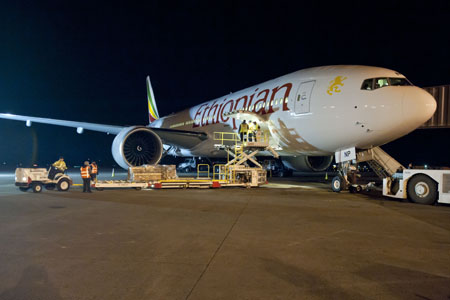
    SEATTLE, Jan. 27, 2011 — For the second time in less than two months, Boeing ( Ethiopian Airlines and Seattle Anesthesia Outreach (SAO) have partnered to deliver medical equipment to Black Lion Hospital, Ethiopia’s largest hospital. The first consignment was delivered in December 2010.

    Approximately 2,700 pounds (1.2 metric tons) of medical supplies were loaded into the cargo hold of a new Boeing 777-200LR (longer range) delivered to Ethiopian Airlines on Jan. 26. Some of the supplies, such as electrical converters and other power items, supplement the anesthesia equipment transported in December.

    “Through collaborative efforts such as this, Boeing is able to help bring relief to people around the world. Black Lion Hospital provides free medical care to the poor and this equipment will improve capabilities there,” said Liz Warman, director of Boeing Global Corporate Citizenship for the Northwest region.

    The supplies will prove vital when a group of 28 Seattle doctors, nurses and technicians travel to Ethiopia next month as part of ongoing humanitarian support to that region.

    Since 1992, Boeing and airline partners as well as non-profit partners in the Humanitarian Delivery Flights (HDF) program have collaborated on many humanitarian missions.
    Ethiopian Airlines is committed to support worthy social activities, which are designed to help build sustainable livelihoods for individuals and the community.

    To include the featured image in your Twitter Card, please tap or click their icon a second time.