|

New Gulfstream G650 Completes 1st Flight

Similar Posts

  • |

    Boeing Production Rate Increase

    SEATTLE, May 17 — Boeing (NYSE: BA) today announced that it will increase production rates on the Next-Generation 737 program to 34 airplanes per month in early 2012. The planned rate increase is aimed at satisfying continued strong demand for the Next-Generation 737. In addition, the company continues to study further potential 737 rate increases, given continued customer demand.

    “With over 5,200 sold to date, the Next-Generation 737 is the workhorse in our customers’ fleets around the world,” said Boeing Commercial Airplanes President and CEO Jim Albaugh. “Even through the global economic downturn, our diverse 737 backlog has remained very strong. Increasing the 737 production rate is the right thing to do to meet the growth and fleet replacement needs of our customers.”
    The current production rate on the 737 program is 31.5 airplanes per month. Suppliers for the 737 program are prepared to support the rate increase. The production rate decision is not expected to have a material impact on 2010 financial results.

    “The global economy continues to recover this year and we believe that airlines will return to profitability in 2011,” said Randy Tinseth, vice president of Marketing for Boeing Commercial Airplanes. “We believe that there will be an increased demand for airplanes – especially in the market served by the Next-Generation 737 – in 2012 and beyond.”
    With more than 2,000 unfilled orders from more than 80 customers around the world, the Next-Generation 737 is the newest and most technologically advanced airplane in its class. Airfinance Journal’s investors’ and operators’ poll consistently ranks the Next-Generation 737 as the most preferred airplane in its class due to its wide market base, superior efficiency and lowest operating costs.

    Forward-Looking Information is Subject to Risk and Uncertainty
    Certain statements in this report may be “forward-looking” within the meaning of the Private Securities Litigation Reform Act of 1995. Words such as “expects,” “intends,” “plans,” “projects,” “believes,” “estimates,” “targets,” “anticipates,” and similar expressions are used to identify these forward-looking statements. Forward-looking statements are based upon assumptions about future events that may not prove to be accurate. These statements are not guarantees of future performance and involve risks, uncertainties and assumptions that are difficult to predict. Actual outcomes and results may differ materially from what is expressed or forecasted in these forward-looking statements. As a result, these statements speak to events only as of the date they are made and we undertake no obligation to publicly update or revise any forward-looking statements, whether as a result of new information, future events or otherwise, except as required by federal securities laws. Specific factors that could cause actual results to differ materially from forward-looking statements include, but are not limited to, statements we make regarding our guidance relating to future financial and operating performance, the effect of economic conditions in the United States and globally, and general industry conditions as they may impact us or our customers, as well as the other important factors disclosed previously and from time to time in our other filings with the Securities and Exchange Commission.

    To include the featured image in your Twitter Card, please tap or click their icon a second time.
  • |

    Aeromar and Continental Airlines to Start Codeshare Flights

    CHICAGO and MEXICO CITY, Jan. 25, 2011
    Aeromar and Continental Airlines, a wholly-owned subsidiary of United Continental Holdings, Inc. (NYSE: UAL) and a Star Alliance member, today announced that they will begin codeshare cooperation on routes within Mexico.

    Effective Feb. 1, 2011 Continental will initially place its code on Aeromar-operated flights between Mexico City and 13 destinations in Mexico. The codeshare builds on frequent-flyer cooperation launched in August 2010 that permits Continental OnePass members to accrue and redeem miles on all Aeromar-operated flights. In addition, Continental international first- and business-class passengers, Presidents Club members and Star Alliance Gold customers may access Aeromar’s Salon Diamante lounge in Mexico City.

    “The expansion of our partnership with Continental Airlines via codesharing will continue to broaden our leading joint market presence to better serve our customers, especially at a time when Aeromar is phasing in its first regional jets and further developing its route network within Mexico,” said Ami Lindenberg, Aeromar president.

    “We are pleased to expand our cooperation with Aeromar, which complements our extensive service to Mexico and offers new options to our customers,” said Jim Compton, executive VP and chief revenue officer of United Continental Holdings, Inc.

    About Aeromar

    Founded in 1987, Aeromar is Mexico’s most experienced airline. From its main operations base at Mexico City’s International Airport Terminal 2, Aeromar currently covers a network of 21 destinations in Mexico, as well as San Antonio, Texas, in the U.S.A. It performs over 100 average daily flights with a fleet of ATR-42 turboprop and CRJ-200 jet complying with the IOSA certification for the airline industry’s highest operational and safety audited standards established by IATA.

    Aeromar is a highly customer-focused airline, featuring the most convenient schedules and amenities for the business and leisure traveler, such as the “Salon Diamante” executive lounges, which are available at the Aguascalientes, Colima, Jalapa, Mexico City and Tepic airports. All-inclusive vacation packages, VIP charter flights and “FastPaq” courier and freight are among some of Aeromar’s additional products and services. For further information please visit us on the web at www.aeromar.us.

    To include the featured image in your Twitter Card, please tap or click their icon a second time.
  • |

    Airline Teamsters Outreach

    United Airlines (UA) mechanics represented by the Teamsters Union are joining Teamster organizers and American Airlines (AA) mechanics in Tulsa today for an outreach program in support of a campaign by AA mechanics to change their current union representation.

    Dozens of mechanics and related employees from both airlines gathered at a local hotel this morning near Tulsa International Airport where American Airlines has its largest maintenance facility. The workers are meeting with Teamster representatives in preparation for an afternoon of door-to-door outreach to AA mechanics throughout the Tulsa area.

    “This is part of a major push by AA mechanics and related workers who are unhappy with their current union representation and want to reach out to their coworkers to build support for a new union,” said Chris Moore, a representative of the Teamsters Airline Division. “With all the difficulties that American is going through right now, we believe these workers want the strong representative that the Teamsters provide to thousands of other aviation mechanics throughout the industry.”

    Teamster organizers conducting house visits with AA workers will be accompanied by UA mechanics who organized with the Teamsters back in 2008 and ratified a strong contract last year.

    “Becoming Teamsters was the best choice we made at United and I think we have a lot to share with AA mechanics,” said Rich Petrovsky, a UA mechanic in San Francisco, Calif. and a business agent with Teamsters Local 986. “American Airlines is threatening mass layoffs and outsourcing maintenance work so it can get out of bankruptcy and, as we saw first hand at United, the Teamsters are the only union with a proven record when it comes to fighting outsourcing.”

    Read more at the International Brotherhood of Teamsters

    To include the featured image in your Twitter Card, please tap or click their icon a second time.
  • Opportunity for a Global Framework on Environment – IATA Urges Agreement at ICAO Assembly

    Montreal – The International Air Transport Association (IATA) urged the governments of the world to reach an agreement on a global framework to manage international aviation’s emissions at the 37th Assembly of the International Civil Aviation Organization (ICAO).

    “The biggest challenge for this Assembly is to reach an agreement on a global solution to manage emissions from international aviation. A united aviation industry of airlines, airports, air navigation service providers, manufacturers and general aviation has made ambitious commitments to cap and eventually cut its emissions. To be successful, governments must endorse these commitments in a globally agreed framework,” said Giovanni Bisignani, IATA’s Director General and CEO, to a group of delegates attending the ICAO Assembly in Montreal.

    The aviation industry is united behind three targets: (1) a 1.5% average annual improvement in fuel efficiency to 2020, (2) capping net emissions from 2020 with carbon-neutral growth and (3) cutting emission in half by 2050 compared to 2005. “No other industrial sector has made such ambitious global commitments. Even UN Secretary General Ban Ki-moon commended the aviation industry as a role model for other industries to follow,” said Bisignani.

    Bisignani highlighted several key elements which could help facilitate global consensus:

    • Place and Process: The Executive Secretary of the United Nations Framework Convention on Climate Change (UNFCCC), Christiana Figueres, confirmed that ICAO is the forum for dealing with emissions from international aviation and that any agreement at ICAO would not, in any way, impact the position of any state on non-aviation issues discussed in the UNFCCC process.
    • Developing Nations: Even within a global agreement, ICAO has a track record of accommodating the needs of developing states. For example, ICAO’s global framework for noise reduction included extended timelines for developing states.
    • Growth: The industry’s global solution will facilitate growth and the economic benefits it brings even while reducing emissions. This will be achieved through the industry’s four- pillar strategy of investments in technology, more efficient infrastructure, more effective operations and globally coordinated positive economic measures.

    “Major blockers are being removed. The industry is ready. And most governments agree that a global framework is needed. There are still some hurdles to overcome, but we are moving in the right direction,” said Bisignani who noted that important regional groupings and individual states have indicated their wish for an agreement.

    The planned inclusion of aviation into the European emissions trading scheme in 2012 has helped to focus governments on the urgency of a global solution. “If this Assembly ends without an agreement, the next opportunity is 2013. In the meantime the industry would be faced with a growing patchwork of conflicting and overlapping measures. For example, against global opposition, Europe would have to try to move forward with its unilateral emissions trading scheme,” said Bisignani.

    “No government or industry player will want to face the consequences of such a development. It would lead to a breakdown of the global standards on which global aviation was built, a patchwork of uncoordinated taxes and schemes, strained bilateral relations and serious challenges on sovereignty issues,” said Bisignani.

    “The livelihoods of 32 million people and $3.5 trillion in economic activity depend on the success of global aviation. As leaders, everyone attending this Assembly has a great responsibility to continue building a safe, secure, efficient and sustainable future for this wonderful industry. The industry is committed to supporting governments in reaching agreement on a responsible solution for aviation and the environment. I am optimistic that we will be successful,” said Bisignani.

    The ICAO Assembly will discuss environmental issues in its Executive Committee on Thursday 30 September with conclusions to be reported by the Assembly’s conclusion on 8 October.

    To include the featured image in your Twitter Card, please tap or click their icon a second time.
  • |

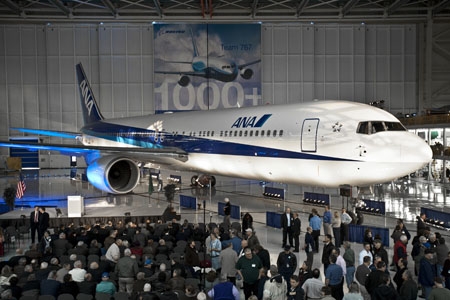
    Boeing Marks a Milestone With Rollout of 1,000th 767


    EVERETT, Wash., Feb. 2, 2011 /PRNewswire/ — Boeing (NYSE: BA) marked a proud moment in the company’s history today at a ceremonial rollout of the 1,000th 767 airplane. Hundreds of current employees, joined by Boeing retirees who worked on the first 767, gathered to celebrate the occasion at the Everett, Wash., factory.

    “It was great to see so many people here today – the engineers, the technicians, the machinists – who have made the 767 the wonderful airplane it is,” said Jim Albaugh, president and CEO of Boeing Commercial Airplanes. “As we salute the 1,000th 767, the next 767 is already being built in a new bay where we can produce airplanes much more efficiently for years to come. We hope many of the new 767s will become U.S. Air Force tankers built right here.”

    The 1,000th airplane is a 767-300ER (extended range) passenger model for ANA (All Nippon Airways) and was the final 767 to complete assembly on the current production line. Final production work already is underway on the 1,001 unit in a new, smaller bay that repositions the production line toward a leaner, more efficient operation.

    Today’s milestone is a chance for the 767 family to celebrate its past, present and future showcased in this video: http://bit.ly/eMZIVv.
    Boeing has offered the 767 as the platform for its NewGen Tanker if it wins the U.S. Air Force KC-X Tanker competition. A decision on the contract award is expected early this year.

    The 767 family is a family of clean, quiet, fuel-efficient airplanes that provide maximum market versatility in the 200- to 300-seat market. The 767 family includes three passenger models – the 767-200ER, 767-300ER and 767-400ER – and a medium-widebody freighter, which is based on the 767-300ER fuselage.

    To include the featured image in your Twitter Card, please tap or click their icon a second time.