|

Press Release – FAA Announces Record Number of Laser Events in 2010

Similar Posts

  • |

    Boeing Statement Regarding USDA-FAA Partnership on Aviation Biofuels

    CHICAGO, Oct. 21 Boeing Vice President, Environment and Aviation Policy, Billy M Glover, issued the following statement in the wake of today’s announcement by the U.S. Department of Agriculture and the Federal Aviation Administration that the two agencies have agreed to work together to bring sustainable biofuels into production for the aviation industry.

    “Today’s announcement is welcome news for the commercial aviation industry, which sees sustainable biofuels as a key element of its plan to lower its carbon emissions. Through test flights with a number of our customers, we have proven that fuels made from plant matter and algae can power jet aircraft safely and efficiently, and we look forward in the months ahead to the approval of these fuels for commercial use. The challenge then will be to prime the production pump, and bring biofuels to an attractive price point for airlines.

    Boeing is currently working with the USDA and the Air Transport Association on the Farm-to-Fly initiative, which seeks to encourage the production of sustainable aviation biofuels through U.S. agricultural policy. The USDA-FAA partnership will further help in that regard. We applaud their efforts and look forward to working with them to commercialize biofuels that can help the aviation industry meet its aggressive carbon reduction goals.”

    To include the featured image in your Twitter Card, please tap or click their icon a second time.
  • |

    FAA Solicits Bids for NextGen Contracts Worth $7 Billion

    The FAA is soliciting bids from companies interested in competing for NextGen support contracts with an approximate combined value of $7 billion, the largest award in the agency’s history. Under the umbrella awards, called System Engineering 2020 (SE2020), the FAA will award as many as five separate contracts for research and development and systems engineering work that will help the agency deliver NextGen.
    The SE2020 contracts will be awarded to teams of companies, up to three of which will perform research and development work and two of which will perform systems engineering work. This work will complement and enhance major NextGen initiatives already under way, such as Automatic Dependent Surveillance – Broadcast, System Wide Information Management and Data Communications. Contract teams will focus on a series of operational capabilities, including Trajectory Based Operations, Collaborative Air Traffic Management and Reduced Weather Impact. The goal is to achieve early NextGen successes to improve safety and bring greater efficiencies to the nation’s airspace system.

    The team concept is designed to create competitive synergy within each group, driving innovation so that each team comes up with the best possible product. The FAA also structured the contracts, using market survey data, to encourage bids from teams that will include small companies as prime contractors as well as subcontractors. The agency is looking for the best and the brightest, regardless of size.

    Five-year contracts will be awarded next summer, with subsequent three- and two-year options

    To include the featured image in your Twitter Card, please tap or click their icon a second time.
  • |

    Letter to Chairmen Oberstar and Costello and Ranking Members Mica and Petri Regarding FAA’s Efforts to Implement RTCA Task Force Recommendations for NextGen

    Summary

    On December 21, we (DOT OIG) issued a letter to the Chairmen and Ranking Members of the House Transportation and Infrastructure Committee and Aviation Subcommittee regarding FAA’s efforts to implement the Next Generation Air Transportation System (NextGen). Last September, a RTCA task force recommended mid-term actions for advancing NextGen. The task force findings and recommendations are consistent with our work, covering areas such as maximizing the use of equipment already on aircraft and new procedures, enhancing information sharing among FAA and airspace users, and reducing delays. We are reporting our results thus far with respect to (1) FAA’s progress in responding to the task force report, (2) potential barriers to implementing the task force recommendations and realizing benefits, and (3) ongoing problems with a key modernization effort that could materially affect the pace of NextGen. In summary, FAA is incorporating RTCA’s recommendations in its NextGen plans but has not specified how it will execute key initiatives for addressing delays in major metropolitan areas. For example, FAA is still working to establish definitive milestones to integrate new airspace designs and procedures at metroplex locations. FAA also has yet to establish a mechanism for integrating metroplex initiatives with programs to better manage airport surface operations. At the same time, FAA faces several organizational, policy, logistical, and training challenges that could impede NextGen implementation in the midterm; these include working across diverse agency lines of business and establishing policies on data sharing. FAA must also resolve implementation problems with critical modernization projects, such as En Route Automation Modernization (ERAM)–a $2.1 billion NextGen tool for processing flight data–which has experienced software problems and delays at key sites.

    To include the featured image in your Twitter Card, please tap or click their icon a second time.
  • |

    CASA Media Release – Moree aerodrome flight safety checks

    Special flight safety checks are being carried out at Moree aerodrome next week.

    There will be a series of low-level flights to make sure flight paths at the aerodrome continue to operate safely.

    A twin-engine Cessna Conquest aircraft will be used to conduct the safety checks within an area up to 35 kilometres from the aerodrome.

    The two pilots flying the aircraft will ensure navigation aids are operational and not suffering interference, as well as looking for any new obstacles that could be a danger to aviation safety.

    The Civil Aviation Safety Authority requires these checks to be carried out every three years to maintain a high level of air safety at Moree aerodrome.

    Low-level flying is an essential part of the safety exercise, with aircraft down as low as several hundred feet at times.

    Local residents may notice an uncommon flying pattern, but this is to make sure obstacles are accurately marked on charts and no new obstacles exist. Obstacles can be towers, trees, masts or buildings that can be a danger to aircraft.

    The checks are scheduled to be carried out on Wednesday 19 January 2011 and Thursday 20 January.

    If poor weather or other factors do not allow the safety checks to go ahead on the planned days they will be carried out as soon as possible.

    CASA has contracted the operation of the special check flights out to Radiola Aerospace Pty Ltd – a company with wide international expertise in these specialist operations

    To include the featured image in your Twitter Card, please tap or click their icon a second time.
  • NTSB TRANSFERS CONTROL OF INVESTIGATION OF AUSTIN PLANE CRASH TO FBI

    NTSB Advisory : NTSB NTSB TRANSFERS CONTROL OF INVESTIGATION OF AUSTIN PLANE CRASH TO FBI

    The National Transportation Safety Board has transferred control of the investigation into yesterday’s crash of a small aircraft into an office building in Austin, Texas to the Federal Bureau of Investigation.

    On the morning of February 18, 2010, a Piper PA-28 struck a 7-story building housing federal offices in Austin, Texas. The NTSB immediately initiated an investigation and dispatched a team of investigators to the scene. Information developed about the circumstances of the crash since that time point toward an intentional act rather than an accident.

    Last night, NTSB Chairman Deborah A.P. Hersman consulted with the United States Attorney General, Eric Holder. They agreed that given the apparent criminal nature of the event, the primacy of this investigation should be transferred to the FBI. NTSB investigators will remain at the scene to assist the FBI.

    To include the featured image in your Twitter Card, please tap or click their icon a second time.
  • |

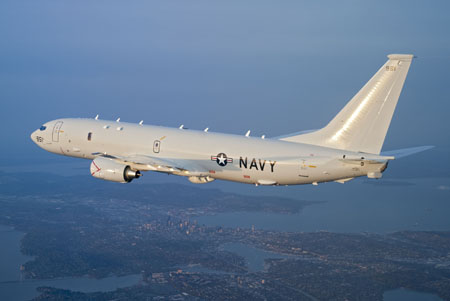
    Boeing Receives $1.6B Contract for P-8A Poseidon Low-Rate Initial Production


    SEATTLE, Jan. 25, 2011 — Boeing [NYSE: BA] on Jan. 21 received a $1.6 billion contract from the U.S. Navy for low-rate initial production (LRIP) of the P-8A Poseidon aircraft. The LRIP 1 contract is for six P-8A aircraft, spares, logistics and training devices.

    The Navy plans to purchase 117 of the Boeing 737-based P-8A anti-submarine warfare, anti-surface warfare, intelligence, surveillance and reconnaissance aircraft to replace its P-3 fleet. Initial operational capability is planned for 2013.

    “Providing these production aircraft to the Navy fleet on schedule is our No. 1 goal,” said Chuck Dabundo, Boeing vice president and P-8 program manager. “This is an exciting day for Boeing and the Navy and a testament to the P-8 team’s hard work and determination.”

    “This first production contract represents a significant commitment by the U.S. Navy to recapitalize its force of long-range maritime patrol and reconnaissance aircraft,” said Capt. Leon Bacon, P-8A deputy program manager for the Navy. “Ensuring that this capability arrives on schedule and within budget remains our primary objective.”

    Boeing will begin final assembly of the first LRIP aircraft at its Renton, Wash., facility this summer. The Poseidon team is using a first-in-industry in-line production process that draws on Boeing’s Next-Generation 737 production system. All P-8A-unique aircraft modifications will be made in sequence during fabrication and assembly.

    “The in-line approach we’ve incorporated on this military derivative aircraft is already paying the dividends we expected by helping us improve efficiency and reduce costs,” said John Pricco, Boeing Commercial Airplanes P-8 program manager.

    As part of the U.S. Navy System Development and Demonstration contract awarded to Boeing in 2004, the team is building and testing six flight-test and two ground-test aircraft. The first three flight-test planes, T1, T2 and T3, are completing testing at Naval Air Station Patuxent River, Md. The program’s static test plane, S1, recently completed its test program, which began in May 2009; S2, the fatigue test plane, will begin testing later this year.

    A derivative of the Next-Generation 737-800, the Poseidon is built by a Boeing-led industry team that includes CFM International, Northrop Grumman, Raytheon, Spirit AeroSystems, BAE Systems and GE Aviation.

    To include the featured image in your Twitter Card, please tap or click their icon a second time.