Press Release: MEDIA INVITED TO INTERVIEW LAUNCH ABORT SYSTEM MANAGER

Similar Posts

  • | |

    Lion Air Celebrates 10-Year Anniversary With Two New 737-900ERs

    SEATTLE, July 1 e-FirstCall/ — Coinciding with the 10th anniversary of Lion Air, Boeing (NYSE: BA) today delivered two Next-Generation 737-900ERs (extended range) to the Jakarta-based carrier. Lion Air, which operates an all-Boeing fleet, was the launch customer of the 737-900ER and is currently the largest operator of the airplane. With today’s deliveries, the Lion Air fleet consists of 36 737-900ERs and two 747-400s. In addition, Lion Air is a launch customer for the new 737 Boeing Sky Interior.
    Lion Air plans to carry 20 million passengers this year to destinations within Indonesia as well as to Malaysia, Singapore, Vietnam and Saudi Arabia. The carrier is based at Soekarno-Hatta International Airport in Jakarta, Indonesia.

    To include the featured image in your Twitter Card, please tap or click their icon a second time.
  • |

    2.5 Billion Gallons of Jet Fuel Saved and Counting…

    SEATTLE, Feb. 9, 2011 /PRNewswire/ — Aviation Partners, Inc. and Aviation Partners Boeing announced today that as of February 9, 2011 at 4:47AM P.S.T. their unique Blended Winglet* Technology has saved the world’s airlines and private jet operators 2.5 Billion gallons of jet fuel, or about 5 Billion U.S. dollars. This represents a global reduction in CO2 emissions of almost 26 Million tons. Aviation Partners Winglet Technology is now flying on more than 4,000 airplanes and 21 different models.

    Joe Clark, Chairman and CEO of Aviation Partners, and John Reimers, CEO of Aviation Partners Boeing, both agreed the fuel savings are significant and this number will climb exponentially to more than 7 Billion gallons within the next five years.

    Clark said, “We are very proud of this achievement and excited that we are ahead of the curve in energy conservation.” This technology is being delivered to the world’s airlines and private jet operators at a rate of over 500 aircraft per year.

    What’s unique about Aviation Partners Blended Winglet Technology is not only available for existing airplanes but new production as well. Aviation Partners Boeing has retrofitted roughly two thousand in-service airplanes to make them more efficient in today’s environment.

    We are doing our part in a changing world.

    Seattle, Washington based Aviation Partners, Inc. (API) is the world leader in advanced Blended Winglet Technology. Aviation Partners Boeing is a joint venture between Aviation Partners, Inc. and The Boeing Company. For more information go to www.aviationpartners.com or www.aviationpartnersboeing.com.

    To include the featured image in your Twitter Card, please tap or click their icon a second time.
  • |

    NTSB FOR IMMEDIATE RELEASE: March 11, 2009 SB-09-11

    FOR IMMEDIATE RELEASE: March 11, 2009 SB-09-11

    NTSB ISSUES URGENT SAFETY RECOMMENDATION TO ADDRESS ENGINE THRUST ROLLBACK EVENTS ON B-777 AIRCRAFT

    Washington, DC – Following two engine thrust rollback events on Boeing 777 aircraft powered by Rolls-Royce engines, the National Transportation Safety Board issued an urgent safety recommendation today calling for the redesign of a Rolls- Royce engine component. The Safety Board also recommended that, after the redesign is completed, the new system be installed on all affected B-777 airplanes at the next maintenance check or within six months.

    These recommendations are being issued in response to the findings in two investigations – an accident and an incident – involving engine thrust rollbacks on Boeing 777-200ER airplanes powered by Rolls-Royce RB211 Trent 800 Series engines. In both cases a build-up of ice (from water normally present in all jet fuel) on the fuel/oil heat exchanger (FOHE) restricted the flow of fuel to the engine, resulting in an uncommanded engine rollback.

    The first event, which is still being investigated by the UK’s Air Accidents Investigation Branch (AAIB), occurred on January 17, 2008, when a Boeing 777 experienced a dual engine rollback on final approach and crashed short of the runway at London’s Heathrow International Airport. One passenger was seriously injured, eight passengers and four of the flight crew sustained minor injuries; the airplane was substantially damaged.

    The second event occurred on November 26, 2008, when a Delta Air Lines Boeing 777 experienced a single engine rollback during cruise flight over Montana while en route from Shanghai to Atlanta. Normal operations resumed after the flight crew followed Boeing’s published procedure to recover engine performance; the airplane landed safely in Atlanta.

    Testing in support of the UK accident investigation led Boeing to develop procedures to help prevent ice accumulation, and to recover thrust in cases of ice blockage. As more information from the Delta rollback event was developed, Boeing modified the procedures, which became the basis of an airworthiness directive issued by the Federal Aviation Administration.

    While the procedures may reduce the risk of a rollback in one or both engines due to FOHE ice blockage, they add complexity to flight crew operations, and the level of risk reduction is not well established. And because the recovery procedure requires a descent, the aircraft may be exposed to other risks such as rising terrain or hazardous weather, or the inability to achieve maximum thrust during a critical phase of flight, such as during a missed approach.

    Because of these hazards, the Safety Board has determined that the only acceptable solution to this safety vulnerability is a redesigned FOHE that would eliminate the potential of ice build-up. On February 23, 2009, Rolls-Royce indicated that a redesign of the FOHE was underway, and that they anticipated the redesign to be tested, certified and ready for installation within 12 months.

    “With two of these rollback events occurring within a year, we believe that there is a high probability of something similar happening again,” said NTSB Acting Chairman Mark V. Rosenker. “We are encouraged to see that Rolls-Royce is already working on a redesign, and we are confident that with the FAA and EASA (European Aviation Safety Agency) overseeing the process, this flight safety issue – even one as complex as this – will be successfully and expeditiously resolved.”

    The NTSB has made the following two recommendations to both the Federal Aviation Administration and the European Aviation Safety Agency:

    Require that Rolls-Royce redesign the RB211 Trent 800 series engine fuel/oil heat exchanger (FOHE) such that ice accumulation on the face of the FOHE will not restrict fuel flow to the extent that the ability to achieve commanded thrust is reduced.
    Once the fuel/oil heat exchanger (FOHE) is redesigned and approved by certification authorities, require that operators of Boeing 777-200 airplanes powered by Rolls Royce RB211 Trent 800 series engines install the redesigned FOHE at the next scheduled maintenance opportunity or within 6 months after the revised FOHE design has been certificated, whichever comes first.

    The NTSB and AAIB will continue to work together closely on both of the rollback events as each of the investigations move forward.

    src: http://www.ntsb.gov/Pressrel/2009/090311.html

    To include the featured image in your Twitter Card, please tap or click their icon a second time.
  • | | | | |

    LAO Airlines Crash Update

    At last the flight data recorder from the crash of a Lao Airlines turboprop ATR-72 has been recovered from the Mekong river. The cockpit voice recorder has been located also but has not yet been retrieved due to the strong currents and muddy water of the Mekong.

    The flight data recorder tracks technical data: altitude, speed and route.

    A cockpit voice recorder records cockpit conversation. The cockpit voice recorder has not been retrieved, though news releases to the contrary have been circulated.

    Lao Airlines most recent press release:

    Read more:

    Lao Airlines Victims Recovered in Mekong River

    LAO Airlines Crash Update: Victims Named

    Painful Search Continues in Laos

    To include the featured image in your Twitter Card, please tap or click their icon a second time.
  • |

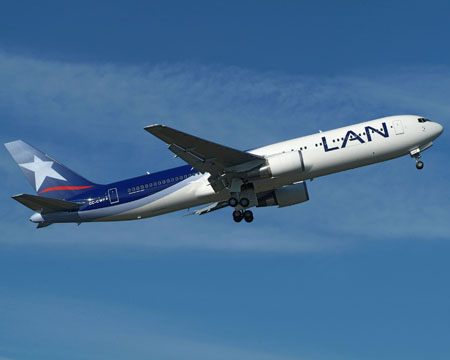
    Boeing, LAN Airlines Announce Order for Three 767s

    Additional 767-300ER airplanes part of the airline’s fleet expansion plans

    EVERETT, Wash., Feb. 18, 2011 /PRNewswire/ — Boeing (NYSE: BA) announced today that Chile’s LAN Airlines ordered three additional 767-300ER airplanes valued at $493 million at today’s list prices. Today’s order brings the total number of 767s ordered from LAN to 33.

    “This order for additional 767s builds on the long-standing relationship between Boeing and LAN,” said Marlin Dailey, vice president of Sales & Marketing for Boeing Commercial Airplanes. “LAN is one of the world’s premier airlines and we are happy to help them expand and grow their long-haul fleet.”

    The 767 family of airplanes is sized between the single-aisle 737 Next-Generation and the twin-aisle 777. As one of the most fuel-efficient airplanes in operation today, the 767 offers improved environmental performance and operating economics over competing jetliners.

    “The versatility, comfort, range and increased payload capabilities continue to make the 767 a staple in the fleets of today’s leading airlines,” said Dailey. “The 767 has benefited from years of technological improvements for greater efficiency and passenger comfort.”

    LAN’s fleet currently consists of 28 767-300ERs and 11 767-300 freighters. The airline has used Boeing’s product advancements to drive operational efficiencies into their long-haul fleet and increase passenger comfort including the passenger-pleasing Boeing Signature Interior.

    The Boeing 767 family is a complete family of clean, quiet, fuel-efficient airplanes that provide maximum market versatility in the 200- to 300-seat market. The Boeing 767 family includes three passenger models — the 767-200ER, 767-300ER and 767-400ER — and a medium-widebody freighter, which is based on the 767-300ER fuselage.

    To include the featured image in your Twitter Card, please tap or click their icon a second time.
  • | |

    Gulfstream International Airlines Fined

    Gulfstream International Airlines is being fined by the FAA for improper scheduling of flight crew duty, installation of unapproved air conditioner compressors and improperly maintained vent blowers on the airline’s fleet of 27 BE-1900-D aircraft.

    See the press release:

    Washington Headquarters Press Release
    For Immediate Release

    May 21, 2009
    Contact: Laura Brown
    Phone: (202) 267-3883

    FAA Proposes $1.3 Million Civil Penalty for Gulfstream International Airlines

    WASHINGTON, D.C. — The Federal Aviation Administration (FAA) has proposed a $1.3 million civil penalty from Florida-based Gulfstream International Airlines, Inc. for violations of the Federal Aviation Regulations.

    The alleged violations include improper scheduling of flight crew duty time, and the installation of unapproved air conditioner compressors and improperly maintained vent blowers on the airline’s fleet of 27 BE-1900-D aircraft.

    An FAA review of the airline’s electronic record-keeping system for tracking crew duty and rest time revealed that Gulfstream International did not accurately input the proper data from its manually generated hard-copy aircraft logbook records into the electronic system. The discrepancies resulted in scheduling crew members in excess of daily and weekly flight time limitations.

    During a June 2008 inspection, the FAA determined that the airline had installed unapproved automotive air conditioner compressors on its aircraft between September 2006 and May 2008. Following the FAA inspection, the airline grounded all of the affected aircraft and replaced the units with approved aircraft air conditioner compressors.

    In the course of a July 2008 inspection of Gulfstream International avionics and component shops in Fort Lauderdale, the FAA discovered that the airline had installed improperly maintained vent blowers on six planes between January 2008 and June 2008. Following that inspection, the airline replaced the blowers with properly maintained units.

    Gulfstream International Airlines has 30 days from the receipt of the civil penalty letter to respond to the FAA.


    #
    (end of release)

    George’s Point of View

    Gulfstream is a former employer of the Captain Marvin Renslow of the ill-fated Continental Connection 3407 flight. If Gulfstream had kept proper records, trained and maintained according to accepted protocol, the Buffalo NY tragedy may never have happened.

    To include the featured image in your Twitter Card, please tap or click their icon a second time.