|

FAA Proposes $580,000 Civil Penalty Against Hillsboro Aviation

Similar Posts

  • |

    NASA Data and New Techniques Yield Detailed Views of Solar Storms

    WASHINGTON — NASA spacecraft observations and new data processing techniques are giving scientists better insight into the evolution and development of solar storms that can damage satellites, disrupt communications and cause power grid failures on Earth.

    The solar storms, called Coronal Mass Ejections (CMEs), are being observed from NASA’s twin Solar Terrestrial Relations Observatory, or STEREO, spacecraft launched in 2006. The duo represents a key component within a fleet of NASA spacecraft that enhance the capability to predict solar storms.

    Previous spacecraft imagery did not clearly show the structure of a solar disturbance as it traveled toward Earth. As a result, forecasters had to estimate when storms would arrive without knowing the details of how they evolve and grow. New processing techniques used on STEREO data allow scientists to see how solar eruptions develop into space storms at the Earth.

    “The clarity these new images provide will improve the observational inputs into space weather models for better forecasting,” said Lika Guhathakurta, STEREO program scientist at NASA Headquarters in Washington.

    CMEs are billion-ton clouds of solar plasma launched by the same sun explosions that spark solar flares. When they sweep past Earth, they can cause auroras, radiation storms that can disrupt sensitive electronics on satellites, and in extreme cases, power outages. Better tracking of these clouds and the ability to predict their arrival is an important part of space weather forecasting.

    Newly released images from cameras on the STEREO-A spacecraft reveal detailed features in a large Earth-directed CME in late 2008, connecting the original magnetized structure in the sun’s corona to the intricate anatomy of the interplanetary storm as it hit the planet three days later. When the data were collected, the spacecraft was more than 65 million miles away from Earth.

    The spacecraft’s wide-angle cameras captured the images. They detect ordinary sunlight scattered by free-floating electrons in plasma clouds. When these clouds in CMEs leave the sun, they are bright and easy to see. However, visibility is quickly reduced, as the clouds expand into the void. The clouds are about one thousand times fainter than the Milky Way, which makes direct imaging of them difficult. That also has limited our understanding of the connection between solar storms and the coronal structures that cause them.

    “Separating these faint signals from the star field behind them proved especially challenging, but it paid off,” said Craig DeForest, scientist at the Southwest Research Institute in Boulder, Colo. and lead author of an Astrophysical Journal article released online yesterday. “We have been drawing pictures of structures like these for several decades. Now that we can see them so far from the sun, we find there is still a lot to learn.”

    These observations can pinpoint not only the arrival time of the CME, but also its mass. The brightness of the cloud enabled researchers to calculate the cloud’s gas density throughout the structure, and compare it to direct measurements by other NASA spacecraft. When this technique is applied to future storms, forecasters will be able to say with confidence whether Earth is about to be hit by a small or large cloud, and where on the sun the material originated.

    STEREO’s two observatories orbit the sun, one ahead of Earth and one behind. They will continue to move apart over time. STEREO is the third mission in NASA’s Solar Terrestrial Probes program. The program seeks to understand the fundamental physical processes of the space environment from the sun to Earth and other planets.

    The STEREO spacecraft were built and are operated for NASA by the Johns Hopkins University Applied Physics Laboratory in Laurel, Md. NASA’s Goddard Space Flight Center in Greenbelt, Md., manages the mission, instruments and science center. The STEREO instruments were designed and built by scientific institutions in the U.S., UK, France, Germany, Belgium, Netherlands, and Switzerland.

    To include the featured image in your Twitter Card, please tap or click their icon a second time.
  • |

    Boeing Press Release: Boeing Completes Acquisition of Narus

    ST. LOUIS, July 29, 2010 — Boeing today announced it has completed its acquisition of Narus, a leading provider of real-time network traffic and analytics software used to protect against cyber attacks and persistent threats aimed at large Internet Protocol networks.

    Narus, headquartered in Sunnyvale, Calif., will operate within Boeing’s Network & Space Systems business as a wholly owned subsidiary.
    Terms of the transaction, announced on July 7, are not being disclosed.
    A unit of The Boeing Company, Boeing Defense, Space & Security is one of the world’s largest defense, space and security businesses specializing in innovative and capabilities-driven customer solutions, and the world’s largest and most versatile manufacturer of military aircraft. Headquartered in St. Louis, Boeing Defense, Space & Security is a $34 billion business with 68,000 employees worldwide.

    To include the featured image in your Twitter Card, please tap or click their icon a second time.
  • |

    PR: FAA Proposal of $206,550 Penalty Against Martinaire Aviation

    The Federal Aviation Administration (FAA) is proposing a $206,550 civil penalty against Martinaire Aviation, of Addison, Texas, for violating U.S. Department of Transportation Hazardous Materials Regulations.

    The FAA conducted a comprehensive hazardous materials inspection at the company’s headquarters on July 8, 2011. As a result of that inspection, the FAA alleges the airline routinely failed to complete documents properly and comply with the requirements for notifying pilots in command about hazardous materials transported as cargo.

    The allegations involve 17 shipments of hazardous materials Martinaire accepted for transportation by air on 12 flights between April 1 and June 22, 2011. Martinaire is a scheduled air cargo and cargo charter company. The flights operated between various cities across the country.

    Martinaire has 30 days from the receipt of the FAA’s enforcement letter to respond to the Agency.

    To include the featured image in your Twitter Card, please tap or click their icon a second time.
  • |

    Letter to Chairmen Oberstar and Costello and Ranking Members Mica and Petri Regarding FAA’s Efforts to Implement RTCA Task Force Recommendations for NextGen

    Summary

    On December 21, we (DOT OIG) issued a letter to the Chairmen and Ranking Members of the House Transportation and Infrastructure Committee and Aviation Subcommittee regarding FAA’s efforts to implement the Next Generation Air Transportation System (NextGen). Last September, a RTCA task force recommended mid-term actions for advancing NextGen. The task force findings and recommendations are consistent with our work, covering areas such as maximizing the use of equipment already on aircraft and new procedures, enhancing information sharing among FAA and airspace users, and reducing delays. We are reporting our results thus far with respect to (1) FAA’s progress in responding to the task force report, (2) potential barriers to implementing the task force recommendations and realizing benefits, and (3) ongoing problems with a key modernization effort that could materially affect the pace of NextGen. In summary, FAA is incorporating RTCA’s recommendations in its NextGen plans but has not specified how it will execute key initiatives for addressing delays in major metropolitan areas. For example, FAA is still working to establish definitive milestones to integrate new airspace designs and procedures at metroplex locations. FAA also has yet to establish a mechanism for integrating metroplex initiatives with programs to better manage airport surface operations. At the same time, FAA faces several organizational, policy, logistical, and training challenges that could impede NextGen implementation in the midterm; these include working across diverse agency lines of business and establishing policies on data sharing. FAA must also resolve implementation problems with critical modernization projects, such as En Route Automation Modernization (ERAM)–a $2.1 billion NextGen tool for processing flight data–which has experienced software problems and delays at key sites.

    To include the featured image in your Twitter Card, please tap or click their icon a second time.
  • | | | | | | |

    Plane Crash Investigation Reveals Cause

    On April 29, we reported the National Air Cargo flight that crashed when it’s load shifted and the plane stalled. Federal investigators and Boeing experts went to Afghanistan to to assist in the investigation.

    On Jun 2nd 2013, the Ministry of Transport and Civil Aviation of Afghanistan investigation announced officially that it was the weight of three armored vehicles and two mine sweepers 80 tons––of shifting cargo that caused the plane to crash.

    The wiring in the back of the plane was cut by impact with the cargo, leaving the pilots helpless to control the plane.

    There were no survivors.

    As a result of the April Crash, on May 17, 2013 Boeing issued the following SAFO:

    To include the featured image in your Twitter Card, please tap or click their icon a second time.
  • |

    Employees Community Fund of Boeing Puget Sound Elects New Board Trustees


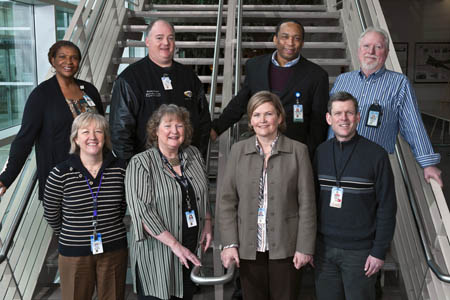
    SEATTLE, Jan. 17, 2011 /PRNewswire/ — The Employees Community Fund (ECF) of Boeing (NYSE: BA) Puget Sound has elected a new slate of board trustees for 2011.

    Pictured from left to right: (first row) Patty Rhodes, first-year trustee; Joyce Nugent, secretary; Andrea Hutchins, first-year trustee; and Bob Malone, treasurer; (second row) Sukari Mdogo, vice president; Robley Evans, president; Renard Burnett, first-year trustee; and Dave Hopkins, first-year trustee.
    Serving for two years, ECF trustees manage the day-to-day operations of the Puget Sound region fund. Since 1951, Boeing employees have donated more than $500 million to ECF Puget Sound, which celebrates its 60th birthday on Sept. 20. The companywide Boeing ECF is one of the world’s largest employee-owned and operated charitable funds.

    To include the featured image in your Twitter Card, please tap or click their icon a second time.