Boeing

  • |

    Boeing NewGen Tanker Win Would Bring 800 Jobs, $400 Million to Iowa

    DAVENPORT, Iowa, May 12, 2010 — The Boeing Company [NYSE: BA] today announced that Iowa will benefit from approximately 800 jobs and an estimated $40 million in annual economic impact if the Boeing NewGen Tanker is selected as the U.S. Air Force’s next aerial refueling aircraft.

    Rockwell Collins, based in Cedar Rapids and a Boeing first-tier supplier in Iowa, will provide the same advanced-flight-deck technology that is being supplied to the most advanced commercial airliner in existence — the Boeing 787 Dreamliner. In addition to the flight deck, Rockwell Collins also will provide Communication, Navigation, Surveillance/Air Traffic Management (CNS/ATM) software, aircraft networks and situational-awareness capability to support the tanker’s mission.

    “In keeping with my jobs strategy of attracting high-paying jobs with benefits to Iowa, I am very encouraged with Boeing’s plan and will remain engaged in this process as we move closer to a better future for every hardworking Iowa family,” said Gov. Chet Culver.

    “This project could have enormous impact on job creation in Iowa,” said U.S. Congressman David Loebsack. “The aerial refueling fleet is the foundation of every mission undertaken by our men and women in uniform and is a critical component of our national security. Iowa workers are among the best in the country, and I am proud of the role that they play in providing our brave troops with the equipment and resources they need to complete their missions safely. I would be proud for the next-generation tankers to be built by highly skilled Iowan innovators.”

    Boeing currently works with 57 suppliers/vendors across Iowa, resulting in an estimated $459 million in annual economic impact.

    The NewGen Tanker is a widebody, multi-mission aircraft based on the proven Boeing 767 commercial airplane and updated with the latest and most advanced technology. Capable of fulfilling the Air Force’s needs for transport of fuel, cargo, passengers and patients, the combat-ready NewGen Tanker is being offered as a replacement for 179 KC-135 aircraft. Boeing is writing a proposal to meet or exceed the 372 mandatory requirements described in the service’s final KC-X Request for Proposal released on Feb. 24. The Air Force is expected to award a contract later this year.

    The NewGen Tanker will be made with a low-risk approach to manufacturing that relies on existing Boeing facilities in Washington state and Kansas as well as U.S. suppliers throughout the nation, with decades of experience delivering dependable military tanker and derivative aircraft. Nationwide, the NewGen Tanker program will support approximately 50,000 total U.S. jobs with Boeing and more than 800 suppliers in more than 40 states.

    The Boeing NewGen Tanker also will be more cost-effective to own and operate than a larger, heavier tanker. It will save American taxpayers more than $10 billion in fuel costs over its 40-year service life because it burns 24 percent less fuel than the competitor’s airplane.

    Boeing has been designing, building, modifying and supporting tankers for decades. These include the KC-135 that will be replaced in the KC-X competition, and the KC-10 fleet. The company also has delivered four KC-767Js to the Japan Air Self-Defense Force and is on contract to deliver four KC-767s to the Italian Air Force. Three of the four Italian tankers are in flight test, with the fourth airplane in production.

    More information on Boeing’s NewGen Tanker, including video clips and an interactive tour of the aircraft, is available at www.UnitedStatesTanker.com. For more information on joining the company’s efforts, visit www.RealAmericanTankers.com.

  • |

    Boeing Begins Assembly of First 747-8 Intercontinental

    EVERETT, Wash., — Boeing announced it began assembly of the first 747-8 Intercontinental at the factory in Everett, Wash. Late this week, mechanics took the first step in major assembly for the new airplane by loading its wing panels and spars in the assembly tools. The spar is the internal support structure that runs through the full length of the wing.

    “This milestone symbolizes the dedication, focus and hard work that our team, suppliers and customers have invested in designing this wonderful airplane,” said Mo Yahyavi, vice president and general manager of the 747 program, Boeing Commercial Airplanes. “The 747-8 Intercontinental will provide our customers with increased levels of passenger comfort, greatly improved fuel efficiency and reduced emissions and noise.”

    Deutsche Lufthansa AG was the first airline to order the new, fuel-efficient passenger airplane, contracting for 20 747-8 Intercontinentals, with purchase rights for an additional 20. “We are very pleased to see that the production on the 747-8 Intercontinental has begun,” said Nico Buchholz, senior vice president, Corporate Fleet of Deutsche Lufthansa AG. “We are looking forward to welcoming the aircraft in our fleet as it is a component of Lufthansa’s strategy to modernize its fleet and increase environmental stewardship. The 747-8 shows our clear commitment to customer orientation.”

    The new 747-8 Intercontinental is stretched 18.3 feet (5.6 m) from the 747-400 to provide 467 seats — 51 more than its predecessor — in a three-class configuration. GEnx-2B engines and a new wing design provide airlines a quieter, more fuel-efficient airplane. The 747-8 is 16 percent more fuel efficient and creates a 30 percent smaller noise footprint than its predecessor. The 747-8 also provides nearly equivalent trip costs and 13 percent lower seat-mile costs than the 747-400, plus 26 percent greater cargo volume.
    The 747-8 interior incorporates features from the 787 Dreamliner, including a new curved, upswept architecture that gives passengers a greater sense of space and comfort while adding more room for personal belongings. The architecture is accentuated by lighting technology that provides smooth transitions for a more restful flight.

    The 747-8, which includes the 747-8 Intercontinental and the 747-8 Freighter, was launched in November 2005. Boeing has 108 orders for the 747-8 — 32 for the 747-8 Intercontinental and 76 for the 747-8 Freighter. The first 747-8 Intercontinental is scheduled to deliver in late 2011.

  • | | |

    RAAF Hercules Rescues 3 Adrift at Sea


    Click to view full size photo at Airliners.net
    Contact photographer Phil Vabre

    What: Qantas Boeing 767-300 en route from Melbourne to Perth
    Where: Esperance
    When: May 10th 2010
    Who: 3 men aboard a life raft
    Why: While en route, the flight got a message to assist in keeping an eye on a drifting raft while rescue crews came in to assist. An RAAF Hercules C130 was en route, but had not yet arrived–but the rescue arrived before the Boeing so the Qantas flight continued as usual. The Hercules rescued three survivors from a sunken fishing boat. Their emergency beacon had gone off about 7 a m about 93 nautical miles SW of Esperance. The distress flair had been witnessed by rescue personnel. The nearest boat was 50 miles away.

    The owner of the sunken crayfishing boat, Paddy Daniels and his crew Corey Major and Anthony Mansted, were rescued at 1:45pm after a harrowing day in freezing conditions on the life raft. They had boarded it with a hurried selection of supplies at 6 a m after discovering the boat taking on water.

  • |

    Press Release: Lufthansa and Boeing Celebrate 50 Years of Cooperation

    From the Boeing 707 to the Boeing 747-8 Intercontinental
    HAMBURG, May 8
    — Lufthansa entered the jet age with Boeing (NYSE: BA) 50 years ago. The airline and airplane manufacturer, both pre-eminent in the aviation industry, can look back on half a century of close and successful cooperation. Neither company shies away from taking the next step forward or from pushing technology and innovation to the next level. Together, Lufthansa and Boeing constantly work on even more efficient and environmentally progressive airplanes.

    Lufthansa began scheduled jet service with a Boeing 707 on a direct flight from Hamburg to New York on March 17, 1960. With this jetliner, Boeing accomplished a quantum leap: Seating 168 passengers, the new airplane accommodated nearly twice as many passengers as the biggest propeller-driven airplane of the time. Traveling at a higher altitude, the 707 reduced flying time from Hamburg to New York by half, to around eight hours.

    Since then, the airline business has continued to advance on many fronts. New technologies and materials have made flying even safer and more efficient. Passenger comfort has risen to unprecedented levels. Fuel consumption has been reduced by more than 70 per cent since the 1970s. And for the future, the air transport industry continues to develop new design criteria, then evaluate and implement them.

    Boeing and Lufthansa are taking their successful cooperation and shared commitment to innovation a major step forward with the introduction of the 747-8 Intercontinental. Lufthansa will soon be welcoming the latest Boeing model into its fleet. The airline placed orders with Boeing for a total of 20 747-8 Intercontinentals. The new 747-8 is cleaner, quieter and more fuel efficient than its predecessor, the 747-400, and adopts the interior cabin architecture and lighting technologies inspired by the 787 Dreamliner.

  • | |

    Terrorist or Mentally Ill?

    What: Ariana Afghan Airlines Boeing 727-200 en route from Kabul to Kandahar to Mashad
    Where: en route
    When: May 9th 2010
    Why: While en route, a passenger began kicking a cabin window and broke through one pane and attempted to open the emergency exit before he was subdued. He had tried to bring a knife aboard but was confiscated at the gate. After attacking the plane, security took him into custody and escorted him to the back of the plane.

    The flight landed landed safely in Kandahar where the window-kicker was taken into custody.

  • | | | | | |

    Continental: Hydraulic Leak over Newark Cancels Japan Flight


    Click to view full size photo at Airliners.net
    Contact photographer Mark Kwiatkowski

    What: Continental Airlines Boeing 777-200 en route from Newark,NJ to Tokyo Japan
    Where: Newark
    When: May 9th 2010
    Who: 275 passengers and 16 crew
    Why: After take-off, exterior observers saw the gear out and observed a leak which was determined to be the hydraulics. The flight returned to Newark for a safe landing after spending about an hour in the air. They made a safe landing and were towed to the gate. Continental arranged for alternative transportation.

  • | | | |

    A Flat…and Airports Need Maintenance Too


    Click to view full size photo at Airliners.net
    Contact photographer Christian Waser

    What: United Airlines Boeing 767-300 en route from Washington to Brussels Belgium
    Where: Dulles (Washington DC)
    When: May 8th 2010
    Who: 176 passengers and 11 crew
    Why: About five minutes after takeoff, the on board crew was informed that pieces of the plane were left on the runway. Those pieces turned out to be the remains of tires. The plane went into a holding pattern to burn off fuel, then landed safely back at Dulles between two and three hours after takeoff. A piece of runway pavement was missing, leading to the conclusion that the runway popped the tire…

    George’s Point of View

    Most times I fly United and hope that their maintenance is better than the look of their wearing interiors. I don’t usually worry too much about the airport.

    If I knew that the plane I was on had left pieces of itself on the runway, I’d rather be circling the airport than over the Atlantic. On the other hand, if I knew a shaggy runway was going to pop a tire on the plane I was on, I’d have walked the runway myself before taking off.

    What is a frequent flier to do but nag the FAA?

  • |

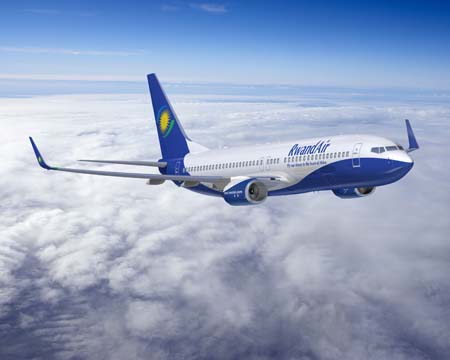
    Boeing and RwandAir announce an order for Next-Gen 787-800

    SEATTLE, May 6 — Boeing and RwandAir today announced an order for two Next-Generation 737-800s.

    Based in Kigali, Rwanda, the airline is renewing and expanding its fleet to broaden its network. RwandAir currently operates a fleet of regional jets.

    “Boeing’s Next-Generation 737-800s will enable us to eventually expand to regional hubs across Africa and the Middle East,” said John Mirenge, RwandAir chairman. “They will become the mainstay of our fleet.”

    “Boeing is honored that RwandAir has selected the Next-Generation 737-800 to support its fleet and growth strategy,” said Marlin Dailey, vice president of Sales, Boeing Commercial Airplanes. “The airplane offers reduced operating costs and environmental impact, as well as a new cabin interior that will delight RwandAir’s customers.”

    The new 737 Boeing Sky Interior features bigger stowage bins that pivot up and out of the way, and sculpted side walls that draw attention to the windows. A new design creates a more open feel in the cabin with overhead lighting that resembles the sky.

  • | | | |

    Southwest Flight loses Pressure


    Southwest Airlines Boeing 737 over Islip – Long Island MacArthur
    Click to view full size photo at Airliners.net
    Contact photographer Gerard Isaacson

    What: Southwest Airlines Boeing 737-300 en route from Islip Long Island to Chicago
    Where: Buffalo-Niagara International Airport
    When: May 07, 2010
    Who: 120 passengers
    Why: While en route, the plane developed a cabin air pressurization problem. The pilot decided to divert to Buffalo, and made a safe landing. Passengers disembarked and boarded an alternative flight to Chicago.

  • | | | |

    SW and Heli: Near Miss over Houston


    Click to view full size photo at Airliners.net
    Contact photographer Dmitriy Shapiro

    What: Southwest Airlines Boeing 737-700 en route from Houston to Baltimore
    Where: Houston
    When: Apr 28th 2010
    Who: 135 passengers and 5 crew
    Why: Over Houston, both the helicopter pilot and the plane pilot noticed their proximity and took evasive action. (Their separation was 100 feet vertically and 125 feet laterally.) Apparently after both got clearance, the helicopter converged on the Boeing’s flight path. The Boeing pilot’s only option to avoid the helicopter was to fly under him.

  • | | | | |

    China Airlines:Bomb Joke bombs.


    Click to view full size photo at Airliners.net
    Contact photographer Jing-Kai Chiou

    What: China Airlines Boeing 747-400 en route from Taipei Taiwan to Shanghai
    Where: Hangzhou
    When: May 1 2010
    Who: Lin, 58 yr old male passenger
    Why: While en route, the passenger told someone he had explosives in his luggage. Consequently, the flight diverted to Hangzhou where it made a safe landing–without blowing up. The passenger denied there were explosives (it was a joke.) He was taken into custody, and the flight continued to Shanghai without him, arriving nearly 6 hours late.

  • | | | | |

    American Airlines Encounters Turbulence over Chicago


    Click to view full size photo at Airliners.net
    Contact photographer Tom.Alfano

    What: American Airlines Boeing 767-200 en route from San Francisco to New York
    Where: Chicago
    When: Apr 29 2010
    Who: 3 flight attendants
    Why: While en route to NY, the flight encountered turbulence. Several flight attendants received bumps and bruises from the encounter. The flight diverted to Chicago, landing there half an hour after the incident, and remained In Chicago for an hour and a half prior to taking off again for New York.

  • |

    President of Boeing Korea Announced

    CHICAGO, April 27, 2010 — The Boeing Company today named Pat Gaines as president of Boeing Korea, effective June 4.
    In a move designed to continue the company’s success in Korea, Gaines will succeed Bill Oberlin, who will retire in July after 25 years with Boeing.

    Gaines will lead Boeing’s enterprise-wide business in Korea, while strengthening the company’s local presence and finding new ways to pursue growth and productivity initiatives.

    “Pat’s leadership experience in global business and operations align directly with our ongoing efforts to increase our presence and collaboration with customers, partners, communities and employees in Korea. In this regard he will be able to build on the solid foundation established by the excellent work Bill Oberlin has done in Korea,” said Shep Hill, president of Boeing International and Senior Vice President, Business Development and Strategy.

    Gaines, a 23-year company veteran, joins Boeing Korea following a position in Boeing Commercial Airplanes in Seattle, where he served as vice president of Customer Support for Asia-Pacific. He has extensive experience in global operations and led the efforts that established the joint venture between FlightSafety International and Boeing, now known as Boeing Training and Flight Services.

    Oberlin came to Korea in 2002 as president of Boeing Korea. He joined Boeing in 1985 and was credited with sales of key Boeing products, such as CH-47 Chinook helicopters, F-15Ks and AEW&C Peace Eye aircraft, as well as commercial airplanes and related services to airline customers in Korea.

    Oberlin was recognized in Korea for his contributions to the local business community as chairman of the American Chamber of Commerce in Korea (2003-2004 and 2007-2008) and as an executive member of the U.S.-Korea Business Council. He was an active proponent of the Korea-U.S. Visa Waiver Program, which allows qualified Korean nationals to travel to the U.S. visa free. Oberlin also worked to support the pending Free Trade Agreement between Korea and the U.S. In 2008, he was appointed to serve on the National Competitiveness Improvement Committee under the President of the Republic of Korea.

    “Bill played a significant role in strengthening our presence and stakeholder relationships in the Republic of Korea. His representation of the company has been characterized by outstanding leadership, unquestioned integrity and demonstrated results,” added Hill. “Korea is an important market for Boeing and presents many opportunities for Boeing and Korea to work together in ways to advance our common interests. We have a solid business plan and a long-term view of the market, and we look forward to continuing the legacy of a true partnership between Boeing and our customers and partners in Korea.”

    Gaines served in the U.S. military as an airborne ranger and a warrant officer pilot. He attended the United States Military Academy at West Point and graduated with honors and a degree in Engineering.

    Boeing shares a successful 50-year relationship with Korea. In 1988, Boeing opened an office in Seoul to work closely with Korean customers and partners. Today, more than 160 Boeing employees work across the country.

  • | | | |

    Toronto: BA Engine Shut Down


    Click to view full size photo at Airliners.net
    Contact photographer Mark Kwiatkowski

    What: British Airways Boeing 777-200 en route from London to Toronto
    Where: Toronto
    When: Apr 25th 2010
    Why: Over Toronto, the crew reported an engine problem and had to shut down the right engine. The flight made a safe landing.

    The cause has possibly been attributed to a crack in one of the engine’s parts.

  • | | | |

    Warsaw: Royal Falcon Cautionary Landing


    Click to view full size photo at Airliners.net
    Contact photographer Mohammad Razzazan

    What: Jordanian Royal Falcon Boeing 767-200 on behalf of Iraqi Airways en route from Stockholm to Baghdad/ Al Najaf
    Where: Warsaw
    When: Apr 25 2010
    Why: After one of the cockpit window panes cracked, the plane made a landing in Warsaw. No one was injured.

    How the passengers will be finishing their journey has not been published.

  • | | |

    Turbulence over Kochi

    What: Emirates Airlines Boeing 777-200 en route from Dubai to Kochi India
    Where: Bangalore
    When: Apr 25th 2010
    Who: 350 passengers and 14 crew
    Why: Prior to landing at Kochi, the plane encountered severe turbulence which resulted in 20 people being hospitalized. At the time of the turbulence, baggage fell from overhead hatches, and those not belted slammed upward. The flight landed at Kochi and was removed from service for ten hours. All injuries were minor.

    Two theories have been presented involving the turbulence. Meteorologists speculate that “the aircraft could have flown into an air pocket.”

    Another theory is that “…World Area Forecast centre wind/temperature charts did not reveal thunderstorm cloudd, but it showed a slight wind shear condition off the coast of Mangalore. At 35,000 feet, the chart shows strong westerly wind with a speed of 60 kts dropping to 25-30 kts. It’s one of the indicators of clear air turbulence (CAT).’’

    There are reports that say the plane suffered some damage after dropping from 20,000 to 5,000 feet.

  • |

    Dreamliner Weather Testing

    787 Dreamliner Undergoing Extreme Weather Testing in Florida

    VALPARAISO, Fla., April 22 — The Boeing 787 Dreamliner has begun a series of extreme-weather tests at Valparaiso, Fla. A special hangar at the McKinley Climatic Laboratory at Eglin Air Force Base allows the airplane to experience heat as high as 115 degrees Fahrenheit (46 Celsius) and as low as minus 45 degrees Fahrenheit (minus 43 Celsius).

    After the airplane is stabilized at either the hot or cold temperatures, flight test technicians will follow the Airplane Maintenance Manual to perform the steps required to prepare the airplane for flight release and operate under these conditions. Sensors and monitors will allow the test team to determine if all systems hardware and software operate as expected.

    Cold-weather testing is being conducted first, with preliminary hot-weather testing to follow. Additional extreme-weather testing will be conducted later in the flight test program.

    “We have Dreamliner customers who will operate the 787 in a wide variety of environments throughout the world,” said Scott Fancher, vice president and general manager of the 787 program for Boeing Commercial Airplanes. “This testing is about ensuring that the airplane meets the expectations of our customers.”

    A crew of approximately 100 people traveled from Seattle to support the test operations on ZA003, the third 787 airplane to be built.

    The McKinley Climatic Laboratory is the second remote testing location for the 787 Dreamliner. The second airplane in the fleet, ZA002, performed a variety of tests in Victorville, Calif., last month. The testing in Florida is expected to last nearly two weeks.

    About the Boeing 787 Dreamliner
    The 787 Dreamliner is an all-new twinjet designed to meet the needs of airlines around the world in providing nonstop service between mid-size cities with new levels of efficiency. The airplane will bring improved levels of comfort to passengers with larger windows, bigger baggage bins and advances in the cabin environment, including lower cabin altitude, higher humidity and cleaner air. Delivery of the first 787 is planned for the fourth quarter of 2010.

    Fifty-seven customers around the world have ordered 866 787s since the program was launched in April 2004, making the Dreamliner the fastest-selling new commercial jetliner in history. Delivery of the first 787 is planned for the fourth quarter of 2010.

  • | | | | |

    Burbank: Close call


    Click to view full size photo at Airliners.net
    Contact photographer Jason Whitebird

    What: Southwest Airlines Boeing 737-700 en route from Oakland to Burbank,CA
    Where: Burbank on Apr 19th 201
    When: Apr 19 2010
    Who: 119 passengers and 5 crew
    Why: Approaching the runway prior to takeoff, a a Cessna 172 passed over the passed over the 737, with a clearance of 200 feet (vertical) and 10 feet (lateral).

    The NTSB is investigating.

  • | | | | |

    United Airlines Cautionary Landing in the Azores


    Click to view full size photo at Airliners.net
    Contact photographer Mathias Henig

    What: United Airlines Boeing 767-300 en route from Washington to Moscow
    Where: Azores Islands
    When: Apr 21 2010
    Who: 170 passengers
    Why: While en route, the crew noted the smell of smoke, and diverted to the Azores (Terceira) to make a safe landing. Eu citizens were bussed to accommodations promptly; non EU were tied in paperwork at the airport for hours, straightening out their visas.

  • |

    PR: Boeing Test Flight


    EVERETT, Wash., April 20 — The U.S. Federal Aviation Administration (FAA) granted Boeing (NYSE: BA) expanded type inspection authorization (TIA) today, clearing the way for its personnel to fully participate in future test flights and for the collection of required flight-test data. Initial TIA was granted Feb. 11, which supported the collection of flutter certification data.
    The expanded TIA marks the FAA’s confirmation that the airplane and team are ready to collect additional certification data. Boeing achieved the expansion by demonstrating the readiness of the airplane throughout a variety of speeds, altitudes and configurations.

    “This TIA expansion is another significant step toward delivering airplanes to our customers. We remain on track to deliver the first airplane to ANA this year,” said Scott Fancher, vice president and general manager of the 787 program, Commercial Airplanes.
    In addition to receiving expanded TIA, Boeing finalized the aerodynamic configuration of the 787.

    “We have completed sufficient testing to decide that no additional changes to the external lines or shape of the airplane are required,” said Fancher. “Having an airplane match its expected performance with so few changes is rare and speaks to the maturity of the design.”
    The 787 flight-test fleet logged its 500th hour of flying April 16. On Sunday, ZA003, the flight-test airplane outfitted with interior elements, landed in Florida, where it will go through extreme weather testing at McKinley Climatic Laboratory at Eglin Air Force Base.

    Boeing released two videos highlighting flutter and ground effects testing. These videos feature commentary by the pilots and the chief project engineer and are available on www.boeing.com and www.newairplane.com.

  • | | | | | |

    Air France Jet Springs Leak Over Atlantic


    Click to view full size photo at Airliners.net
    Contact photographer Aurélien TRANCHET

    What: Air France Boeing 747-400 en route from Paris to San Francisco
    Where: Atlantic Ocean
    When: Apr 20 2010
    Why: While en route over the Atlantic, the left engine developed a leak. The crew shut down the engine to contain the damage and returned to Paris where they made a safe landing. A replacement jet was provided.

    Follow up
    Flight: (AF) Air France 84
    Departure Date: Tue Apr 20, 2010
    Status: Landed 914 minutes late

  • | | | | |

    Miami: American Airlines Flat


    Click to view full size photo at Airliners.net
    Contact photographer Jose Mendez

    What: American Airlines Boeing 737-800 en route from Miami to San Juan
    Where: Miami
    When: Apr 18th 2010
    Why: The Boeing was maneuvering on the runway when it made an explosive noise. On acceleration, the plane began vibrating.

    Instead of taking off, the plane returned to the gate with a flat tire. Passengers disembarked and were provided alternative transport.

  • |

    Boeing 787-8 Freighter Begins Flight Test


    PALMDALE, Calif., April 19 — The second Boeing 747-8 Freighter, RC521, landed in Palmdale, Calif., today, marking the beginning of a planned transition of 747-8 Freighter testing to Southern California. The more than four-hour flight from Boeing Field in Seattle included testing on avionics and cruise performance.

    “Taking the airplane to Palmdale is a big step,” said Mo Yahyavi, vice president and general manager of the 747 program. “The team is focused on ensuring a seamless transition into the next phase of the flight-test program as we prepare to expand testing of the 747-8 Freighter’s performance characteristics.”

    The airplane will be stationed in Palmdale for the majority of its scheduled flight-test program. The crew will conduct several tests on the airplane with fuel-mileage and engine-performance testing as key focus areas.

    “Palmdale provides an excellent test environment for the 747-8 Freighter,” said Andy Hammer, 747 test program manager. “It allows us to take full advantage of one of the world’s premier experimental test flight facilities and the excellent weather conditions to meet our flight-test requirements on the road to obtaining our amended type certification.”

    A contingent of employees has been stationed at Palmdale for the testing, including flight-test engineers and the support personnel who prepare the airplane for each day’s flights. In the coming weeks, the two other 747-8 airplanes in the flight-test fleet will join RC521 in Southern California.
    The entire flight-test program calls for the three airplanes to perform a total of about 3,700 hours of ground and air testing. The first 747-8 Freighter delivery to Cargolux is planned for the fourth quarter of this year.

  • | | | |

    Virgin Blue: Fumes over Adelaide


    Click to view full size photo at Airliners.net
    Contact photographer John Richard Thomson

    What: Virgin Blue Boeing 737-800 en route from Perth to Sydney
    Where: Adelaide
    When: Apr 19 2010
    Who: 150 passengers
    Why: While en route, passengers began suffering from breathing problems. An odor was detected aboard. The flight routed to Adelade where affected individuals were tested for Carbon Monoxide poisoning.

    Fire crews and flight engineers cleared the flight for continuing to Sydney and passengers reboarded after being grounded for about an hour.

    Eight passengers suffered nausea; one was taken to the hospital.