Boeing

  • | | |

    Unruly Diverts Westjet


    Click to view full size photo at Airliners.net
    Contact photographer Alevik

    What: Westjet Airlines Boeing 737-700 en route from Calgary to Halifax
    Where: Winnipeg
    When: Jul 6th 2010
    Who: 131 on board
    Why: While en route, a passenger attempted to open a door to the plane. The flight diverted to Winnipeg where the passenger was detained and taken into custody to be charged with “endangering safety of an aircraft and interference with flight crew.” After a nearly three hour delay, the flight continued to Halifax.

  • | | |

    Southwest Boeing Diverts to Cleveland


    Pictured: A Southwest Airlines Boeing 737
    Click to view full size photo at Airliners.net
    Contact photographer

    What: Southwest Airline Boeing 737-500 en route from Chicago to Providence
    Where: Hopkins International Airport
    When: July 5, 2010
    Why: While en route, the plane developed hydraulic problems and had to make a cautionary landing in Cleveland. The plane made a safe landing, with no injuries. The plane taxied to the gate, but there was no indication of the allocation of the passengers–whether they were provided alternative transportation or accommodated at a local hotel.

  • | |

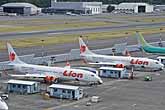
    Lion Air Celebrates 10-Year Anniversary With Two New 737-900ERs

    SEATTLE, July 1 e-FirstCall/ — Coinciding with the 10th anniversary of Lion Air, Boeing (NYSE: BA) today delivered two Next-Generation 737-900ERs (extended range) to the Jakarta-based carrier. Lion Air, which operates an all-Boeing fleet, was the launch customer of the 737-900ER and is currently the largest operator of the airplane. With today’s deliveries, the Lion Air fleet consists of 36 737-900ERs and two 747-400s. In addition, Lion Air is a launch customer for the new 737 Boeing Sky Interior.
    Lion Air plans to carry 20 million passengers this year to destinations within Indonesia as well as to Malaysia, Singapore, Vietnam and Saudi Arabia. The carrier is based at Soekarno-Hatta International Airport in Jakarta, Indonesia.

  • | | | | | | |

    Cathay Pacific Lands in Amsterdam with one engine down


    Click to view full size photo at Airliners.net
    Contact photographer Peter Kesternich

    What: Cathay Pacific Boeing 747-400 en route from Hong Kong to Amsterdam
    Where: Amsterdam
    When: Jun 27th 2010, 6:35 am
    Who: 377 passengers and 20 crew
    Why: On landing in Amsterdam, one of the plane’s four engines developed a problem and was shut down. The flight made a safe landing in Amsterdam on three engines. A replacement engine was flown in to Amsterdam to repair the plane.

    George’s Point of View

  • | | | | |

    Tokyo: Continental Micronesia Emergency Landing


    Click to view full size photo at Airliners.net
    Contact photographer J.Suzuki

    What: Continental Airlines Boeing 737-700 on behalf of Continental Micronesia, registration N27734 performing flight CS-916/CO-916 from Fukuoka (Japan) to Guam (Guam)
    Where: near Tokyo
    When: Jun 29 2010
    Who: 40 passengers and 5 crew
    Why: While en route, oil fumes developed in the cabin. The pilot returned to Tokyo where he made a safe landing at 1:41 pm.

    The fumes were determined to be from the right engine generator.

  • |

    Boeing Statement on IAM 837 Contract Ratification

    ST. LOUIS, June 27, 2010 — The International Association of Machinists and Aerospace Workers (IAM) 837, which represents about 2,500 employees in the St. Louis area, voted 1,237-838 today to ratify the adjusted best-and-final contract offer that The Boeing Company presented last week. Boeing responded with the following statement:
    “We are very pleased that our employees represented by IAM 837 voted today to ratify the contract we have been discussing over the past several weeks. When we began negotiations, our goal was to produce a contract that recognizes both the significant contributions of our employees and the competitive environment in which we must compete to keep jobs here in St. Louis. This contract does both. The vote by our employees allows us to keep delivering on our commitments to our customers.

  • | | | | |

    Continental Airlines Emergency Landing in San Antonio


    Click to view full size photo at Airliners.net
    Contact photographer Orlando G. Rivera Rivera – SJU Aviation Photography

    What: Continental Airlines Boeing 737-900 en from Houston,TX to Puerto Vallarta
    Where: San Antonio
    When: Jun 25 2010 6:34 p.m
    Who: 172 people on board
    Why: After experiencing air pressurization problems while en route, the oxygen masks were deployed. Unable to handle the problem, the pilot diverted to San Antonio where it made a safe landing. A replacement jet was provided Saturday which left at 7:45 a.m. Passengers were provided hotel accommodations in the meantime.

  • | | | | |

    Continental Airlines Emergency Landing


    Click to view full size photo at Airliners.net
    Contact photographer Flyoverfred

    What: Continental Airlines Boeing 737-800 en route from Seattle to Newark
    Where: Hector International Airport
    When: June 25, 2010
    Who: 160 passengers
    Why: While en route, a fire in a galley oven forced the pilot to divert to Fargo. Flight attendants put out the fire, but the plane was delayed in Fargo for several hours. The flight reached Newark eight and a half hours late.

  • |

    Boeing and FAA to Team for Cleaner Skies, Quieter Airplanes

    WASHINGTON, June 24 /PRNewswire-FirstCall/ — The Boeing Company (NYSE: BA) and the U.S. Federal Aviation Administration announced today that they will work together to speed the development and application of environmentally progressive technologies for cleaner and quieter jet aircraft.

    As part of the FAA’s Continuous Lower Energy, Emissions and Noise (CLEEN) program, Boeing and the FAA each will contribute up to $25 million during the next five years to conduct flight demonstrations of emergent airframe and engine technologies that have the potential of reducing greenhouse gas emissions and community noise.

    “By combining our resources and expertise, we believe we can transition promising technologies from development into service more quickly to help reduce the environmental footprint of airplanes,” said Matt Ganz, vice president and general manager of Boeing Research & Technology, which is leading the program at Boeing. “We recognize the importance of protecting our ecosystem and are looking forward to working with the FAA on a variety of innovative solutions to help define the future.”

    The technologies being developed under the CLEEN program will be flight tested aboard two demonstration vehicles, a Next-Generation Boeing 737 in 2012, with a second series of test flights aboard a yet-to-be-determined twin-aisle airplane in 2013.

    This flight-test program builds on the success of the company’s Quiet Technology Demonstrators, which successfully highlighted a variety of noise reduction technologies during test flights aboard Boeing 777 aircraft from 2001 to 2005.

    According to Boeing CLEEN Program Manager Craig Wilsey, the technologies that will be developed and tested during demonstration flights include adaptive wing trailing edges and ceramic matrix composite acoustic engine nozzles.

    Adaptive trailing edges pertain to a collection of small controllable devices that are integrated into the aft portion of the wing. Most traditional wings are designed for best performance while at cruise, and have performance compromises during other flight phases. Adaptive trailing edges can help tailor the wing configuration to reduce fuel burn at takeoff, climb and cruise, and to reduce community noise at takeoff and landing.

    New-generation engines on commercial airplanes are more efficient, but require materials that are capable of withstanding higher temperatures than previous engines. Ceramic matrix composites offer the potential of better thermal and structural performance, while helping to reduce weight and acoustic footprint.

    In addition to Boeing Research & Technology, the company’s advanced central research, technology and innovation organization, Boeing’s CLEEN team is composed of engineers and support staff from Boeing Commercial Airplanes and Boeing Test & Evaluation.

    Boeing continues to take aggressive steps to improve the environmental performance of its products including:

    Producing the world’s newest commercial airplanes, the 787 Dreamliner and the 747-8, designed to be significantly more fuel-efficient and have lower emissions than earlier generation jetliners.

    Pioneering research into sustainable aviation biofuel made from biomass sources that do not compete with food crops or land or water use. Aviation biofuels have lower carbon emissions over their lifecycle and help lessen aviation’s dependence on fossil fuels.

    Developing ways to improve the efficiency of the global air traffic control network, which will enable passengers to arrive at their gates sooner and reduce the carbon footprint of commercial air travel.

  • | | |

    American Airlines eyes Boeing Engine Pylons

    Cracks in the engine pylons of three American Airlines Boeing 767’s are prompting concerns over the need of more frequent inspections of Boeing 767’s. The FAA says American and Boeing are looking for the cause of the cracking, which was discovered during routine metallurgical tests. Boeing is preparing a service bulletin establishing new guidelines for inspecting this particular part, over and above the every “1500 flights” which stands now. The flight which originally caught American’s attention had developed the cracks during the last 500 flights since its last pylon inspection. Caution about underlying structural issues is being addressed.

    The preliminary conclusion is that certain maintenance practices may play in the underlying cause of the cracking. A known issue is that some of the cracks arise from holes used to install bolts, implying that the bolt holes may compromise the structural integrity, or at least affect the pylon’s longevity; and may affect “fail-safe” design.

    The FAA has not yet mandated inspection of 767 other jets operated by other carriers, nor have they determined if winglets are a contributing factor.

  • |

    Is Oxygen Hose Length an Issue?

    We talked about the May 16 cockpit fire on a United Boeing 757 (New York to Los Angeles) that made an emergency diversion to Dulles. That event involved an airborne cockpit fire so extreme that the pilot reached for the fire extinguishers to put out flames coming from his windshield—but he was brought up short by the length of the oxygen hose. In the smokey situation, it must have been a special concern to have the oxygen mask rip away from the pilot’s face. I can only assume there is other essential gear stored and unreachable due to the length of the hose, because I haven’t seen anyone talk about solving the hose length issue by moving the extinguishers closer.

    In fact, on some Boeing 757 and 767s the length of the hose attached to the pilot’s oxygen mask and smoke goggles is under scrutiny now by the FAA for being too short to reach the fire extinguishers. Apparently Boeing has resisted lengthening the hose because of the danger of the pilot getting tangled in the hose.

    Since the FAA is looking into the issue of the possibility of the hoses being too short, one can not help but wonder if this problem were a factor in the May 22 – Air India Express Flight 812 Boeing 737-800 crash at Mangalore International Airport, or the Jan 25 Ethiopian Airlines Flight 409 Boeing 737-800 that crashed into the Mediterranean Sea shortly after take-off from Beirut. How do we know that too-short hoses did not contribute to those tragic events?

    Conversely, if the 737 hose length is not too short and allows the pilot to reach where it essential for the pilot to reach, and there is no hose problem on the 737, then why has Boeing not corrected this problem on 757s and 767s?

  • | | | | |

    Thai Boeing Hits Turbulence


    Click to view full size photo at Airliners.net
    Contact photographer Mu yun

    What: Thai Airways Boeing 777-200 en route from Bangkok to Osaka
    Where: Kansai International Airport in the city of Izumisano in Osaka Prefecture
    When: Jun 20th 2010
    Who: 227 passengers and 17 crew, 4 injured
    Why: The flight encountered turbulence at 6:30 am over the Pacific Ocean off Kochi Prefecture

    The flight landed safely Osaka 15 minutes later. Three cabin crew and one passenger were hospitalized for injuries. The weather service says that the atmosphere was unstable due to a rain front.

  • |

    Press Release: Boeing 787 Dreamliner Passes 1,000 Hours of Flying

    EVERETT, Wash., June 17 /PRNewswire-FirstCall/ — The Boeing 787 Dreamliner flight test fleet passed 1,000 hours of testing yesterday. The program estimates that it is about 40 percent through the test conditions required to certify the first version of the all-new jetliner.
    “More work remains but we are seeing excellent progress in flight test,” said Scott Fancher, vice president and general manager of the 787 program for Boeing Commercial Airplanes. “Even more important than the hours we’ve logged are the test conditions we have completed. The team is being very efficient in getting the data we need.”

    “It’s also important to note that we are making solid progress on the ground testing required on the flight test fleet as well,” Fancher said.

  • | | | |

    Ethiopia Flight Makes Cautionary Landing

    What: Ethiopian airplane Boeing 737-800 Flight 407 en route from Addis Ababa to Beirut
    Where: Beirut International Airport
    When: June 17 2010
    Who: 78 passengers
    Why: The flight returned to the airport because of an “undisclosed technical problem.” Crew noticed a door was rattling and had been closed improperly. (It is unclear if that was the technical problem.) The flight made a safe landing. The same plane was cleared for takeoff six hours later.

  • |

    Boeing Team Helps Royal Netherlands Air Force Achieve Aviation Milestone

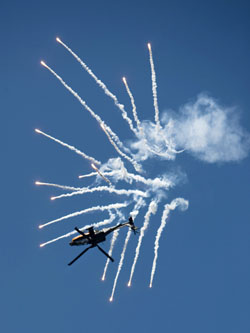
    GILZE-RIJEN AIRBASE, Netherlands, June 16, 2010 — Boeing ] and The Royal Netherlands Air Force (RNLAF) today made aviation history when a Boeing AH-64D Apache became the first rotorcraft in the world to fly using a blend of sustainable bio-kerosene and standard aviation jet fuel.
    The 20-minute flight, conducted at Gilze-Rijen Airbase, home of the RNLAF’s combat rotorcraft squadrons, was witnessed by dozens of industry observers and defense journalists.
    The sustainable biofuel used in the flight was produced using algae-based biomass and used cooking oil, and processed by UOP, LLC, a Honeywell company, into a Bio-Synthetic Paraffinic Kerosene (Bio-SPK), which has been used in previous commercial biofuel flights. In a series of preflight tests, the 50/50 bio-kerosene and traditional jet fuel blend met or exceeded the JP-8 fuel specifications for the Apache. No engine or airframe modifications were made prior to flight.
    “This is a tremendous achievement for the Royal Netherlands Air Force, Boeing, Honeywell, and the engine manufacturer GE Aviation in our efforts to develop sustainable aviation fuel solutions,” said Al Winn, vice president of Apache Programs for Boeing, who attended the demonstration. “Both Boeing’s commercial and military customers are pursuing alternatives to fossil fuels, sharing a vision that was demonstrated flawlessly by our Apache customer today.”

    “Today is an important milestone for the more intensive usage of sustainable bio-kerosene in aviation,” said Eimert van Middelkoop, Minister of Defense of the Netherlands.
    The RNLAF biofuel flight test program encompasses seven flights that will highlight the technical feasibility of flying rotorcraft using renewable fuels that do not reduce the availability of food crops or water. The Ministry of Defense of the Netherlands, which authorized the flight test program, has publicly stated its commitment to minimizing its environmental footprint of military aircraft.

    “This program also will help stimulate market development for aviation biofuel within the Netherlands that can help improve the environmental performance of commercial and military aviation,” said Jan Närlinge, president of Boeing Northern Europe.

    Boeing is engaged in sustainable biofuel research around the world and supported the Apache flight and the RNLAF through preflight planning, testing and technical consultation based on a strong body of biofuel experience. The company supplied technical support to a KLM Royal Dutch Airlines biofuel flight aboard a Boeing 747 in November 2009, and also to the U.S. Navy F/A-18 Super Hornet biofuel flight on Earth Day this year. Boeing also supported four previous biofuel flights using varying fixed-wing commercial aircraft and engine types.
    Extensive laboratory testing by fuel processors, feedstock providers and engine manufacturers has further shown that aviation biofuels meet or exceed the high performance and quality standards specified for military and commercial jet fuels.

    A unit of The Boeing Company, Boeing Defense, Space & Security is one of the world’s largest defense, space and security businesses specializing in innovative and capabilities-driven customer solutions, and the world’s largest and most versatile manufacturer of military aircraft. Headquartered in St. Louis, Boeing Defense, Space & Security is a $34 billion business with 68,000 employees worldwide.

  • | | |

    Flight Attendant Stands in


    Click to view full size photo at Airliners.net
    Contact photographer Alejandro Ruiz

    What: American Airlines Boeing 767-300 en route from San Francisco to Chicago O’Hare
    Where: en route
    When: Jun 14 2010
    Who: 225 passengers and 7 crew
    Why: When the first officer became ill aboard 1612 from San Francisco, a fight attendant with a commercial pilots license stepped in as copilot (taking the first officer’s seat) for the landing.

    Ride ’em cowboy, American Airlines. Way to go.

  • |

    Boeing Begins Fuselage Assembly for First 747-8 Intercontinental

    EVERETT, Wash., June 14 /PRNewswire-FirstCall/ — Boeing began fuselage assembly of the first 747-8 Intercontinental at the factory in Everett, Wash. Mechanics loaded panels for the 31-foot, 8-inch (9.6 m) long front section of the new airplane into the assembly tool. The panels are part of section 41, the area of the fuselage that houses the flight deck on the upper deck and the forward passenger cabin on the main deck, an area that most airlines typically configure with first class seating.

    The 747-8 Intercontinental is the new, high-capacity 747 that offers airlines the lowest operating costs and best economics of any large passenger airplane while providing enhanced environmental performance. Boeing has 109 orders for the 747-8 — 33 for the 747-8 Intercontinental and 76 for the 747-8 Freighter. The first 747-8 Intercontinental is scheduled to deliver in late 2011.

  • | | |

    Boliviana de Aviacion at La Paz


    Click to view full size photo at Airliners.net
    Contact photographer Andrés Contador – AirTeamImages

    What: Boliviana de Aviacion Boeing 737-300 en route from from Sucre to La Paz
    Where: La Paz
    When: Jun 11th 2010
    Who: 46 passengers and 6 crew
    Why: On landing, a bracket failed, a hydraulic line on the right hand main gear was cut. This resulted in all the hydraulic fluid releasing, and the brakes failing. The crew used reverse thrust and managed to stop the plane.

  • | | |

    Greece-bound Boeing Diverts to Boston


    Click to view full size photo at Airliners.net
    Contact photographer N94504

    What: Continental Airlines Boeing 767-400 en route from Newark to Athens
    Where: Boston
    When: June 11, 2010
    Who: 233: 220 passengers and 13 crew
    Why: After the pilot had reported smoke in the cockpit, the flight was diverted to Logan International Airport for safety reasons. A replacement jet was provided; and no cause has been released as to the source of the smoke.

    George’s Point of View

  • | | | | |

    Hot Delta Flight Lands Safely


    Click to view full size photo at Airliners.net
    Contact photographer Vladimir Voronov

    What: Delta Airlines Boeing 767-300 en route from New York to Rome
    Where: Halifax
    When: Jun 10 2010
    Who: 214 aboard
    Why: While en route over the Atlantic, smoke was found on board. The flight diverted to Halifax where they made a safe landing. A replacement jet was provided. There’s no indication (yet) as to the cause of the smoke.

  • | | | | | |

    Cautionary Landing in Dammam


    Click to view full size photo at Airliners.net
    Contact photographer TK

    What: Saudi Arabian Airlines Boeing 777-200 en route from Dammam to Kochi
    Where: Muscat
    When: Jun 7th 2010
    Why: After developing instrument problems while en route, the crew turned around and returned to Dammam where they made a safe landing two hours into the flight. The plane underwent repairs before resuming the flight.

  • | | | | | | |

    Royal Air Maroc Loses Bird Encounter


    Click to view full size photo at Airliners.net
    Contact photographer Roberto Bianchi

    What: Royal Air Maroc Boeing 737-400 en route from Amsterdam to Nador
    Where: Amsterdam
    When: Jun 6th 2010
    Who: 156 passengers and 6 crew
    Why: On takeoff, the plane encountered a flock of geese, which resulted in an engine fire, damage to the left engine fan blade and denting the inlet. The engine was shut down, fire suppression engaged, and the crew returned to the airport where they made a safe landing. Passengers disembarked on the runway after less than a twenty minute flight.

  • | | | |

    In Denial: Transaero Landing Gear Fire


    Click to view full size photo at Airliners.net
    Contact photographer Christian Waser

    What: Transaero Boeing 737-400 from Novosibirsk to Moscow
    Where: Novosibirsk Russia
    When: Jun 7th 2010
    Who: 124 passengers 6 crew
    Why: While en route, the plane indicated there was a fire. The crew indicated there was no fire but returned to the airport. On landing (after burning off fuel, maintenance determined that the landing gear had been on fire.

    Something fishy in the state of Novosibirsk? Can a crew just decide “there’s no fire?” Obviously not, since they did return to the airport. Fortunately, they did, since the landing gear apparently was on fire.