NTSB TO EXAMINE SAFETY EFFECTS OF ‘GLASS COCKPITS’ IN SMALL LIGHT AIRPLANES

Similar Posts

  • |

    CIT, Boeing Announce Order for 38 Next-Generation 737 Airplanes

    Order Includes 737-800s and 737-900ERs

    NEW YORK and SEATTLE, Jan. 4, 2011 /PRNewswire/ — CIT Group Inc. (NYSE: CIT), and Boeing (NYSE: BA) today announced that CIT Aerospace placed an order for 38 Next-Generation 737 airplanes and purchase rights for seven additional 737s.

    The order, with deliveries into 2017, includes 15 737-900ER (extended range) and 23 737-800 airplanes. It is the largest order placed by a leasing company for the 737-900ER, the largest and newest member of the Boeing Next-Generation 737 family. This is also the largest order placed by CIT for Boeing airplanes.

    “This order of Next-Generation Boeing aircraft reflects our efforts to maintain one of the youngest and most technologically advanced fleets in the industry,” said C. Jeffrey Knittel, president of Transportation Finance at CIT. “As a leading aircraft lessor, it is important that we continue to maintain a portfolio of operationally dependable and fuel-efficient aircraft for our customers.”

    “CIT’s choice of the Next Generation 737 shows its confidence in the product family and especially in its newest member, the 737-900ER, which features incredible economics and operational capability,” said Marlin Dailey, vice president of Sales & Marketing, Boeing Commercial Airplanes. “CIT is one of the leading companies in global transportation finance, and clearly recognizes the value that the Next Generation 737 will bring to its airline customers. CIT will be receiving its 737s with the innovative Boeing Sky Interior and other performance improvements that will keep its airplanes at the leading edge of passenger comfort, efficient operations and reduced fuel consumption.”

    CIT owns or finances a fleet of more than 300 commercial aircraft. As of Sept. 30, 2010, CIT had 140 Boeing airplanes in its portfolio. With this new order, the company now has a total order book of 111 aircraft, of which 58 are Boeing.

    To include the featured image in your Twitter Card, please tap or click their icon a second time.
  • |

    Lockheed Martin Receives $360 Million in Contracts to Support U.S. Navy MH-60R Helicopter Fleet

    WASHINGTON, Jan. 12, 2011 /PRNewswire/ — The U.S. Navy demonstrated its continued commitment to keeping its MH-60R Seahawk helicopter fleet at the forefront of anti-submarine and anti-surface warfare, awarding Lockheed Martin (NYSE: LMT) a variety of production and development contracts totaling $360 million. The end-of-year awards cover a spectrum of systems aboard the MH-60R, built by Sikorsky Aircraft Corporation (NYSE: UTX).

    “The Navy’s investment in the MH-60R fleet ensures our pilots and aircrews have the best and most advanced equipment for every mission,” said Capt. Dean Peters, U.S. Navy MH-60 program manager. “We are looking for reliable, modern aircraft upgraded efficiently and affordably, and that’s why we have devoted these resources to the MH-60 fleet.”

    As Lockheed Martin prepares for its 300th cockpit delivery milestone in late February, the Navy exercised a $38 million option under the current multi-year contract to cover production of the next lot of common cockpits for MH-60S and MH-60R helicopters. The bulk of the work will be performed at Lockheed Martin’s facility in Owego, N.Y., and is scheduled for completion by April 2013.

    Additionally, the Navy will provide MH-60R/S crews with improved situational awareness by incorporating Lockheed Martin’s Situational Awareness Technology Insertion (SATI) aboard the aircraft under a $35 million contract. The award covers a pre-development iteration of SATI, an eight-component package of upgrades and improvements to the helicopter’s flight management system. Improvements include a new integrated digital map to give pilots a clear picture of their operating area, and an upgrade to the Identification Friend-or-Foe (IFF) system. The IFF upgrade will prevent interference during transmission and ensure interoperability with the Federal Aviation Administration and other agencies.

    One of the most highly advanced systems aboard the MH-60R – Automatic Radar Periscope Detection and Discrimination (ARPDD) – will transition from system development and demonstration (SDD) to production under a $36 million contract award. The Telephonics radar used in ARPDD is the latest iteration of the radar currently deployed with the MH-60R, but adds a new mode requiring improved radar performance and eight times the processing power of the previous version.

    In October 2010, Lockheed Martin and the Navy successfully completed initial flight tests of the system aboard an MH-60R, marking the first time a helicopter has had the functionality for its on-board radar to automatically discriminate between a periscope and other small surface objects, significantly improving the probability of finding a submarine. This recent contract award covers the infrastructure required to meet full-rate production and the fielding of the ARPDD radar system aboard six MH-60R production aircraft to support Initial Operational Capability in 2013.

    Construction of the next lot of 24 MH-60R mission avionics suites and 18 MH-60S cockpits will begin under a $72 million Multi-Year II advanced acquisition contract award that covers long-lead items for the helicopters and cockpit systems. Lockheed Martin and partner Sikorsky Aircraft have delivered more than 85 MH-60R helicopters to date and are on track to reach the century mark early in 2011.

    Headquartered in Bethesda, Md., Lockheed Martin is a global security company that employs about 133,000 people worldwide and is principally engaged in the research, design, development, manufacture, integration and sustainment of advanced technology systems, products and services. The Corporation’s 2009 sales from continuing operations were $44 billion.

    To include the featured image in your Twitter Card, please tap or click their icon a second time.
  • |

    Federal Officials Mark Opening of New Aiken Transportation Resource Center

    Tuesday, August 17, 2010 – Peter Appel, Administrator of the U.S. Department of Transportation’s Research and Innovative Technology Administration (RITA), and Federal Transit Administration Regional Administrator Dr. Yvette Taylor today joined state and local officials to mark the expansion of a $2.9 million transportation resource center that will provide enhanced, coordinated, accessible, cost-effective transportation choices for older adults, people with disabilities and low-income populations in a six county region surrounding Aiken, SC.

    “The Resource Center here in Aiken is a great example of how Intelligent Transportation Systems technology can make a real difference in the lives of the people who depend on transportation and transit services to meet their most basic needs,” said RITA Administrator Appel. “American Recovery and Reinvestment Act-sponsored projects are getting Americans back to work and having a positive impact on the quality of life in our communities.”

    Funded in part by a $561,000 American Recovery and Reinvestment Act grant and $980,032 in grants from the U.S. Department of Transportation’s United We Ride/Mobility Services for All Americans (UWR/MSAA) initiatives, the Lower Savannah Council of Governments Aging, Disability & Transportation Resource Center (ADTRC) will now provide accessible customer-based travel information and trip planning services to a 4,000 square mile rural region with a population of 300,000 people.

    The newly enhanced transportation resource call center has added customer-oriented features, such as automated telephone and Internet-based trip reservations and management, and has expanded its transportation resources to four counties that previously had no access to transportation services. In addition to transportation management, callers and those visiting the center’s website will also have access to a searchable database of human service resources information, including utility bill assistance, local food pantries, support groups for health issues, workforce training, and how to contact officials concerning local governmental questions.

    The goal of the UWR/MSAA initiative is to improve transportation services and simplify access to employment, healthcare, education, and other community activities through advanced technologies like Intelligent Transportation Systems, and by extending transportation service partnerships with consumers and human service providers at the federal, state, and local levels across various modes of transportation, social welfare programs, and geographic areas. The ADTRC is one of three national demonstration one-call centers funded by the UWR/MSAA initiative.

    To include the featured image in your Twitter Card, please tap or click their icon a second time.
  • | |

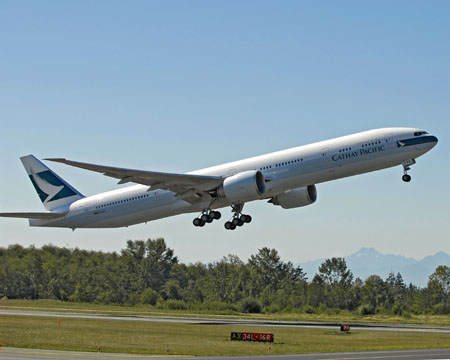
    Boeing, Cathay Pacific Airways Finalize Contract for Six 777-300ERs

    SEATTLE, Sept. 22 — Boeing and Cathay Pacific Airways today announced the Hong Kong-based carrier has exercised existing purchase rights for six additional Boeing 777-300ERs (extended range).

    The six new airplanes, with an estimated value of US$1.6 billion at Boeing list prices, will increase Cathay Pacific’s 777-300ER future fleet from 30 to 36.
    Cathay Pacific, one of the world’s largest operators of the popular jetliner, also operates 12 Boeing 777-300s and five 777-200s.

    “Cathay Pacific is a valued long-time Boeing customer. The global reach of Cathay Pacific’s 777 fleet showcases the airplane’s exceptional performance features and its passenger appeal around the world,” said Marlin Dailey, vice president of Sales for Boeing Commercial Airplanes. “This additional commitment from a world-class operator like Cathay Pacific is a testament to the greater efficiency, economics and reliability of the 777-300ER.”

    Cathay Pacific first announced its selection of the 777-300ER in 2005. This announcement is Cathay Pacific’s fourth increase in its acquisition plans for the long-range jetliner.

    “We are very pleased to confirm this purchase of six more Boeing 777-300ERs – a superb aircraft that already has significantly enhanced our operations on key long-haul routes,” said Cathay Pacific Chief Executive Tony Tyler. “We have been very impressed by the operating economics of these aircraft, while their high efficiency has resulted in a reduced environmental impact. As we continue to enhance our fleet, the 777-300ER will play a crucial role in our operations in the years to come.”
    The Boeing 777 is the world’s most successful twin-engine, long-haul airplane. The 777-300ER extends the 777 family’s span of capabilities, bringing twin-engine efficiency and reliability to the long-range market.

    Boeing incorporated several performance enhancements for the 777-300ER, extending its range and payload capabilities. Excellent performance during flight testing, combined with engine efficiency improvements and design changes that reduce drag and airplane weight, contributed to the increased capability.

    In addition to Boeing 777s, Cathay Pacific operates 47 747-400s in both passenger and cargo versions. The airline also has ordered 10 Boeing 747-8 Freighters. The highly efficient new cargo airplane will augment the airline’s fleet of 25 747 Freighters used to connect Hong Kong to a wide range of international markets.
    Sixty-one customers around the world have ordered more than 1,100 777s.

    To include the featured image in your Twitter Card, please tap or click their icon a second time.
  • | | |

    FAA and Singapore Sign Aviation Safety Agreement

    FAA and Singapore Sign Aviation Safety Agreement

    SINGAPORE—The Federal Aviation Administration (FAA) signed a milestone Maintenance Agreement Guidance (MAG) yesterday with the Civil Aviation Authority of Singapore (CAAS). The agreement allows for mutual surveillance conducted on certified repair stations located abroad for each of the agreement partners.

    It provides guidance for the implementation of the previously agreed-upon. In cases where there are sufficient certificated facilities in both partner countries, MIPs may reduce the number of surveillance activities, free up inspector resources for the authorities, and reduce the regulatory burden on industry. There are 58 FAA-approved repair stations located in Singapore.

    The MAG furthers the Maintenance Implementation Procedures (MIP) agreement signed by FAA Administrator Michael Huerta and CAAS on February 16, 2016. That agreement was the first of its kind in Asia and reduces costs by allowing the reciprocal acceptance of Singapore and the United States’ surveillance of maintenance work.

    The MIP and MAG permits reliance on each other’s surveillance systems to the greatest extent possible while maintaining safety. Agreements such as the MIP allow for greater efficiency and ultimately save valuable industry and authority resources. The FAA and the CAAS have agreed to conduct surveillance on each other’s behalf to ensure compliance with the respective regulatory requirements for maintenance and the applicable Special Conditions. Both agreements build on the 2004 U.S-Singapore Bilateral Safety Agreement (BASA) which has benefitted both countries by saving time and reducing costs in aircraft design and manufacturing.

    FAA Assistant Administrator for NextGen James Eck and Executive Director for International Affairs Carey Fagan are participating in the World Civil Aviation Chief Executives Forum this week in Singapore as part of the agency’s continued collaboration with Association of Southeast Asian Nations (ASEAN) member states.

    As part of the strong U.S.-Singapore bilateral relationship, the FAA and the CAAS also partner under Singapore’s Air Traffic Management Center of Excellence to expand understanding and build Air Traffic Management capacity in the region.

    To include the featured image in your Twitter Card, please tap or click their icon a second time.
  • |

    OIG: FAA Fulfilled AARA

    ACTION: FAA Fulfilled Most ARRA Requirements in Awarding Airport Grants Federal Aviation Administration Report Number AV-2011-053
    From: JeffreyB.Guzzetti Assistant Inspector General
    for Aviation and Special Program Audits

    February 17, 2011
    JA-10
    Memorandum
    On February 17, 2009, the President signed into law the American Recovery and Reinvestment Act (ARRA),1 designating $1.1 billion for the Federal Aviation Administration (FAA) to invest in Airport Improvement Program (AIP) projects. These funds were intended for airport projects that could achieve several key goals, including investing in transportation infrastructure to provide long-term economic benefits, create jobs, and promote economic recovery. ARRA established tight timeframes for distributing and expending funds and emphasized preference for projects that could be completed in 2 years.

    In August 2009, we issued an advisory to the Office of the Secretary outlining our concerns with FAA’s process for awarding ARRA grants.2 We questioned the economic merit of some lower scoring projects and highlighted several ARRA recipients with grant management problems identified in prior single audit reports.3 Based on these preliminary findings, we initiated this audit to determine the extent to which FAA’s process for awarding ARRA grants complied with ARRA requirements and other associated guidance.4 We conducted this audit from September 2009 through December 2010 in accordance with government

    American Recovery and Reinvestment Act of 2009, Pub. L. No. 111–5 (2009). OIG Advisory Number AA-2009-003, “FAA’s Process for Awarding ARRA Airport Improvement Program Grants,” August 6, 2009. OIG reports are available on our website: www.oig.dot.gov. Single audit is a mechanism relied upon by Executive Branch agencies to oversee financial compliance and grant 4 assurances. For the purpose of this report, we define “requirements” as a collective term to refer to ARRA statutory requirements, Presidential direction, and Office of Management and Budget (OMB) and FAA guidance related to ARRA implementation.

    Read the entire PDF here

    To include the featured image in your Twitter Card, please tap or click their icon a second time.