NTSB TO MEET ON GROUND FIRE ABOARD CARGO AIRPLANE IN SAN FRANCISCO

Similar Posts

  • |

    Press Release – FAA Awards $18 Million Environmental Grant to Seattle-Tacoma International Airport

    WASHINGTON – The Federal Aviation Administration (FAA) announced the award of its largest Voluntary Airport Low Emission (VALE) grant for an $18.3 million project at Seattle-Tacoma International Airport (Sea-Tac) to improve air quality and to reduce the use of conventional fuels at the airport.

    With the VALE grant, Sea-Tac will be able to install a centralized preconditioned air plant that will allow aircraft arriving at the gates to shut off their auxiliary power units and connect to a cleaner central heating and cooling system. This project will greatly reduce aircraft emissions on the ground.

    “This program is helping airports around the country make needed technological investments so they can be more environmentally friendly,” said U.S. Transportation Secretary Ray LaHood.

    Since the first VALE grant award in 2005, the FAA has funded 40 projects totaling $83 million dollars.

    FAA Administrator Randy Babbitt announced the grant during a press conference in Seattle where he highlighted environmental efforts under way at Sea-Tac and by the Alaska Air Group (AAG) as examples of the kind of innovative work being done in the aviation community.

    “The FAA is encouraging airlines and airports to find creative ways to reduce aviation’s impact on the environment,” said Administrator Babbitt. “NextGen technology will also help aviation go even greener by significantly reducing the amount of fuel burned during air travel.”

    Administrator Babbitt discussed an innovative program under way in the Sea-Tac area known as the Greener Skies over Seattle project. The project began in early 2009 with the Alaska Air Group (AAG), which includes Alaska Airlines and Horizon Airlines, the Port of Seattle and the Boeing Co. The AAG is seeking to improve efficiency at Sea-Tac through expanded use of NextGen satellite-based technologies to provide more direct and optimized descent paths to landing.

    The program has the potential to provide environmental benefits to the region through reducing fuel burn, emissions, and the number of people impacted by aircraft noise. In addition, lessons and benefits gained from this effort may be transferred to other airports around the nation. In mid-2010 Greener Skies over Seattle became a FAA project and the first phase of Performance Based Navigation instrument flight procedure development is now under way.

    To include the featured image in your Twitter Card, please tap or click their icon a second time.
  • |

    Lockheed Martin Awarded $15 Million Production Contract to Upgrade Military Helicopter Sensor System

    ORLANDO, Fla., Jan. 6, 2011 — The U.S. Army awarded Lockheed Martin (NYSE: LMT) a $15 million contract for production of a low-light-level TV capability, called VNsight, for the Apache’s combat-proven Modernized Target Acquisition Designation Sight/Pilot Night Vision Sensor (M-TADS/PNVS), also known as Arrowhead®. The new VNsight visible/near infrared sensor is integrated into the Modernized PNVS, providing the Warfighter with significant tactical advantages, particularly in low-light-level conditions.

    The VNsight Lot 1 production contract for 65 sensors and spares will equip two Apache battalions. It will also provide an initial quantity of cameras and spares to outfit a Foreign Military Sales customer. The M-TADS/PNVS systems will be upgraded as a field retrofit. Lockheed Martin Missiles and Fire Control will produce the VNsight lens and serve as the system integrator, while Lockheed Martin Mission Systems and Sensors in Akron, OH, will provide the sensor’s camera.

    “The VNsight completes a commitment to the Warfighter to deliver a blended image capability in the Apache to support both situational awareness for the pilot and improved air-to-ground coordination,” said U.S. Army Apache Sensors Product Manager Lt. Col. John Vannoy. “After thorough testing of this system with pilots experienced in both combat theaters, I’m confident that their appraisal of the system as a must-have capability will result in the Apache becoming even more lethal on the battlefield.”

    “The VNsight camera upgrade represents a mission enhancing capability improvement for the Lockheed Martin produced Apache sensor,” said Monty Watson, VNsight program manager at Lockheed Martin Missiles and Fire Control. “VNsight provides an increase in pilot situational awareness, flight safety and mission flexibility.”

    By blending VNsight imagery with the M-PNVS forward looking infrared (FLIR) imagery, pilots can see cultural and military lighting (lasers, markers, beacons, tracer rounds, etc.) accurately registered within the thermal image over the full 30-by-40 degree field of view of the sensor. This ensures safer flying conditions and enhanced mission capability by improving situational awareness in low-light-level conditions and situations where existing light sources cannot be imaged by the FLIR.

    The capability to image light sources in-band with the VNsight sensor allows aviators to see some laser pointers, improving coordination with ground units. It also allows the aircrew to see their own laser spot while designating targets for laser-guided munitions engagements, providing an extra level of certainty that the correct target and aim-point are designated. Enhanced air-to-ground situational awareness reduces the potential for fratricide.

    Headquartered in Bethesda, Md., Lockheed Martin is a global security company that employs about 133,000 people worldwide and is principally engaged in the research, design, development, manufacture, integration and sustainment of advanced technology systems, products and services. The Corporation’s 2009 sales from continuing operations were $44.0 billion.

    To include the featured image in your Twitter Card, please tap or click their icon a second time.
  • | |

    NTSB COMPLETES DATA COLLECTION FOR EXPERIMENTAL- AMATEUR-BUILT AIRCRAFT ACCIDENT Study

    National Transportation Safety Board
    Washington, DC 20594

    Throughout the 2011 calendar year, the NationalTransportation Safety Board has been conducting a study ofExperimental Amateur-Built (E-AB) aircraft to evaluate thesafety of this growing and innovative segment of general aviation. In addition to using the information gathered during its accident investigations, the NTSB has been working with the Federal Aviation Administration (FAA), the Experimental Aircraft Association (EAA), and individual owners and builders to evaluate a range of issues unique to this popular segment of general aviation.

    “The cooperation we have received from EAA and the E-AB community has been tremendous,” said NTSB Chairman Deborah A.P Hersman. “Through this study, we hope that we’ll be ableto give the innovators and aviators in the community
    information about accidents that will result in a real and immediate safety payoff for them when they are flying these aircraft.”

    As part of the study, NTSB investigators have conducted in-depth investigations of 222 E-AB aircraft accidents that occurred during 2011. Fifty-four of these accidents resulted in 67 fatalities. Most of these accidents (93%) involved
    amateur-built airplanes, the remaining accidents involved gyroplanes (4%), helicopters (2%), and gliders (1%). These accidents occurred in 44 states, with California (18 accidents), Texas (16 accidents), and Florida (14 accidents)
    accounting for the most. More than half (53%) of the E-AB accidents investigated in 2011 involved E-AB aircraft that were bought used, as opposed to having been built by the current owner.

    The EAA has supported the study by conducting a web-based survey of E-AB owners and builders. More than 5,000 E-AB owners and builders responded to EAA’s survey, and 4,923 of these responses were sufficiently complete to use in
    analyses. Most respondents (97%) described E-AB airplanes, while gliders, gyrocopters, and helicopters were each described by slightly less than 1% of the respondents. Sixty-three percent of respondents had already built their
    E-AB aircraft, 13% were currently building their E-AB aircraft, and nearly 24% had bought used E-AB aircraft. More than 340 distinct makes of amateur-built aircraft were reported, although kit manufacturers accounted for more than 55% of the reported aircraft.

    “The NTSB is extremely pleased with the number of respondents who participated in the survey,” said Dr. Joseph Kolly, Director of the Office of Research and Engineering. “The survey data provides us with quantifiable, factual
    information that enriches our understanding of how E-AB aircraft are built and operated.”

    The safety study is scheduled to be completed in the spring of 2012.

    To include the featured image in your Twitter Card, please tap or click their icon a second time.
  • |

    NTSB INVESTIGATING OPERATIONAL ERROR NEAR NEW YORK

    The National Transportation Safety Board has been investigating an operational error that occurred near New York City in January.

    The Safety Board was notified of a Traffic Collision and Alerting System (TCAS) resolution advisory that occurred due to a near midair collision involving American Airlines flight 951 on January 20, 2011, at about 10:30 p.m. Eastern Standard Time. The American Airlines aircraft, a Boeing 777-200 (N7CA), had taken off from John F. Kennedy International Airport en route to Sao Paulo, Brazil and was flying southeast. A flight of two U.S. Air Force C-17s was heading northwest toward McGuire Air Force Base, New Jersey. There were no injuries in the incident.

    The NTSB has interviewed air traffic controllers on duty at the time of the incident, and is gathering information from American Airlines and the Air Force.

    The air traffic controllers talking to each of the aircraft received conflict alerts, and immediately provided traffic advisories and turned their aircraft to resolve the conflict. In addition, the American Airlines crew responded to directions provided by TCAS. Radar data indicate that the aircraft came within a mile of each other at their closest point. The incident occurred about 80 miles southeast of New York City.

    Betty Koschig has been designated the NTSB’s Investigator-in-Charge for this incident. Further information will be released as it becomes available.

    To include the featured image in your Twitter Card, please tap or click their icon a second time.
  • |

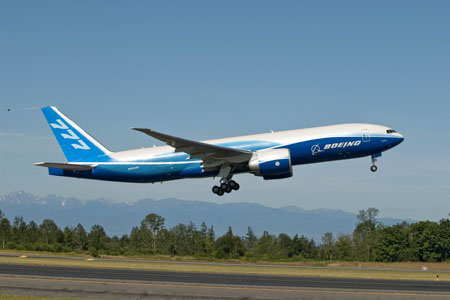
    Boeing 777 Freighter Completes 2 Years in Service

    EVERETT, Wash., Feb. 28, 2011 /PRNewswire/ — Hauling everything from giant panda bears to high-performance race cars the Boeing 777 freighter in its first two years in service is earning the reputation as the work horse of the industry.

    The growing fleet of 777 freighters has flown approximately 120,000 hours and boasts a daily utilization rate of 11.34 hours. Fleet schedule reliability is at 99.37 percent, which means the freighter has a near-perfect record of on-time takeoff and landings. Eighty-three have been ordered, and 39 freighters now are in service with nine airlines.

    FedEx Express is the largest 777 freighter operator with a fleet of 11 currently in operation, and another airplane just delivered. An additional 13 777 freighters remain in Boeing’s backlog for FedEx.

    “The world’s longest range twin-engine freighter is elevating our high level of service to customers around the world,” said James R. Parker, executive vice president of FedEx Express Air Operations. “Our customers are enjoying the nonstop 777 flights that offer them the latest cutoff times in key manufacturing centers in China, an advantage unmatched by the competition.”

    Emirates SkyCargo, the freight division of Emirates airline, now operates two 777 freighters. The airplane is playing an integral role in Emirates’ freighter fleet due to the airplane’s long-range capability.

    “Emirates has opted for these brand new, super-efficient aircraft to ensure we are best placed to serve the industry’s requirements in the long term,” said Emirates Divisional Senior Vice President Cargo Ram Menen. “We are absolutely delighted with this airplane!”

    The 777 freighter is the world’s longest-range, twin-engine freighter and features the lowest trip cost of any large freighter, with high-cargo density and 10-foot (3.1-meter) interior height capability that complements the popular 747 freighter family.

    Providing cargo capacity normally associated with larger airplanes, the 777 freighter can fly 4,900 nautical miles (9,070 kilometers) with a full payload of 225,200 pounds (102 metric tons). The 777 freighter is powered by General Electric’s GE90-110B1L and meets QC2 noise standards.

    “The 777 freighter is a great example of how Boeing is committed to continuously improving the 777 family to deliver top value to owners and operators,” said Larry Loftis, vice president and general manager of the 777 program.

    Boeing is the air cargo industry leader, using its expertise to support customers in their success and to promote the industry. The company also offers the most complete family of freighters, which provide superior efficiency and operational economics in support of airline profitability.

    To include the featured image in your Twitter Card, please tap or click their icon a second time.
  • |

    Press Release-A400M, world’s most advanced airlifter, completes first flight

    11 December 2009The first Airbus Military A400M military airlifter has landed back in Seville, Spain today at 14:02 local time (13:02 UTC) after completing a successful maiden flight lasting 3h 47min following its take-off at 10:15 local time.

    Chief Test Pilot Military, Edward “Ed” Strongman, captained the flight supported by Experimental Test Pilot Ignacio “Nacho” Lombo. The engineering team on board included: Senior Flight Test Engineer Jean-Philippe Cottet who had responsibility for the powerplants; Senior Flight Test Engineer Eric Isorce with responsibility for the aircraft systems and performance; Senior Flight Test Engineer Didier Ronceray with responsibility for the handling qualities of the aircraft; and Test Flight Engineer Gerard Leskerpit.

    The crew confirmed that the aircraft, known as MSN 1 and its four Europrop International TP400D turboprop engines performed as expected.

    Ed Strongman said: “We have had a very successful first flight – the take-off performance was impressive, we explored a lot of the operational flight envelope, and it was a delight to operate in such a well-designed cockpit with its easy interface to all the normal and military systems. I’m sure our customer pilots are really going to like it – we certainly did.”

    Nacho Lombo added: “From the very beginning of the flight we were impressed by the ease of handling of the aircraft which was in line with what we experienced in the simulator. The aircraft, systems and engine performance were highly satisfactory. We sense the great potential of this magnificent machine. It has been an honour for all the crew to fly the A400M on its maiden flight, representing all the people involved in the programme.”

    Chief Executive Officer Airbus Military, Domingo Urena-Raso, said: “I would like to congratulate Ed Strongman, Nacho Lombo and all of the flight-test team for completing the first flight of the A400M with great success. I am also deeply grateful to everyone in the design, manufacturing and early operations of this programme for their enormously hard work and dedication that have made this aircraft a reality. And I want to thank all those people in our industrial partners and suppliers, as well as our customers, who have contributed so much to the definition and creation of an outstanding product.”

    Airbus CEO Tom Enders said: “I hope we can soon provide certainty that we are able to continue the A400M programme. This is expected by those at Airbus, our partners and suppliers worldwide who contributed so strongly to today’s success as well as by the air forces who wait for their plane.”

    For its first flight the aircraft took off at a weight of 127 tonnes, carrying 15 tonnes of test equipment including two tonnes of water ballast, compared with its maximum take-off weight of 141 tonnes. As planned, the six-man crew extensively explored the aircraft’s flight envelope in direct law, including a wide speed-range, and tested lowering and raising of the landing gear and high-lift devices at altitude. After checking the aircraft’s performance in the landing configuration the crew landed back at Seville.

    In the first half of 2010 MSN 1 will be joined by two sister aircraft, MSN 2 and MSN 3, followed by MSN 4 by the end of the year. A fifth aircraft will join the programme during 2011. This fleet will be used for some 3,700 hours of test-flying between now and first delivery to the French Air Force at the end of 2012. This will be followed by additional military development flying. The type will be certificated by both the civil and military authorities.

    A total of 184 aircraft have so far been ordered by Belgium, France, Germany, Luxembourg, Malaysia, Spain, Turkey and the United Kingdom,

    Airbus Military

    Airbus Military is the only military and civil transport aircraft manufacturer to develop, produce, sell and support a comprehensive family of airlifters ranging from three to 37 tonnes of payload. Within Airbus, Airbus Military is responsible for the A400M programme, as well as for military tanker transport derivatives based on Airbus civil aircraft, with the integration of the state-of-the-art flight-refuelling boom (ARBS) which is unique in its class. With the C-295, CN-235 and C-212, Airbus Military is the global leader in the market segments for light and medium-sized military transport aircraft. Altogether Airbus Military has sold more than 1,000 aircraft with over 650 flying with more than 100 operators worldwide.

    To include the featured image in your Twitter Card, please tap or click their icon a second time.